
Submission by Useful Simple Trust.
Being a good ancestor
Practice
1. Do you have a clearly stated purpose aligned with the planetary emergency? We’re looking for a bold ambition here, and a culture which recognises the need for long-term thinking.
Our 2024–28 Business Plan sets our purpose to ‘blaze a trail in the regeneration of our built and natural environment to meet the needs of all people and planet’. Inspired by Doughnut Economics, we recognise that most of our built and natural environment already exists, but work is needed to transition to a zero carbon and inclusive society.
We’re committed to our Science-Based Target: ‘reducing Scope 1 & 2 operational GHG emissions 46% by 2030 from a 2019 base year, and to reduce our Scope 3 emissions.’ Our Carbon Transition Action Plan details a plan to deliver these emission reductions.
To date, we’ve completed 47 project ‘Handprint’ assessments, reviewing impacts on a scale from degenerative to regenerative. As a Social Enterprise, we reinvest at least 50% of our profit into activities, including pro-bono professional services, outreach activities and mission-aligned R&D.
2. Do you have a clearly stated purpose aligned with the planetary emergency? We’re looking for a bold ambition here, and a culture which recognises the need for long-term thinking.
Our founders went beyond the concept of an Employee Owned Business, establishing an Employee Benefit Trust (EBT) in 2008, gifting their shares in the business. The intention was to evolve and continue to ‘trailblaze’ in the unpredictable future through investment in the founding principles rather than individuals.
Becoming an EBT supports succession and diversity by separating ownership from seniority and wealth. By providing transparency across all levels, our leadership teams consult, share information about the company, and spread responsibility that allows our employees to have a significant and meaningful stake in the business, as well as a say in how it’s run.
Our governance includes a Board of Trustees, comprising external members, current staff, (including an employee elected representative) and several of our founders. They hold the Executive Board accountable for delivering against our Ethos, a 10-point commitment to our values and purpose.
3. Do you share research and knowledge for the benefit of society and the wider world?
We exist within a wider ecosystem of people trying to drive the sort of change that interests us all as individuals and as an organisation. We’re actively involved in leveraging our expertise through collaborative networks, including contributing time to universities, charities, and industry bodies. In 2025, we published the ‘Beyond the Buildings: Decarbonising Infrastructure on Masterplans’ research piece, co-funded with the ICE, and are currently disseminating it with the wider industry, co-creating next steps to move the industry forward in this important field.
Through our ‘Useful Giving’ initiative, employees have volunteered 50 hours to Climate Ed, delivering climate literacy education courses to primary school children across London. We also contributed to the creation of the Institution of Structural Engineers’ first-ever Student Challenge in 2025, and helped shape a brief that encourages students to consider the long-term wellbeing of people and the planet through their group projects.
Project
1. Do you advocate for long-term thinking at the outset of work? Do you initiate work with long-term thinking and challenge clients? Also, can the organisation demonstrate that this approach has worked?
Last year, we launched our ‘Handprint’ process to assess projects on a scale from degenerative to regenerative over the course of their lifetime. It evaluates energy, carbon, biodiversity, social equity, and resource use. Assessments are conducted at the start of projects to identify regenerative opportunities, and again at the end to reflect on outcomes and lessons learned.
The process builds on a regenerative design tool we use with clients and design teams to shift the conversation from ‘doing less harm’ to creating positive impact. It promotes whole-life costing over CapEx-only approaches, targets net carbon positive outcomes, supports biodiversity net gain, and prioritises adaptive reuse over demolition and new construction.
A standout example is the adaptive reuse of the 1950s Marks & Spencer HQ on Baker Street. By successfully advocating for refurbishment instead of demolition, we avoided 35,000 tonnes of CO₂ emissions, demonstrating the tangible benefits of regenerative thinking in practice.
2. Does your work take account of the future climate and the need for resilience?
Our projects are developed with future climate conditions and long-term resilience in mind, combining material efficiency, structural robustness and adaptability. Our gantry redesign for the Lower Thames Crossing, delivered with Atkins Réalis/Jacobs, Steve Ellis Consulting, and National Highways reduced embodied carbon by 50%, cut steel use by 65%, lowered concrete foundation requirements by 40%, and reduces wind loading by 46%. These improvements were achieved through detailed wind-tunnel testing, computational fluid dynamics, and whole-life carbon analysis, helping to ensure the design performs safely and efficiently under changing environmental conditions.
The resulting solution is leaner, more durable and suitable for application across more than 90% of the strategic road network through a ‘design once, use many times’ approach. Alongside this, our wider work includes modular and demountable interventions designed for disassembly, relocation and reuse as needs change over time – the AVA Footbridge & Lift System is a built example of this approach.
3. Does the majority of your work go beyond mitigating negatives and towards optimising positives?
Our ‘Handprint’ methodology assesses whether our projects go beyond minimising harm to creating positive environmental and social outcomes. To date, we have completed 47 assessments, giving us a growing evidence base for how our work aligns with our mission and helping to build a culture in which colleagues reflect critically on project impacts and feel confident challenging degenerative approaches.
These assessments show that, while none of the projects are fully regenerative, none are entirely degenerative either. Most perform strongly in areas such as operational energy or biodiversity, while other areas reveal gaps in embodied carbon. This helps us identify priorities for improvement, track progress over time, and better support clients and collaborators in moving towards more regenerative practice. We’re now developing the methodology into a digital tool to streamline data collection, improve consistency, and support wider dissemination.
Co-evolving with nature
Practice
1. Do you use biophilia within your premises and/or do you regularly gather in natural settings?
Our office sits adjacent to Temple Gardens where the gardening team share information about seasonal patterns throughout the year. We encourage staff to have ‘walking meetings’ where possible and regularly organise team lunches in the Gardens, including a recent welcome picnic for new starters.
Over the last three years, our summer party has included an afternoon of volunteering to support nature – with High Trees Community Development Trust, Bee Urban Social Enterprise, and Citizen Zoo Rewilding.
We also fund and provide paid time for staff to participate in outdoor/regenerative training programmes, including UKGBC Future Leaders and Change Accelerator programmes, and the Constructivist Regenerative Design Lab.
We have plants throughout the office alongside cork wall tiles and timber shelving. The concept of biophilia extends into the office layout, with a range of spatial qualities echoing that of the natural landscape, such as cave-like focus booths and larger zones for relaxing.
2. Can you share examples of where you have considered nature in decision making?
Our 2024–28 Business Plan sets our ambitions for a ‘regenerative business model’, based on delivering impactful solutions on purposeful projects and for engaged clients, with at least 50% of profits reinvested in furthering our mission.
In 2025, the Chief Executive of Berkshire, Buckinghamshire & Oxfordshire Wildlife Trust joined our Board of Trustees. She is working with us to embed nature into our governance and decision making in a way that is meaningful, impactful, and non-performative.
In 2024-25 we invested in a Critical Thinking training programme, led by Oli Broadbent (1851 Fellow in Regenerative Design) which all staff (including professional services and administrative roles) we invited to attend. The programme brought together elements from systems thinking, regenerative design, and innovation strategy, including modules on ‘Working with Ecosystems’ and ‘Working with Living Cycles.’
3. Are you supporting nature locally and nationally?
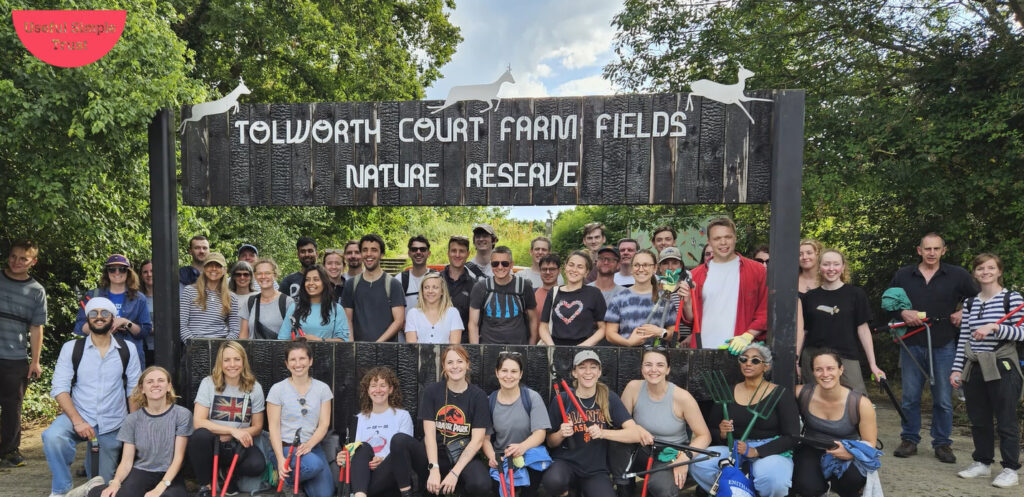
Over the last three years, our summer party has included an afternoon of nature-based volunteering, such as a day at the Bee Urban Social Enterprise in Kennington Park in 2022, where we helped restore a green roof, learned about beekeeping, and labelled jars of honey, as well as carrying out general gardening tasks. We’ve also spent time volunteering with Tolworth Farm Nature Reserve and the High Trees Community Development Trust. This year, we also made a cash donation of £2,500 to The Wildlife Trusts’ Rewilding Project.
We are providing pro bono director time to support the 100 Miles Wilder initiative, pioneering sustainable living and nature’s recovery across the Oxford to Cambridge Growth Arc.
At a national and global level, our published research report, ‘Embodied Biodiversity Impacts of Construction Materials’, is helping shift the dial on how we specify materials that support nature and biodiversity.
Project
1. Can you demonstrate work that strives to match the performance of a mature ecosystem?
We aim to prioritise projects where nature is a key stakeholder. For example, the Eden Project Dundee was granted planning permission last year and includes pioneering an innovative structural regenerative design process. We are also part of the landscape-led design team working on The Tower of London Legacy project (confidential) to create a resilient and biodiverse green and blue landscape within the former moat.
We continue to work on the redevelopment of Gurnell Leisure Centre in West London. The site includes approx. 4ha of parkland area adjacent to the River Brent and within the floodplain. Proposals include enhancing the parkland area, introducing a variety of planted species, and the introduction of wetlands forming a key part of the drainage strategy, providing storage in flood events. Large permanent water bodies will form thriving ecosystems and habitats to be enjoyed by the public.
2. Are you working on material stewardship?
We appointed a Head of Sustainable Materials in 2025, a new role that reflects our commitment to embedding low-carbon and regenerative materials in our work and accelerating uptake across the industry.
Our research reports, including the ‘Embodied Biodiversity Impacts of Construction Materials’ and ‘Steel Reuse in Bridges’ demonstrate how we share knowledge on material stewardship, reuse, responsible sourcing, and reducing the impacts of extractive processes on planetary systems.
As active members of the Net Zero Bridges Group, Don’t Waste Buildings, and the Infrastructure Client Group’s Low Carbon Concrete Accelerator Programme, we’re helping to translate research into practice for major UK infrastructure clients.
We’re also currently designing the UK’s first footbridge to use reused steel as its primary structure as well as using salvaged structural steel for a new higher education building in Suffolk. We recently launched Re-Bridge, the UK’s first central database of bridge assets available for reuse.
3. Does the majority of your work demonstrate the use of biologically-inspired approaches such as Bioregionalism, Biophilia or Biomimicry?
We’ve provided strategic input and a report on biophilic design to the rail sector, helping design teams and clients embed these principles in stations and network-wide buildings, including depots.
Our civil engineering and masterplanning projects adopt principles of bioregionalism and ecomimicry. For example, the Gomm Valley and East Hemel masterplans used catchment-led engineering to design around natural watersheds and make space for water and green infrastructure within the landscape. At Southall Minet Wetland, we created a new landscape and wetland pond to filter runoff and restore water where it had previously been drained.
At the Lee Valley Ice Centre in East London, we developed an innovative sustainable water strategy, reducing water use within the facility, maximising greywater recycling, and creating constructed wetlands to manage stormwater, clean ice melt water, and improve biodiversity.
Creating a just space for people
Practice
1. Do you have a progressive EDI policy and can you evidence many forms of diversity, which are welcomed and acknowledged, within your company/organisation?
Diversity is at the heart of our Ethos, fueling our ability to develop innovative solutions in the built environment. Our Executive Board boasts 50% female membership and has been female-led since 2019. Our Trustee Board is 57% female and 54% of our leadership team are women, further to reducing our gender pay gap to 8.2%.
Across 2025-26, we hosted a series of EDI workshops with representatives across the built environment to explore wider collaborations that will ensure we continue to progress as an industry. Facilitated by Built by Us, we explored the status quo and shared lived experiences. Leadership at board level in organisations was seen as critical to establishing culture and values. The language of inclusion was also unpacked as we shared the need to create brave, not safe spaces, to enable us to have creative and constructive conversations.
2. Do you operate a no overtime culture, meet the living wage consistently, and stipulate a fair salary ratio between staff of all levels?
We recognise that unpaid overtime is an issue in our industry and continue to monitor the hours worked by staff to ensure that regular or excessive overtime is identified, and steps are taken to provide support in managing time and workload.
Where it is necessary to work additional hours to meet business requirements, staff are encouraged to take Time Off In Lieu (TOIL). Junior to mid-level grade employees are also eligible for paid overtime at their normal hourly rate. We undertake regular pulse checks for wellbeing, including an annual survey, as part of our wider wellbeing programme. This also allows us to understand the reasons for, and frequency of, overtime. As an accredited Living Wage Employer, our salary ratio across all grades is currently 1:7, with an exec to median ratio of 1:3.
3. Do you support charities, community groups, social enterprises, action groups and others through pro-bono work, charitable giving or in-kind donations?
As a B Corp, Social Enterprise, and purpose-led organisation, we’re committed to addressing social and environmental challenges through our projects and the way we run our business. Each year, we reinvest at least 50% of our profit in support of this purpose, including pro bono work, mission-aligned R&D, and cash donations. In 2025 this included climate literacy training for primary school children in London with Climate Ed, support for a community-led restoration project on the River Ver in Hertfordshire, and 132 hours of volunteering for High Trees Community Development Trust.
We also provide paid time for employees to support charities and community organisations, including Maggie’s Centres, and to contribute to design and quality review panels and industry bodies such as ICE, CIBSE, LETI, UKGBC, NLA, and Architects Declare. In January, we also hosted a charity bingo night that raised £1,000 for Maggie’s, further to donating £2,500 to The Wildlife Trusts.
4. Do you use an ethical framework to assess opportunities and/or supply chain partners and is them team consulted on these decisions?
Whilst ethics has always framed what we do, we have evolved a structured process to help us decide what projects to work on.
Rather than trying to draw absolute boundaries, we review opportunities on a case-by-case basis, focusing on three tests: our ability to have a positive impact, the likely impact on beneficiaries, and reputational risks associated with participation.
Where significant ethical considerations arise, we trigger a structured and diverse review panel to explore issues, seek counter views, and make a recommendation to the Executive Board. Outcomes are shared transparently to support organisational learning, recognising the process can be bumpy and that we are still improving. This governance helps us maintain integrity and focus efforts where a genuine difference can be made. This does not mean we don’t engage where ethical issues remain, but we have turned down opportunities where it could not credibly achieve positive impact.
Project
1. Does your work demonstrate deep engagement with local stakeholders and end users?
Across our strategic consultancy work, we collaborate with clients, organisations, and specialists to develop methodologies that shift practice and strengthen community outcomes. This includes improving how community benefits are secured, managing risk across national estates, assuring value for money, and embedding social value in place-based investment.
For Cwmni Egino, we developed a social value framework for North Wales, ensuring the work was rooted in community perspectives, Welsh language, and culture. On other projects, we have set up citizens’ and tenants’ panels, bringing local people into an ongoing series of design conversations and paying participants a living wage for their time.
At the Phoenix in Lewes, we also led ‘river walks’ that enabled residents to meet the engineering team informally, raise concerns, and learn more about the proposals at a highly sensitive site. Together, these examples show how our engagement often goes beyond consultation towards longer-term, more participatory forms of co-design.
2. Does your work create connected and resilient communities which positively contribute to neighbourhoods and allow equality of access?
Our projects are designed to create connected, resilient, and inclusive places that deliver benefits beyond the site boundary. Through our regenerative design toolkit, informed by Doughnut Economics, we help clients respond to flood and overheating risk while also strengthening social and economic value (e.g. the Phoenix, Lewes).
We’re designing a higher education facility with Suffolk New College, linked to the Sizewell C apprenticeship pipeline. The building will support 150 full-time students and 1,500 apprentices each year, while remaining open to the wider community. In an area with limited civic amenities, it creates lasting local opportunity, skills, and social infrastructure.
The adaptable AVA Footbridge is designed to accelerate accessibility improvements across the rail network by providing step-free access more quickly, safely, and affordably than conventional approaches. Its offsite, modular construction halves the time from contract to handover, reducing disruption for passengers and communities while improving equality of access.
3. Does the majority of your work promote equity in society, and consider all people, not only building inhabitants
We take our organisational principle to ‘do our projects so they meet the needs of the present without compromising the ability of future generations to meet their own needs’ seriously.
Rather than drawing absolute boundaries, we review opportunities on a case-by-case basis, focusing on our ability to have a positive impact and the likely impact on employees. Where significant ethical considerations arise, we trigger a structured and diverse review panel.
Outcomes are shared transparently with all employees to support organisational learning. This governance helps us maintain integrity and focus efforts where a genuine difference can be made. This doesn’t mean we don’t engage where ethical issues remain, but we’ve turned down opportunities where it could not credibly achieve positive impact.
Members of our team also sit on the IStructE, ICE, and RAEng ethics panels, actively working to improve ethics across the construction industry.