
Submission by Urquhart and Hunt Landscape Design.
Being a good ancestor
Practice
1. Do you have a clearly stated purpose aligned with the planetary emergency? We’re looking for a bold ambition here, and a culture which recognises the need for long-term thinking.
Our business is engaged primarily in ecological restoration and all our designs are based around principles of sustainability and regeneration. As a practice we feel ourselves to be in an ongoing, long-term “conversation with nature” in which we learn and adapt alongside nature to ameliorate effects of the climate emergency. We therefore engage with the twinned crises of extinction and habitat loss through actively rehabilitating landscapes, assessing and supervising species reintroductions, and planting adaptively to changing climate conditions. Creating new and robust areas of habitat for wildlife, and monitoring progress and ecosystem health. We also adapt our planting schemes to climate conditions and frequently engage with woodland and meadow rehabilitation, aiming to restore balance and increase the resilience of landscapes where climate change has negatively impacted ecosystem health. Our projects play out over long time periods, often generating systems-level changes to help nature adapt to fluctuating conditions on our planet.
2. Do you have a clearly stated purpose aligned with the planetary emergency? We’re looking for a bold ambition here, and a culture which recognises the need for long-term thinking.
Our succession plan involves transforming to an employee-owned trust, thereby enabling our team to carry on according to the values we have pioneered. We are in the process of implementing this.
3. Do you share research and knowledge for the benefit of society and the wider world?
Sharing research, knowledge and best practice is an important part of our work. We believe that landscape and ecological knowledge should be shared widely to support better environmental stewardship and regenerative thinking across society.
We regularly contribute to public and professional conversations through lectures, conferences, panel discussions and university teaching. This year, for example, we co-chaired the Wilding Gardens conference at Manchester University and have delivered talks on the subject both nationally and within our local community.
Alongside speaking engagements, we actively share research and ideas through writing and collaboration, including work towards a book that aims to bring our area of expertise to a wider audience. We see knowledge-sharing not as an addition to practice, but as part of our responsibility — helping to broaden understanding, encourage dialogue and support more regenerative approaches to landscapes and land stewardship.
Project
1. Do you advocate for long-term thinking at the outset of work? Do you initiate work with long-term thinking and challenge clients? Also, can the organisation demonstrate that this approach has worked?
Long-term thinking is embedded into our work from the outset of every project. We approach landscape design as a long-term investment, creating landscapes that evolve, mature and strengthen ecologically over time rather than delivering short-term outcomes.
From the earliest stages of design, we work closely with clients to advocate for resilient, future-focused approaches and, where necessary, challenge assumptions to improve long-term performance. This includes influencing decisions around planting, materials and maintenance to ensure landscapes adapt to changing environmental conditions. For example, on a project in Burgundy, we challenged conventional planting methods and advocated drought-resistant gravel mulching to improve resilience to dry conditions.
We demonstrate this approach through continued engagement with projects. We maintain relationships with landscapes after delivery, allowing us to observe how they evolve over time. In some cases, projects benefit from ecological monitoring, enabling us to assess interventions and refine future approaches based on evidence and long-term outcomes.
2. Does your work take account of the future climate and the need for resilience?
Climate resilience is embedded into our work from the outset of every project. Our designs are rooted in local environmental conditions and informed by current and anticipated climate pressures.
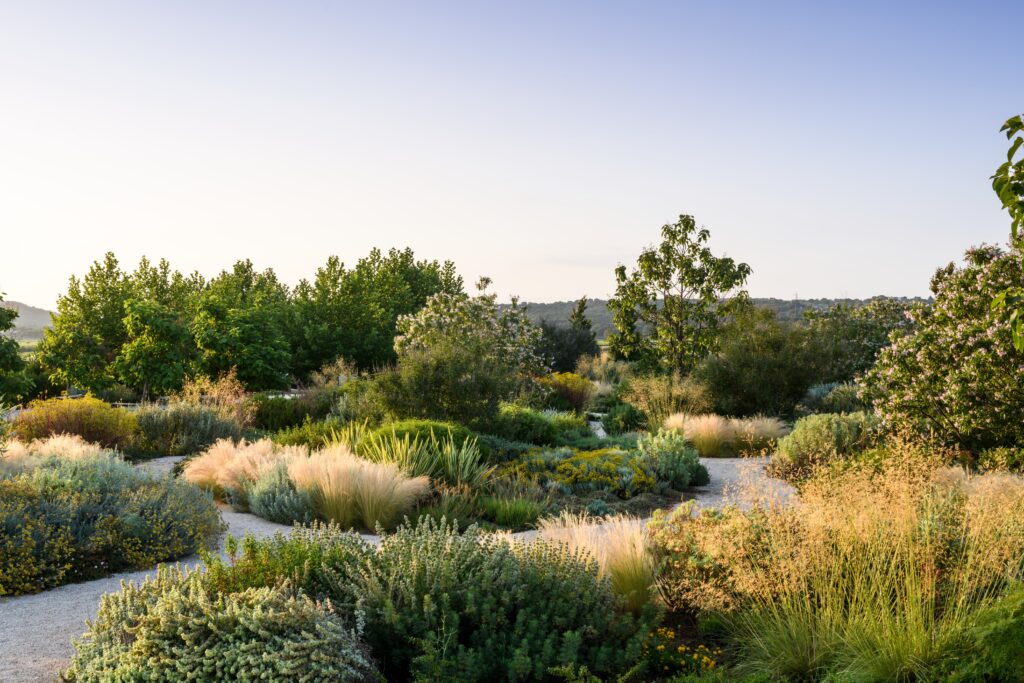
We consider how changing temperatures, rainfall patterns and extreme weather will affect landscape performance, adapting our design responses accordingly. This has been particularly important in our work in Puglia, where increasing temperatures and water scarcity directly inform our approach. There, we prioritise drought-tolerant and native planting, working with — rather than against — the local climate.
We integrate landscape strategies that reduce resource reliance, including xeriscaping principles and natural cooling and water-retention processes such as evapotranspiration, minimising dependence on irrigation systems. More broadly, many of our planting palettes are selected not only for present conditions, but for climate scenarios we may experience in 20–30 years’ time. This helps create landscapes that are adaptable, resilient and capable of thriving long term.
3. Does the majority of your work go beyond mitigating negatives and towards optimising positives?
The majority of our work focuses on creating positive environmental outcomes, rather than mitigating negative impacts. Our approach is rooted in designing landscapes that work with natural systems to enhance biodiversity, restore ecological function and build resilience.
From concept to completion, we assess decisions against our core values to ensure projects contribute positively to their ecological and cultural context. This means prioritising interventions that regenerate landscapes, strengthen habitats and support sustainable relationships between people and nature.
We are careful about the projects we undertake. While occasionally approached to create landscapes intended to ‘offset’ environmental damage elsewhere, we do not see landscape design as justification for habitat loss or natural beauty. Instead, we seek projects where ambitions align with our principles and meaningful ecological enhancement can be achieved.
Ultimately, our aim is not only to reduce harm, but to create landscapes that improve environmental quality, biodiversity and long-term ecological health.
Co-evolving with nature
Practice
1. Do you use biophilia within your premises and/or do you regularly gather in natural settings?
Biophilia is embedded both in how we work and in the environments we spend time in as a team. As a landscape design practice, regular engagement with nature is fundamental to our process, wellbeing and creativity.
We spend significant time outdoors and visit project sites weekly. This immersion in landscapes allows us to understand ecological relationships, seasonal change and site-specific qualities that are difficult to grasp through drawings or desk-based analysis.
We also gather regularly in natural settings as a team. Several times a year we organise visits to notable gardens, landscapes and ecological projects to learn from exemplary places, exchange ideas and deepen our understanding of landscape stewardship.
Our studio in Bruton, Somerset is closely connected to nature, with access to the River Brue and surrounding countryside. Team members regularly spend time outdoors during the working day, supporting wellbeing, reflection and connection to the landscapes that inspire our work.
2. Can you share examples of where you have considered nature in decision making?
Nature informs decision-making across our projects, from early site analysis through to long-term management. We approach gardens and landscapes as living ecosystems, making design decisions that support biodiversity, habitat resilience and ecological function.
At the outset of each project, we undertake ecological assessments to understand habitats and species, guiding decisions around planting, water management, habitat restoration and land use. We encourage clients to view gardens not simply as designed spaces, but as habitats supporting birds, insects, mammals and wider ecological systems.
One example is a long-term rewilding project in Somerset, where we are designing a biodiverse landscape informed by the site’s ecology. Our approach includes riparian and meadow restoration, alongside expanding scrub and hedgerows to strengthen habitat networks. Ecological surveys identified horseshoe bats on site, informing habitat decisions and planting strategies.
We are planning the reintroduction of keystone grazing species, including longhorn cattle, to support habitat creation and ecosystem resilience.
3. Are you supporting nature locally and nationally?
We support nature locally and nationally through design, education, advocacy and partnerships. Across our projects, we seek to restore ecological function, increase biodiversity and create habitats that contribute positively to wider environmental systems.
Beyond project work, we share knowledge through talks and conference, promoting nature-led approaches to landscape management and stewardship. We also support organisations working to protect biodiversity, including through our membership of the Wildlife Trust.
Locally, we are committed to strengthening ecological networks within Somerset. Alongside delivering projects that enhance habitat connectivity and biodiversity, we promote Somerset Wildlife Trust’s Wilder Gardens scheme, encouraging local gardeners to manage plots with nature in mind.
We also engage directly with the community through education and collaboration. For example, our recent Wilder Bruton talk, delivered with the Forest of Selwood restoration charity, explored practical approaches to rewilding domestic gardens, helping residents understand how small interventions can strengthen habitat corridors and support biodiversity.
Project
1. Can you demonstrate work that strives to match the performance of a mature ecosystem?
Many of our projects are designed to emulate the ecological performance of mature ecosystems and support long-term ecosystem health. We aim to create resilient landscapes that become increasingly self-sustaining, biodiverse and ecologically functional over time.
In practice, this means designing with natural processes: restoring wetlands, increasing habitat diversity, strengthening ecological connectivity and using planting and land management strategies that encourage resilience and natural regeneration. We are interested in projects that move beyond ornamental landscapes towards functioning ecosystems supporting biodiversity, water retention and carbon sequestration.
A key example is our involvement in rewilding initiatives, including projects supporting the reintroduction of beavers after 400 years of extinction in Britain. As a keystone species, beavers restore wetlands, slowing water flow and supporting biodiversity.
Our 2022 Chelsea Flower Show Garden celebrated the ecological role of beavers by recreating a Devon riparian landscape, helping raise awareness of nature-led approaches to landscape resilience and ecosystem restoration.
2. Are you working on material stewardship?
Material stewardship is central to how we approach every project. We consider the environmental, cultural and ethical impact of materials from the outset of the design process.
Our material palette is guided by what is naturally available and historically appropriate to each location — prioritising local limestone and granite in Ireland, flint in Wiltshire and Blue Lias stone in Somerset. We also seek opportunities to use reclaimed materials, particularly in historic landscapes where their longevity has already been proven.
Where possible, we source materials within the UK to reduce transport emissions and prioritise suppliers with clear provenance and ethical standards.
Material stewardship also means supporting local craftsmanship. We collaborate with regional makers and traditional craftspeople — from drystone walling in Devon to Cornish hedging and hazel hurdle fencing in Dorset — helping preserve regional skills and create landscapes rooted in place.
3. Does the majority of your work demonstrate the use of biologically-inspired approaches such as Bioregionalism, Biophilia or Biomimicry?
Yes, we frequently employ these in the vast majority of our work. In terms of how we situate our projects in their wider context, we are always looking at the larger natural systems and basing our interventions on those factors, whether that is the target species within a specific area, or a palette of indigenous plants, or a larger, more ideological land-based listening practice. On a smaller scale, the principals of biophilia are deeply embedded in our practice, especially with enclosed or interior spaces, where plants soften and change the sense of space and quality of life. Biomimicry lies at the heart of how we design, with sacred geometry forming the core principle of how we work with form and balance in the shapes that our work ultimately assumes. We view our practice as an ongoing conversation with nature, and we seek inspiration and guidance from the natural world constantly.
Creating a just space for people
Practice
1. Do you have a progressive EDI policy and can you evidence many forms of diversity, which are welcomed and acknowledged, within your company/organisation?
We are committed to fostering an inclusive, equitable and respectful working environment where diversity is recognised, welcomed and supported. As a small studio, we understand that creating an inclusive culture requires continual reflection and action.
We maintain a workplace free from discrimination, where team members are treated fairly and have equal opportunity to contribute and develop. Our approach is grounded in mutual respect, openness and flexibility, recognising the value of different experiences and perspectives.
We seek to create a supportive working environment through fair recruitment, flexible ways of working and a culture that values wellbeing and individual lived experience. We also recognise the importance of broadening representation within the landscape and design sectors through education, collaboration and engagement.
As our organisation grows, we remain committed to continually reviewing and improving our approach to equity, diversity and inclusion.
2. Do you operate a no overtime culture, meet the living wage consistently, and stipulate a fair salary ratio between staff of all levels?
We are committed to fair pay, healthy working practices and maintaining a supportive working culture. All members of our team are paid in excess of the Living Wage, and we maintain a fair and proportionate salary structure across different levels of experience and responsibility.
We aim to foster a healthy working environment and do not operate a culture of regular overtime. Workloads are managed to support sustainable working practices and staff wellbeing. On the rare occasions where additional hours are necessary to meet project deadlines or exceptional circumstances, time off in lieu is provided to ensure staff are appropriately recognised and supported.
As a small studio, we believe fair pay and sustainable working practices are essential to creating a positive, motivated and collaborative workplace.
3. Do you support charities, community groups, social enterprises, action groups and others through pro-bono work, charitable giving or in-kind donations?
We support charities in many and various ways: hosting fundraising events; giving time and materials to charitable organisations; offering expertise to our local community groups; and at a wider level, advising on community rewilding projects globally.
One of our on-going charitable partnerships is with the Forest of Selwood, we have worked with them regularly to aid their efforts to restore, create and enhance areas of ecological importance within this ancient landscape.
Another member of our team, Sarah, has also worked with local charity Good Company Bruton to assist with the creation of a public accessible green space, including allotment plots, a swimming pond, a wildflower meadow and woodland space.
In the past six months we have also donated towards two charitable auctions for Rewilding Britain and the Atlantic Wild Salmon Trust. We have also donated a piece of artwork for inclusion within a fundraising exhibition for Mount Vernon Cancer Centre.
4. Do you use an ethical framework to assess opportunities and/or supply chain partners and is them team consulted on these decisions?
Yes, we are guided by principles which uphold a strong core of ethics. Which relate to sustainability, organic and biodynamic principals, biodiversity, conservation, and also social welfare. We work with peat-free nurseries and are strictly pesticide and herbicide free in all of the work that we do. We are guided on these principles by a company handbook and we frequently consult with our wider teams and suppliers to make sure our ethics are upheld on every project.
Project
1. Does your work demonstrate deep engagement with local stakeholders and end users?
Meaningful engagement with local stakeholders and end users is integral to our process. We believe the strongest landscapes emerge through listening to people, communities and ecologies that shape and use them. From concept to delivery, we ensure designs respond to cultural context, practical needs and long-term stewardship.
A key example is the garden we designed for Cambridge Mosque in 2019. We worked closely with Islamic garden specialist Emma Clark to ensure the landscape reflected Islamic garden traditions, while community engagement sessions informed the final design.
Similarly, in Cork, Ireland, we collaborated with Valerie Bond on a therapeutic garden for Marymount Hospice and Hospital. The design process involved close engagement with hospice staff and users, whose lived experience shaped decisions around accessibility, practical needs and outdoor space.
Across projects, we see stakeholder engagement as an ongoing dialogue that strengthens outcomes and creates landscapes that feel meaningful, inclusive and rooted in place.
2. Does your work create connected and resilient communities which positively contribute to neighbourhoods and allow equality of access?
We have created many community-oriented projects, from community gardens, large scale productive gardens, permaculture schemes and places of worship. We increase the resilience of communities by bringing nature and wildlife into the heart of our schemes, increasing the mental and physical wellbeing of those who engage with them. Access to green space, engagement with nature, access to secure food systems and also visual beauty are all key concerns in our work.
3. Does the majority of your work promote equity in society, and consider all people, not only building inhabitants
The majority of our work promotes broader social and ecological equity by considering the needs of communities, local ecologies and future generations, not only immediate users. We see landscapes as shared environments with impacts extending beyond site boundaries and ownership.
From the outset of a project, we consider accessibility, wellbeing, cultural context, ecological connectivity and long-term stewardship. We believe landscapes should create benefits beyond a single client — supporting biodiversity, resilience and people’s connection to place.
Our work seeks to create restorative and inclusive spaces, particularly in healthcare and community settings, while engaging closely with stakeholders to ensure designs respond meaningfully to local needs. Guided by a philosophy of coexistence rather than extraction, we aim to create landscapes that benefit people, wildlife and future generations.