
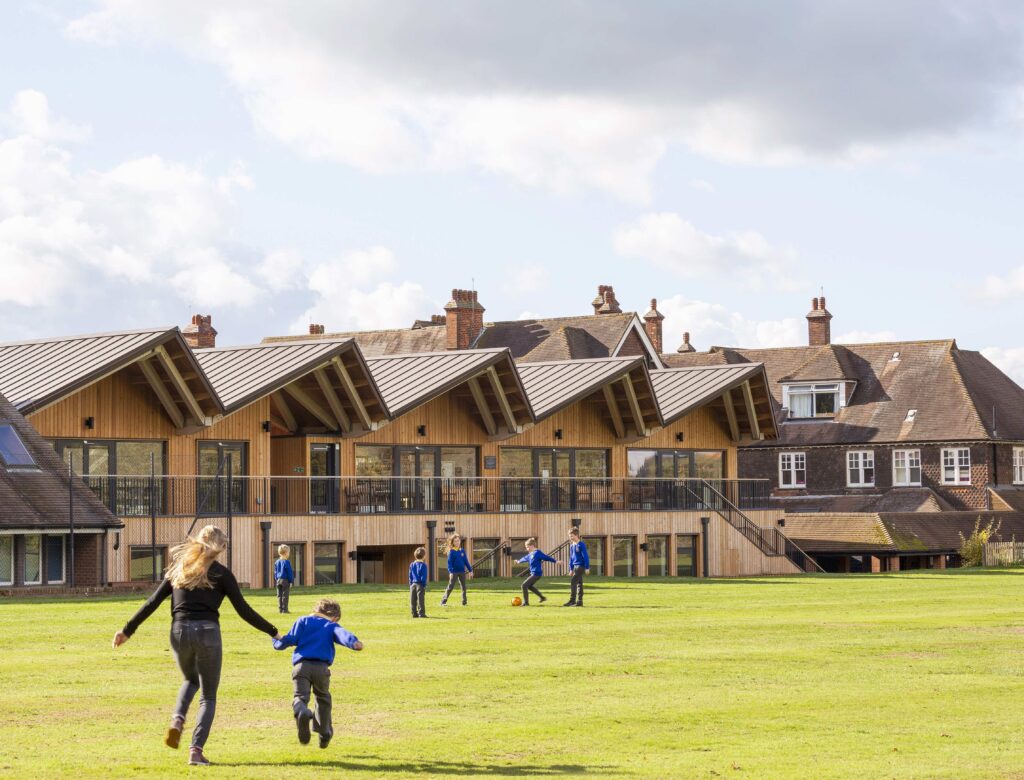
Submission by Tate + Co Architects.
Being a good ancestor
Practice
1. Do you have a clearly stated purpose aligned with the planetary emergency? We’re looking for a bold ambition here, and a culture which recognises the need for long-term thinking.
We were founded in 2007 and since then we have been committed to working within a Regenerative Design Framework. This framework has three key priorities for creating positive project outcomes: reducing carbon and energy use, enhancing biodiversity and nature and creating positive outcomes for people and communities. The framework is applied across all standard RIBA Stages.
We use PHPP and One Click LCA to measure whole-life carbon, allowing us to better understand and reduce the environmental impact of our work. We have proven experience in incorporating nature within our projects and work closely with trusted specialists and collaborators to achieve the best outcomes. Stakeholder engagement is an integral part of our process and every project includes direct and meaningful consultation with the people and communities involved.
We can share our company Production Manual. This comprehensive document outlines the additional measures and approaches we have built into our design process.
2. Do you have a clearly stated purpose aligned with the planetary emergency? We’re looking for a bold ambition here, and a culture which recognises the need for long-term thinking.
We are committed to developing the next generation of leaders who will ultimately help shape the future of the practice and take the company forward.
As our team continues to grow, new colleagues are helping strengthen and evolve our ethos, while positively contributing to a culture of inclusion, collaboration, energy and shared ambition.
Alongside architectural and CPD training, we invest in improving wider business skills across the team, including business development, presentation skills and future leadership training. We also provide one-to-one mentoring and business coaching to support personal and professional growth.
We are currently progressing a structured, company-wide profit share scheme, supported by regular financial updates that are shared openly with the whole team. At the same time, we are working with our legal advisors and financial consultants to explore the best long-term structure for the company.
3. Do you share research and knowledge for the benefit of society and the wider world?
We are keen to share our knowledge and experience whenever we can. One example of this is the Knowledge Hub on our website, where the team addresses issues around design, sustainability and regenerative thinking. We also deliver talks and take part in panel discussions and seminars focused on how our industry can continue to improve its approach to regenerative architecture. As an example, we recently presented a lecture on Emergent and Regenerative Design to ARCSOC, the University of Cambridge Architecture Society.
Our practice runs a programme of education and wider community engagement. For example, colleagues recently took part in a series of school Accessible Design Workshops. Delivered in partnership with the RIBA and a team drawn from a number of UK practices, a series of creative sessions was held in local Junior Schools and considered the design of an accessible building for people with a range of needs.
Project
1. Do you advocate for long-term thinking at the outset of work? Do you initiate work with long-term thinking and challenge clients? Also, can the organisation demonstrate that this approach has worked?
We seek to create lasting positive outcomes for clients, projects and communities.
Around a third of our clients are charities, with another third made up of educational institutions. Both groups typically focus on long-term stewardship and future generations and have an extended horizon compared to the UK legal, 60-year lifespan.
Residential projects can present challenges; developers can have difficulty in justifying extended, positive outcomes. We do, however, educate and encourage long-term thinking and sustainability, and recently have been specifically working with residential developers who adopt much longer-term thinking in their approach.
We design flexible, adaptable environments that can evolve to accommodate future spatial needs, extending the lifespan and relevance of a building. We introduce “naturalness” within our architecture and focus on the inclusion of fresh air, daylight, views of nature and strong connections to the outdoors which research and our own post occupancy data shows boosts wellbeing.
2. Does your work take account of the future climate and the need for resilience?
Our ambition is to create buildings that are flexible, climate resilient and ready for the future. We use PHPP as part of our assessment of operational energy in projects to make sure potential challenges associated with future climate change and overheating are accounted for within the external envelope specification and design.
Supporting our commitment to regenerative architecture, we ensure our designs are also adaptable. For example, at a University Creative Centre, we set out multiple future scenarios for the main teaching block. To support this flexibility, we designed a clear span structure with modular servicing, with illustrations of how the space could be adapted over time
We generally prioritise prefabricated, “dry” construction methods wherever possible, typically using timber frame systems and reducing the use of concrete through alternatives such as steel micropiles. This allows many of our built projects to be more easily adapted, disassembled and reused in the future.
3. Does the majority of your work go beyond mitigating negatives and towards optimising positives?
Across our projects we aim to create positive outcomes focussed on three connected areas: carbon and energy, nature and biodiversity, and people and communities.
For carbon and energy, we use PHPP and One Click LCA during design to optimise operational and embodied carbon, and to test whether projects can move beyond low-carbon towards carbon-negative outcomes. We are also actively advocating for whole life carbon tools to better recognise carbon sequestered in natural materials.
For nature and biodiversity, we seek measurable improvement, including significant BNG gains, alongside a broader philosophy of “naturalness”: prioritising daylight, natural ventilation, natural materials, and direct views and access to nature. This supports both ecological value and wellbeing.
For people and communities, we use a tailored engagement strategy on each project, helping stakeholders co-create places that are useful, loved, and capable of bringing long-term joy.
Co-evolving with nature
Practice
1. Do you use biophilia within your premises and/or do you regularly gather in natural settings?
We moved into our new studio in January and since then, we have been establishing an environment to celebrate our commitment to regenerative design and love of nature.
Fixed elements, including storage and shelving, were taken from our previous address and have been recycled and re-imagined to fit within the new space. The re-used items are constructed from FSC certified OSB boards and have a natural timber finish.
Planting, again from our old office, is integrated throughout the studio. We worked with horticulturalists from the Eden Project on the selection of the plants, generally choosing forest floor species that thrive in indoor environments.
There are a number of green spaces nearby where we generally have lunch and meet as a team, weather permitting! We regularly have office ‘away-days’ and these are split 50/50 between cultural activities in London and getting a train out to enjoy a walk in the countryside.
2. Can you share examples of where you have considered nature in decision making?
Nature is central to decision making in our practice, shaping both our design work and how we manage our company and premises.
Our projects often apply the idea of “naturalness”, creating direct connections between people, buildings and landscape. At a preparatory school, we designed a new teaching building with external circulation, allowing pupils to move through and engage with the outdoors throughout the day, improving the learning environment. At a University Creative Centre, natural materials, daylight, ventilation and an integrated landscape-led masterplan helped deliver greater nature abundance and a 53% BNG uplift in a central urban location.
In a London park, our recently completed work within a new garden reused existing site materials to create structures that support both people and wildlife, including a ‘biodiversity nest’ on a redundant water tower.
This commitment also informs our workplace, from natural connections in the office to policies encouraging outdoor activity and cycling.
3. Are you supporting nature locally and nationally?
A significant proportion of our work is with organisations who are seeking to promote preservation, protection and connection with nature. Our clients include; an environmental garden project in Cornwall, wildlife trusts, natural country estates and four ongoing park renewal projects for three councils. For all of our projects, as part of our practice Regenerative Design Framework, we seek to ensure that nature is protected, enhanced and integrated.
For example we have recently completed a project for a London park. Working within a team, part of our brief was to retain an original water tower structure located within the garden and create a focal point and wildlife habitat. The structure was adapted to provide a safe and encouraging environment for birds and bats and introduced roosting and nesting boxes while climbing plants offer food, shelter and breeding sites.
Project
1. Can you demonstrate work that strives to match the performance of a mature ecosystem?
As mentioned in previous sections, many of our clients are actively engaged with creating and maintaining mature eco-systems and this is, therefore, something that we consider and deliver on a regular basis.
Our work in this field includes the creation of a rainforest canopy walkway in a mature forest in Cornwall, the recreation of endangered habitats with a zoological society and the design and delivery of a large-scale, re-wilded landscape for a wildlife trust. We have also worked as part of a team to create a new garden at a London park which will require no irrigation over its lifetime through a balanced ecological understanding of the planting system.
Beyond these perhaps more obvious examples, we use our skills and experience to ensure our more ‘standard’ projects achieve outstanding ecology outcomes. This is a central part of our practice Regenerative Design Framework.
2. Are you working on material stewardship?
We are also exploring super-local sourcing on several projects, where material provenance becomes part of the architectural concept. At a nature positive country estate, a tourism development within a chestnut coppice, we are looking to use timber from the site itself, working with roundwood expert Ben Law and timber specialists Xylotek. For a new housing project in Cheshire, we are mapping local material availability to establish a palette with clear provenance that feels genuinely “of the place”.
This knowledge is supported by wider practice expertise. Our founder regularly teaches timber structure courses within the woodland from which the material has been sustainably harvested, reinforcing a direct understanding of stewardship from source to building.
3. Does the majority of your work demonstrate the use of biologically-inspired approaches such as Bioregionalism, Biophilia or Biomimicry?
Our practice was formed in 2007, the manifestation of a shared interest in and dedication to biologically-inspired processes. Today, we continue to strive to meet this commitment.
We genuinely believe that this is a rich territory for the creation of ideas that will help deliver a regenerative future for our built environment.
Our work seeks to demonstrate our thorough understanding and deep appreciation of natural systems and how these can be harnessed to create a virtuous circle of resources within a project.
Our commitment to a biologically-inspired approach can be identified throughout our portfolio and is something have pursued in depth in a number of our projects, in particular our work with a large scale, environmentally and botanically diverse garden and the education and residential sectors. All of these projects demonstrate biophilia and biomimicry in their design to integrate and enhance a connection to nature.
Creating a just space for people
Practice
1. Do you have a progressive EDI policy and can you evidence many forms of diversity, which are welcomed and acknowledged, within your company/organisation?
We are proud of our progressive Equality, Diversity and Inclusion Policy. The policy is included in our Handbook; a document that is issued to all team members prior to joining the practice so they are able to understand fully our commitment, requirements and expectations.
As well as this, we have a number of other policies, such as a Menopause Policy, which demonstrate our pledge to making our workplace as inclusive as possible.
Beyond our own practice, we are actively involved in a number of initiatives to improve diversity and equality in the architecture profession, including regular school workshops with the RIBA Ambassadors programme and working with the Grimshaw Foundation of which our founder and director is a trustee.
2. Do you operate a no overtime culture, meet the living wage consistently, and stipulate a fair salary ratio between staff of all levels?
We do not encourage overtime and carefully manage our resourcing to ensure that deadlines and workloads are controlled and manageable. Detailed, regular and ongoing resourcing is a priority.
We have a TOIL Policy (Time Off In Lieu) which stipulates that additional time spent working beyond the standard week is compensated for.
We are a certified London Living Wage Employer.
In terms of wages across the various levels within the company, there are clear salary bands and these are set out in our Handbook/ We discuss these bands in terms of fairness as a team on a regular basis.
Our monthly “Town Hall” sessions provide an open forum for everyone to discuss efficiencies and opportunities. At these forums, we learn from each other; share practical and past experience and together explore fresh ideas.
We are working towards setting up a profit share scheme.
3. Do you support charities, community groups, social enterprises, action groups and others through pro-bono work, charitable giving or in-kind donations?
We work with Open City, the RIBA and the Grimshaw Foundation, of which our Founder and Director is a trustee, to regularly deliver educational workshops for children and outreach programmes. In particular these are focused on schools in diverse or disadvantaged communities as, through this work, our aim is to improve the diversity of those entering the profession.
We are supporters of the London Neighbourhood Scholarship programme where, as a group of practices, we financially support students through their university architecture training.
We support Crisis through an annual donation in lieu of physical Christmas cards.
As a side note we also actively encourage our team to participate in charity cycle rides and fun-runs etc, through time off and financial support.
4. Do you use an ethical framework to assess opportunities and/or supply chain partners and is them team consulted on these decisions?
We are members of The London Practice Forum. The London Practice Forum’s charter mandates that members assess a potential client’s, consultant’s, contractor’s or supplier’s stance on social value, environmental impact, finance sources, profit allocation and human rights record prior to accepting commissions or engagement.
This guideline does not restrict member practices working in specific geographic regions nor is it prescriptive on the type of work accepted but rather provides an ethical framework to follow to ensure alignment with the Forum’s principles.
Aside from and in addition to the recommendations of The London Practice Forum’s, we consider all potential clients, consultants and contractors very carefully and asses every opportunity to engage on an individual basis.
Project
1. Does your work demonstrate deep engagement with local stakeholders and end users?
Deep engagement with local stakeholders and end users is central to our work, particularly through our local authority and community-led projects.
For a sports ground in a vibrant London borough, we worked with consultation specialists Urban Symbiotics to run engagement through community events, market stalls and an online social media campaign. The feedback gathered directly informed the project brief and helped shape the design around local needs.
Working for a high profile developer on a housing project located in a tight-knit northern town, we undertook extensive community co-creation and consultation to ensure the development provided meaningful shared spaces and responded to local identity. The scheme has since received overwhelmingly positive comments in local press coverage.
This approach sits within our Regenerative Design Framework, particularly our focus on People and Communities, ensuring engagement is not treated as a separate exercise but as a core part of design decision making.
2. Does your work create connected and resilient communities which positively contribute to neighbourhoods and allow equality of access?
We create projects which deliver a positive contribution to their neighbourhoods and local area on multiple levels.
As part of our Regenerative Design Framework, at RIBA Stage 1 we undertake extensive research on the local area in terms of existing connectivity and sustainable transport opportunities, biodiversity and ecology and local economic centres. This means that our design will build upon and incorporate resources already available on or near the site.
At RIBA Stage 2 we produce a materials map of the area, nominally an 80-mile radius but sometimes larger depending on the site. This enables us to assess what materials, suppliers and sub-contractors are available within the local area and allows us to make qualified, early material specification and recruitment decisions. Whilst this is partly to create a lower embodied carbon outcome, it also ensures the economic benefits of a development are maximised in terms of the local impact.
3. Does the majority of your work promote equity in society, and consider all people, not only building inhabitants
Our projects are designed to have the widest positive impact possible, beyond simply serving the needs of the buildings’ inhabitants.
This includes providing as many broad social and community benefits as possible such as creating jobs in the local supply chain, improving local economic opportunities, providing meaningful and publicly accessible community spaces and creating improved sustainable transport links through our sites and developments.
In terms of the conditions of workers on our construction sites, we operate as the CDM and BSA Principal Designers for our projects and are therefore genuinely involved in ensuring that contractors create a safe and equitable working environment.
We also complete thorough background checks on all potential contractors and subcontractors. Checks include, for example, their stated commitment and proven record in terms of the avoidance of modern slavery.