
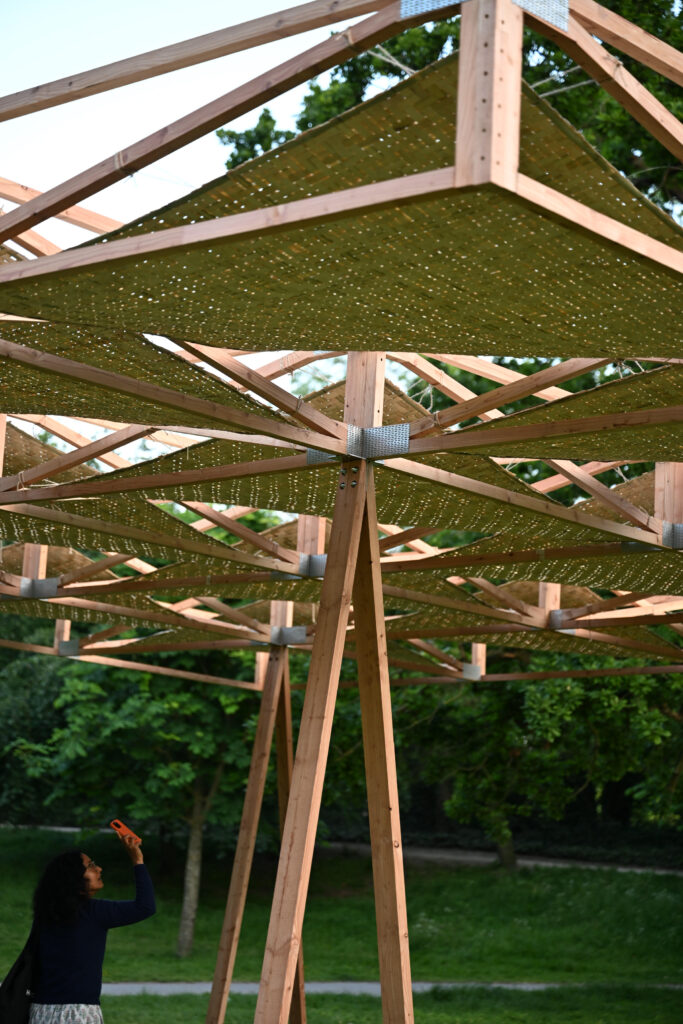
Submission by Studio Saar.
Being a good ancestor
Practice
1. Do you have a clearly stated purpose aligned with the planetary emergency? We’re looking for a bold ambition here, and a culture which recognises the need for long-term thinking.
Our purpose is to transform the built environment from extractive practice to regenerative systems that restore and enhance the living world. We work with the inherent potential of each project, its place, people and ecology, to create architecture that supports all life to flourish.
We do this by developing new capabilities within our practice, our collaborators and our clients: embedding circular thinking, ecological intelligence and long-term stewardship into every stage of design and delivery. This reflects our dharma, our responsibility to act in service of planetary and societal wellbeing.
In doing so, we aim to generate lasting value beyond the brief, contributing to climate stability, biodiversity recovery and social equity. In response to the planetary emergency, our ambition is to act as catalysts for systemic change, creating projects that build resilience and positive impact over generations.
2. Do you have a clearly stated purpose aligned with the planetary emergency? We’re looking for a bold ambition here, and a culture which recognises the need for long-term thinking.
No.
3. Do you share research and knowledge for the benefit of society and the wider world?
We believe our impact is multiplied by sharing knowledge openly and contributing to collective learning. We actively disseminate our work through conferences, publications, teaching and public engagement, fostering cross-cultural exchange and collaboration. We support students at Masters level through sponsorship and research facilitation. Every year we award a sustainability prize for students and invest in the development of emerging practitioners through mentorship.
Our research extends beyond practice. In the UK, we are exploring local supply chains and community-led delivery models through partnerships spanning education, industry and grassroots organisations.
We also lead an urban planning and design research group focused on our home city – past, present and future – working with government, organisations and citizens. Through this platform, we provide accessible, free-to-use resources and create opportunities for public participation.
Our aim is to democratise knowledge, empower communities, and enable wider society to shape more equitable and regenerative futures.
Project
1. Do you advocate for long-term thinking at the outset of work? Do you initiate work with long-term thinking and challenge clients? Also, can the organisation demonstrate that this approach has worked?
Our practice puts systems-thinking, place essence, regenerative practices, and enduring impact at our heart. In projects, we choose briefs that embed long-term civic value, climatic intelligence, and local practices.
For a community led masterplanning project our approach shifted the conversation from solely looking at immediate viability towards ecological and social repair, community connections, and long-term stewardship, in turn ensuring viability at all stages. We are also engaged in ongoing research into the future needs of the place, including local material sourcing.
At a manufacturing facility we designed we have worked with the client to take a resource-heavy, polluting industry to world-leading regenerative standards: cost-effectively providing water positivity, carbon neutrality, ecological restoration, social and education impact, as well as considering whole-site lifecycle.
Ongoing post-occupancy evaluation has demonstrated continued effectiveness of long-term thinking, where an ambitious landscaping strategy has benefited ecosystem wellbeing while also improving manufacturing capability in monsoon season.
2. Does your work take account of the future climate and the need for resilience?
Our practice spans civic, residential, industrial, and agricultural contexts, all designed with effective lifetime resource use, user wellbeing, and passive resilience over decades if not centuries. We emphasise simple, adaptable, culturally contextual details that rebalance towards longevity rather than short-lived, technocentric fixes.
This empowers users to understand, maintain and adapt their buildings, reducing operational energy and water use while extending building life.
We learn from vernacular construction and regional knowledge, integrating these with contemporary technologies to create responsive and resilient places. This approach supports local industries, strengthens place-specific skills, and reduces reliance on fragile global supply chains.
By prioritising adaptability, repairability, and local material sourcing, our projects are better equipped to respond to climate stresses such as heat extremes, water scarcity, and material volatility, benefiting both clients and the wider communities they serve.
3. Does the majority of your work go beyond mitigating negatives and towards optimising positives?
The majority of our projects are conceived as net-positive interventions, moving beyond mitigating harm to actively restoring and enhancing the systems they are part of. We seek to regenerate ecological systems, strengthen social infrastructure, rediscover craft, and build long-term local capacity.
Our projects commonly integrate rewilding strategies, material reuse and closed-loop systems, establishing low-cost, locally grounded approaches to high-quality, enduring space-making.
Public parks completed expand access to inclusive, free-to-use environments that support learning, wellbeing and ecological awareness. They are designed not only as places, but as platforms, empowering citizens and communities to take ownership of their environments and futures.
Through this approach, our projects generate lasting positive impact, enabling places and communities to become more resilient, self-sustaining and regenerative over time.
Co-evolving with nature
Practice
1. Do you use biophilia within your premises and/or do you regularly gather in natural settings?
Biophilic principles are embedded within our studios and working practices. Recent refurbishments prioritise bio-based materials, natural light, passive ventilation and sensory comfort, alongside abundant planting. These environments are designed to support wellbeing, creativity and a daily connection to natural systems.
Beyond the studio, we regularly gather in natural settings. Walking meetings, site-based discussions and time spent outdoors form an integral part of our design and decision-making processes. This ensures our work remains grounded in direct experience of landscape, climate and seasonal change.
We see this as essential to how we practise: maintaining an embodied relationship with nature sharpens our awareness, informs our design responses and reinforces our commitment to regenerative outcomes.
By aligning how we work with the systems we design for, we cultivate a practice that continuously learns from and co-evolves with the natural world.
2. Can you share examples of where you have considered nature in decision making?
We cannot design regeneratively without first understanding how life works in a place; every context is unique, and this is our starting point. Our vision is to create spaces where all life can thrive, embedding ecological understanding into decision-making from the outset.
On a manufacturing project, we are restoring 8 acres of land in collaboration with ecologists, botanists and Ayurvedic researchers, reintroducing native flora to support local ecosystems. This has enabled the return of over 40 bird species, including a resident colony of egrets and kingfishers, and has inspired users to establish a bird and wildlife club.
We work within an interdisciplinary ecosystem, bringing together expertise from landscape architecture, geography, craft and the arts. Across projects, we see water, soil, vegetation and wildlife as active stakeholders, shaping design responses that restore ecological relationships and create lasting value for both human and non-human communities.
3. Are you supporting nature locally and nationally?
We actively support nature at both local and wider scales, recognising our responsibility to contribute beyond project boundaries. Our parent company is responsible for funding a long-term programme to enable communities to plant and nurture one million trees within our home city limits, including the rewilding of 100 acres of denuded hillside with native flora.
Alongside this, our projects prioritise biodiversity enhancement, ecological restoration and the strengthening of local landscapes, ensuring that nature recovery is embedded within the places we design.
We also engage with local stakeholders, organisations and communities to build awareness, participation and stewardship of natural systems over time.
Through these combined efforts, practice, partnerships and wider initiatives, we seek to play an active civic and ecological role, contributing to the regeneration of ecosystems and supporting resilient, nature-rich environments at multiple scales.
Project
1. Can you demonstrate work that strives to match the performance of a mature ecosystem?
Our projects are designed to emulate the performance of mature ecosystems, integrating ecological, social and economic systems to create self-sustaining and evolving environments. While recently delivered, they are structured to establish the conditions for long-term regeneration and increasing performance over time.
On one of our manufacturing projects, this included large-scale rewilding, reforestation and biodiversity enhancement, restoring degraded land and supporting diverse habitats. In our public park projects, we focused on rebuilding relationships between people and landscape, reconnecting communities with local wildlife and water systems.
In the UK, our masterplans embed green infrastructure, ecological corridors and long-term stewardship within community-led development models, enabling landscapes to adapt and thrive.
We understand ecosystems as interconnected networks, linking environment, behaviour, governance and resource flows, ensuring our projects support not only ecological recovery, but also the social and organisational systems needed for resilience over time.
2. Are you working on material stewardship?
Material stewardship is fundamental to our practice, guided by the principles of reuse, repair and circularity. We prioritise locally sourced, low-impact materials, minimising transport and designing for long-term durability, adaptability and eventual reuse at end of life.
We have been at the forefront of repurposing stone waste from quarrying, transforming an abundant by-product into a valuable regional construction resource. Across projects, we work to significantly reduce construction waste, water use and embodied energy through careful detailing, material efficiency and collaboration with skilled craftspeople.
We partner with clients and an extended network of collaborators to develop cost-effective, regenerative material strategies that reintroduce craft and strengthen local supply chains.
At a manufacturing completed project, we constructed an 11-million-litre underground rainwater harvesting tank using fly ash bricks, lime mortar and sandstone, eliminating the need for concrete, steel and plastic, while enabling three local fly-ash brick factories to be established.
3. Does the majority of your work demonstrate the use of biologically-inspired approaches such as Bioregionalism, Biophilia or Biomimicry?
The majority of our projects are grounded in bioregional principles, forming a core part of our “global yet hyperlocal” approach. We design in response to local climate, ecology, materials and culture, sourcing resources regionally and, where needed, helping to establish local supply chains. This supports local economies while reducing environmental impact.
Our work also embraces biophilic thinking, creating environments that foster connection with nature and draw from natural systems in their organisation and performance.
We actively translate bioregional learning across contexts. For a cultural centre, we developed a canopy using locally sourced bamboo and traditional weaving techniques, enabling ongoing cycles of growth, repair and adaptation. This approach was later explored in a UK pavilion, “Craft not Carbon”, advocating for low-carbon, craft-led construction in a different context.
Through this, we embed place-specific, nature-informed thinking across the our work.
Creating a just space for people
Practice
1. Do you have a progressive EDI policy and can you evidence many forms of diversity, which are welcomed and acknowledged, within your company/organisation?
We are committed to creating an inclusive and equitable practice, supported by the wider policies and governance of our parent company. Our studios are located in India and the UK, and reflect a broad range of cultural perspectives, with colleagues from five countries across three continents within a team of 24 people.
We see diversity not as a target, but as a fundamental strength, and actively cultivate an environment where different voices, experiences and ways of thinking are welcomed and valued. We support this through open collaboration, mentorship and opportunities for cross-cultural exchange.
We also recognise that nurturing individual passions and interests increases motivation, creativity and the impact of our work. As we grow, we are working to further formalise our EDI approach across recruitment, development and everyday practice.
2. Do you operate a no overtime culture, meet the living wage consistently, and stipulate a fair salary ratio between staff of all levels?
We are a living wage employer, our annual salary benchmarking process looks fairly both internally and externally to guide our salary review process. Our salaries and people practices are governed by merit and performance. Our Managing Partner does not draw a salary from the business. In India the maximum salary difference is 1:3, while it is 1:2.5 in the UK.
We believe in enabling each of our colleagues to live their life in balance. The ebbs and flows of projects rarely result in overtime working, which is balanced by a clear flexitime approach to working hours and a generous leave policy. We believe, as culture, we foster an outcome-based working environment.
3. Do you support charities, community groups, social enterprises, action groups and others through pro-bono work, charitable giving or in-kind donations?
We actively support charities, community groups and social enterprises through pro-bono work, in-kind support and knowledge sharing. Despite our young age and small size, this forms an important part of our practice.
We provide pro-bono design and advisory support to community organisations, including assisting a local group in engaging with a developer on an inner-city retrofit to secure meaningful community use and benefit. We also host and contribute to local built environment networks, offering free community architecture clinics to widen access to design expertise.
Our support extends into education, from workshops with primary schools to sponsoring university student projects, helping to build capacity and inspire future practitioners and citizens.
We see this work as essential to creating a more just and inclusive built environment, and are committed to expanding our contribution as the practice grows.
4. Do you use an ethical framework to assess opportunities and/or supply chain partners and is them team consulted on these decisions?
Our decisions are guided by a clear ethical framework rooted in our purpose, values and regenerative principles. This informs how we select projects, engage with clients and collaborate with supply chain partners.
We assess opportunities against criteria including environmental impact, social value, alignment with long-term thinking and the potential to contribute positively to place. Where there is misalignment, we are prepared to decline work; we have previously turned down opportunities that did not meet our ethical standards.
These decisions are not made in isolation. We maintain an open and collaborative studio culture where the team is actively consulted on project selection and key partnerships, ensuring shared ownership of our direction and accountability to our values.
This approach enables us to act consistently and with integrity, aligning our work with our broader commitment to social and ecological responsibility.
Project
1. Does your work demonstrate deep engagement with local stakeholders and end users?
Deep engagement with local stakeholders and end users is fundamental to all our projects. We begin by building a shared understanding of the brief, expanding it through dialogue with clients, communities and, where relevant, consideration of non-human stakeholders such as local ecosystems.
We encourage the formation of project “guilds”, bringing together diverse voices to shape outcomes from the outset and throughout the design process. This ensures projects respond to real needs while unlocking wider social and ecological value.
For a cultural centre project, we established “Space Sparker” groups across age groups, children, young people and adults, who were actively involved at every stage of design development. This engagement continues beyond completion, enabling the building to evolve in response to its users.
Through this approach, our projects are co-created, fostering ownership, relevance and long-term success within the communities they serve.
2. Does your work create connected and resilient communities which positively contribute to neighbourhoods and allow equality of access?
Our projects are designed to foster connected, inclusive and resilient communities, contributing positively to their wider neighbourhoods. We challenge conventional building typologies by introducing mixed-use and shared spaces, from sports facilities within factories to the integration of science, arts and cultural programmes, encouraging interaction across ages, backgrounds and social groups.
We consider the social implications of all design decisions, from accessibility and spatial organisation to material choices and construction methods. Our aim is to create environments that support lifelong learning, chance encounters and active community participation, ensuring spaces are welcoming and usable by all.
Beyond individual projects, we engage with wider communities through research and digital platforms. Our urban planning and design group leads initiatives such as community-led heritage restoration, using online tools to understand local priorities and empower collective action.
Through this, we enable more equitable access, stronger connections and long-term community resilience.
3. Does the majority of your work promote equity in society, and consider all people, not only building inhabitants
Promoting equity and widening access to architecture is one of the core reasons we exist. The majority of our projects are conceived to benefit not only building users, but wider communities – particularly those who are often underserved by conventional development models.
Our cultural centre project aims to create a long-term impact by providing much needed spaces and resources for fostering curiosity, creativity, and community. This inclusion-centric project is altering how people see buildings in India, from a colonised mindset to one that is celebrating India’s rich cultural heritage, while responding to climate, and addressing modern India’s forward-looking culture.
Across our portfolio, we design spaces which enable diverse communities to engage with and benefit from them. In the UK, our work and research into housing explores more inclusive, multi-generational and community-led models.
Through this, we aim to expand who architecture serves, and how it contributes to a more equitable society.