
Submission by Studio PDP.
Being a good ancestor
Practice
1. Do you have a clearly stated purpose aligned with the planetary emergency? We’re looking for a bold ambition here, and a culture which recognises the need for long-term thinking.
‘Future Thinking Heritage’ and adaptive reuse are at the core of Studio PDP’s purpose. We believe the most sustainable building is the one that already exists, and our practice is centred on the long-term stewardship, adaptation and decarbonisation of the built environment for future generations.
We recognise the built environment’s critical role in limiting global warming to 1.5°C and embed this responsibility into both our projects and practice operations. Our approach prioritises retrofit-first thinking, fabric-first design, adaptive reuse and low-carbon material strategies to create resilient, future-proof buildings that retain cultural and material value over short-term gain.
As signatories to Architects Declare and LETI, we actively support industry-wide climate action and net zero targets. Internally, we have measured our carbon footprint for over ten years and operate under a Carbon Reduction Plan aligned with Science Based Targets initiative (SBTi) principles, maintaining carbon-neutral operations through emissions reduction and responsible offsetting.
2. Do you have a clearly stated purpose aligned with the planetary emergency? We’re looking for a bold ambition here, and a culture which recognises the need for long-term thinking.
We’re committed to long-term continuity, shared ownership and protection of the values that have shaped the practice since its founding in 1994. Succession planning is embedded within our annual career review process, where future leaders and successors are identified and supported across all levels of the business.
Our partner-led structure encourages collaboration, stewardship and knowledge-sharing, ensuring expertise and responsibility are passed between generations of staff. We actively nurture talent through mentoring, structured training, professional development and opportunities for increased responsibility.
To safeguard the practice’s long-term purpose, we have established an ESG Policy and Carbon Reduction Plan that act as a roadmap for future growth and accountability. Our core values — Quality, Respect and Support — were co-created with staff through workshops, ensuring they genuinely reflect the culture of the practice while remaining adaptable to future needs.
Programmes such as our Shape mentoring initiative further support progression from student level through to leadership.
3. Do you share research and knowledge for the benefit of society and the wider world?
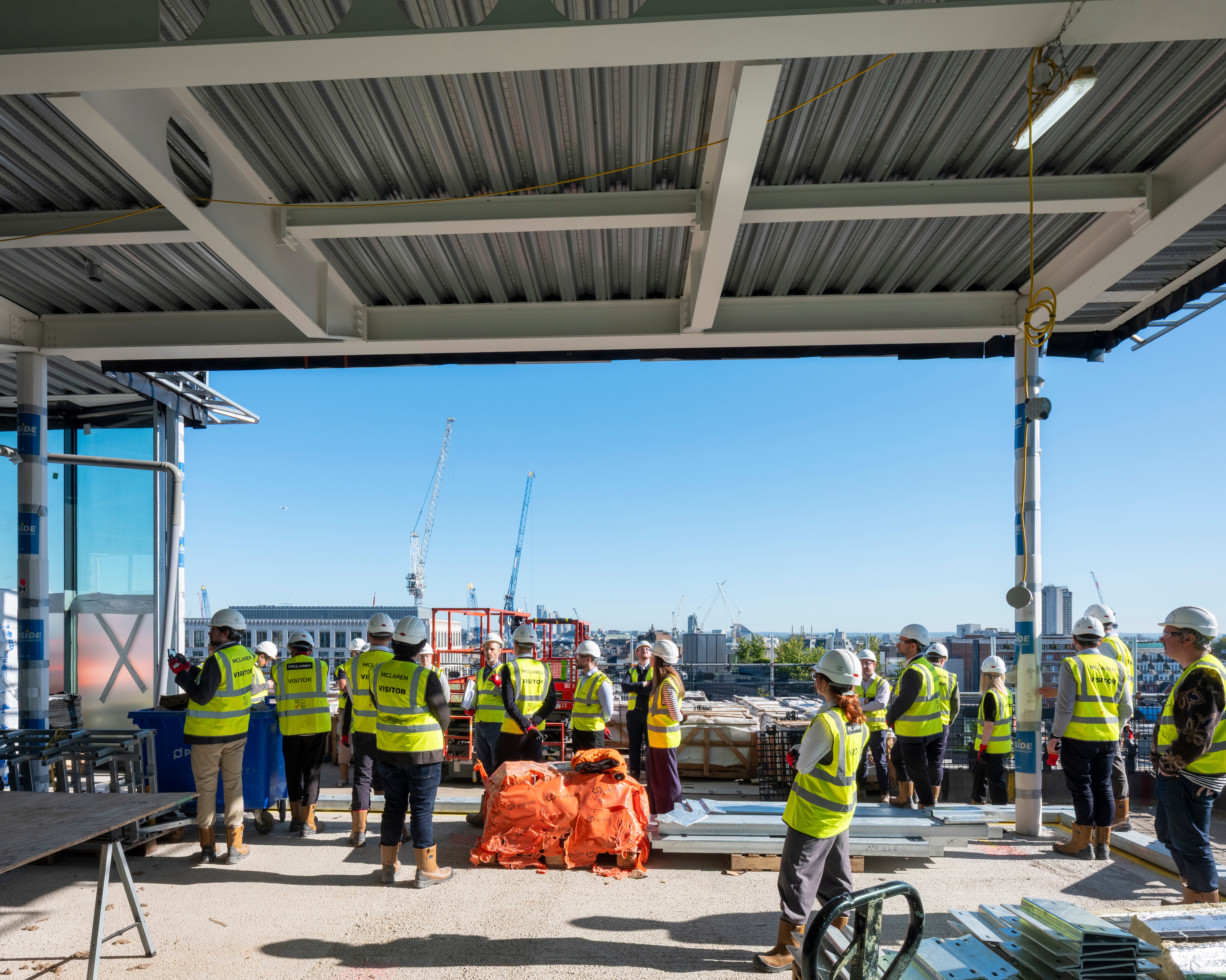
Studio PDP actively shares research and knowledge through industry advocacy, academic partnerships and public engagement. We regularly host tours of exemplar retrofit projects to promote best practice in low-carbon design and adaptive reuse. Over the past year alone, more than 250 industry professionals have visited Claridge House to learn from its deep retrofit and decarbonisation strategy.
Projects such as The Elephant demonstrate our commitment to circular economy principles through urban mining and the pioneering reuse of structural steel both within the project and through external collaboration. We believe making innovative approaches visible is essential to normalising regenerative practice across the industry.
Our staff contributed to the LETI Retrofit Guide, while our Head of Sustainability is a coordinator of the ACAN Existing Building Group. We maintain strong academic links through our longstanding support of the London School of Architecture, tutoring at the Royal College of Art and hosting educational site visits.
Project
1. Do you advocate for long-term thinking at the outset of work? Do you initiate work with long-term thinking and challenge clients? Also, can the organisation demonstrate that this approach has worked?
Studio PDP advocates for long-term thinking from the outset of every project, embedding sustainability, adaptability and building longevity into the earliest design decisions. We challenge clients to consider the long-term environmental, social and economic performance of their assets through retrofit-first thinking, fabric-first design and low-carbon material strategies.
Our approach is grounded in six key principles derived from Passivhaus methodology, with Moisture Management added as a sixth pillar to support the long-term health of existing buildings: sufficient insulation, efficient windows, robust airtightness, minimal thermal bridging, sufficient ventilation and moisture balance. By addressing these areas holistically, we create comfortable, healthy and future-proof environments with minimal operational energy demand.
Claridge House demonstrates the success of this approach, achieving a 93% reduction in carbon emissions through deep retrofit. The project was recently presented by our Head of Sustainability at the International Passivhaus Conference in Germany as an exemplar of low-carbon heritage retrofit.
2. Does your work take account of the future climate and the need for resilience?
Studio PDP’s projects are designed to respond to future climate conditions through a fabric-first approach that prioritises the optimisation of the building envelope before relying on mechanical systems. By reducing baseline energy demand at source, we improve operational resilience, reduce carbon emissions and protect occupants from volatile energy costs.
Our approach combines durable, low-carbon materials with high-performance ventilation, airtightness and moisture management strategies to ensure buildings remain healthy, comfortable and robust over the long term. Deep expertise in building physics and retrofit allows us to carefully balance thermal performance with the protection of existing fabric.
We are currently delivering Bush House for King’s College London to the EnerPHit standard, involving extensive building physics research and moisture analysis. The project includes the UK’s largest application of Diathonite, a lime-based cork insulating plaster with significantly lower embodied carbon than conventional insulation systems.
3. Does the majority of your work go beyond mitigating negatives and towards optimising positives?
Studio PDP seeks to create projects that actively improve environmental, social and cultural value through regenerative retrofit, adaptive reuse and long-term stewardship of the built environment. We see existing buildings as assets for future generations, not disposable resources.
Our multidisciplinary sustainability team — including Passivhaus designers, retrofit coordinators and building physics specialists — embeds low-energy design, moisture management and low-carbon material strategies from the earliest stages of every project. This approach not only reduces carbon emissions, but creates healthier, more resilient and future-proof environments with extended building lifespans.
Projects such as Claridge House and The Elephant demonstrate how deep retrofit and circular economy principles can unlock positive impact through urban mining, structural reuse and sensitive heritage renewal. Alongside environmental outcomes, we prioritise education partnerships, apprenticeships, mentoring and industry knowledge-sharing to help accelerate the wider adoption of low-carbon retrofit and regenerative practice.
Co-evolving with nature
Practice
1. Do you use biophilia within your premises and/or do you regularly gather in natural settings?
Studio PDP encourages daily interaction with nature as part of staff wellbeing, collaboration and environmental awareness. During the retrofit of our Eccleston Yard studio, we introduced an outdoor terrace to provide staff with direct access to fresh air, planting and informal outdoor working and social spaces within a dense central London setting.
We also regularly use natural settings to support reflection, creativity and connection. Staff take part in ‘walk and talk’ meetings to nearby Hyde Park, lunchtime visits to The Onion Garden – a local community green hub – and annual practice retreats to rural locations in Wales and Cornwall.
These initiatives reflect our belief that people are part of nature, not separate from it. Creating opportunities to reconnect with natural environments supports wellbeing, strengthens team culture and reinforces the values that underpin our regenerative, people-focused and long-term approach to design.
2. Can you share examples of where you have considered nature in decision making?
Studio PDP considers nature as an integral part of long-term urban resilience and wellbeing, particularly within complex retrofit and regeneration projects in dense city environments. Our work seeks opportunities to introduce greening, improve biodiversity and strengthen connections between people and nature within existing urban fabric.
At The Gaumont, we incorporated landscaped courtyard spaces to create areas for planting, habitat and social interaction within a constrained heritage setting. At an urban scale, The Low Line Commons masterplan reimagines a stretch of Victorian railway viaduct running through Bankside, London Bridge and Bermondsey as a connected green corridor that responds to environmental, social and economic challenges.
Commissioned by the Low Line Partners, the project promotes greening, biodiversity and climate resilience while celebrating the identity and heritage of each neighbourhood it passes through. The scheme has since been recognised by multiple prestigious design awards, highlighting its contribution to regenerative public realm thinking.
3. Are you supporting nature locally and nationally?
Studio PDP supports nature both locally and nationally through climate advocacy, community engagement and regenerative design initiatives. As a practice rooted in retrofit and adaptive reuse, we see the retention and improvement of existing buildings as a critical way to reduce resource extraction, minimise waste and protect land and ecosystems from unnecessary development.
Locally, we support community green initiatives such as The Onion Garden in Westminster and incorporate planting, greening and biodiversity measures into our urban projects wherever possible. Through projects such as The Low Line Commons, we advocate for greener, healthier public spaces that strengthen ecological resilience within dense city environments.
Nationally, our staff contribute to wider environmental action through organisations including ACAN and LETI. During London Climate Action Week, we hosted events focused on climate literacy, regenerative thinking and the environmental impact of construction, helping to promote knowledge-sharing and industry-wide cultural change.
Project
1. Can you demonstrate work that strives to match the performance of a mature ecosystem?
Studio PDP strives to create projects that operate as resilient, low-energy systems by working with existing buildings, reducing resource consumption and improving environmental performance over the long term. Our approach combines fabric-first retrofit, passive design principles, circular economy strategies and moisture-balanced construction to create healthy and adaptable environments with minimal energy demand.
Claridge House exemplifies this approach through a deep retrofit strategy that achieved an estimated 93% reduction in carbon emissions while extending the life of the existing structure. At Bush House for King’s College London, we are delivering an EnerPHit retrofit using low-carbon natural materials, including the UK’s largest application of Diathonite lime-based cork insulating plaster, selected for its thermal, moisture-regulating and low embodied carbon properties.
Projects such as The Elephant further demonstrate regenerative thinking through urban mining and structural steel reuse, reducing waste and retaining the embodied value of existing materials.
2. Are you working on material stewardship?
At Studio PDP, we champion material stewardship through responsible sourcing, resource efficiency, and a clear commitment to eliminating waste. Our work actively supports a circular economy, including urban mining strategies as demonstrated on The Elephant project, where 40 tonnes of steel were salvaged and reintroduced into industry reuse streams.
We also reduce embodied carbon by specifying innovative, low-carbon alternatives to conventional materials. At Claridge House, this included timber framing, Diathonite insulation, and Fermacell drylining manufactured from recycled content. At Bush House, we are taking this further, delivering what will be the largest application of Diathonite in a UK project to date.
To strengthen this approach, we are building an internal material library and advancing research into biomaterials, including the potential of food waste as a construction resource. Alongside this, we are upskilling our team in embodied carbon assessment to ensure every project is guided by informed, data-driven material decisions.
3. Does the majority of your work demonstrate the use of biologically-inspired approaches such as Bioregionalism, Biophilia or Biomimicry?
No.
Creating a just space for people
Practice
1. Do you have a progressive EDI policy and can you evidence many forms of diversity, which are welcomed and acknowledged, within your company/organisation?
Studio PDP takes a proactive approach to Equity, Diversity and Inclusion, embedding EDI across our culture, projects, and employment practices. We value the perspectives and experience of people from diverse backgrounds and recognise the urgent need to strengthen inclusion across the built environment sector.
Our EDI Policy and Charter set clear expectations and actions across key stages of the career journey, from education and recruitment through to progression, leadership, and advocacy, with regular review to ensure meaningful progress.
To widen access to architecture for underrepresented groups, we have introduced an applicant tracking system, interview training, diverse recruitment panels, an internal mentoring programme (‘Shape’), an apprenticeship scheme, and ongoing support for the London School of Architecture.
This commitment is reflected in our workforce: a 50/50 gender split, 54% of qualified architects being female, 18 nationalities speaking 19 languages, representation across four generations, and 20% of employees working part-time.
2. Do you operate a no overtime culture, meet the living wage consistently, and stipulate a fair salary ratio between staff of all levels?
Studio PDP is committed to fair, ethical employment practices that prioritise wellbeing, inclusion, and long-term career sustainability. We actively discourage excessive overtime and promote balanced, manageable workloads to support healthy work–life integration across the practice.
Flexible working is embedded wherever possible, recognising that individuals have different responsibilities, rhythms, and wellbeing needs. We support agile and part-time working to enable staff to balance professional and personal commitments effectively.
All employees are paid at or above the Living Wage, and we maintain a transparent and fair salary ratio across all levels of the organisation to ensure equity and clarity in pay structures.
Through these commitments, we aim to foster a supportive, respectful, and sustainable working environment where people can thrive professionally while maintaining personal wellbeing.
3. Do you support charities, community groups, social enterprises, action groups and others through pro-bono work, charitable giving or in-kind donations?
Studio PDP supports charities and community organisations through fundraising, donations, and professional engagement. Our staff-chosen charity is Architects Benevolent Society (ABS), alongside support for The Passage, a local homelessness charity, and fundraising initiatives including a charity lunch in support of ACAN. We integrate giving into our environmental strategy through the purchase of carbon credits from HACT, a charity funding the decarbonisation of the UK housing stock.
Our most significant contribution is pro-bono work for Centrepoint, tackling youth homelessness through the Charter Close project in Lambeth – delivering 18 affordable homes. The project provides opportunities for early-career staff to take on supported responsibility present to clients and engage in live project delivery.
“The collaboration with Centrepoint is empowering – delivering real impact for young people, while also allowing us to push sustainability, spatial quality, and innovation into practice, and give emerging designers a stronger voice.’” Kamil Perzanowski, Architectural Apprentice at Studio PDP.
4. Do you use an ethical framework to assess opportunities and/or supply chain partners and is them team consulted on these decisions?
Studio PDP uses its ESG policy as a clear roadmap to remain a responsible, forward-thinking practice. The framework is grounded in our core values of Quality, Respect, and Support, which was co-created with staff through workshops to reflect a shared organisational vision.
While we already prioritise responsibly sourced materials, we have committed to strengthening this further by implementing more rigorous supply chain monitoring as a key future objective.
Staff voice is central to how we operate. Our Staff Forum provides a structured channel between employees and partners, ensuring all perspectives inform decision-making. Whole-practice design charrettes enable collaborative input across teams, bringing collective expertise to project development. In addition, student-led groups such as Blueprints, our Part 3 community, foster open dialogue around practice operations, professional ethics, and continuous improvement.
Together, all these platforms ensure ESG is not just a policy, but a lived and evolving part of how we work.
Project
1. Does your work demonstrate deep engagement with local stakeholders and end users?
Studio PDP defines social value as the creation of sustainable wellbeing for both people and projects, delivered through continuous development and active dialogue with stakeholders at every stage of design. Our people-first, collaborative approach seeks to reimagine how individuals live, work, and spend time, ensuring that user experience is central to decision-making.
A key example of this engagement is our ‘Urban Designer for a Day’ programme at the London Festival of Architecture, delivered in collaboration with the Royal Borough of Kensington and Chelsea. The initiative invited participants to explore urban regeneration strategies grounded directly in community needs and lived experience.
Our pro-bono work on the Charters Close project for Centrepoint further demonstrates this commitment, providing affordable homes for young people experiencing homelessness. The scheme integrates shared social spaces designed to foster connection, belonging, and a strong sense of community among residents.
2. Does your work create connected and resilient communities which positively contribute to neighbourhoods and allow equality of access?
Our projects are designed to create connected, resilient communities that positively contribute to their neighbourhoods while supporting equality of access.
At Charters Close, shared social spaces and a woodland setting within generous green space help foster interaction, wellbeing, and a sense of belonging among residents. The scheme is rooted in ‘true affordability’, delivering 18 homes for young people experiencing homelessness, with rents capped at one-third of salary to ensure long-term security and access.
At a wider urban scale, The Elephant project maintains an active retail frontage on Oxford Street, helping sustain a vibrant public realm and strengthen neighbourhood activity – all ahead of its impending pedestrianisation.
We also engage communities directly through initiatives such as our ‘Urban Designer for a Day’ programme, delivered with local authorities to explore regeneration strategies grounded in local identity and community need. Together, these approaches ensure our work supports inclusive, accessible, and socially resilient places.
3. Does the majority of your work promote equity in society, and consider all people, not only building inhabitants
Studio PDP’s work promotes equity in society by addressing the needs of diverse users and contributing to inclusive, accessible, and socially connected places beyond individual building occupants.
Across projects such as The Gaumont, Bush House, Low Line Commons, Duke of York Square, and Cadogan Hall, we work to strengthen civic value, public realm quality, and access to culture, education, retail, and shared urban life. These schemes prioritise permeability, active ground conditions, and spaces that welcome a broad cross-section of society.
At Charters Close, equity is addressed directly through the delivery of genuinely affordable homes for young people experiencing homelessness, alongside shared spaces that support dignity, wellbeing, and community.
Together, these projects demonstrate a consistent commitment to designing for the wider public good—creating environments that reduce barriers, encourage participation, and support more equitable access to the city.