
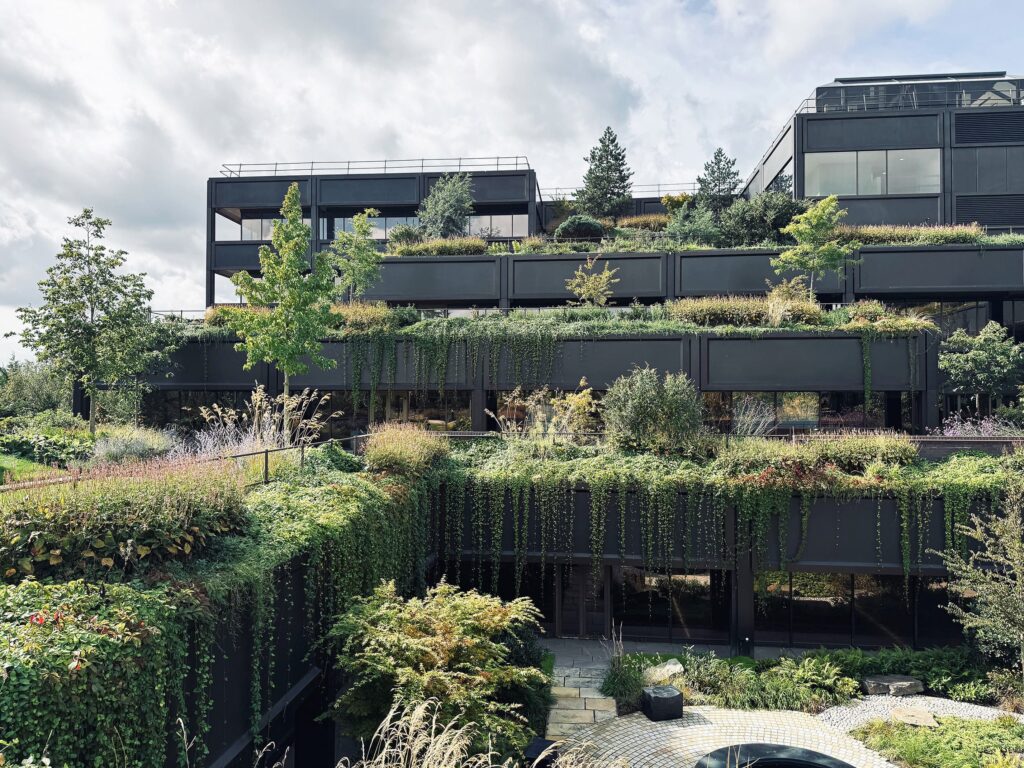
Submission by Studio Knight Stokoe.
Being a good ancestor
Practice
1. Do you have a clearly stated purpose aligned with the planetary emergency? We’re looking for a bold ambition here, and a culture which recognises the need for long-term thinking.
We describe ourselves as Regenerative Landscape Architects, working with a planet-positive agenda. We are a Certified B Corp™, and Better Business Act member, with amended Articles of Association that legally embed environment and society as key stakeholders. Three overarching design drivers shape all strategic decisions: resilient, regenerative, and empathic design.
In Q4 2025 we finalised our Regenerative Practice Roadmap, reviewed annually. In Q1 2026 we updated our public profile to reflect our planet-positive mission and established five baseline project targets:
- Minimum 20% BNG
- Minimum 200% tree replacement (or 100% new planting where no loss occurs)
- 100% on-site retention, re-use, and recycling of existing site materials
- Minimum 30-year management and maintenance plans
- Minimum 50% permeable surfaces contributing to SuDS
We are setting out that by 2030, all projects meet or exceed at least three of these five targets.
2. Do you have a clearly stated purpose aligned with the planetary emergency? We’re looking for a bold ambition here, and a culture which recognises the need for long-term thinking.
No.
3. Do you share research and knowledge for the benefit of society and the wider world?
Our annual impact report is published and shared publicly via our website, social media, and the B Corp community directory. It includes thought leadership, project metrics, and practice findings, grounded in transparent and honest analysis and reflections.
We conduct post-occupancy evaluations, hold knowledge-sharing sessions at project outset, and engage in regional and national design review panels. Our ongoing stewardship role at Plant in Basingstoke enables direct site monitoring and analysis – findings will be shared in future impact reports.
One of our co-directors is a specialist lecturer at Oxford Brookes University, sharing landscape architecture knowledge and expertise with architecture students. We participate in industry events, including Footprint+, SoilsCon, and Festival of Place, and conduct client, collaborator, and stakeholder satisfaction surveys. We are developing an in-house carbon and biodiversity tool to support design development and post-occupancy auditing. Ideally, this would be freely accessible to others, pending testing and further development.
Project
1. Do you advocate for long-term thinking at the outset of work? Do you initiate work with long-term thinking and challenge clients? Also, can the organisation demonstrate that this approach has worked?
At project outset we run knowledge-sharing sessions covering management and maintenance across a minimum 30-year horizon. We challenge clients on design life, advocate for demountable, reusable, and recyclable elements, prioritise climate-resilient plant species and a regenerative approach to planting substrates, and assess the climate and carbon costs of materials from the outset.
The Climate Positive Design Pathfinder Calculator is used across all projects to model carbon impact and sequestration, including the predicted number of years to reach a net-positive outcome, enabling design decisions to be tested against long-term performance. This has resulted in changes to materials and planting approaches on projects, to decrease the time to net-positive.
On all projects we advocate for a post-completion stewardship role to maintain design intent and support ongoing planet-positive management. This is now in place at Plant in Basingstoke, where stewardship continuity was written into the management and maintenance plan for the site.
2. Does your work take account of the future climate and the need for resilience?
All projects incorporate climate-adaptive planting schemes capable of withstanding extreme weather and supporting biodiversity. Microclimate modelling uses Met Office data spanning present-day through to anticipated future conditions, so design decisions account for future use cases rather than current climate only.
We prioritise adaptability through modular, recyclable, and demountable landscape structures designed for disassembly and component reuse. Non-deterministic solutions including green infrastructure and natural drainage are designed to respond dynamically to fluctuating conditions. At Canons Wharf in Bristol, all ground-level planting beds form part of the sitewide SuDS strategy.
Applicable projects achieve or target beyond minimum 10% BNG and BREEAM Excellent or Outstanding. A London school project advocates for sustainable on-site material harvesting and composting, reducing reliance on external supply and eliminating material removal from site.
3. Does the majority of your work go beyond mitigating negatives and towards optimising positives?
All projects are aligned with the UN Sustainable Development Goals and measured through the Climate Positive Design Pathfinder Calculator. Minimum practice targets include 20% BNG, 200% tree replacement, and 100% on-site material retention, re-use, and recycling.
Plant in Basingstoke achieves 19% BNG and achieved BREEAM Outstanding. Canons Wharf in Bristol targets a minimum 35% BNG and over 300% tree replacement. Greyfriars in Reading is on course for BNG in excess of 300%.
We are pledged to alignment with the RIBA 2030 Challenge and global net-zero targets, prioritising regenerative and carbon-capturing landscapes, protection of irreplaceable habitats, maximised functional biodiversity, and soft landscape over carbon-intensive hard materials. Healthy microclimate design, passive strategies, water conservation, and low-embodied-carbon material specification are standard across all projects.
Co-evolving with nature
Practice
1. Do you use biophilia within your premises and/or do you regularly gather in natural settings?
The studio is situated within mature gardens, with natural light, natural materials throughout, and low-water evergreen interior planting. A covered garden terrace functions as a year-round outdoor workspace and staff break area.
Walking meetings and design workshops take place in local countryside and woodland. Studio visits to inspiring gardens and outdoor spaces are held throughout the year. Staff CPD allowances include provision for outdoor and nature-related courses and volunteering.
We maintain external space at the studio for testing design elements and exploring horticultural techniques. A new studio move is underway, presenting a blank-slate opportunity to apply our regenerative design principles directly to our own workspace.
2. Can you share examples of where you have considered nature in decision making?
Our Articles of Association formally recognise society and nature as essential stakeholders. A flexible working policy including a four-day week, remote working, and consideration of circadian rhythms reflects alignment with natural patterns at a practice management level. We recognise the seasonal nature of people’s capacity and workload.
On all projects we advocate for a dedicated Nature Champion, operating at a senior project level to question and assess the implications of design decisions for ecological outcomes. We advocate for a landscape and nature-led design approach, working within and building upon existing ecosystems rather than overriding them.
3. Are you supporting nature locally and nationally?
As a 1% for the Planet member, we commit a minimum 1% of annual turnover to environmental charities, a requirement we have exceeded for three consecutive years. We donate annually to Rainforest Concern and hold paid Woodland Trust memberships for staff.
We are working with clients at Plant in Basingstoke for the gardens to be opened to the public as part of the National Garden Scheme. We maintain an ongoing stewardship role there, supporting site establishment and evolution.
We have partnered with the charity Jamie’s Farm to support their flagship schools programme through pro bono design services. One of our co-directors is a specialist lecturer at Oxford Brookes University, sharing landscape, climate and regenerative design knowledge with architecture students. One of our co-founding Directors sits on the Design West design review panel, advocating for nature-based design solutions, and consideration for the twin challenges of climate and biodiversity emergencies.
Project
1. Can you demonstrate work that strives to match the performance of a mature ecosystem?
All projects target a minimum 20% BNG, above statutory requirements. Existing trees, habitats, and landscape features are the starting point for every project, with retention and enhancement of established ecosystems prioritised before any new provision is considered. This includes a micro-urban forest school in London where all existing on-site habitats are retained and enhanced.
Plant in Basingstoke achieved 19% BNG. Canons Wharf in Bristol targets a minimum 35% gain and over 300% tree replacement. Greyfriars in Reading is on course for BNG in excess of 300%. The Vincent Square schools project retained 100% of existing trees while enhancing existing planting and habitats.
All projects are assessed against BNG and Urban Greening Factor standards.
2. Are you working on material stewardship?
Material selection is guided by the BRE Green Guide and assessed over a 50-year period using the Climate Positive Design Pathfinder Calculator. We maintain extensive material libraries and advocate for on-site reuse, locally sourced materials, and future recyclability throughout all projects.
Plastics are strictly prohibited across all specifications. All timber is FSC certified. Concrete, stone, and metalwork are specified from UK and European sources to reduce embodied carbon.
Plant in Basingstoke retained and reused all existing hard landscape materials, either in place or as crushed aggregate for sub-bases. Canons Wharf in Bristol and a London school both target 100% on-site material retention, re-use, and recycling. The London school uses cork as a sustainable, repairable outdoor surface finish, that is soft to touch, hypoallergenic, and a safe surface for play.
3. Does the majority of your work demonstrate the use of biologically-inspired approaches such as Bioregionalism, Biophilia or Biomimicry?
Canons Wharf in Bristol draws its overarching design concept from local marshland and grassland ecosystems, applying Ecomimicry principles to embed resilience, adaptability, and self-sustaining function into the scheme.
Plant in Basingstoke applies Biophilic design throughout, creating multilayered garden spaces that connect the built environment with natural systems, supporting well-being and human-nature relationship for staff and visitors.
Bioregionalism is applied across all projects through mapping and sourcing local materials and regionally appropriate tree and plant species. All projects integrate biophilic design principles and a regenerative systems-based approach to create self-sustaining landscapes.
Creating a just space for people
Practice
1. Do you have a progressive EDI policy and can you evidence many forms of diversity, which are welcomed and acknowledged, within your company/organisation?
A progressive EDI policy is in place. The founding directorship is equally split between a male and female co-director, with equal shares and voting rights. Blind interviews are standard practice and all role advertisements are drafted to minimise bias.
We provide educational opportunities, work placements, mentoring, pro-bono services, and financial contributions to support diversity. We advocate for equity and inclusivity consultants on all projects, moving beyond a traditional accessibility-only framing. We are committed to diversity at all levels of the practice, with the objective that the profession reflects the society it serves.
2. Do you operate a no overtime culture, meet the living wage consistently, and stipulate a fair salary ratio between staff of all levels?
No overtime is written into the Studio Handbook and reinforced by studio-wide behaviour, with no expectation of out-of-hours communication. Staff can work a four-day week. Weekly task allocation reviews ensure workload is fairly distributed.
Salaries consistently exceed Living Wage standards; the practice is in the process of becoming an accredited Living Wage Employer. Salary information is included in all role advertisements. Pay structures are based on objective criteria including experience, qualifications, and performance, applied equitably across the organisation.
3. Do you support charities, community groups, social enterprises, action groups and others through pro-bono work, charitable giving or in-kind donations?
A minimum 1% of annual turnover is donated to environmental causes under 1% for the Planet, which we’ve exceeded for the past three years. Staff are granted up to 40 hours of paid time per year for pro-bono or voluntary work.
We’re currently providing pro-bono design services to Jamie’s Farm, supporting their flagship schools programme. We are registered supporters and financial contributors to the equity advocacy group, Part W. We donate annually to Rainforest Concern. One of our co-directors is an expert panellist for the charity Design West; the practice is also a registered member of Design West, providing financial support for their invaluable work. We prioritise independent local businesses within a 10-mile radius of the studio.
4. Do you use an ethical framework to assess opportunities and/or supply chain partners and is them team consulted on these decisions?
As a Certified B Corp™ we declare any involvement with industries or organisations flagged on the B Corp assessment. We have declined opportunities on ethical grounds, specifically where projects overlap with gambling, alcohol, and animal rights concerns.
The practice has taken a principled position against working in countries where governments are known to oppress free speech or carry out political oppression.
We publish an annual impact report disclosing our client relationships publicly. An internal Environmental Stewardship database tracks suppliers and vendors assessed for ethical alignment, ensuring we work with responsible businesses.
Project
1. Does your work demonstrate deep engagement with local stakeholders and end users?
All projects follow a Stakeholder Engagement Policy aligned with the RIBA Plan of Work Engagement Overlay and the QOLF Inclusive Engagement Toolkit. We advocate for co-design as standard and actively collaborate with EDI professionals to ensure engagement is inclusive and equitable.
At Canons Wharf in Bristol, engagement with the local authority, independent design review, and local business and community stakeholders produced actionable changes to the design. At the flagship schools programme, co-design will be actively practised with school staff, pupils, and the local community. We identify underrepresented demographics in each project’s stakeholder composition and prioritise their inclusion.
2. Does your work create connected and resilient communities which positively contribute to neighbourhoods and allow equality of access?
Projects are designed to generate social and economic value beyond the site boundary. Canons Wharf in Bristol integrates ecological systems, public-facing retail and dining, and programming to activate spaces within the wider neighbourhood. Plant in Basingstoke embeds inclusive, accessible environments designed for enjoyment by the local community. Plant in Basingstoke also supports local employment through a locally contracted horticultural management company and a local on-site caterer.
Andover New Theatre provides vital community and arts access in the town centre; design development included engagement with inclusive design user groups and the local theatre community.
3. Does the majority of your work promote equity in society, and consider all people, not only building inhabitants
Projects are designed to generate social and economic value beyond the site boundary. Canons Wharf in Bristol integrates ecological systems, public-facing retail and dining, and programming to activate spaces within the wider neighbourhood. Plant in Basingstoke embeds inclusive, accessible environments designed for enjoyment by the local community. Plant in Basingstoke also supports local employment through a locally contracted horticultural management company and a local on-site caterer.
Andover New Theatre provides vital community and arts access in the town centre; design development included engagement with inclusive design user groups and the local theatre community.