
Submission by Tezuka Architects.
Being a good ancestor
Practice
1. Do you have a clearly stated purpose aligned with the planetary emergency? We’re looking for a bold ambition here, and a culture which recognises the need for long-term thinking.
No.
2. Do you have a clearly stated purpose aligned with the planetary emergency? We’re looking for a bold ambition here, and a culture which recognises the need for long-term thinking.
No.
3. Do you share research and knowledge for the benefit of society and the wider world?
Our company founding partners and lead architects – both of whom are teachers – actively engage in sharing research and knowledge derived from their own experiences as architects and processes of design. We design architecture for Life.
These experiences and process developing partnerships, both in local and international projects have been published.
Project
1. Do you advocate for long-term thinking at the outset of work? Do you initiate work with long-term thinking and challenge clients? Also, can the organisation demonstrate that this approach has worked?
In specific projects, we engage with local communities to help foster a future where the client`s organization will play a central role for the local community, including efforts to create new jobs and trades, helping boost local economy.
Creating a place for learning opportunities and long term skill and job creation to ensure the continued resilience of local culture and revivalism of traditional practices in construction and beyond.
As an example of the above, we`re engaged with the Jhamtse Gatsal Children`s Community – an NGO based in Tawang, within the Arunachal Pradesh province in Northeast India – towards design of their new Academic Block. Although our work scope is not limited to design of the facilities only. We are actively in support of their own efforts to secure financing and long term sustainability. We now understand our role as closer to that of a new added “family member”, honing in our own abilities to support the community.
2. Does your work take account of the future climate and the need for resilience?
As architects, it is quite often that we find ourselves first as advocates for the protection, rehabilitation or extension of existing natural systems. If not, we challenge the creation of new natural spaces.
Our work also aims to build sustainably, by the extensive use of natural materials.
3. Does the majority of your work go beyond mitigating negatives and towards optimising positives?
We design for life. As such, we are continuously engaged in creating solutions, that strive towards a deep connection to the natural world.
Especially in Japan, we extensively use timber structural solutions.
Co-evolving with nature
Practice
1. Do you use biophilia within your premises and/or do you regularly gather in natural settings?
Our office location is right across a natural valley, still heavily forested, wherein we can actually find a temple. This serene environment is somewhat of a luxury in Tokyo. Yearly, we engage with some local traditions at the temple, and its proximity to our office, certainly plays a key role in the well-being of all our team.
Our office includes a couple of balconies, where some staff members have placed some plants. During the difficult times of COVID, these balconies also provided some necessary space for relief and social distancing.
Otherwise, our lead architects are keen outdoor adventurers, with many staff members actively engaging in outdoor activities.
It is also our company practice to gather for a few outdoor events yearly. Especially for the Mt. Fuji climb taking place every year.
2. Can you share examples of where you have considered nature in decision making?
Our approach to architecture is clearly defined by our commitment to structural clarity and the natural environment that surrounds and permeates our design. In our works, the space in-between the built environment and the natural world is of great importance. As such, we strive to ensure a continuity between the outdoors and internal spaces.
Both locally in Japan, and internationally, for example, in France or the UAE, we have – in close collaboration with landscape architects – designed new natural systems or helped maintain and enrich pre-existing gardens. These natural spaces become a kind of “secondary nature”. We are well aware of the well-being and health benefits of the entire community of a space. Be it an office space or a school. That employees, visitors and guests, teachers and learners all profit from.
3. Are you supporting nature locally and nationally?
Our company is not officially signatory in any formal accords. Although we, with clients, partners and others, are many times leading the way in advocating for naturally integrated solutions.
Project
1. Can you demonstrate work that strives to match the performance of a mature ecosystem?
We are currently engaged with a Foundation for Sustainable Agriculture and Education, on the basis of designing their entire new Campus, integrating it`s own management and cultural facilities, including a School (nursery to elementary). Where existing natural local systems, managed sustainably for soil purification and water resilience are in place. Our project aims not only to maintain such systems, but increase their scope, wherein the water management cycle – made visible by the use of ponds – and a syntropic agriculture (mixed forest and agriculture), make the basic premises of the project, adding value to the landscape and for educational purposes. These systems are to be productive and a part of the local community. After these systems are in place, we gently nestle the buildings within it.
2. Are you working on material stewardship?
No.
3. Does the majority of your work demonstrate the use of biologically-inspired approaches such as Bioregionalism, Biophilia or Biomimicry?
No.
Creating a just space for people
Practice
1. Do you have a progressive EDI policy and can you evidence many forms of diversity, which are welcomed and acknowledged, within your company/organisation?
No.
2. Do you operate a no overtime culture, meet the living wage consistently, and stipulate a fair salary ratio between staff of all levels?
Our company meets all regulatory frame-work, in regards to overtime, living wages and stipulates a fair salary ratio between staff of all levels.
Indeed, our company – on average, estimated to be 26 people on average per year since its inception – is organized in a “horizontal”. no levels frame. It is quite informal, and while meeting all labor laws, allows staff freedom to manage their own time.
We host both local and international staff members, where all designers and administration, share an open-space.
3. Do you support charities, community groups, social enterprises, action groups and others through pro-bono work, charitable giving or in-kind donations?
Some of our current work actively engages with an NGO, without any formal commitment. In that way, our work as design professionals could be viewed as kind of donation. Although it is our belief, that our duty as architects is to help create a more just and fair world. As such, it is indeed our honor to help our client and their work reach a larger audience, through our own work as architects.
4. Do you use an ethical framework to assess opportunities and/or supply chain partners and is them team consulted on these decisions?
We strive to work with partners that in their own mission, are working towards a healthier, happier and just world for all.
Project
1. Does your work demonstrate deep engagement with local stakeholders and end users?
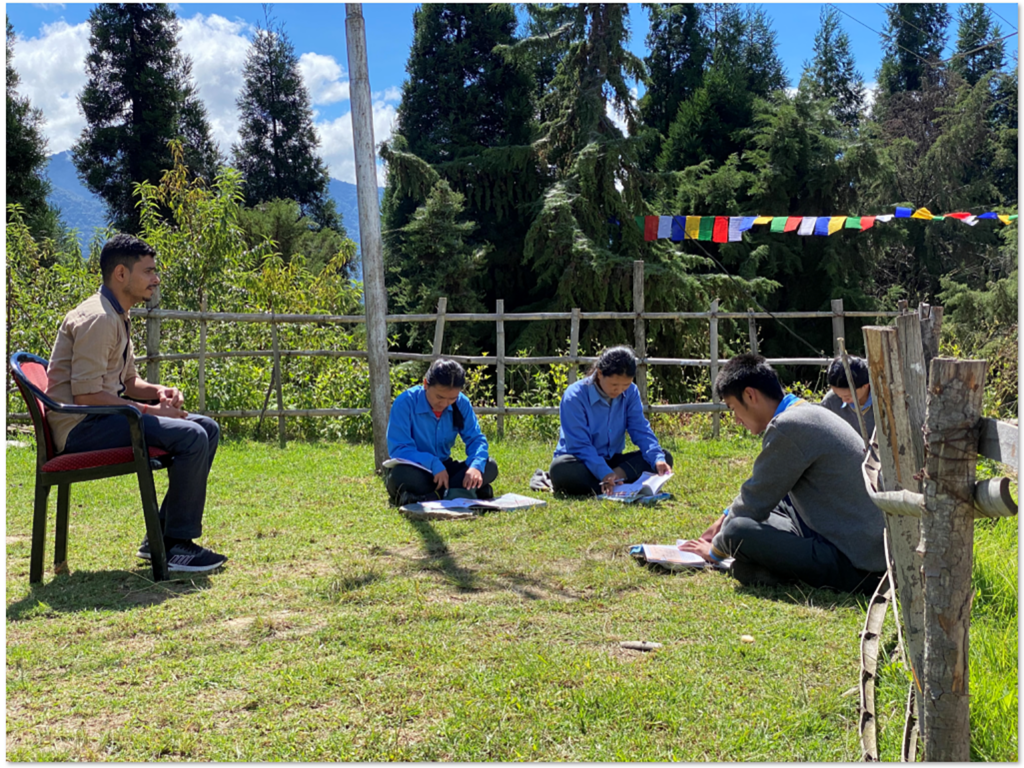
In specific projects, we have actively engaged with the Client and all its stakeholders. For example, is our school design in Tawang, we have engaged the whole community (emphasis on teachers, students and administration), in testing the classroom on a real scale mock-up and used that information and data to adjust the design to match their real world needs. This is following research in Tokyo, at the university where our lead is teaching. In that way, we cross reference design intentions with real world demand. Therefore, a precise plan, with obvious gains in efficiency is achieved.
2. Does your work create connected and resilient communities which positively contribute to neighbourhoods and allow equality of access?
Our current works include the design of a new academic block for a learning community – not only for children but for all. Within this community, deeply rooted and in mutual support of local villages, it has become a center for positive change in the local region. Our efforts are to help them manifest their core values, while supporting new initiatives that will be possible, once the new building is completed. It will also be a place welcoming to international guests, to learn from their practices.
3. Does the majority of your work promote equity in society, and consider all people, not only building inhabitants
The meaning of a building and its values are not limited to their immediate users. Architecture is but a part of Life, and it should be viewed as an integral part of its environment. Capable of enabling positive change in its surrounding and inhabitants.
A current project in Japan, “Town of Hope”, proposes – as many of our projects – a positive shift in society. Achieving it by inclusion – even of those deemed as outcasts – and openness to its environment.
Dialogue is created, prompting a fair and more connected society.