
Submission by Studio Moren.
Being a good ancestor
Practice
1. Does the practice have a clearly stated purpose aligned with the planetary emergency? We are looking for a bold ambition here, and a practice culture which recognises the need for long-term thinking. For example, a strong mission, a theory of change, or a sustainability roadmap.
Studio Moren acknowledges the climate crisis is now at a point where urgent action is necessary. We have made a commitment as signatories to the UK Architects Declare initiative and will focus on advancing a sustainable future through the work we do with buildings and the built environment. We will also undertake to run our practice in as sustainable way as possible, to reduce our environmental footprint by taking practical steps to cut down on waste, travel, consumed energy and consumed resources.
2. Does the practice have a clear succession plan, which passes on ownership and protects the values and legacy of those who built and contributed to the practice? For example is the practice an employee owned trust.
Yes, Studio Moren rebranded from Dexter Moren Associates on its 30th anniversary to reflect the success and expansion of the practice that Mr Moren founded. This has been publicised and a clear hierarchy of positions within the firm is in place to enable staff to target and plan career progression initiatives, and to also know that they can be recognised for their contributions to the practice and the built environment. Studio moren is an employee-owned company limited by shares.
3. Does the practice share research and knowledge for the benefit of society and the wider world? For example, you regularly carry out post occupancy evaluation and share information with others.
Studio Moren share their decades of knowledge with schools and industry in the form of guest lectures from staff, speeches and panel discussions at conference and trade events, as well as partnering with non-design industry groups to educate their members on sustainable architecture and interior design for refurbishment and new-build development projects.
Project
1. Does the practice advocate for long-term thinking at the outset of projects? Do you initiate projects with long-term thinking and challenge the client on design life? Also, can the practice demonstrate that this approach has worked – with a shorter or longer design life, or an innovative approach to financing or payback period?
We take every opportunity to discuss long-term sustainable approaches to every project we have the opportunity to work on, and as far upstream in the project stage as possible. We advocate for clients to commission pre-redevelopment and pre-demolition audits at the start of projects regardless if this is required for compliance or not. We have trained passive house designers, lifecycle carbon advisors and circular economy strategists on staff to support clients with taking long-term decisions whether they plan to own their buildings for short or long terms. We can demonstrate that this approach has worked as some of our projects that require WLCAs and Circular Economy statements either meet or improve on benchmark sustainability metrics regulated by planning policy.
2. Do your projects take account of the future climate and the need for resilience? For example, do the projects demonstrate flexibility, design for adaptation, design for disassembly, non-deterministic solutions, or demountable structures.
Yes, we champion design for disassembly or deconstruction wherever feasible and practicable, and forward-plan opportunities for adaptability and flexibility over the life of a building. This is evidenced in the success our projects have had with achieving various BREEAM ratings and circular economy reporting to local and regional planning authorities.
3. Do the majority of your projects go beyond mitigating negatives and towards optimising positives? For example, are they meeting or exceeding the RIBA 2030 Challenge.
Yes. For example, the majority of our projects improve on minimum operational carbon emissions reductions over GLA policy and achieve BREEAM ratings above the minimum required scores for a given rating.
Co-evolving with nature
Practice
1. Does the practice use biophilia within the office or regularly host meetings and retreats in natural settings? For example do you have extensive planting within the office or rely on natural patterns and imagery for stress relief or quiet areas.
Yes, we have many small and large plants in the office in staff and visitor areas, as well as a biophilia champions group within the practice. We also hold multiple outdoor staff events throughout the year taking advantage of our proximity to great parks in London.
2. Can the practice share examples where it has considered nature in decision making? For example by having a nature proxy to encourage eco-centric decision making, using natural systems as inspiration for the company structure, recognising the seasonal nature of people’s capacity and workload or celebrating equinoxes and solstices together.
We have not set out to impose a natural system of decision-making inspired by nature, but we have an uncomplicated hierarchy and champion the philosophy that great ideas can come from everyone. We offer flexible working, which is beneficial to staff wanting flexibility working from the office or home, or to be flexible with child-care requirements. We send practice-wide emails about the solstices and equinoxes to raise awareness of these natural phenomenons and to socialise over food and drinks in the office.
3. Is the practice supporting nature locally and nationally? For example, does the practice support local gardens, gardeners, planting programmes, rewilding programmes or advocate for changes in legislation to protect nature.
No.
Project
1. Can the practice demonstrate projects which strive to match the performance of a mature ecosystem? As a minimum this would mean achieving biodiversity net gain.
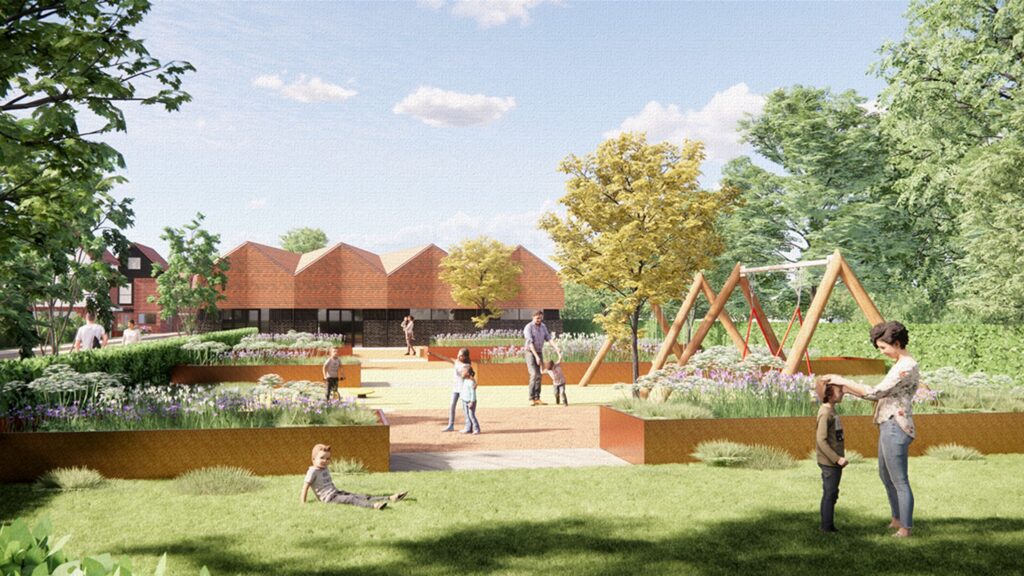
Yes. One great example of this is a housing project we designed and secured planning permission for in the Essex countryside consisting of 87 new homes. We worked in close collaboration with the landscape architect to both link with the mature forest surrounding the site and to create new areas of planting and woods using indigenous species and large water features. This has the effect of embedding residents within nature and welcoming insects and animal life to the site to improve biodiversity and the health of the ecosystem.
2. Is the practice working on material stewardship? For example, evidence could be shown through repeated use of low carbon materials, extensive material libraries and research or publications supporting responsible use of materials and elimination of waste.
We are working on material stewardship. We have developed our own material resource efficiency strategies and have tools to carry out carbon optioneering of early-stage design proposals at the pre-application stage.
3. Do the majority of projects demonstrate the use of biologically-inspired approaches such as Bioregionalism, Biophilia, Biomimicry, Ecomimicry (also referred to as Ecosystems Thinking, Industrial Ecology or Industrial Symbiosis) or BioTRIZ?
Yes. Our projects maximise ground and roof landscaping, as well as sustainable drainage, in close collaboration with landscape architects and civil engineers whom hone in on indigenous and local species to improve biodiversity and prevent flooding. The majority of our projects achieve at least the minimum biodiversity net gain and urban greening factors required by planning authorities. Our biophilia champions also seek opportunities to enter design competitions to showcase our research and latest thinking around these subjects to improve the built environment through these means.
Creating a just space for people
Practice
1. Does the practice have a progressive EDI policy and can you evidence many forms of diversity, which are welcomed and acknowledged, within the practice?
Studio Moren is proud of its commitment to equality and diversity. Our profession is enriched by the input of different opinions, cultures, lifestyles and circumstances. Hence, we aim to provide a working environment where this is encouraged and welcomed. Our Equity & Diversity Policy sets out our organisation’s position on equality of opportunity and the encouragement of diversity in all aspects of employment, including recruitment and promotion, and provides guidance and encouragement to employees at all levels to act fairly and prevent discrimination on the grounds of any protected characteristic – these being sex, sexual orientation, gender reassignment, pregnancy and maternity, race, religion or belief, age, marriage and civil partnership or disability.
We have a programme of enabling staff to highlight aspects of their cultures as multicultural events happen throughout the year. We also organise multiple potlucks throughut the year to encourage staff to showcase and indulge in the various cuisines represented by our staff.
2. Does the practice operate a no overtime culture, meet the living wage consistently, and stipulate a fair salary ratio between staff of all levels?
Overtime is a difficult thing to avoid in architecture – it is not always a 9 to 6 job. However, we discourage habitual overtime and do what we can to support our colleagues to carry out their tasks efficiently and in a manageable way. We have a company policy of providing dinner and travel home for staff that cannot avoid overtime, as well as compensating staff with time off in lieu for those that have worked an unusual amount of overtime in support of the success of the practice.
3. Does the practice support charities, community groups, social enterprises, action groups and others through pro-bono work, charitable giving or in-kind donations?
We have supported, and continue to support, multiple charities through a combination of fundraising and pro-bono projects. One example of the latter is an interior design project we designed and delivered for a medical facility treating active service members of the military. Their state-of-the-art facility had no area for patients and staff to retreat from the clinical environment. We transformed an underutilised orangery-style lean-to structure into a vibrant cafe and lounge that managers found difficult to clear out for photography once patients and staff moved in!
4. Does the practice publicly refuse to work with certain clients, suppliers or organisations on ethical grounds?
No.
Project
1. Do the projects demonstrate deep engagement with local stakeholders and end users? For example, is there evidence that your project engagement goes beyond consultation towards co-design?
We routinely engage with planners, in public consultations and design or quality review panels for our projects. The best evidence for this is that our pre-application design documents showcase how a design has evolved by taking into consideratoin guidance, addvice and feed back from these stakeholders.
2. Do your projects create connected and resilient places which positively contribute to their neighbourhoods and allow equality of access? For example, do your projects create economic opportunity, retain value locally and generate social value?
Yes. We champion universal access in every project where it is feasible, with improvements to heritage buildings being the typical case where universal access becomes challenging. We research and tap into the local character of our project sites and hone in on a neighbourhood story to give a sense of place to our projects that the community will recognise and appreciate. Our projects create many jobs, which are most often within the local community, and typically give a community a new place to eat, drink, work and play.
3. Do the majority of your projects promote equity in society, and consider all people, not only the building inhabitants? For example, do your projects show due regard for workers within the supply chain and take active steps to avoid modern slavery?
Yes. We champion universal access in every project where it is feasible, with improvements to heritage buildings being the typical case where universal access becomes challenging. We design worker areas and servicing in the most practical and efficient way possible ot encourage workers to adopt neighbourly, best practice. We have an anti slavery policy and do our best to carry out due diligence when procuring materials and services from suppliers.