
Submission by studio 8FOLD ltd.
Being a good ancestor
Practice
1. Do you have a clearly stated purpose aligned with the planetary emergency? We’re looking for a bold ambition here, and a culture which recognises the need for long-term thinking.
(https://www.studio8fold.com/2050)
By 2050 an additional 2.1 billion people will need water, food, shelter, sanitation, education, and more.
What does this world look like? How dense can we go? What about the rural lands that support our cities? How do we do this whilst going beyond protecting- and begin regenerating the planet?
Disruptive technologies are transforming the way we inhabit the world and lead our lives, and design must engage. We believe starting with infrastructure at a neighbourhood-scale can expand to a planetary shift, where we shift from living on a planet to living with our planet.
Design is the art of synthesis across all disciplines, and with the right strategy has the ability to tackle our challenges of tomorrow.
“A problem cannot be solved by the same level of thinking that created it” Einstein. Studio 8FOLD is driven to innovate, and create meaningful change through design and strategy.
2. Do you have a clearly stated purpose aligned with the planetary emergency? We’re looking for a bold ambition here, and a culture which recognises the need for long-term thinking.
No.
3. Do you share research and knowledge for the benefit of society and the wider world?
Founded by two South Africans, and both part of the founding cohort of the London School of Architecture, it is a core belief to ‘walk the earth’ and work between academia & practice.
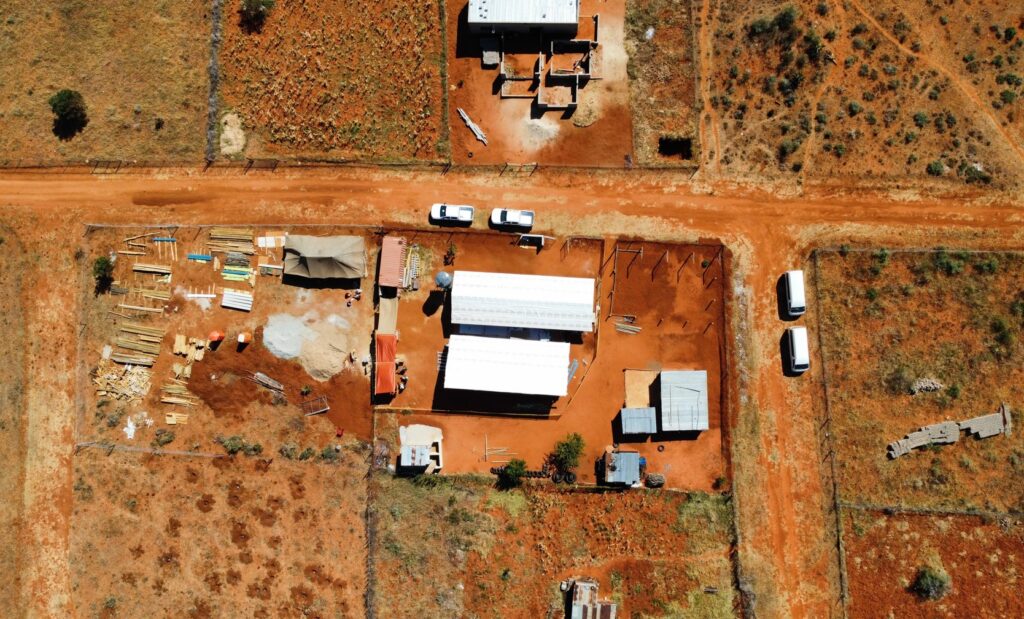
We have been teaching the design/build unit at University of Nottingham for over five years, and working together with the Thusanang Trust (local NGO) we have completed three Early Childhood Development centres in rural regions of Limpopo, South Africa. This project bridges between academia, construction, and the cross-pollination of cultures. Each year we visit the previous build to analyse what has worked and where lessons are to be learnt, sharing this knowledge with everyone involved.
The practice has also been involved in putting forward innovative ideas in tackling waste through invited exhibitions and competitions, from proposing a decentralised data-collecting waste system across London boroughs, to a competition for a centre designed to mine a landfill in German.
Project
1. Do you advocate for long-term thinking at the outset of work? Do you initiate work with long-term thinking and challenge clients? Also, can the organisation demonstrate that this approach has worked?
Part of the story behind 8FOLD is an approach to ‘make the problem bigger’, to zoom out, to think well beyond the realms of the now.
Each project kicks off with a workshop, bringing the client and their greatest aspirations and deepest fears into the process from the onset. The long-term plan and client’s understanding of what does ‘sustainability’ mean to them is always discussed, especially with a close consideration of the related budget.
For projects where the ambition is greater than the budget, we discuss the benefit of future proofing the design today, through passive systems (stacked ventilation, served/service systems thinking) or active systems (such as easy fitting of ASHPs, solar panels, etc.); for larger builds we consider designing the structure for ‘long life / loose fit’ for where change is inevitable, and we can reduce waste and consider the reuse of design elements in the future.
2. Does your work take account of the future climate and the need for resilience?
Each project will have its own unique constraints, and careful consideration needs to be given to which ‘resilient’ approach will be best suited.
We hosted an exhibition ‘WASTELINE’ as part of the Brompton Design Week’s brief of ‘Material Consequences’, where a garbologist we invited pointed out that a soda can made of aluminium is highly durable, lightweight container, unbelievably energy-intensive container that can take 200-500 years to degrade in a landfill, all for a 5 minute refreshment.
Most recently we have started to move materials between our project sites, supplying the discarded material from one site as the finishes in another – we have done this with floor boards, tiles, and even built in speakers.
At a larger scale, working as advisory board members to Education Africa Social Architecture, we are investigating and figuring out how to scale, low maintenance, regenerative early education centres (ECDs) in South Africa.
3. Does the majority of your work go beyond mitigating negatives and towards optimising positives?
Yes. We are not paper architects, we have several building sites on the go right now, and the reality and challenge of trying to minimise waste and maximise reuse is something we are actively working on, together with both our clients and contractors. Incredibly, most of the solutions in achieving this are win-wins, saving on cost, on new material and on landfill – working towards saving the planet.
Each and every one of our briefs will look at the operational energy, embodied carbon, potable water use, and health & wellbeing. The opportunities and emphasis on each of these varies of course, depending of course on the existing constraints.
The 8FOLD philosophy is going beyond the confines of the, challenging ourselves – what more we can achieve? How do we create something that achieves the client’s brief but also the current agenda at hand: regenerating the planet?
Co-evolving with nature
Practice
1. Do you use biophilia within your premises and/or do you regularly gather in natural settings?
We are strong advocates of biophilia. We have improved upon our average of 1.25 plants per sqm in our studio since last time!
In several projects in the past, such as an office refurbishment in Holborn for a sustainability consulting firm SYSTEMIQ, there was a considerable ‘plant budget’ set aside for the fitout. This was supported by a workshop we conducted with a cross section of firm, where ‘coffee, meeting rooms and plants’ were the three key priorities!
More recently we have encouraged clients to invite landscape designers and architects early into the design process, to create a habitat where architecture becomes the backdrop to nature, often leading to far more interesting results.
2. Can you share examples of where you have considered nature in decision making?
Studio 8FOLD’s recent work places ecology, regeneration and learning at the centre of design thinking. With Wildheart, The Common Space and local stakeholders, we helped develop a vision for rewilding the Isle of Wight, beginning with the island’s rich ecology, UNESCO Biosphere status and the principle that nature should be the primary design constraint.
We also recently secured outline planning for a rural Scottish masterplan centred around a small loch, cabins and sports and leisure facilities. The proposal was shaped by existing ecological assets and constraints, including habitat mapping for badgers, otters and red squirrels, with the ambition to expand and regenerate the site’s habitats.
Most recently, we were shortlisted for Hummingbird Learning Labs: a demountable learning, research and exploration space reflecting a neuroscience-grounded approach to education and community engagement.
3. Are you supporting nature locally and nationally?
On a local scale, our studio is based at LJ Works where the space between the two main buildings offers a mix of local fruit and vegetable growing. It was previously vacant council-owned land before being transformed into the Loughborough Farm in 2013, where residents could grow food, now still run locally as a community garden, where all members of LJ Works are invited to help with garden work. The structures house workshops, a co-working space, and food-and-drink-based social enterprises like Old Spike Roastery and Planted. The Platform Cafe across the road cook with the food grown on these premises, which is where the studio frequents – enjoying both local flavours and supporting this project.
On a larger scale, the project in Scotland previously mentioned, a team is consulting on a proposed woodland plan, looking to remediate and replant several hundred acres of vacant land.
Project
1. Can you demonstrate work that strives to match the performance of a mature ecosystem?
As previously mentioned, the project in progress in Scotland is focused on exactly this.
2. Are you working on material stewardship?
We discussed this recently in the studio, and would like to start recording the amount of material we are mitigating from going to landfill. Being in a position where we are on site with four different projects, there is an incredible opportunity to hone in on the narrative that “one person’s waste is another person’s product”. We have saved tiles, timber, lights, speakers and even have a rooflight set aside which was wrongly ordered which we are planning to design into another project soon to go to site.
3. Does the majority of your work demonstrate the use of biologically-inspired approaches such as Bioregionalism, Biophilia or Biomimicry?
No.
Creating a just space for people
Practice
1. Do you have a progressive EDI policy and can you evidence many forms of diversity, which are welcomed and acknowledged, within your company/organisation?
Yes, we believe we are progressive in our EDI, evidenced through our team, collaborators, and clients. Our first member of the team was an architect who was the primary carer for her children in the household, who wanted to continue work as an architect but required highly flexible working hours and wanted to be involved in meaningful projects.
Our studio is based at LJ Works, which is a community-driven institution, where tenants have to be involved in local ‘give-back’ focused projects, and be embedded in the Loughborough community.
2. Do you operate a no overtime culture, meet the living wage consistently, and stipulate a fair salary ratio between staff of all levels?
Absolutely. We offer balanced hours and accommodate staff diverse needs where possible in terms of flexibility of hours and days.
3. Do you support charities, community groups, social enterprises, action groups and others through pro-bono work, charitable giving or in-kind donations?
Through our commitment to the ECD Centres in Limpopo with the Thusanang Trust we raise funds for solar panels, water tanks, children’s books, planting, and sponsor our time on site in support of the build. Both directors were also recently appointed to the Education Africa board as advisors, working closely on delivering the ECDs in South Africa and helping raise funds and plan future builds.
Furthermore our involvement here at LJ Works as previously mentioned, encourages us to assist and get involved in several community based projects and events.
We also are a monthly contributor to Shelter, supporting those who are struggling with homelessness.
4. Do you use an ethical framework to assess opportunities and/or supply chain partners and is them team consulted on these decisions?
We believe in an equitable world. To do this we need to think beyond our own immediate spheres or work. In accordance with the RIBA Code of Professional Conduct, we look to comply with applicable legislation, notably the Modern Slavery Act 2015. Our in-house methods prioritise the welfare of all workers, including those in our supply chain.
We will raise awareness of Modern Slavery issues, and exercise skill and care to ensure our supply chains are free of Modern Slavery, treat our supply chains fairly, and report any abusive labour practices to the appropriate authorities immediately.
Additionally, we adhere to the CIOB report on UK construction and Modern Slavery, embracing recommendations to change the narrative, lead, train, act with fairness, map risks, investigate, declare, collaborate, evolve, and protect. We are looking to engage with the Supply Chain School to develop our processes, stamping out Slavery within our supply chain.
Project
1. Does your work demonstrate deep engagement with local stakeholders and end users?
We worked together with Architekturbuero Lindstedt on a project in Nettlestedt called ‘Dorf im Dorf’ (Village within a Village), proposing an intergenerational co-living project, deeply embedded in a small town community. We had community-wide workshops and presentations, along with smaller focus-groups, looking at exactly what ‘co-living’ and ‘intergenerational’ really meant to them, and understanding both long-term views, budgetary constraints, and greatest concerns. One outcome was a request for a training session on how to do co-living, explaining how the community garden and workshop should be used and engaged with.
Various iterations of the design were presented and shared with not only the client but the whole community, which was crucial in making sure it was accepted by the community, and suited future users.
2. Does your work create connected and resilient communities which positively contribute to neighbourhoods and allow equality of access?
ECD Centres in South Africa, Dorf im Dorf, Jorejick House, Smart Recycing Factory, Ukuaji, Kaira Looro Women’s House, are amongst many projects that focus primarily on exactly these outcomes. Social value is created by the long term thinking that accompany these projects, which are driven by a ground-up design process.
3. Does the majority of your work promote equity in society, and consider all people, not only building inhabitants
We believe in an equitable world. To do this we need to think beyond our own immediate spheres or work. In accordance with the RIBA Code of Professional Conduct, we look to comply with applicable legislation, notably the Modern Slavery Act 2015. Our in-house methods prioritise the welfare of all workers, including those in our supply chain.
We will raise awareness of Modern Slavery issues, and exercise skill and care to ensure our supply chains are free of Modern Slavery, treat our supply chains fairly, and report any abusive labour practices to the appropriate authorities immediately.
Additionally, we adhere to the CIOB report on UK construction and Modern Slavery, embracing recommendations to change the narrative, lead, train, act with fairness, map risks, investigate, declare, collaborate, evolve, and protect. We are looking to engage with the Supply Chain School to develop our processes, stamping out Slavery within our supply chain.