
Submission by Stride Treglown.
Being a good ancestor
Practice
1. Do you have a clearly stated purpose aligned with the planetary emergency? We’re looking for a bold ambition here, and a culture which recognises the need for long-term thinking.
As one of the 1st architecture practices to become a BCorp, and having recently recertified, climate action is an important part of our DNA.
We have been signed up to Science Based targets (SBTi) since 2021, and our Sustainability Ambassador group have developed the following mission:
‘To inspire hope. To collaborate with our project partners and local communities in using design, construction and development processes to make the world a better place. To imagine, find solutions and work urgently towards an ecologically regenerative future, where we are respecting our planetary boundaries and enabling nature, people and communities to flourish. To create healthy, uplifting and beautiful places that promote joy, wonder, distinctiveness, social equity and prosperity.’
2. Do you have a clearly stated purpose aligned with the planetary emergency? We’re looking for a bold ambition here, and a culture which recognises the need for long-term thinking.
We became one of the first UK architectural practices to embrace employee ownership in 2014.
Last year marked our official transition to an Employee Ownership Trust (EOT) model. The EOT model places all company shares in a trust held for every employee, both current and future.
The move to an EOT gives our employees a stronger voice in how we run the practice and ensures we remain independently owned with the freedom to make decisions driven by our values rather than external shareholder pressures.
In the words of our Chair, “This transition is a natural complement to our B Corp status and progresses our commitment to creating a practice where everyone has a genuine stake in our collective success. It formalises what we’ve always believed, that our people should share in the rewards they help create.”
3. Do you share research and knowledge for the benefit of society and the wider world?
In the spirit of Architects Declare commitment: ‘share knowledge and research on an open-source basis’, we have published 4 ‘Emergency’ design guides:
- Maximising biodiversity Through Design
- Health & Wellbeing Designed-In
- Transitioning to Net Zero Carbon
- Towards a Circular Built Environment
These guides stem from the awareness that amid the plethora of available information on sustainability, much of it is unwieldy and complex, and therefore often inaccessible or impractical for those immersed in the day-to-day planning, design, and management of projects. These freely downloadable guides condense this knowledge for the practical benefit of the industry.
We are currently working on a guide to specifying materials with regenerative potential which will be published imminently, a collaboration with the University of Bath’s Regenerative Design department.
We also have an online series called Inhabitant. This is an ongoing interview project, created to share feedback from those who live, work, and study in our completed projects.
Project
1. Do you advocate for long-term thinking at the outset of work? Do you initiate work with long-term thinking and challenge clients? Also, can the organisation demonstrate that this approach has worked?
In our ‘Towards a Circular Built Environment’ design guide one of the early questions we pose is: ‘Is the expected building lifespan LONG or SHORT?’ For short lifespans (under 25 years) we encourage designing for disassembly and reuse but for long lifespans we encourage designing for longevity or transformation, with following guidance for each. An example where we’ve achieved this is on our Neighbourhood North retrofit project in Bristol, where soffits and services are left exposed, maximising flexibility of future use and the ease of replacing fittings.
2. Does your work take account of the future climate and the need for resilience?
Our Oasis Academy School in Bristol, currently on site, will meet a huge need for a Secondary school in the central St Phillips Marsh district of the city. The challenge is that the only site available to accommodate a school in this area is susceptible to flooding (flood zone 3a), particularly in a changing climate. We overcame this with a resilient-focused design, accommodating 1800 pupils in a smaller building footprint, going up to 4 storeys. An accessible undercroft void and extensive site greening provide space for the adjacent feeder canal to flood. Elevated walkways provide safe dry access in a flood event and simultaneously offer up the waterside for improved public access.
3. Does the majority of your work go beyond mitigating negatives and towards optimising positives?
While we have signed up to RIBA 2030 Climate Challenge we have struggled to get clients to adopt this on projects, and this is still something we are working on.
However a net positive approach is something that we continue to advocate for on our projects. In our Transitioning to Net Zero bitesize guide we set out a ‘Regenerative thinking. In ‘Going beyond zero’ a 10 point approach, we explore moving from a ‘doing less bad’ philosophy to reversing harm through positive, restorative impact. We are about to launch our ‘Regenerative primer’ – a template for a workshop at RIBA stage 1, which aims to encourage project teams to explore the art of the possible.
We have spoken at numerous events about positive impact, which aligns with our BCorp status, and we are developing another bitesize guide called ‘Degenerative to Regenerative. How can we shift to net positive impact building materials.’
Co-evolving with nature
Practice
1. Do you use biophilia within your premises and/or do you regularly gather in natural settings?
Many of our offices have extensive planting. A lot of people coming to our Bath office remark that it feels like a jungle! In our Bristol HQ all of the plants have been given names and have been allocated guardians.
For our event with Avon Wildlife Trust ‘Imagining the future we want’ – a conference about the how to make nature-flourishing cities we have reached out to collaborate with Chew Valley Trees and we will be working together to create a miniature forest inside the venue for the event.
In several of our offices we have external garden spaces which provide opportunities for outside meetings.
We now also host Freshwalks – in collaboration with other businesses. These are networking events that get people out into nature.
2. Can you share examples of where you have considered nature in decision making?
We did explore the idea of representing ‘Nature on the Board’ recently, in the same way that the eco beauty company Faith in Nature have put this into place. However we felt, for now, that this sentiment is formally covered in by our BCorp commitments. We were the first large architect practice to certify as a B Corp in 2021and in 2022 we changed our Articles of Association so that the Board are legally required to run the business for the benefit of our members as a whole and to have a material positive impact on society and the environment, including nature.
Our members are exclusively our employees, as an Employee Ownership Trust now owns the business. And we aim to be as flexible as possible with people’s working patterns, with many of our staff choosing to work 4 days weeks, some just during the 6 months around summer.
3. Are you supporting nature locally and nationally?
In previous years we have ‘sounded the alarm’ about nature loss, using the State of Nature Report’s shocking conclusion that we are one of the most nature-depleted countries in the world, as a prompt to organise a mock funeral for nature procession through the streets of Bath. The event involved 1000-people and was strikingly choreographed to raise awareness of the biodiversity crisis. This year we have teamed up with Avon Wildlife Trust to explore what a nature-abundant future could look like, by organising a public event as part of the Bristol and Bath Festival of Nature called ‘Imagining the future we want – How do we create towns and cities where nature can truly flourish?’ As part of this we have radically re-imagined areas of the city, to prompt conversation and action.
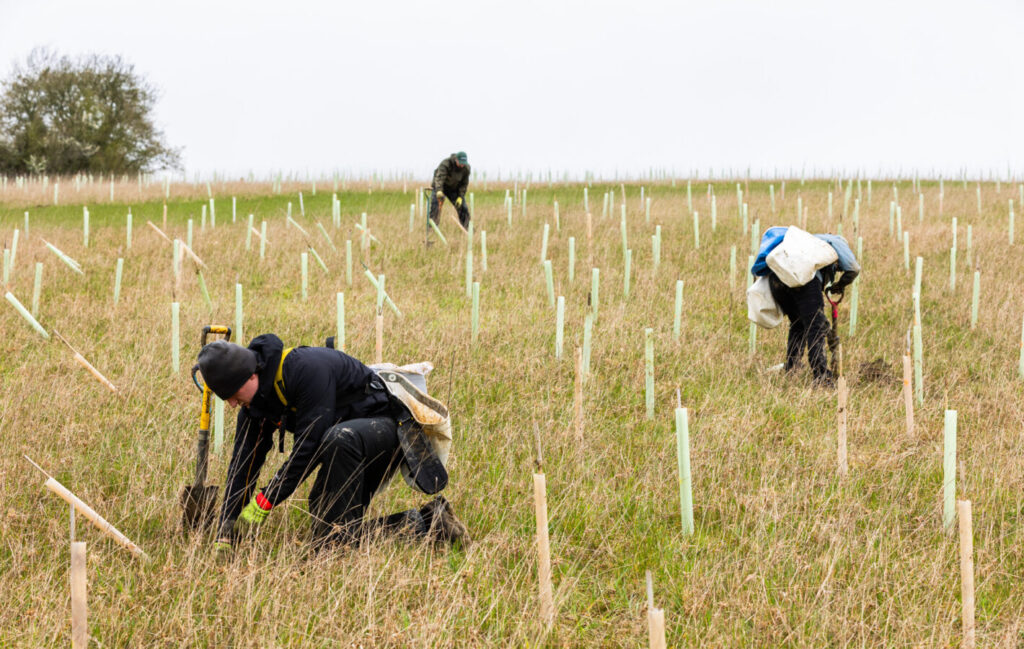
We continue to be involved in numerous planting initiatives across our offices, working with Community Interest Company 9Trees.
Project
1. Can you demonstrate work that strives to match the performance of a mature ecosystem?
In our Bath City Farm project we are designing a community hub building as a mini ecosystem. Inspired by feedback and ideas from local schoolchildren, the curvy-walled structure aims to be fun and welcoming. We are working with the Bath city farm’s ecology team to maximise the regenerative and biodiversity opportunities – it will be a strawbale and timber construction, with straw sourced from local farms and co-built by the community; the roof and main façade will be substantially planted using plants grown on site; the remaining facades will be permeable ‘habitat-walls’, entirely designed to provide habitat potential for insects and birds; roof water will be harvested for irrigation and inside the building there will a mini garden. Approached from higher ground the building will integrate completely into the landscape. The building will serve as a community and education space, hopefully inspiring younger generations to care for the planet.
2. Are you working on material stewardship?
Our bitesize guide called ‘Degenerative to Regenerative. How can we shift to net positive impact building materials’, in collaboration with the University of Bath’s Centre for Regenerative design and Engineering for a NEt positive World (RENEW) will be published soon. Like last year, our most notable projects which demonstrate excellence in material stewardship are Gwynfaen near Swansea, which is an ultra-low carbon housing development and LETI pioneer project that is partially complete on site now. The project prioritises materials that are low in embodied carbon and locally sourced. Our Welsh Tai ar y Cyd Pattern Book promoting timber frame construction with locally-grown, sustainably sourced timber and bio-based insulation and airtight detailing to reduce embodied and operational carbon, is entering its next phase. It has generated considerable interest, even as far as Australia!
3. Does the majority of your work demonstrate the use of biologically-inspired approaches such as Bioregionalism, Biophilia or Biomimicry?
We wouldn’t claim that these approaches are embedded in all our projects, yet. But they’re themes that are beginning to get traction. We have spoken at both of the UK Biophilic Design Conferences in the last two year, a Biophilic talks series in Bath, and next month at the inaugural Regenerative Futures conference at the University of Bath. We are currently working on a biophilic-influenced housing project in Anglesey, with earth-sheltered homes clustered around shared garden spaces. Return visits to our Met office HQ have seen how the building and landscape are harmonising, with 500 different species of plant, animal, insect and fungi recorded on the site. Our Glyn Coch school, completing this year, also has holistic thinking, with outdoor learning spaces, natural materials, green roofs and rain gardens and will be NZC in operation, passivhaus, Building with Nature standard and the 1st school in Europe to be WELL certified.
Creating a just space for people
Practice
1. Do you have a progressive EDI policy and can you evidence many forms of diversity, which are welcomed and acknowledged, within your company/organisation?
Our approach to EDI is embedded in our identity as a B Corp and an Employee Owned Trust. We define “progressive” as an environment where active belonging is a commercial and cultural importance to us, because we are collectively owned, our long-term success depends on a diversity of thought. We maintain robust data across all protected characteristics and where we can maintain anonymity we utilise intersectional metrics to ensure our recruitment and retention strategies remain equitable. We conduct our Inclusion Survey every two years. The survey acts as a feedback loop, confirming that our colleagues feel their unique contributions are not only welcomed but essential to our design ethos.
2. Do you operate a no overtime culture, meet the living wage consistently, and stipulate a fair salary ratio between staff of all levels?
As an Employee Owned Trust, we recognise that our success relies on a healthy, balanced culture. We view “overtime” as the exception rather than the rule; while project deadlines occasionally require flexibility, we utilise a proactive Flexitime and TOIL framework to ensure this is recovered immediately. We monitor capacity via timesheets to prevent burnout and ensure staff wellbeing remains protected.
We are proud to be an accredited Living Wage Employer, extending this commitment to all contractors. Regarding pay equity, we formally monitor and publish our highest to lowest paid ratio (currently 4.7x), ensuring it remains within a fair. This data is published annually alongside our Gender Pay Gap report to ensure institutional accountability to our fellow employee-owners.
3. Do you support charities, community groups, social enterprises, action groups and others through pro-bono work, charitable giving or in-kind donations?
We have three annual socially responsible business targets:
1) £50,000 pro bono budget
2) Deliver 1% revenue towards positive impact
3) 2-day volunteering allocation for each employee.
In 2024, we provided:
£18,878 of pro bono expertise
£2,492 charitable donations and 1.13% revenue delivered positive impact.
Pro bono projects include: Mousehole Wild Bird Hospital, YMCA Plymouth and Bath City Farm.
We present our activities each year in a Positive Impact report on our website each year.
Each regional studio has a Social Value Delivery Plan (3 themes) supporting charities / community groups.
We have charitable, pro bono and voluntary budgets apportioned to support and empower each studio’s Social Value Delivery Plan. This budget will increase and be reviewed in 2030.
Employees participate in our carbon offset tree planting in locations close to our regional studios.
Our Quartet Foundation provides local charities with grants. The Foundation has provided £27,205.00 since 2005.
4. Do you use an ethical framework to assess opportunities and/or supply chain partners and is them team consulted on these decisions?
Whilst we believe in tolerance and viewpoint diversity, we also need to be consistent and evidenced in our decisions of what projects we work on – to avoid charges of double standards or hypocrisy, and to protect our reputation.
Therefore, we treat every potential project on a case-by-case basis, reviewing evidence to inform our decisions. We are currently updating our Ethics Policy, Go/NoGo process and other guidance, which uses the current B Corp guidance for companies with clients in controversial industries as a non-binding guidance framework.
When this is completed, we will update our public disclosure as part of our B Corp listing and update our website.
Project
1. Does your work demonstrate deep engagement with local stakeholders and end users?
The Social Impact Research team supports the practice in co-creating places which celebrate local life through evidence led design to enable meaningful social impact. This team focuses on early project people centred research, co-design, meanwhile-use, community engagement and POE.
The Inhabitant POE initiative reconnects with occupants of our projects and through interviews share their lived experiences and stories – an honest reflection of the impact our designs have on those who occupy them.
The Impact Analysis initiative consists of 3 project engagement tiers. This is a bespoke learning tool based in research methodology that combines engagement, research, analysis and feedback. It goes beyond standard design processes by placing deep community listening, local context, and well-being at the heart of an architectural project.
Our annual Impact Report focusses on the human stories associated with our projects and practice. This covers community pro bono projects such as Circular Kitchen, Gympanzees etc.
2. Does your work create connected and resilient communities which positively contribute to neighbourhoods and allow equality of access?
We aim to deliver evidence-based designs that go beyond the red line and secure positive outcomes for local social context.
Pixel, Penzance – Tackling changing retail habits, providing 34 enterprises with versatile collaborative working spaces. This hub brings new life to the heart of the town.
YMCA – £20,983 pro bono services provided to a community facility with roofing leaks, therefore enabling the community to access the £393,080 funded sports facility.
Caerphilly – Ccatalyst for business growth, local people to reconnect and attract tourism into the town. The project aimed to provide £20,698 of impact. At completion delivered more than £57,000.
Glyncoch – Engagement evidenced a community need for service provision, community relationships, safety and security. The co-location of services within the school strengthened social relations and created economic opportunities.
Gwynfaen – Prioritising local growth – we collaborated with local timber suppliers, procured materials within 100 miles and a contractor located within 13 miles.
3. Does the majority of your work promote equity in society, and consider all people, not only building inhabitants
Our social value strategy prioritises Better Places, Empowered People and Resilient Partnerships.
Our practice is rooted in 9 regions across the UK and the relationships we hold with those we work with have stretched over decades and our locally resident employees best understand the community context influencing our project work.
The Procurement Principles guidance shapes how we work with our supply chain to generate shared positive impact. The guidance clarifies any business we purchase from, partner with, subcontract with or interact with sets clear expectations about our ESG aspirations. We aim to pay our supply chain within 30 day period.
Our go / no go evaluation process reviews potential project opportunities & evaluates whether the scope aligns with our strategy and values. This considers the purpose and profitable balance a project brings and its potential considerations to the wider society and environment.