
Submission by Ridge and Partners.
Being a good ancestor
Practice
1. Do you have a clearly stated purpose aligned with the planetary emergency? We’re looking for a bold ambition here, and a culture which recognises the need for long-term thinking.
Ridge demonstrates a strong and evolving commitment to sustainability that aligns with the planetary emergency and reflects the need for long-term, systemic change. Our ambition to Redefine Excellence in the Built Environment is grounded in ESG-led delivery, Net Zero carbon strategies and commitment to creating places that are resilient, low-carbon and socially valuable. Sustainability is embedded across our culture – from whole-life project delivery and technical advisory to internal operations and community engagement.
There is clear evidence of a long-term, forward-thinking culture at Ridge. Projects are approached through whole-life thinking, considering operational performance, embodied carbon and long-term value. We emphasise resilience, adaptability and futureproofing, and recognise that sustainability is a continuous process of learning and improvement. Our growing engagement with regenerative development thinking – acknowledging that Net Zero alone is not sufficient and that developments should create wider environmental and social value – signals an important cultural shift towards deeper, more systemic change.
2. Do you have a clearly stated purpose aligned with the planetary emergency? We’re looking for a bold ambition here, and a culture which recognises the need for long-term thinking.
Ridge’s succession model is rooted in its partner-led structure, ensuring continuity of ownership and the protection of our values and legacy. 2026 marks our 80th year as an established practice. Ridge has grown from an infant firm in Oxford under the leadership of Harold Ridge, to a 1,500-strong multidisciplinary consultancy, while retaining the principles of personal service and accountability that shaped our earlier years.
Our business model is built around small, empowered teams supported by wider disciplines, enabling expertise to be developed and passed on. Clear career pathways from apprenticeship and graduate entry through professional qualification, management and ultimately partnership ensure that leadership is grown from within. This is exemplified by our current Senior Partner, who progressed through the organisation over several decades.
These structures create a sustainable pipeline of future leaders, safeguard our culture, and ensure that Ridge’s values, expertise and client‑focused ethos are preserved for generations to come.
3. Do you share research and knowledge for the benefit of society and the wider world?
Ridge is a partner on the UKGBC’s Regenerative Places Programme, redefining retrofit as a catalyst for wider place-based benefits, from decarbonising heat and enhancing green spaces to improving climate resilience and community wellbeing. This reflects our commitment to driving industry change through collaboration, knowledge-sharing and shaping best practice to support regenerative approaches.
Ridge also supported the UKGBC Retrofitting Retail and Logistics Buildings report through sponsorship and technical input, helping develop practical guidance to optimise and decarbonise non-domestic buildings, including key measures and decision-making considerations.
Through CPDs, professional talks and technical papers on structural materials and global emissions (IStructE), we share emerging knowledge with industry peers to maximise impact across the built environment.
Ridge is also a founding member of I2SL UK, advancing sustainability in laboratories and high-tech facilities. By joining at inception, we are helping lead cross-sector collaboration to address the energy and operational challenges of these complex building types.
Project
1. Do you advocate for long-term thinking at the outset of work? Do you initiate work with long-term thinking and challenge clients? Also, can the organisation demonstrate that this approach has worked?
Ridge consistently embeds long-term thinking at project inception, challenging clients to move beyond short-term cost towards whole-life value.
We have recently completed a Decarbonisation roadmap for the National Audit Office (NAO), where we led a structured optioneering process, testing retrofit pathways against energy, carbon, cost and resilience criteria. Rather than defaulting to low-cost, light-touch upgrades alone, we demonstrated that fabric-first, deep retrofit could halve energy demand from 196 to 86 kWh/m²/yr while significantly reducing long-term costs and improving climate resilience. This has resulted in NAO planning to implement our recommendations.
At portfolio scale, we have also shaped the national retail strategy for Barclays, embedding whole-life carbon assessment, operational energy analysis and future climate adaptation at the outset of every project, enabling consistent, future-proof decision-making.
This approach reframes success from lowest capital cost to long-term performance, delivering measurable outcomes, influencing client strategy, and embedding regenerative thinking across entire estates.
2. Does your work take account of the future climate and the need for resilience?
Our projects are designed to respond to future climate conditions and deliver long-term resilience. We routinely undertake thermal comfort modelling using future climate projections to address overheating risk, including on projects such as Francis Barber School and Camberwell Hotel.
Beyond overheating, we take a holistic approach. We design for future energy systems through electrification, reduced demand and on-site generation, improving resilience to energy price volatility. For example, at Bay House School we minimised operational energy demand before maximising roof-mounted PV to match annual energy use.
We also prioritise durable, low-maintenance materials to reduce lifecycle impacts, alongside passive design strategies such as solar control, fabric optimisation and natural ventilation to ensure buildings perform under future climates. At the Royal Observatory 1894 Building, this approach informs a Net Zero carbon refurbishment, combining lifecycle carbon analysis, an optimised fabric strategy and predominantly natural ventilation to future-proof this Category A listed building.
3. Does the majority of your work go beyond mitigating negatives and towards optimising positives?
Social value is embedded in the majority of our public sector projects and in an increasing number of private sector developments. Guided by four strategic social value pillars, Ridge shapes programmes informed by a Theory of Change model which seek to bring immediate positive environmental and socio-economic impact and leave a transformational legacy over the longer term. Ridge in-house social value and sustainability experts are frequently embedded in our project teams and work in partnership with our clients and their communities to realise outcomes far beyond the mere mitigation of negative impacts and which strive for net positive results for the people and places where we work. In 2025, our activity delivered tangible results equating to more than £45m of audited additional social, economic and environmental value across the UK.
Co-evolving with nature
Practice
1. Do you use biophilia within your premises and/or do you regularly gather in natural settings?
Ridge prioritises well-being centred workplaces, with biophilia playing a central role. Our ambition to promote nature throughout the workday stems from research undertaken while supporting our multinational clients in developing workplace design standards. This work strengthened our understanding of the benefits of high-quality biophilic design, from improved mental health and reduced anxiety to enhanced indoor air quality and humidity control.
Our Head Office, the Cowyards, is surrounded by the natural setting of the Blenheim Estate Heritage site. All staff members are permitted free access during the workday to the Great Lake and surrounding parkland. Every desk is no less than 2m from windows that overlook a natural landscape, ensuring all staff benefit from consistent daylight and views of greenery.
We integrate real plants into every one of our urban offices. These intentionally positioned installations create moments of privacy, restorative spaces for our people, and a meaningful connection to nature.
2. Can you share examples of where you have considered nature in decision making?
Ridge embraces an eco-centric approach from the inside out – shaping our facilities, internal strategies and our people. By embedding nature-focused principles at the core of the organisation, we ensure our ethos is reflected in every project / decision.
Our Head Office, The Cowyards (a Grade II listed building located on the Blenheim Estate World Heritage site in Oxfordshire) reflects our commitment to a regenerative, nature-led built environment. Acting as both occupier and consultant, we delivered the full range of multidisciplinary and sustainability services needed to sensitively convert and refurbish the historic Victorian dairy yard into our workspace. Balancing heritage conservation with modern sustainability measures, the project stands as a testament to our dedication to circular, environmentally responsible design.
Our pioneering work on the new Oxford United FC all-electric stadium has also seen the implementation of nature-focused strategies such as nature corridors and bee posts built into the plans for the grounds.
3. Are you supporting nature locally and nationally?
e are deeply invested in supporting nature on a local and national scale. Environmental Stewardship is one of our four social value pillars, and we embed environmental outcomes into social value programmes for clients and their communities nationwide.
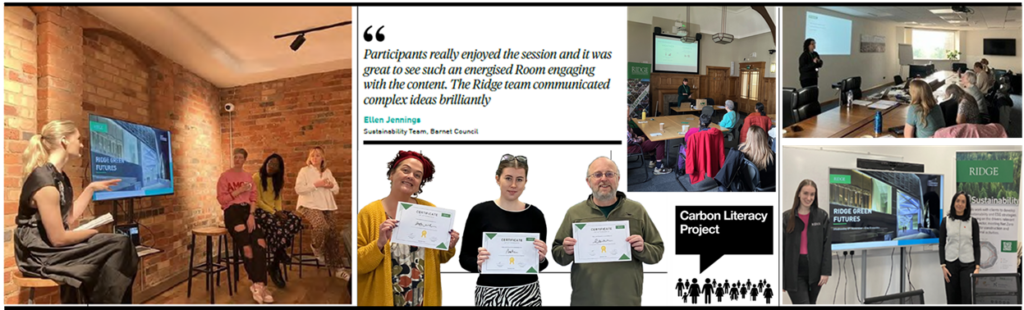
Ridge Green Futures, our Carbon Literacy Project-accredited workshop, is a consistent feature of our programmes. It educates communities, VCSEs and small businesses about climate change, Net Zero and sustainability, and facilitates local action plans. We’ve delivered it for members of Greater Manchester Youth Network, Barnet and Wokingham Councils residents, female business leaders in Birmingham and customers of the Sanctuary Network Group.
Each office supports a local charity through fundraising; our Cheltenham office’s chosen partner is the Gloucestershire Wildlife Trust. Our network of Ridge Environmental Champions promote staff volunteering and local environmental initiatives which are directed toward local projects designed to enhance nature, shared green spaces and biodiversity.
Project
1. Can you demonstrate work that strives to match the performance of a mature ecosystem?
Our approach to masterplanning projects begins with placing a deep understanding of the ecosystems that exist on the sites. Through multidisciplinary investigation, we analyse how the landscape, infrastructure and the built environment interact with the natural ecosystems. This is demonstrated in our masterplan for Bicester Motion and the creation of a Design Guide for a client adjacent to Ribble Estuary National Reserve.
At Bicester Motion, we identified the distinct attributes of each area of the site. Through careful analysis of the natural environment, climate, and micro-ecosystems we shaped a masterplan that enhanced each of these. This included the creation of Wilderness Quarters to protect the established landscape and enhance the existing lakes.
The Design Guide was created to protect the National Reserve adjacent to an industrial site, including design measures to allow native birds to nest safely, increased planting to support wildlife and sensitive lighting design to protect natural habitats.
2. Are you working on material stewardship?
As a company delivering Life Cycle Assessment (LCA), we analyse the environmental impacts of materials at every stage — from raw extraction and manufacturing through to use and end of life. This enables data driven decisions on material selection, durability, recyclability, and waste reduction, identifying opportunities to lower carbon emissions and embed circular economy principles more effectively. In this way, LCA strengthens material stewardship by providing the evidence base needed to optimise sustainability performance across the entire value chain, and this approach is applied consistently across all our projects worldwide.
We prioritise durable, recyclable and reusable materials, promote off‑site manufacturing to minimise waste, and collaborate with companies such as Material Index to advance high‑value material reuse — contributing to industry discussions, including a UKREiiF 2026 panel on circularity and supply‑chain value.
Through BREEAM assessments, we support responsible sourcing by ensuring Sustainable Procurement Plans are produced, embedded into specifications, and verified through certification.
3. Does the majority of your work demonstrate the use of biologically-inspired approaches such as Bioregionalism, Biophilia or Biomimicry?
Biologically inspired approaches are increasingly reflected across our projects, though the application varies depending on client and brief. Biophilic design is our most widely adopted method, focusing on enhancing wellbeing through natural light, ventilation, and strong connections to nature.
We also integrate bioregional principles, ensuring our developments respond to local environmental, cultural, and climatic contexts. When selecting or analysing sites, we focus on understanding the existing natural landscape by identifying climate conditions, habitats and watercourses, so layouts and designs enhance or interact with the landscape rather than manipulate it to suit the project,
Biomimicry is applied more selectively, typically in projects that have ambitious sustainability or innovation drivers. While not every project explicitly deploys all three approaches, the majority incorporate elements of nature-informed design in a balanced, context-led way ensuring practical, deliverable solutions aligned to client objectives and environmental performance goals.
Creating a just space for people
Practice
1. Do you have a progressive EDI policy and can you evidence many forms of diversity, which are welcomed and acknowledged, within your company/organisation?
Ridge has a clear and progressive Equality, Diversity and Inclusion (EDI) policy, but our focus is on how inclusion is lived every day. We actively welcome and recognise diversity across gender, age, ethnicity, disability, neurodiversity, sexual orientation and caring responsibilities. This commitment is embedded through our Inclusion Networks – covering Multicultural, Pride, Gender Equity, Families & Carers, Military Community, and Disability & Neurodiversity – alongside company-wide awareness events and visible leadership sponsorship.
We champion flexible and inclusive working, family-friendly and wellbeing benefits, and targeted development programmes that ensure equitable access to opportunity. Colleagues are encouraged to bring their whole selves to work, and regular feedback through Great Place to Work surveys shapes our priorities. We treat EDI as an ongoing journey rooted in fairness, belonging and continuous working.
Our commitment is externally recognised through BITC membership, the Mental Health at Work Commitment, and independent evaluation by Unum for our inclusive wellbeing provision.
2. Do you operate a no overtime culture, meet the living wage consistently, and stipulate a fair salary ratio between staff of all levels?
Ridge promotes a healthy, sustainable working culture through flexible and hybrid working, regular 1:1 workload conversations, wellbeing check-ins and proactive stress-prevention measures. While we do not operate a formal “no overtime” policy, overtime is neither expected nor embedded in our culture, and managers are trained to address workload pressures early.
Ridge consistently meets the Living Wage for the vast majority of employees, with 97% paid at or above this level. Those below are primarily apprentices and trainees progressing through structured early career development pathways.
Although we do not stipulate a fixed salary ratio between levels, Ridge operates transparent grading structures, equitable reward frameworks and publishes gender pay gap reports, ensuring fairness, accountability and consistency across all levels of the organisation.
3. Do you support charities, community groups, social enterprises, action groups and others through pro-bono work, charitable giving or in-kind donations?
Ridge provides structured and sustained support to charities, community groups and social enterprises through a combination of pro bono services, charitable giving and in-kind support. Our Community Investment and Climate Excellence Funds provide grants to community-led projects, charitable causes and targeted initiatives supporting climate and social resilience. In 2025, these funds distributed over £70,000. Ridge staff contribute directly through paid volunteering, (3,400 hrs in 2025) with each receiving three days annually to support charitable and grassroots initiatives personal to them or connected to our projects. Ridge also delivers pro bono professional advice, with discipline specialists offering expertise to community groups and social enterprises on areas such as budgeting, project delivery and operational management. Our offices further strengthen local impact with annual charity partnerships, equipment donations and fundraising support to causes addressing poverty, health, education and environmental challenges. Together, these approaches ensure meaningful, measurable community benefit aligned to local needs.
4. Do you use an ethical framework to assess opportunities and/or supply chain partners and is them team consulted on these decisions?
Ridge applies a clear ethical framework to assess opportunities and supply chain partners, embedded within our Sustainable Procurement Policy and Supplier Code of Conduct. All suppliers are required to operate in line with defined standards covering legal compliance, ethical conduct, human rights, health and safety, environmental stewardship and community engagement, with adherence forming a condition of doing business with Ridge. Supplier selection and management are underpinned by proportionate, risk-based due diligence, including pre-qualification checks, ethical and modern slavery assessments, and ongoing monitoring. Our Responsible Business Framework, informed by strategic partnerships with organisations such as BITC, further reinforces this approach by embedding ESG principles across procurement processes and requiring partners to align with Ridge’s core values and ethical expectations.
These controls ensure that opportunities and partners are assessed not only on technical and commercial capability, but on their ability to meet robust ethical, social and environmental standards across the value chain.
Project
1. Does your work demonstrate deep engagement with local stakeholders and end users?
We often define the success of a project by its ability to meet the current and future needs of end-users and stakeholders. We foster conversation around innovative ways of functioning within new spaces. All design disciplines at Ridge – Architecture, M&E, Structural Engineering – adopt an interdisciplinary approach and are actively involved in stakeholder engagement, treating all voices with equity.
We identify the right stakeholders and end-users and guide them through a structured design journey, using in-person, on-site workshops to understand real needs. This approach builds long-term relationships; at RAF Lossiemouth, the strength of engagement during design means we are still invited to their annual squadron dinner five years post-completion. This continued connection helps us understand how the building performs in use and informs future projects. In similarly secure defence projects, this depth of insight enables us to design facilities that meet operational requirements and support the wellbeing of all users.
2. Does your work create connected and resilient communities which positively contribute to neighbourhoods and allow equality of access?
Ridge works across a wide range of sectors that interact in diverse ways within neighbourhoods and the wider community. Each project we undertake is unique in its situation, location, and ability to positively contribute to the community.
Our design for a SEND school located within a residential area created a community within a community. During operational hours, the school centres around the idea of ‘streets’, providing familiar, safe spaces for users. Community spaces and a public facing café promote the facility as an accessible centre of the neighbourhood.
In contrast, Ridge have many projects located within the advanced manufacturing and defence sectors. Although these projects are often perceived as disconnected from local communities, we work with clients to develop design standards and masterplans that prioritise community and neighbourhood integration. This includes promoting green, accessible spaces, designing minimally intrusive boundaries, and collaborating with landscape architects to enhance biodiversity.
3. Does the majority of your work promote equity in society, and consider all people, not only building inhabitants
Ridge projects are purposefully designed to promote equity and consider the needs of all people impacted by our developments. Social value is embedded within our service delivery model, ensuring that every project contributes to social, economic and environmental benefits for building inhabitants, proximate communities, local businesses, charities and community-led organisations.
Our approach is guided by UK Institute for Social Value principles, placing local stakeholders at the heart of decision-making. Through the early and ongoing engagement of our specialist consultants, we work with local residents, community groups and regional partners to understand local priorities and co-design outcomes that meet diverse needs.
Ridge applies a Theory of Change model across four strategic themes, including ‘Equitable Economy’ and ‘Resilient Communities’. Initiatives under these themes focus on reducing economic and health inequalities, improving access to opportunity and strengthening community capacity – ensuring our developments deliver inclusive, transformational legacy for local people and society at large.