
Submission by RIOS Design Studio Ltd.
Being a good ancestor
Practice
1. Do you have a clearly stated purpose aligned with the planetary emergency? We’re looking for a bold ambition here, and a culture which recognises the need for long-term thinking.
RIOS recognises climate change and ecological degradation as defining challenges of our time, embedding sustainability as a core principle from the outset of every project. Through its climate-positive and regenerative design framework, Sustainability Action Plan, and Climate Action Committee (CAC), the practice advances resilience, environmental responsibility, and regenerative outcomes across its portfolio.
Its design ethos is shaped by three interconnected principles: New Function, embracing adaptability and evolving ways of living; New Vernacular, expressing the relationship between materials, culture, and place through contextual design; and New Nature, integrating climate, ecology, and landscape into the form and performance of architecture.
RIOS promotes a transdisciplinary approach in which environmental performance, human wellbeing, and long-term resilience are embedded directly into the design process. The CAC supports continuous learning, research, training, and innovation, fostering a shared culture of sustainability and ensuring these values guide future generations of designers and leaders.
2. Do you have a clearly stated purpose aligned with the planetary emergency? We’re looking for a bold ambition here, and a culture which recognises the need for long-term thinking.
RIOS is a multigenerational practice with a strong commitment to protecting and evolving the values, culture, and legacy established by its founders and contributors. After more than 40 years, the practice is thoughtfully transitioning leadership to the next generation of designers, ensuring continuity while allowing the organisation to evolve, innovate, and modernise.
The firm maintains a clear long-term succession approach built around collaboration, inclusion, mentorship, and the development of future leaders. By fostering a multigenerational team structure, RIOS encourages the sharing of knowledge, experience, and design culture across all levels of the organisation.
Through ethical, inclusive, and participatory leadership, RIOS remains committed to preserving its legacy while adapting to future challenges, opportunities, and the evolving needs of both the profession and the communities it serves.
3. Do you share research and knowledge for the benefit of society and the wider world?
RIOS actively shares research, approaches, and lessons learned through publications, speaking engagements, project case studies, and interdisciplinary collaboration. Internally, our Climate Action Committee (CAC) facilitates continuous education, training, and knowledge exchange across studios and disciplines, helping embed sustainability thinking throughout the practice. Each year, we also welcome students from a range of universities and support them through dedicated research projects.
Our research occurs both within and beyond project boundaries and often flourishes through collaboration with experts outside the practice. At RIOS, we aim to continuously inform and evolve our work through knowledge, transparency, and shared learning, feeding insights back into the landscapes, interiors, architecture, and cities we help shape.
Externally, we contribute to broader industry conversations around resilience, wellbeing, circularity, and regenerative design through publications and speaking engagements. We also share project performance data through the AIA 2030 Design Data Exchange (DDx), supporting transparency, accountability, and collective industry progress.
Project
1. Do you advocate for long-term thinking at the outset of work? Do you initiate work with long-term thinking and challenge clients? Also, can the organisation demonstrate that this approach has worked?
We strive to integrate long-term thinking from the earliest stages of every project through our climate-positive and regenerative design framework and Climate Action Plan. Where applicable, we collaborate with stakeholders to establish project-specific performance targets around resilience, carbon reduction, adaptability, wellbeing, water, ecology, and operational efficiency from the outset, ensuring sustainability becomes a “golden thread” throughout delivery and beyond. We actively encourage design teams to consider whole-life value, future climate scenarios, flexibility, and long-term operational impacts rather than focusing solely on upfront costs.
This approach has informed projects such as the 1901 Project in Chicago: a transformative mixed-use masterplan focused on neighborhood regeneration, ecological restoration, and long-term resilience. Through interconnected green networks, biodiversity strategies, and climate-responsive public spaces, the project demonstrates how integrated master planning and ecological thinking can support a more resilient, inclusive, and people-focused urban future.
2. Does your work take account of the future climate and the need for resilience?
Design for Change and Resiliency is one of the core pillars of RIOS’s regenerative and climate-positive design framework, and we strive to embed it throughout our design approach. We see resilience not simply as mitigation, but as the creation of places capable of adapting, evolving, and thriving over time.
Where applicable, we assess our projects against both current and future climate conditions through environmental performance modelling, climate analysis, and long-term adaptation strategies that address challenges such as extreme heat, flooding, drought, sea level rise, wildfire risk, and resource scarcity.
We integrate passive design, green infrastructure, stormwater management, biodiversity enhancement, renewable energy systems, and climate-responsive, performative landscapes to improve long-term performance, adaptability, and environmental resilience. Through a combination of internally developed tools, data-driven analysis, and advanced environmental software, we strive to shape places that support durability, flexibility, and resilience under evolving climate conditions.
3. Does the majority of your work go beyond mitigating negatives and towards optimising positives?
Our design approach is grounded in the belief that every project is shaped by its distinct ecology, cultural and contextual history, and the community it serves. Nearly one-third of our designers are landscape architects, reflecting our “New Nature” design ethos, seeking to blur the boundaries between what is man-made and what is natural, creating a unified relationship where architecture and landscape, people and environment, coexist and support one another.
We increasingly approach projects through a regenerative lens that seeks not only to reduce environmental harm, but also to create positive ecological, social, and cultural outcomes.
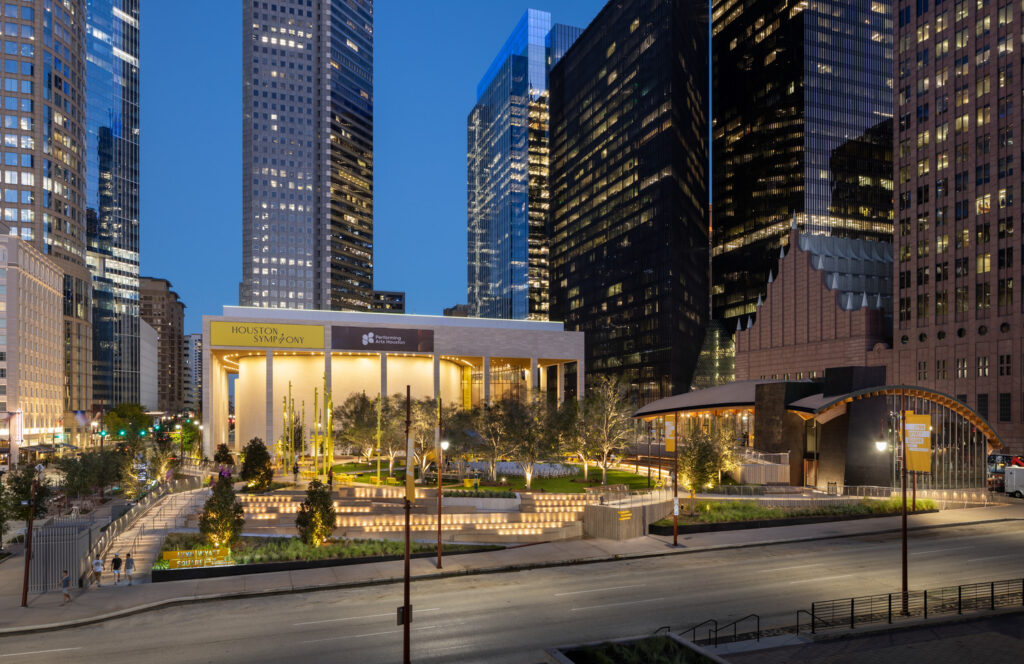
Many of our projects integrate biodiversity restoration, green infrastructure, passive environmental systems, and public realm improvements that strengthen both communities and ecological systems simultaneously. Projects such as Houston’s “Cool & Connected Corridors” and Lynn Wyatt Square demonstrate how climate-responsive design, ecological thinking, accessibility, and community-focused public spaces can support more resilient, inclusive, and future-focused urban environments.
Co-evolving with nature
Practice
1. Do you use biophilia within your premises and/or do you regularly gather in natural settings?
Our offices integrate biophilic principles into studio environments and encourage regular engagement with natural settings as part of everyday culture and project practice. The workplace incorporates natural light, planting, materiality, visual connectivity, and collaborative spaces designed to support wellbeing, creativity, and a stronger connection to nature.
Beyond the office environment itself, teams regularly gather outdoors in both formal and informal settings. These activities include project site visits, completed project tours, local park visits, and attendance at groundbreaking and opening events related to our work. Informal gatherings such as outdoor lunches, walking meetings, and picnic-style breaks are also encouraged as part of studio culture.
These experiences reflect our belief that direct and ongoing engagement with landscapes, ecology, and public space strengthens design thinking, team wellbeing, collaboration, and our connection to the communities and environments we help shape through our projects.
2. Can you share examples of where you have considered nature in decision making?
RIOS’s nature is a primary driver in decision-making across disciplines, scales, and project typologies. As a multidisciplinary practice, we work collaboratively to build strong relationships between architecture, landscape, interiors, and urban systems rather than treating them as separate elements. We see nature not as a backdrop, but as the connective tissue of a project.
Our designs aim to create fluid relationships between inside and outside through landscape integration, daylight, ecology, materiality, texture, and climate-responsive thinking from concept through delivery. This nature-led approach informs decisions ranging from site planning and biodiversity strategies to user experience, wellness, and material selection.
Our work is grounded in the understanding that humans are part of nature, and that successful design should foster a reciprocal relationship between people and the environment. This approach is further reinforced in regions such as Singapore and the UK, where evolving policies increasingly prioritise ecological integration, biodiversity, and nature-positive design approaches.
3. Are you supporting nature locally and nationally?
Supporting nature locally and nationally is embedded within our design approach through projects that prioritise ecological integration, biodiversity enhancement, landscape preservation, and long-term environmental resilience. Across regions and project typologies, we work with local ecological conditions, native planting strategies, and landscape systems to strengthen connections between people and nature.
Our work promotes habitat restoration, biodiversity corridors, climate-responsive landscapes, integrated water management, and nature-based solutions that support both ecological and community wellbeing. We also collaborate with local communities, suppliers, ecologists, and craftspeople to ensure projects respond to regional environmental and cultural contexts.
Beyond projects, RIOS supports nature through internal sustainability initiatives, applied research, biodiversity-focused design workflows, and educational efforts that encourage more regenerative and nature-positive approaches across the practice and the wider industry.
Project
1. Can you demonstrate work that strives to match the performance of a mature ecosystem?
We have an established track record of projects that seek to align more closely with the performance of mature ecosystems through regenerative and landscape-led design approaches. Across project types, from residential within sensitive natural settings to larger campus environments, we prioritise working with existing ecological systems rather than replacing them. Our approach begins with avoiding disturbance wherever possible through sensitive siting, preservation of existing habitats, and integration with the surrounding landscape. Where impacts are unavoidable, we seek to minimise disruption, restore affected areas, and enhance ecological performance through planting, habitat creation, water-sensitive design, and long-term resilience strategies. This framework supports healthier relationships between people, architecture, and the natural environment while strengthening biodiversity and ecological continuity over time.
2. Are you working on material stewardship?
Material stewardship is a structured and active area of work at RIOS, embedded within the practice’s Sustainability Action Plan and led by the Climate Action Committee (CAC). CAC promotes retrofit, adaptive reuse, deconstruction, material salvage, circularity, and low embodied carbon design strategies across projects. RIOS is currently testing a range of early-stage embodied carbon assessment tools and Life Cycle Assessment (LCA) methodologies to better measure, evaluate, and reduce environmental impacts throughout the design process.
The practice has developed internal guidance for high-impact material categories such as concrete, metals, insulation, and mass timber. It has also launched an initiative focused on identifying and promoting fully bio-based materials while supporting design teams with specification, procurement, and product availability. On a recent UK project involving buildings scheduled for demolition, RIOS conducted a Pre-Deconstruction Audit and used digital material tracking platforms to identify reuse opportunities, recover materials, and connect salvaged components to reuse markets.
3. Does the majority of your work demonstrate the use of biologically-inspired approaches such as Bioregionalism, Biophilia or Biomimicry?
Many of projects at RIOS demonstrate biologically informed and nature-led design approaches, even if they are not always explicitly labelled as bioregional, biophilic, or biomimetic. Our work is grounded in the understanding that people are part of nature, and design should strengthen that relationship rather than separate from it. Projects regularly integrate natural light, airflow, thermal comfort, planting, habitat creation, and connections to landscape to support wellbeing and ecological performance. We work closely with local climates, ecologies, and planting palettes to reinforce biodiversity and create environments that support both flora and fauna. Rather than mimicking nature superficially, our approach focuses on learning from natural systems, understanding local conditions, and applying those insights in ways that are responsive, regenerative, and place-specific.
Creating a just space for people
Practice
1. Do you have a progressive EDI policy and can you evidence many forms of diversity, which are welcomed and acknowledged, within your company/organisation?
RIOS has a progressive Equality, Diversity, and Inclusion (EDI) approach embedded across its workplace culture, recruitment, professional development, and community engagement. Diversity is central to the practice’s ethos, with active commitments to equity regardless of race, gender, sexual orientation, religion, age, or background.
The Social Impact Initiative (SII) is a firm-wide effort focused on using design, resources, voices, and skills as catalysts for social change and positive community impact, particularly advocating for Black, Brown, and Indigenous communities.
RIOS maintains a balanced and diverse workforce, with over 200 staff representing broad cultural, ethnic, linguistic, and religious diversity, while also monitoring pay equity across disciplines. The practice invests 5% of annual revenue into social impact initiatives, including mentorship, diversity training, community programmes, partnerships with Historically Black Colleges and Universities, and inclusion-focused internship programmes. RIOS is also a majority LGBTQIA+ owned company certified by the NGLCC as an LGBT Business Enterprise.
2. Do you operate a no overtime culture, meet the living wage consistently, and stipulate a fair salary ratio between staff of all levels?
RIOS is committed to fair pay, employee wellbeing, and equitable workplace practices. We believes all employees should be treated with respect and compensated fairly, and commits to paying a living wage across all levels of staff. Salaries are regularly reviewed against the MIT Living Wage Calculator for Los Angeles County and for the UK, Real Living Wage, including for employees at the lower end of the pay scale, even where this exceeds market-rate pay for comparable roles.
RIOS also maintains pay equality regardless of gender or race and promotes equitable professional development opportunities across the organisation. Overtime for non-exempt employees is carefully managed, must be pre-approved, and is compensated in accordance with employment law. Flexible working arrangements and support for caregivers further reinforce a healthy and balanced working culture.
3. Do you support charities, community groups, social enterprises, action groups and others through pro-bono work, charitable giving or in-kind donations?
RIOS and RIOS+ actively support non-profit organisations through pro bono design services, community partnerships, and financial contributions. Each year, the practice allocates funding and fully subsidised project work to charities, social enterprises, grassroots organisations, and community groups delivering positive social impact. Operationally, RIOS dedicates 5% of its annual profit to Social Impact Initiatives supporting diversity and bias training, mentorship, education programmes, pro bono work, and investment in local and national communities.
In 2020 alone, RIOS contributed more than $1 million in professional services to organisations including Harvest Home and the Los Angeles Al Fresco Dining Initiative. As a JUST-certified company currently undergoing renewal, RIOS also provides ongoing support to health, Diversity, Equity and Inclusion (DEI), arts, and community organisations. The team further demonstrates its commitment through continued support of NSPCC fundraising initiatives for vulnerable children and families.
4. Do you use an ethical framework to assess opportunities and/or supply chain partners and is them team consulted on these decisions?
RIOS applies an ethical assessment process as part of its internal go/no-go procedure when evaluating new opportunities, clients, consultant involvement and supply chain partners. Each opportunity is reviewed for alignment with the organisation’s values, reputation, and long-term brand impact.
Key considerations include ethical standards, social and environmental responsibility, inclusivity, and the potential reputational impact of working with particular individuals, organisations, or industries. Opportunities that conflict with the company’s core values would not be pursued.
These decisions are made collaboratively, with leadership and team members consulted throughout the process to ensure a balanced, values-led approach.
Project
1. Does your work demonstrate deep engagement with local stakeholders and end users?
We use a range of approaches to support meaningful stakeholder engagement, combining quantitative and qualitative research, including demographic, social, and economic data alongside community narratives to shape inclusive and meaningful environments. Local Projects, a multidisciplinary design studio, specialises in creating emotionally engaging experiences by working closely with clients and stakeholders to define success metrics and build collaborative visions throughout the design process.
Examples include the Erie Canal Harbor Development Corporation project, where installations encouraged visitors to explore the canal’s history and its impact on Indigenous Peoples, and the El Pueblo Vision Plan, which incorporated stakeholder meetings and surveys with agencies, elected officials, and community organisations.
Similarly, the Los Angeles County General Hospital revitalization project demonstrates deep engagement through tenant coordination, public agency collaboration, accessibility improvements, community event programming, and long-term strategies focused on wellbeing, connectivity, safety, and community resilience for both hospital users and the surrounding neighbourhoods.
2. Does your work create connected and resilient communities which positively contribute to neighbourhoods and allow equality of access?
We have track record of projects aim to foster connected and resilient communities, enhancing neighborhoods and ensuring equal access. An example is Chicago’s Connected Communities Ordinance, developed with over 80 stakeholders, which promotes equitable development near transit. This ordinance encourages walkable, mixed-use communities by expanding incentives, improving street safety for pedestrians and cyclists, and increasing housing affordability and accessibility, especially near transit hubs. It also includes an “Inclusionary Application Zoning Process” to prioritise affordable housing in zoning decisions.
As an example, the Los Angeles County General Hospital revitalization aims to create a more connected and resilient community by improving pedestrian circulation, equitable and inclusive access, public open spaces, ecological performance, and transit-oriented connectivity across the campus. The revitalization addresses fragmented green spaces, disconnected pathways, and limited community gathering areas while preserving the site’s historic identity and supporting long-term environmental and social resilience.
3. Does the majority of your work promote equity in society, and consider all people, not only building inhabitants
We believe that diversity in design perspectives enables projects to meaningfully reflect the wide range of human experiences. We strive to ensure our work promotes equity in society and considers all people beyond a building’s immediate occupants. This is achieved through inclusive design and engagement strategies that prioritise accessibility, wellbeing, and social value.
Projects often focus on creating inclusive public spaces and community-centred environments that ensure equitable access for diverse users, including people with disabilities. Initiatives such as vibrant civic hubs and accessible green spaces demonstrate this commitment in practice. A core part of the approach is deep engagement with local stakeholders and end-users, ensuring outcomes reflect the needs, cultures, and aspirations of diverse communities and support underrepresented groups.
RIOS leverages cultural and aesthetic relationships to enhance quality of life. Overall, there is a strong commitment to designing for accessibility, inclusion, and wellness across cultures, ages, and abilities.