
Submission by New Practice, part of Civic.
Being a good ancestor
Practice
1. Do you have a clearly stated purpose aligned with the planetary emergency? We’re looking for a bold ambition here, and a culture which recognises the need for long-term thinking.
We exists to strengthen the social infrastructure of places so that communities can thrive long into the future, aligned with the values of the Just Transition. We recognise the planetary emergency as both environmental and social: resilience depends on connected communities, inclusive economies, and stewardship of existing resources.
The practice combines community engagement, place activation and community‑led architecture to create meaningful social value. Retrofitting, rather than demolition and rebuilding, is one way we ensure continuity in communities, preserving structures that hold historical and emotional significance – as well as reducing carbon output. We prioritise long-term value over short-term outputs, helping clients test ideas, build local capacity, and embed stewardship.
2. Do you have a clearly stated purpose aligned with the planetary emergency? We’re looking for a bold ambition here, and a culture which recognises the need for long-term thinking.
Ethical governance is at the heart of our practice, dictated via a decision making matrix to guide transparent, resilient, and ethical decision-making and actions. It ensures our operations, policies, projects and supply network are fair, inclusive and planet positive. We make design choices on our projects, and actively collaborate with ethical partners and organisations to bring about positive change.
We foster a culture where knowledge is distributed rather than held by individuals, enabling continuity as the practice grows. Team members are actively involved in shaping direction, contributing to strategy, and developing new areas of work.Our long-term intention is to continue evolving towards models that protect the ethos of the practice-ensuring that its commitment to social value, inclusivity and regenerative thinking is maintained regardless of the team make up.
3. Do you share research and knowledge for the benefit of society and the wider world?
We are a socially and politically engaged team who are passionate about contributing to the wider discourse of architecture and placemaking. Examples include:
– Our senior team all regularly speak in academic settings. Recent examples include the Manchester School of Architecture, Glasgow School of Art and the Centre for Alternative Technology
– We wrote a chapter in the recently published book ‘Collective Action!: The Power of Collaboration and Co-Design in Architecture.’
– We run a pro-bono programme called ‘A Building for Your Community’ which provides advice on community-led development. Most recently we have published a podcast series.
– In 2023 we launched ‘Waiting to Happen,’ a Glasgow-based cycling safety campaign which gathered extensive data about road users’ experiences at three problem junctions. This work contributed to the council completely redeveloping one such junction.
– We are founding members of Open Plan Scotland, an advocacy and support network for LGBTQIA+ architecture students and practitioners
Project
1. Do you advocate for long-term thinking at the outset of work? Do you initiate work with long-term thinking and challenge clients? Also, can the organisation demonstrate that this approach has worked?
We embed long-term thinking at the outset of every project, challenging briefs that focus solely on immediate outputs or measurable data (social value typically develops in the long term and is difficult to measure using singular metrics). Our approach reframes projects as evolving systems – considering future use, governance and adaptability from the outset. With public sector clients, we can lean on policy frameworks and longer-term community value. With private clients, it’s often about helping them stand out – showing how doing the right thing can also be a strategic differentiating move.
With our work on Kinning Park Complex and Many Studios (community centre and co-working space respectively), we have worked closely with the client producing longer-term plans and remained present during RIBA Stage 7 to support extended post-occupancy evaluation and future-planning. This includes small-scale pilot projects for the benefit of the local communities and longer-term maintenance.
2. Does your work take account of the future climate and the need for resilience?
Our work supports resilience by focusing on adaptability, reuse and local capacity. Through flexible design and incremental development, we enable spaces to evolve over time in response to changing environmental and social conditions. Meanwhile-use plays a key role here – testing how spaces perform, identifying future needs, and avoiding premature or resource-intensive interventions. We see social resilience as integral to climate resilience.
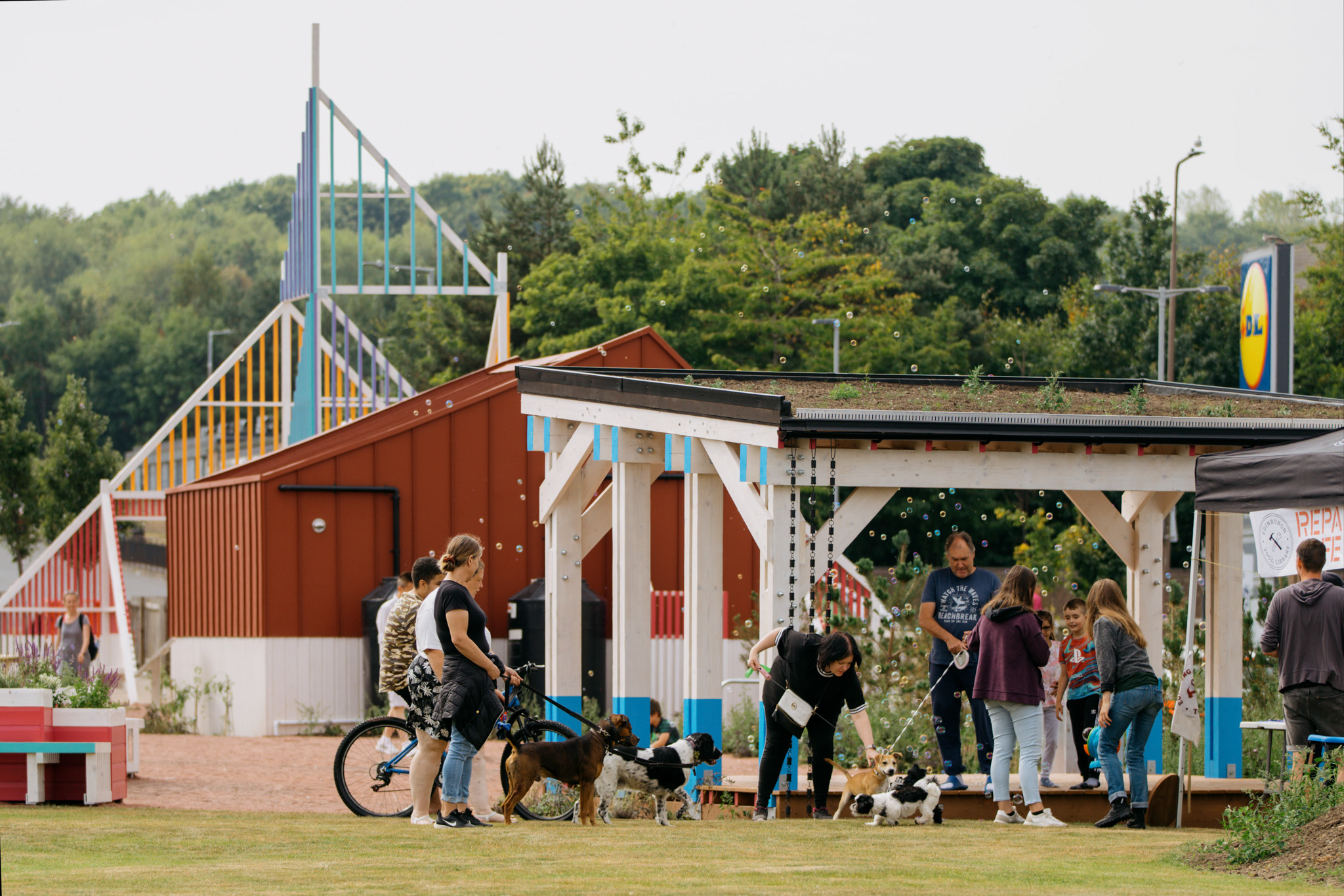
We maximise greenspace, biodiversity and drainage on all our projects. For the public space ‘Walk Up Avenue,’ in order to reduce future flood risk we integrated a number of ‘blue-green infrastructure’ features: raingardens and swales, a rill, tree-planted SuDS trenches and woodland areas, as well as wildflower meadows and a turfed play green.
3. Does the majority of your work go beyond mitigating negatives and towards optimising positives?
We focus on unlocking opportunities, increasing accessibility, supporting local enterprise, fostering connection, and creating moments of joy. Through adaptive reuse and activation, we turn underutilised sites into productive assets, often supporting community organisations, artists, and social enterprises – avoiding waste while generating lasting social, economic and cultural value.
We use colour and materiality to bring joy to everyday environments. We do so not simply as aesthetic devices, but to create identity, aid wayfinding, reflect landscape, and strengthen heritage and narrative. For example at ‘Walk-Up Avenue’ we advocated to include a colourful sculptural entranceway. While the client (the council) was resistant at first due its ‘folly’ nature and perceived vandalism risk, they eventually agreed and it went on to become a well-loved emblem of the site- functioning as a clear entrance and wayfinding marker, while forming a boundary to the road in a joyful rather than defensive way.
Co-evolving with nature
Practice
1. Do you use biophilia within your premises and/or do you regularly gather in natural settings?
Our office is full of plants, both inside and out.
Our previous office was in co-working space in a post-industrial neighbourhood, with an outlook onto an underused carpark. We secured grant funding to design and self-build a ‘pocket park’ on this site, to create a new biodiverse gathering space for people and wildlife.
Our new office looks onto a courtyard in the city centre, where there is a marked lack of green or quiet space to sit. Again, we secured grant funding and recently installed two seating structures with integrated planting. These are used by our colleagues, for meetings and breaks, as well as by the general public.
2. Can you share examples of where you have considered nature in decision making?
At Walk-Up Avenue, a brownfield urban site, we integrated wildflower meadows and native trees to enhance biodiversity. We also included features such as deep-gutters on the cafe unit, providing birds with drinking water.
For Jamestown Road, a medium-scale residential development in Camden, we led the landscape and public realm design. The Urban Greening Factor (which measures the quantity and quality of urban greening) far surpassed the statutory target. We designed two courtyards each balancing a number of amenity uses while maximising biodiversity for visual amenity, environmental benefit and privacy.
We also have the examples given in question 1 above.
3. Are you supporting nature locally and nationally?
We support Nature Based Solutions (NbS) at a variety of scales across the UK and Ireland, spanning design development, delivery and policy. An example includes our recent work producing guidance for planners and developers in Ireland for LAWPRO (Ireland’s Water Authority). This guidance embeds NbS within the planning system to ensure water management and run-off management is central in the design of new developments nationally. We are currently developing similar guidance for TfL looking at the interactions and challenges that exist when co-locating utilities, trees, and SuDs.
Project
1. Can you demonstrate work that strives to match the performance of a mature ecosystem?
No.
2. Are you working on material stewardship?
We avoid ‘build-and-burn’ wherever possible on all our projects, favouring demountable materials and reusable components – particularly so on meanwhile-use projects.
3. Does the majority of your work demonstrate the use of biologically-inspired approaches such as Bioregionalism, Biophilia or Biomimicry?
No.
Creating a just space for people
Practice
1. Do you have a progressive EDI policy and can you evidence many forms of diversity, which are welcomed and acknowledged, within your company/organisation?
We are a women and LGBTQ+ led architecture practice. We strive for diversity in our team which is made of people from all backgrounds, impairments and communities. We are committed to the perspective of the ‘unusual suspects’, viewing briefs through the lens of women, queer and differently-abled people.Our parent company has a progressive EDI policy. This is directed by an Inclusion Steering Group – made up of a range of employees – that sets our strategic vision while develops policy, targets and metrics. That sits alongside our ‘Inclusion Lab’ that takes a more practical role in reviewing our policy as it is put into practise and holds inclusion promises to account.
2. Do you operate a no overtime culture, meet the living wage consistently, and stipulate a fair salary ratio between staff of all levels?
We operates a hybrid flexitime model, with established core hours from 10am – 4pm. Employees are responsible for recording their time through the agreed Company systems and monitoring additional hours, giving them agency to adjust hours worked each day/week according to personal commitments and workload – without having to ‘ask permission.’ We aim to avoid a culture of excessive overtime, recognising that long-term impact depends on maintaining a healthy and motivated.
We are a certified Living Wage Employee. We are opposed to zero-hour contracts for all team members, including freelancers.
3. Do you support charities, community groups, social enterprises, action groups and others through pro-bono work, charitable giving or in-kind donations?
Open Plan is an advocacy and support network for LGBTQIA+ architecture students and practitioners in Scotland, which was founded by three of our team. It aims to promote visibility of LGBTQIA+ voices, support critical dialogue and provide mentorship. Activities include socials, surveys and exhibitions.
Waiting to Happen, the cycling safety campaign, was run entirely pro-bono and created by our team. We created the campaign, ran the survey and analysed the data and shared the findings through group workshops and publications.
A Building for Your Community is a pro-bono programme that we created – designed for community members and organisations looking to learn how to best approach the transformation of community-led spaces, buildings and other assets. We have run information sharing sessions, published resources on the website (www.abuildingforyourcommunity.co.uk), and are currently recording our second podcast series.
4. Do you use an ethical framework to assess opportunities and/or supply chain partners and is them team consulted on these decisions?
We prioritise local supply chains and fabricators as a core part of our approach, supporting both community wealth building and circular economy principles. We regularly work with SMEs – including local artists and fabricators – who contribute to the delivery of community engagement and social benefit across our projects. While not formalised in a charter, this commitment is embedded in how we work.
Internally, we foster an open and inclusive culture where all team members are encouraged to share views and challenge decisions. This strengthens accountability and collective alignment. For example, concerns raised by a junior team member about OpenAI led to a practice-wide decision to stop using ChatGPT.
Project
1. Does your work demonstrate deep engagement with local stakeholders and end users?
We help our clients build honest relationships with communities through inclusive, creative engagement and co-design programmes, using a blend of stewardship, collaboration, and digital and in-person dialogue. Our use of meanwhile interventions allows communities to test and shape ideas in real conditions – building trust, generating insight, and ensuring projects reflect the needs of those who will use and care for them
An example is Meet Our Waterfront, where we led stakeholder engagement for a major riverside masterplan in Glasgow. We designed a layered process of surveys, guided site walks, public exhibitions, and creative workshops to reach a wide and diverse audience. Engagement was embedded throughout the design process, not treated as a single stage – enabling ongoing dialogue between communities and the wider design team. We also developed targeted programmes, including a youth-focused ‘Street Art Summer Camp’, which invited young people to co-create and test ideas through live making and activity.
2. Does your work create connected and resilient communities which positively contribute to neighbourhoods and allow equality of access?
Our work is driven by creating people-focused, community-centred briefs that embed shared decision-making and inclusively shape the future of neighbourhoods, towns and cities.
Social value underpins our practice, guiding us to deliver projects that place people first while supporting community resilience and responsible use of resources. We foster intergenerational belonging, build local capacity, and enable shared ownership to create equitable, connected and thriving places.
This is exemplified by our award-winning redevelopment of Kinning Park Complex in Glasgow. We transformed a deteriorating former school into a flexible, accessible civic hub that is now community-owned and supports a wide range of activities—from meals and workshops to cultural events, learning programmes and affordable workspace. Our approach prioritised inclusivity and adaptability, introducing flexible ‘baggy’ spaces and improving accessibility, while using colour and layout to support navigation and create a welcoming environment for all.
3. Does the majority of your work promote equity in society, and consider all people, not only building inhabitants
By working at the intersection of design, strategy and activation, our approach supports equitable access to space, resources and opportunity – particularly through enabling community-led use and supporting local organisations. We also consider how value is distributed, seeking to retain social and economic benefit within local areas.
This is exemplified by ‘Streets for All’ in central Glasgow, where we worked across multiple neighbourhoods to create small-scale public realm interventions that reconnect communities divided by major infrastructure. The project introduced planting, artworks, and adaptable street elements to encourage everyday interaction, improve safety, and support biodiversity. Crucially, interventions were designed to respond to diverse local needs – offering free gardening toolkits, enabling residents to shape their own environments. Through this approach, the project supports more equitable access to green space and strengthens neighbourhood identity.