
Submission by New-works.
Being a good ancestor
Practice
1. Do you have a clearly stated purpose aligned with the planetary emergency? We’re looking for a bold ambition here, and a culture which recognises the need for long-term thinking.
The climate emergency demands we fundamentally change the way we work.
We closed our previous practice, TDO, and founded New-works with a new business model giving us the agency to do this.
We believe the generational challenges we face require a break with business-as-usual by moving away from all-services architectural practice towards specialism and collaboration. This approach allows us to create the space to change old habits. Rather than rely on repeating old methods, we can make space for deeper work and creativity, and engage in designing differently to address the climate emergency.
Under this model of practice we prioritise R&D, and lead projects through workstages 0-3+. We collaborate with delivery practices from the start to the end of the project, handing the design lead role to them in workstage 4. The delivery side of our business is then focused on a client side advisory role.
2. Do you have a clearly stated purpose aligned with the planetary emergency? We’re looking for a bold ambition here, and a culture which recognises the need for long-term thinking.
An issue we see with succession in the industry is the value that is often placed on the presence of the directors. We have moved away from a practice name that lists the directors and instead one that focuses on the key values the practice will explore: new ways of working that focus on collaboration, wellbeing and sustainability. These are the driving forces behind the practice, and they will survive without the presence of any particular director, facilitating future succession.
3. Do you share research and knowledge for the benefit of society and the wider world?
Yes, a key element of our Low Line arches projects, for example, was our Good Practice Guide. This captured the learning from the process from client, collaborators and our own experiences. It also captures post-occupancy evaluation from the first year of operation, identifying where we would make changes in hindsight. It is available as a free guide to anyone either considering carrying out works to railway arches including clients, designers, landlords and lay-people. It sets out the technical, physical, statutory, procurement, environmental and other opportunities and constraints particular to railway arches. The guide will be updated to capture the latest Low Line arches project in Bermondsey.
Project
1. Do you advocate for long-term thinking at the outset of work? Do you initiate work with long-term thinking and challenge clients? Also, can the organisation demonstrate that this approach has worked?
Yes, at Great Suffolk Yard we advocated for a retrofit-led project in place of a demolition and new build (previously proposed by others). Along with a significant embodied carbon benefit, the approach placed social sustainability and the importance of place at its heart. Our proposals demonstrated that a loose-fit layout could be deployed around a central courtyard, with multiple terraces and yards providing outdoor amenity space, with the proposals using robust, face finished materials that were consciously chosen to stand the test of time and provide future legibility and adaptability. The building can be occupied by a range of different tenant sizes (let by floor, building, or floor of a building). The cores are strategically placed to facilitate future change of use and adaption, and the facades were changed to be non-combustible immediately prior to construction to withstand potential regulatory requirements triggered by such a change of use.
2. Does your work take account of the future climate and the need for resilience?
Yes, we addressed these challenges at large scale at Great Suffolk Yard, as above. At the smaller scale our Low Line arches projects explore these principles in a more experimental manner.
The Low Line arches are designed to be low cost, sustainable, demountable, adaptable and reusable. The project explores the potential of componentised design, allow rapid construction on site. By being spaceswithin-spaces pulled away from the railway arch they address statutory constraints that touching the arch would trigger. This also allow for ease of maintenance and future demountability and reuse. They are inherently adaptable spaces. At Ewer Street they have undergone several successful changes of use already, attesting to their flexibility.
3. Does the majority of your work go beyond mitigating negatives and towards optimising positives?
Yes, all our new projects do.
We follow a retrofit and reuse first policy, for example at GSY, as discussed above, and in Lyme Regis where we are exploring a re-use only brief. On that project we have recorded the testing and decision making process around material choices. The resulting document captures the opportunities and constraints we explored throughout the collaborative design process with our client, and the suitability of various regenerative and reused materials, which can inform future decisions. It will be made freely available for download when we launch the project.
Where new build is required we prioritise MMC (and mass timber in particular) as a construction approach. We worked closely with Human Nature to develop the timber construction methodology, which has also informed our approach to other projects.
Co-evolving with nature
Practice
1. Do you use biophilia within your premises and/or do you regularly gather in natural settings?
We have extensive planting within the new studio. Our studio has moved to Bermondsey where we are now walking distance to Southwark Park, which runs to the river. We encourage walking, cycling and engaging with nature over using the underground and have a route mapped from London Bridge station along the riverside and through Southwark Park to the studio. Our working hours promote this: 10-5 with an hour before and after for personal physical and mental wellbeing.
2. Can you share examples of where you have considered nature in decision making?
We have shortened the working day to 10am-5pm with an hour before and after for individual physical and mental wellbeing. The time at work is then split into mornings for deep work away from phones and emails, shared lunch, and the afternoon for communication. We believe this more closely aligns with our bodies’ natural mental and physical circadian rhythms. Our working day of 7 hours aligns with the shortest day of the year, which is 7hours and 49 minutes.
3. Are you supporting nature locally and nationally?
Yes, our Low Line arches projects are part of a wider collaboration with the Low Line commons, which seeks to create a green corridor along the Victorian railway viaduct. Part of this is the work of the Bankside Urban Gardening team, whose facilities we designed into our Bankside Low Line arches projects. Teaming up with the Commons team as a ‘band of Low-Liners’, we have been working in a pro-bono capacity promoting the Low Line vision for connecting people to nature in highly urban environments to other local authorities and BIDs around London and nationally. Once the Low Line arches are complete in Bermondsey we will be able to implement the vision in that location to connect with nature with project stakeholders either side of the arches (Blue Bermondsey market and the Biscuit Factory).
Project
1. Can you demonstrate work that strives to match the performance of a mature ecosystem?
Our Horcott Lakes project converts 150 acres of disused cement quarry and intensive sport fishing to a biodiversity led community facility and nature tourism. We were aware that our client viewed the site as a lifetime project. Our initial feasibility study set out the unique biodiversity opportunities on the site, and articulated an opportunity for a regenerative benchmark project which would provide him with a legacy lasting generations.
2. Are you working on material stewardship?
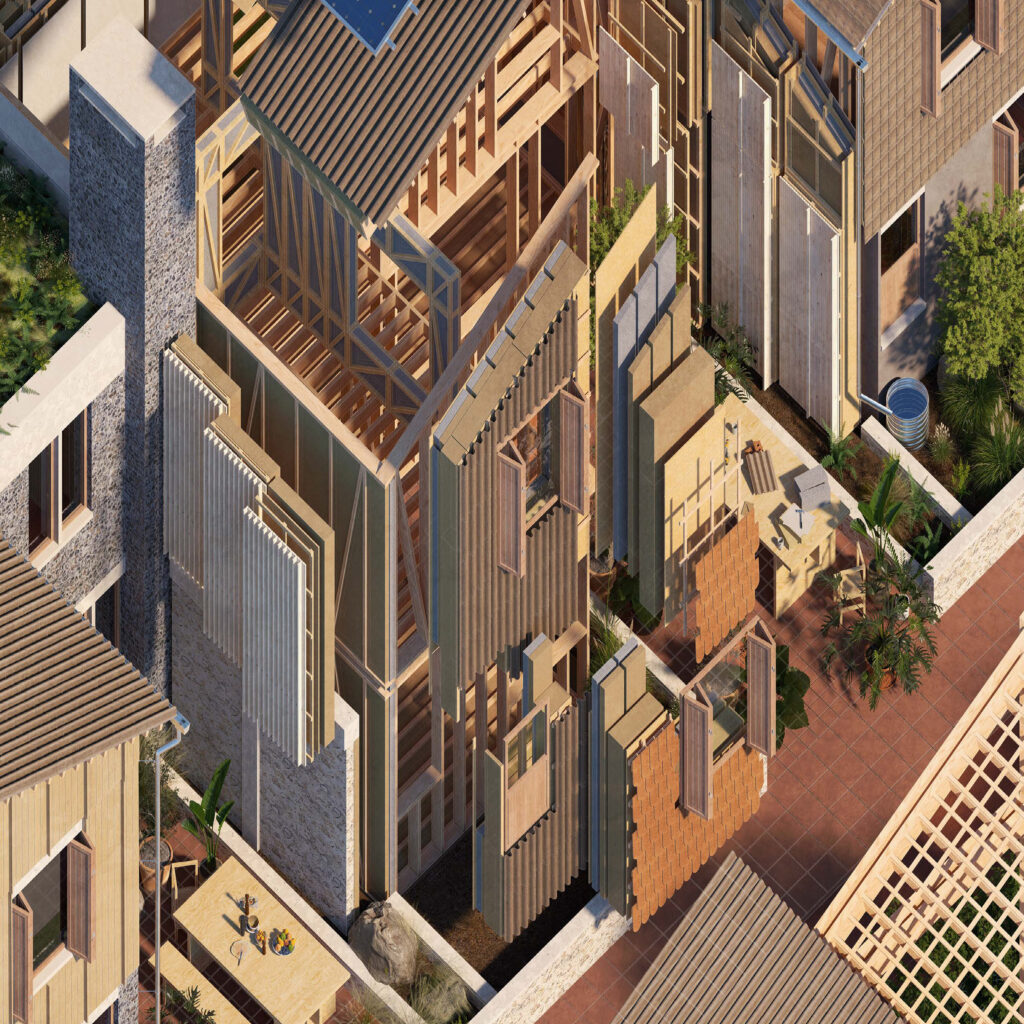
Yes, our project at Erith Road is a study in delivering suburban houses using regenerative materials. We carefully and respectfully analysed the pebble-dash and red tile house typology prevalent in the area, and responded to that architecturally by proposing clay tiles and dabbed lime render on external walls made up of Steico woodfibre boards inside a structural timber frame. Quilt insulation is replaced with sheep’s wool. The project is intended to demonstrate the feasibility of responsible material choices in projects that are not high budget or high profile.
3. Does the majority of your work demonstrate the use of biologically-inspired approaches such as Bioregionalism, Biophilia or Biomimicry?
No.
Creating a just space for people
Practice
1. Do you have a progressive EDI policy and can you evidence many forms of diversity, which are welcomed and acknowledged, within your company/organisation?
More than 50% of the New-works team is LGBTQ+. Inclusion and making space for all from the community both physically through our projects and within the profession itself is a core belief of the practice. This is led by our director Doug Hodgson, himself from the LGBTQ+ community.
2. Do you operate a no overtime culture, meet the living wage consistently, and stipulate a fair salary ratio between staff of all levels?
Yes we have a strict no overtime policy. In fact we have shortened the working day to 10-5pm. We ensure that is focused and productive by making the morning for deep work away from phones and emails, which we publicly declare to manage expectations of anyone contacting us. After a shared lunch the afternoon is for communication. An hour before and after work is for individual physical and mental wellbeing.
3. Do you support charities, community groups, social enterprises, action groups and others through pro-bono work, charitable giving or in-kind donations?
Yes, for example we are supporting Lewes Community Football Foundation and the adjacent secondary school through pro-bono work designing a low cost, demountable and reusable changing and storage facility. The school and club share a 3G playing surface which is a long way from the school buildings and has no shelter or changing facility. The proposals, which are community funded, will address this and enable the expansion of the juniors teams, and crucially give access for 1,000 students from the school to the pitch, which they currently underuse.
4. Do you use an ethical framework to assess opportunities and/or supply chain partners and is them team consulted on these decisions?
We only work with clients and other collaborators that share our ethical values. For example, we returned from UKREiiF with one less client than we arrived with, as we’d had the opportunity to spend time with them and realised that their public ethical positions were paper thin and cynical.
Project
1. Does your work demonstrate deep engagement with local stakeholders and end users?
Yes, our Low Line arches projects was the result of a close collaboration and critiquing process with the Friends of the Low Line, and the end user, Better Bankside BID. This is captured in our Good Practice Guide, which demonstrates how the project evolved through that collaboration and resulted in a design that fosters shared ownership and supports the Low Line’s values.
2. Does your work create connected and resilient communities which positively contribute to neighbourhoods and allow equality of access?
Yes, our Low Line arches projects bring into use otherwise unused, or under used railway arches to the benefit of the businesses and communities around them. For example, our Bermondsey Low Line arches project will deliver shared, low cost workspace which will allow local small businesses and enterprises to be sited in the heart of the communities they have emerged from and serve. The project will also open a step free link through the arches between the Bermondsey Blue market and the Biscuit Factory, giving direct access to the market from the Biscuit Factory site.
3. Does the majority of your work promote equity in society, and consider all people, not only building inhabitants
Yes, we actively promote MMC, which we believe facilitates fundamental change. Successful engagement with the opportunities presented by MMC demands us to think differently about how buildings are built, and design in a way that is process, rather than purely outcome, driven. At its most extrapolated this is volumetric modular, but all forms of MMC seek to improve working conditions, health and safety of the workforce, building performance, while also minimising waste and defects. Factory processes also allow much improved tracking of materials and allows for continuous data driven improvement..