
Submission by MWD Architects.
Being a good ancestor
Practice
1. Do you have a clearly stated purpose aligned with the planetary emergency? We’re looking for a bold ambition here, and a culture which recognises the need for long-term thinking.
Our purpose is to create architecture with regenerative practices at the heart of our projects. Our projects aim to build not just environmental but also social resilience, recognising that today’s decisions shape the world for generations.
In direct response to the planetary emergency, we embed long-term thinking into every stage of our practice from site analysis and material choices to energy performance, embodied carbon reduction, and adaptable design.
Our culture of continuous learning and challenging industry standards ensures all projects support the Sustainable Development Goals, enhance biodiversity, foster community wellbeing, and leave a positive legacy for the future.
2. Do you have a clearly stated purpose aligned with the planetary emergency? We’re looking for a bold ambition here, and a culture which recognises the need for long-term thinking.
We have a clear succession and governance plan to ensure our regenerative values and legacy endure. Future leadership is being cultivated through mentorship and training by exchanging knowledge within our team, with opportunities for key staff to take on ownership roles.
Our policies safeguard ethical, ecological, and social commitments, ensuring that the company continues to prioritise long-term ecological regeneration, social resilience, and positive community impact well beyond the tenure of its founders.
3. Do you share research and knowledge for the benefit of society and the wider world?
We actively share research and knowledge communicating insights on regenerative design via social media, publications, and public engagement.
Several members of the team extend the practice’s commitment to knowledge‑sharing having previously taught or are currently teaching at The Centre for Alternative Technology, The Leicester School of Architecture or The University of Wales, Trinity St. David, strengthening connection between academia and professional practice. Their roles as tutors allows them to bring emerging research, experimental thinking and fresh perspectives into the studio, while offering students valuable insight drawn from live projects and real‑world challenges. Through this dual engagement, the practice contributes to the wider world by helping shape the next generation of designers, ensuring that architectural knowledge remains open and socially relevant.
We also open our doors to the public by hosting art exhibitions for emerging and established local artists creating a space where creative disciplines intersect and spark new conversations.
Project
1. Do you advocate for long-term thinking at the outset of work? Do you initiate work with long-term thinking and challenge clients? Also, can the organisation demonstrate that this approach has worked?
We embed long-term thinking from the outset of every project, prioritising adaptability, whole-life value, ecological integrity, and social relevance. Our designs always aim to focus on durable, low maintenance, and environmentally responsible design, while encouraging clients to think beyond conventional construction methods and timelines.
We work closely with clients to challenge preconceptions about material options and encourage clients to think long term about the adaptability of the design, the benefits of opting for higher performing materials or moving away from fossil fuel based heating options.
Through our work, including projects developed within the One Planet Development framework, we demonstrate how regenerative design, innovative materials, and flexible approaches can deliver high performance, reduced environmental impact, and lasting value for both clients and communities.
2. Does your work take account of the future climate and the need for resilience?
We design with the future climate in mind, creating buildings and spaces that are resilient, adaptable, and long-lasting. Our approach integrates the reuse of existing structures, locally sourced natural materials and a fabric first, enhanced energy performance. By combining these strategies, we ensure thermal comfort, minimise reliance on energy-intensive systems, and support ecological, social, and economic sustainability as the climate evolves.
Projects also focus on implementing various ecological and flooding resilience strategies such as green or blue roofs, rainwater harvesting, permeable surfaces, native planting of local provenance, a variety of wildlife habitats and retention or improvement of existing ecosystems.
Our projects also promote social and community resilience, a recent example of this being the Ammanford Foodbank and help centre project which provides a flexible and adaptable space for the local community and helps to build current and future resilience against community members facing crises, food shortage and financial hardship.
3. Does the majority of your work go beyond mitigating negatives and towards optimising positives?
Our work moves beyond minimising harm to delivering positive environmental and social outcomes.
We prioritise sustainable materials, alongside locally sourced and construction methods that celebrate traditional craft. We go beyond meeting minimum standards and aim to exceed building performance targets using fabric first principles, passive design, renewable technologies, and low embodied carbon solutions to create adaptable, durable buildings that support community wellbeing.
We are often privileged to work in rural locations which offer many positive opportunities for designing buildings that compliment the landscape both in their form but also their materiality. As an example, a farmhouse in Scotland that we designed celebrates the tradition of dry stone walling, natural oak timber cladding and a green roof that uses turf from the surroundings fields to seamlessly blend with the surroundings and optimise local and on site materials sourcing.
Co-evolving with nature
Practice
1. Do you use biophilia within your premises and/or do you regularly gather in natural settings?
All our offices provide good levels of natural daylight, natural ventilation and have a number of thriving indoor plants. Our offices also offer a variety of spaces that permit staff to work in quiet areas or join a more social setting depending on their preference.
We recognise the strong connection between people and nature and actively encourage engagement with the outdoors through site visits, walks, and informal gatherings in nearby green spaces and local parks. On brighter days, we extend our working environment outside, using garden settings for creative discussions and design workshops fostering reflection, open thinking, and a closer connection to the natural context that informs our work.
2. Can you share examples of where you have considered nature in decision making?
Nature regularly forms part of our our decision making process. We chose to disperse our offices into a collection of smaller networks rather than one centralised hub. This benefits several employees who are now able to either walk, cycle or run to work rather than commute via car. We also encourage those that do commute to use public transport.
We understand the value and importance of employee well-being and that each employee has their own working preferences and demands outside of work which we address by offering hybrid, part-time and remote working options. We are also looking to introducing a flexible working policy that allows staff to optimise a work-life balance that can accommodate seasonal and circadian rhythms.
3. Are you supporting nature locally and nationally?
Our practices support nature locally by integrating biodiversity-first principles into every project such as specifying native planting, bat boxes, bird habitats and pond creation where applicable.
As part of our design process we start by ensuring as much of the existing nature is retained as possible and restored when required. We have collaborated with clients to develop nature-based masterplans that and are always looking for opportunities to support nature initiatives and to find ways in which we can support these or offer potential collaborations with wider communities.
Project
1. Can you demonstrate work that strives to match the performance of a mature ecosystem?
Our practices support nature locally by integrating biodiversity-first principles into every project such as specifying native planting, bat boxes, bird habitats and pond creation where applicable.
As part of our design process we start by ensuring as much of the existing nature is retained as possible and restored when required. We have collaborated with clients to develop nature-based masterplans that and are always looking for opportunities to support nature initiatives and to find ways in which we can support these or offer potential collaborations with wider communities.
2. Are you working on material stewardship?
Our practice demonstrates material stewardship through the repeated use of low-carbon, locally sourced, and responsibly managed materials.
The practice has developed standardised dwellings, including the 2024 One Planet Park Home prototype, using only UK-grown timber and hemp insulation, and prioritizes recycled, reclaimed, and natural finishes.
A conversion and extension to a stone barn on a historic country estate is another excellent example of our approach to material stewardship, in particular the material sourcing. The project utilises reclaimed stones found on the site and opts for locally sourced waney edge timber cladding to reduce embodied carbon of timber processing. The new extension will be built from a pre-fabricated timber frame and insulated with recycled newspaper whilst the existing stone barn will be internally insulated with UK grown hempcrete.
3. Does the majority of your work demonstrate the use of biologically-inspired approaches such as Bioregionalism, Biophilia or Biomimicry?
The inspiration for our work is rooted in our knowledge that we are an integral part of the natural world.
As a Welsh based practice we always strive to use a bioregional approach through locally sourced materials and traditional local craft techniques such as dry stone walling which has the benefit of providing not only a regional aesthetic value but also a rich habitat for various flora and fauna.
An example of our approach is a spa retreat in Merthyr Tydfil where we designed a bespoke timber screen to provide secluded privacy within the outdoor nature areas for the spa users. Crafted from untreated Welsh larch, the screen echoes the organic rhythm of the nearby tree branches and the distinct landscape character of the Park and Gardens in which it sits, harmoniously nestling into its bioregional context.
Creating a just space for people
Practice
1. Do you have a progressive EDI policy and can you evidence many forms of diversity, which are welcomed and acknowledged, within your company/organisation?
Although we are a small practice, we are deeply committed to fostering a workplace that is respectful, inclusive and supportive, even though a formal EDI policy is not yet in place.
Our team reflects a rich diversity of backgrounds and experiences, with a near equal gender balance of three women and two men, and international representation including colleagues from the England, Wales and Thailand.
We prioritise flexible and hybrid working arrangements to accommodate various parenting, health, and personal needs and our small team structure encourages an open dialogue and collaborative environment that recognises and celebrates different perspectives, ensuring that all forms of diversity are welcomed and valued in everyday practice.
2. Do you operate a no overtime culture, meet the living wage consistently, and stipulate a fair salary ratio between staff of all levels?
We operate a culture that prioritises well-being and work-life balance. We do not have an overtime culture and actively encourage our team to maintain healthy boundaries between work and personal life.
As a small practice, our salary structure reflects role and experience, but the gap between the highest and lowest paid team members remains modest and proportionate.
We believe that all staff deserve a wage that reflects the real cost of living and allows them to thrive. While we currently meet all legal National Minimum Wage requirements, we recognise that we are not yet at the stage where every member of our team receives the voluntary Real Living Wage. We are actively working towards this goal, treating it as a long-term investment in our people.
3. Do you support charities, community groups, social enterprises, action groups and others through pro-bono work, charitable giving or in-kind donations?
We have provided pro bono services to local community groups in and around Cardiff, including design services, community engagement and reaching out to planning authorities free of charge. We have also developed the visuals for an ambitious nature-based masterplanning project free of charge to allow our client to incorporate them into a website to communicate the shared vision to the wider public.
4. Do you use an ethical framework to assess opportunities and/or supply chain partners and is them team consulted on these decisions?
We prioritise a collaborative approach to assessing opportunities and supply chain partners by working closely with local suppliers and contractors to source and build with materials that align with our environmental values. While we are currently in the process of developing a formal ethical framework, we already rigorously screen products against key sustainability criteria, with a particular focus on reducing embodied carbon and eliminating material toxicity.
Our team is central to this evolving process. We maintain an open internal dialogue where staff at all levels are encouraged to scrutinise potential partnerships and material choices. This collective oversight ensures that even as our formal systems mature, our projects consistently reflect our commitment to the planet and the local economy.
Project
1. Does your work demonstrate deep engagement with local stakeholders and end users?
As a small practice, our work is defined by a deep commitment to ensuring our designs are not only functionally relevant but rooted in the aspirations and backgrounds of the people who use them.
A recent example of our work that demonstrates the practices commitment to deeper engagement with local stakeholders and end users is the extension and renovation of an Islamic cultural centre. We used collaborative briefing and a community workshop where members and other local stakeholders actively participated in meetings, providing guidance on key elements such as the design of the minaret, ablution areas, and layouts aligned with the qibla direction. This collaborative workshop ensured that design decisions were informed directly by the users’ cultural, religious, and functional requirements, moving beyond consultation toward genuine co-design.
2. Does your work create connected and resilient communities which positively contribute to neighbourhoods and allow equality of access?
As a small architectural practice rooted in South Wales, our approach is informed by the Well-being of Future Generations (Wales) Act, ensuring that every project we undertake contributes to a more resilient and equal Wales. We believe that architecture is not just buildings, but about fostering social connections.
An innovative housing scheme in Gower features six semi-detached homes crafted from natural, locally sourced materials, including timber grown entirely in Wales. Designed as “homes as power stations,” these ultra-insulated dwellings generate more electricity than they consume.
Central to the project’s mission was resilient communities. Working in collaboration with a community-led housing group, the construction was carried out by diverse community groups, particularly those from “hard to reach” and disadvantaged backgrounds. By putting vulnerable communities at the heart of the process, the project demonstrates that architecture can be a powerful tool for social equity.
3. Does the majority of your work promote equity in society, and consider all people, not only building inhabitants
We believe architecture should serve broader societal equity, not just immediate end users.
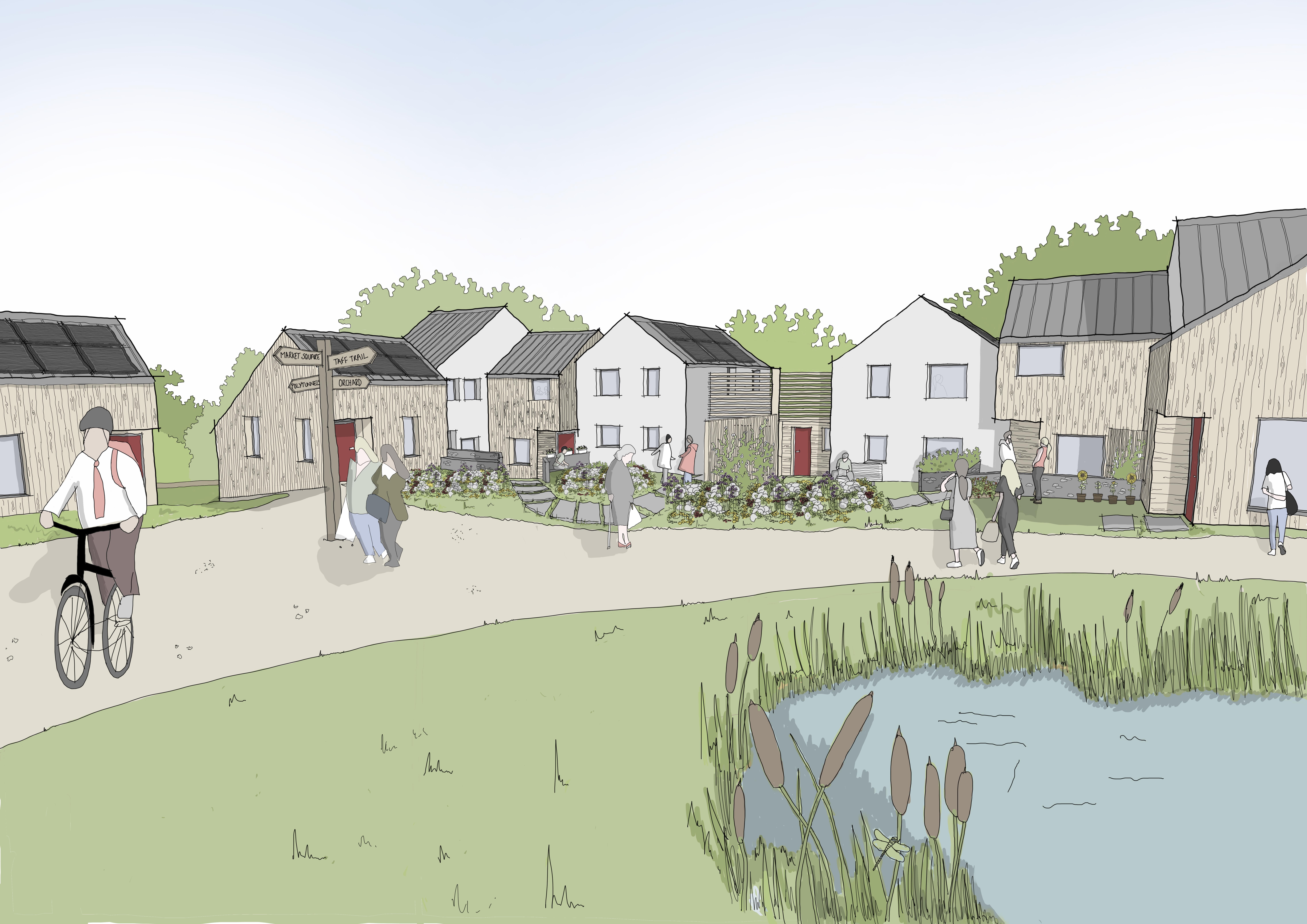
A nature-based masterplanning project near Cardiff looks to re-establish modern and sustainable modes of living with an emphasis on social wellbeing through permaculture design. The priorities for the scheme were to integrate a variety of flexible housing types to suit the ever-changing modern family unit throughout a lifetime. Tactfully locating areas of activity with routes along a street throughout the site creates civic centres and encourages the community’s mutual participation while inviting the wider city to partake in the land-based economy.
In a world that is becoming increasingly disconnected, the project strives to reconnect people, plants and wildlife within an intrinsically linked system that can be mutually beneficial for all. This promotes social equity, wellbeing and longevity and in turn reduces wasteful and inefficient processes.