
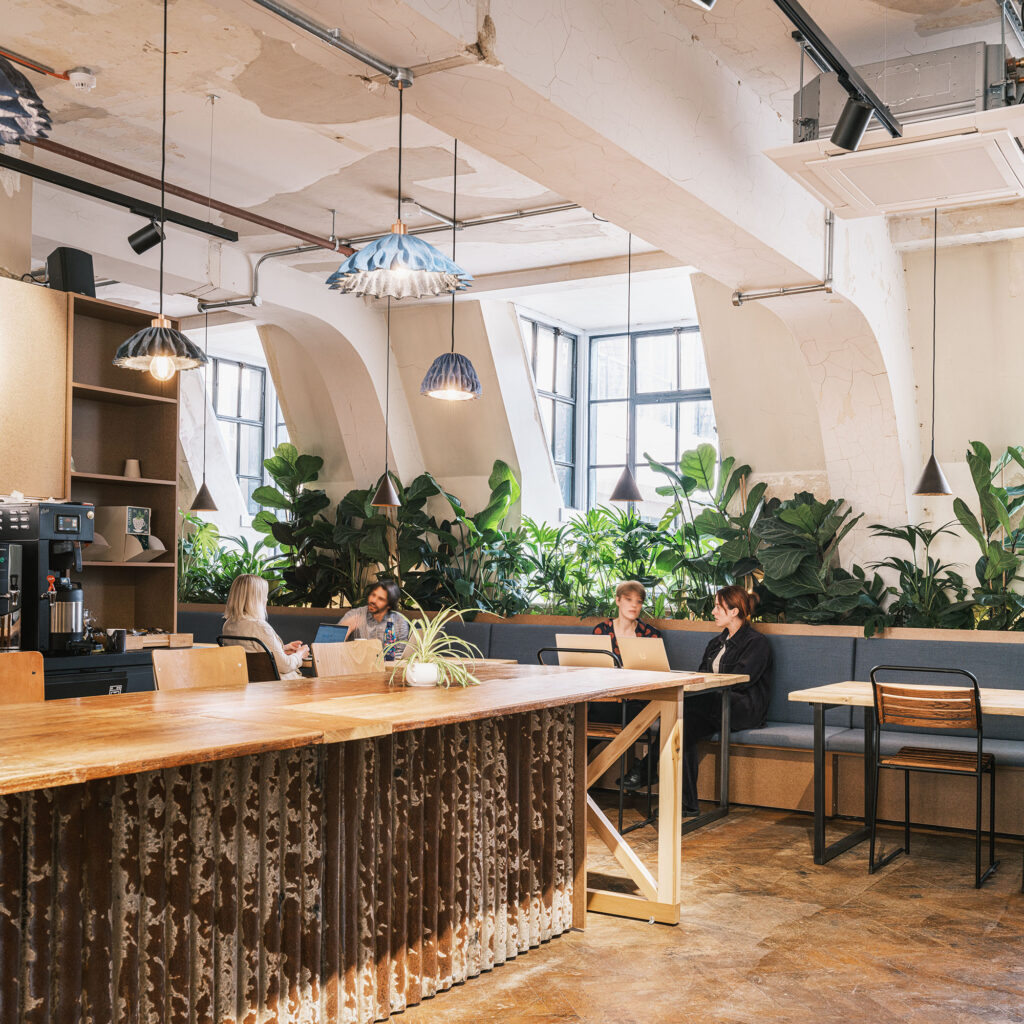
Submission by Material Works Architecture.
Being a good ancestor
Practice
1. Does the practice have a clearly stated purpose aligned with the planetary emergency? We are looking for a bold ambition here, and a practice culture which recognises the need for long-term thinking. For example, a strong mission, a theory of change, or a sustainability roadmap.
We understand that an optimistic future is only achievable through radical change.
We challenge orthodoxy. From aesthetics, to procurement, from specification to construction detail – all design processes need to change in the light of the climate emergency.
Stewardship not reinvention. We focus on reducing waste and resource, encouraging adaptable and repairable spaces that defy the need to demolish or replace.
Updating the existing building stock is more pertinent than creating new. We focus on re-energising existing buildings, in particular the overlooked and underperforming.
We use energy and embodied carbon modelling as a key design tool, analysing live design decisions to minimise operative and embodied carbon emission.
We champion the use of reclaimed and re-manufactured materials throughout.
We design for disassembly and re-use, using modular techniques and accessible fixings to encourage adaptation or allow disassembly to base materials.
2. Does the practice have a clear succession plan, which passes on ownership and protects the values and legacy of those who built and contributed to the practice? For example is the practice an employee owned trust.
No.
3. Does the practice share research and knowledge for the benefit of society and the wider world? For example, you regularly carry out post occupancy evaluation and share information with others.
We undertake post occupancy evaluation on all our projects. This involves the recording and monitoring of data including energy usage and embodied carbon as well as recording qualitative and stakeholder opinions and anecdotes. Examples include data and surveys from our completed work at County Hall for Sustainable Workspaces as well as data from our deep retrofit at Hackney Lofts.
We share POE Information shared on our website along with concluding remarks and opinion to encourage discussion.
We share our learning through practice on social media – including both our successes and failures.
We aim to contribute to the debate – sharing thoughts and findings through industry presentations as well as academically through student presentations and design reviews.
We work collectively with other small practices and are keen to share knowledge and findings through shared CPD sessions and discussion.
Project
1. Does the practice advocate for long-term thinking at the outset of projects? Do you initiate projects with long-term thinking and challenge the client on design life? Also, can the practice demonstrate that this approach has worked – with a shorter or longer design life, or an innovative approach to financing or payback period?
The practice was established to challenge accepted notions of design life and exceed established norms. We create buildings that can be easily adapted and repaired rather then demolished and replaced.
Our work at County Hall for Sustainable Workspaces minimised resource and materials – delivering a low carbon and highly adaptable space that celebrated the ‘as fond’, incorporated re-useable modular components and was solely formed from reclaimed or regenerative natural materials.
Our conversion of a redundant office space to residential accommodation at Hackney Lofts was financed following a detailed investigation into the pay-back periods and economic benefit of deep retrofit techniques. This research resulted in an increased scope and specification that lowered long term energy demands beyond best practice level, and used regenerative building materials throughout to minimise embodied emissions.
2. Do your projects take account of the future climate and the need for resilience? For example, do the projects demonstrate flexibility, design for adaptation, design for disassembly, non-deterministic solutions, or demountable structures.
Our design approach looks to move away from a cycle of demolition and construction towards an approach of lasting construction, repair, stewardship and steady adaptation.
Long-term circular thinking is central to our work. For Sustainable Workspaces at County Hall, we used demountable modular systems throughout to allow for easy reconfiguration and disassembly for material re-use. Partition and joinery modules formed from natural regenerative materials, have since been adapted and re-used both on and off site, proving the concept.
Our work for Republic at East India Dock included the creation of a modular timber framed glazed atrium, designed to be low carbon, de-mountable and with a resilient natural timber finish that is easily repaired. The adaptability of the original design has been demonstrated as the space has adapted to changing demand away from the intended workspace use to an education campus.
3. Do the majority of your projects go beyond mitigating negatives and towards optimising positives? For example, are they meeting or exceeding the RIBA 2030 Challenge.
This allows us to push beyond targets including the RIBA 2030 Climate Challenge, the pilot UK Net Zero Carbon Building Standard, BREEAM and SKA ratings.
We are certified Passivhaus designers – incorporating principles in all our design work, using PHPP to predict energy consumption and working with one-click on embodied carbon calculations.
In our fit-our work we have worked to SKA ratings to achieve the maximum gold standard in all assessed projects.
As well as certification, we aim to directly demonstrate the benefits of our approach in context – at our scheme for Sustainable Workspaces we included printed annotations on building surfaces that explains the environmental benefit of the materials and processes used.
Co-evolving with nature
Practice
1. Does the practice use biophilia within the office or regularly host meetings and retreats in natural settings? For example do you have extensive planting within the office or rely on natural patterns and imagery for stress relief or quiet areas.
While our office is located in an urban context, it is filled with plants and we are fortunate to be have a space with good day-light provision, natural ventilation and external space.
Our office was fitted out by ourselves using reclaimed timber found abandoned in neighbouring building sites. The natural timber, combined with the use of planting creates a natural haven.
2. Can the practice share examples where it has considered nature in decision making? For example by having a nature proxy to encourage eco-centric decision making, using natural systems as inspiration for the company structure, recognising the seasonal nature of people’s capacity and workload or celebrating equinoxes and solstices together.
No.
3. Is the practice supporting nature locally and nationally? For example, does the practice support local gardens, gardeners, planting programmes, rewilding programmes or advocate for changes in legislation to protect nature.
No.
Project
1. Can the practice demonstrate projects which strive to match the performance of a mature ecosystem? As a minimum this would mean achieving biodiversity net gain.
Within our work for Republic at East India Dock, we helped transform an existing built-up site into an extensively landscaped public realm that significantly boosted on site bio-diversity. Areas of paving were removed to create planting, including new tress alongside smaller shrubs while parts of an existing canal were reconfigured and adapted to house aquatic plants and encourage wildlife.
For our work with Sustainable Workspaces at County Hall we worked closely with Floratec to develop a scheme of internal planting. Housed with custom made planters formed from bio-based construction board, the planting creates a calming internal atmosphere and helps improve air quality.
2. Is the practice working on material stewardship? For example, evidence could be shown through repeated use of low carbon materials, extensive material libraries and research or publications supporting responsible use of materials and elimination of waste.
We have developed an extensive office library of low-carbon materials that is regularly updated and accompanied with associated learning and workshop sessions.
We have a network of innovative suppliers we’ve collaborated with – including Biohm, with whom we developed mycelium acoustic baffles and prototype joinery finishes from salvaged bio waste – orange peel and coffee grounds.
We are now working with Deakin-bio on innovative low-carbon tiles and rigid panel sheep wool with Wull technologies. We have recently constructed a low-carbon studio building using only low carbon materials – timber and cork throughout.
We are currently undertaking an research project into low-carbon cladding and roofing materials to inform design development for a new project which we hope to share on completion.
In all projects we use natural insulation materials, wiring extensively with wood fibre and cork. We do not use PVC and limit materials derived from petrol-chemicals as far as possible.
3. Do the majority of projects demonstrate the use of biologically-inspired approaches such as Bioregionalism, Biophilia, Biomimicry, Ecomimicry (also referred to as Ecosystems Thinking, Industrial Ecology or Industrial Symbiosis) or BioTRIZ?
No.
Creating a just space for people
Practice
1. Does the practice have a progressive EDI policy and can you evidence many forms of diversity, which are welcomed and acknowledged, within the practice?
We have an active Equality, Diversity and Inclusion strategy in place that is regularly reviewed, shared, discussed and adapted as the practice progresses. The policy follows guidance from Good Equality Practice for Employers by Equality and Human Rights Commission and outlines our intention to eliminate discrimination, treat all employees fairly, encourage diversity amongst our workforce and not to discriminate. We have signed up to the RIBA Inclusion Charter – committing to promoting diversity within the architecture profession and wellbeing for all employees.
As a micro practice we cannot represent all sectors of society and so work with others to ensure we never assume or unknowingly apply unconscious bias in the employment or projects process. Our employees come from a range of backgrounds and we embrace conversation, discussion and a willingness to challenge assumptions.
2. Does the practice operate a no overtime culture, meet the living wage consistently, and stipulate a fair salary ratio between staff of all levels?
As a micro practice, we have moments when extra work is required at short notice, but we exercise over-time only in exceptional circumstances and work hard for it now to become part of our culture.
All staff are paid above the living wage and there are clear and transparent levels of pay representing experience and level of responsibility within the office.
3. Does the practice support charities, community groups, social enterprises, action groups and others through pro-bono work, charitable giving or in-kind donations?
The practice has provided small amounts of pro-bono advice to local schools and donated to local charities. As the practice develops we hope to contribute more and look for local opportunities to contribute more to community groups.
4. Does the practice publicly refuse to work with certain clients, suppliers or organisations on ethical grounds?
The practice has a policy to refuse to work with organisations or individuals on ethical grounds but to date we have had no call to do so either privately or publicly.
Project
1. Do the projects demonstrate deep engagement with local stakeholders and end users? For example, is there evidence that your project engagement goes beyond consultation towards co-design?
No.
2. Do your projects create connected and resilient places which positively contribute to their neighbourhoods and allow equality of access? For example, do your projects create economic opportunity, retain value locally and generate social value?
Our work with Sustainable Ventures involved the creation of hubs in London and Manchester to house start-up companies working in the climate tech sector. Sustainable Ventures is a CIC acting as an ecosystem connecting climate-tech innovators to resources and investment. We worked closely with them to create physical workspace for the network as well as space and facilities for stakeholders to meet amongst each and connect with the broader community.
Crucial to both schemes was the provision of resilient, adaptable and affordable space that would encourage local investment, create local employment opportunities and empower new businesses that have a real environmental and social impact. Both projects have seen the renovation of underutilised buildings in central locations into open, accessible spaces which include meeting and event spaces designed to provide broader community connection and encourage open interaction.
3. Do the majority of your projects promote equity in society, and consider all people, not only the building inhabitants? For example, do your projects show due regard for workers within the supply chain and take active steps to avoid modern slavery?
We design all our projects to be equitable and accessible to all and work hard to ensure our projects reflect the needs of a diverse community. We follow an approach to design that is open and constantly informed through interaction with end-users and broader stakeholders.
Our work at Republic in East India Dock identified needs to upgrade existing public realm spaces with hard and soft landscaping as well as external seating. The designs dramatically increased the use of the space, with a variety of accessible locations for users, visitors and the broader public to stop and enjoy the landscaping.
The practice has a clear forced labour policy covering work within our company, our direct supply chain and those specify during the design process. It states our positions against all forms of forced labour, and includes checks to ensure it carries through to those we work for or alongside.