
Submission by Max Fordham LLP.
Being a good ancestor
Practice
1. Does the practice have a clearly stated purpose aligned with the planetary emergency? We are looking for a bold ambition here, and a practice culture which recognises the need for long-term thinking. For example, a strong mission, a theory of change, or a sustainability roadmap.
Social and environmental responsibility are embedded in our practice, to look after each other, care for our communities, and to create a sustainable world. We’re an employee-owned business and our culture thrives on open, honest, collaborative relationships based on mutual trust and respect. We were the first UK company in our industry to become a Limited Liability Partnership.
Our world is facing a climate and biodiversity emergency and we’re fully committed to continue pushing boundaries, to keep learning, keep sharing what we’ve learnt, and keep campaigning for our industry to do better. We ‘practice what we preach’ through our various commitments, including the Science Based Targets initiative, the World Green Building Council (GBC) Net Zero Carbon Buildings Commitment, and being the first UK business to have all our offices verified as net zero carbon in operation.
2. Does the practice have a clear succession plan, which passes on ownership and protects the values and legacy of those who built and contributed to the practice? For example is the practice an employee owned trust.
We’re an employee-owned business and our culture thrives on open, honest, collaborative relationships based on mutual trust and respect. We strive to build a diverse partnership that is truly representative of the society we live in. Our commitment is not only to eliminate and avoid discrimination but to create an environment where our differences are celebrated and valued. We see all employees as “Partners-in-waiting” and offer all employees the opportunity to join the partnership after four years. Around half of our people are Partners, but with transparency, collaboration, and democratic decision-making as core principles, all our people can voice their opinions and contribute meaningfully to the running of the business.
Max sought a partnership approach to running the business, to encourage shared responsibility and a feeling of ownership. To this day, all our Partners and employees share this sense of commitment towards each other, our collaborators, and our projects.
3. Does the practice share research and knowledge for the benefit of society and the wider world? For example, you regularly carry out post occupancy evaluation and share information with others.
We are committed to sharing our knowledge and experience, such as our recently published Beyond Net Zero whitepaper, which can be downloaded from our website. It’s an encapsulation of what we believe as a practice, a summary of what we see as the state of the net zero nation, and shares valuable lessons learned on our projects.
In 2020 we created The Net Zero Carbon Guide, a free and open resource for helping to navigate the process of achieving net zero carbon for both old and new buildings.
We contributed to the new UK NZCBS by joining tasks groups for operational energy, culture and entertainment, schools, and sports and leisure.
We regularly publish our research and project outcomes on our website journal.
Project
1. Does the practice advocate for long-term thinking at the outset of projects? Do you initiate projects with long-term thinking and challenge the client on design life? Also, can the practice demonstrate that this approach has worked – with a shorter or longer design life, or an innovative approach to financing or payback period?
We encourage clients to think long-term in their brief, so that potential changes in needs are anticipated, short-term needs aren’t over-catered for, and projects are flexible and adaptable for longevity. For design life we advocate for longevity and also recognise the different design lives and replacement cycles elements may have, and design such that replacement/maintenance can take place without compromising longevity of neighbouring parts. Where organisations have several buildings we recommend undertaking a masterplan study to explore how long-term needs may be best accommodated over time by alteration and adaptation of their existing buildings, to minimise short-term decision-making. Snape Maltings and Trinity College New Court received AT Test of Time awards celebrating longevity.
2. Do your projects take account of the future climate and the need for resilience? For example, do the projects demonstrate flexibility, design for adaptation, design for disassembly, non-deterministic solutions, or demountable structures.
We undertake building performance analysis against future climate scenarios to test climate resilience of proposals, and to either meet future requirements (eg, control of overheating) or identify future mitigation measures which can be applied in the future (eg shading). We encourage clients to undertake this forward-looking analysis even where not part of their brief, to aid resilience. We promote greywater and rainwater recycling where possible, and design for reduced water consumption, for resilience to future drought scenarios.
3. Do the majority of your projects go beyond mitigating negatives and towards optimising positives? For example, are they meeting or exceeding the RIBA 2030 Challenge.
We have developed a bespoke sustainability framework to guide both processes and outcomes of project briefing, design and construction, to encourage clients and design teams to consider the wider environmental and social benefits that their projects can promote.
We have committed to our projects going beyond net zero and being biodiversity positive, by considering environmental impacts on site and beyond throughout the supply chain. We have benchmarked some of our most sustainable and ambitious projects against the embodied carbon and operational carbon limits of the UK NZCBS, revealing how challenging meeting those targets will be.
Co-evolving with nature
Practice
1. Does the practice use biophilia within the office or regularly host meetings and retreats in natural settings? For example do you have extensive planting within the office or rely on natural patterns and imagery for stress relief or quiet areas.
Our offices are a veritable forest of planting. From the practice’s inception, 60 years ago, our offices have been filled and enlivened with well-tended plants. Our founder’s wife established and nurtured our London office’s interior office greenery until the mid-00s. The tradition continues today with colleagues regularly exchanging cuttings.
2. Can the practice share examples where it has considered nature in decision making? For example by having a nature proxy to encourage eco-centric decision making, using natural systems as inspiration for the company structure, recognising the seasonal nature of people’s capacity and workload or celebrating equinoxes and solstices together.
As a partnership, our major decision-making practices are collective. Across the practice there is an emphasis on cycling to/from work and incentives are offered to each group to enjoy meals together wherever they want during the working day. We have a very flexible working structure which enables all members of the practice to prioritise the events and celebrations that matter most to them. Some choose to work over Easter, or other bank holidays, in favour of taking time off during other religious holidays or times of year, including equinoxes and soltices. Our flexible working structure is used to assist those with additional childcare responsibilities in the summer and during school closures.
Our offices are selected for their daylighting and natural ventilation, so they are comfortable and productive places to work. Our Cambridge office features removable seasonal glazing which can be insulated during winter and used to ventilate in summer. We know that natural light is associated with many psychological and physiological benefits. It has been shown to improve productivity, mood, and overall well-being. Workers and residents in spaces well-lit by daylight tend to be more satisfied with their environments. We ensuring our offices have a view (especially of the sky and nature) to promote better mental health, productivity and learning ability. The circadian rhythms in our bodies, which are intrinsically linked to our health and normal bodily functions, are maintained by changes in light intensity and tone throughout the day. We have circadian lighting in our London office and actively encourage cycling to work across the practice, providing facilities that make it a practical and desirable transport choice.
3. Is the practice supporting nature locally and nationally? For example, does the practice support local gardens, gardeners, planting programmes, rewilding programmes or advocate for changes in legislation to protect nature.
Members of the Manchester office volunteer with the Manchester Urban Diggers at Platts Field Market Garden, helping to harvest vegetables ready to sell at market. All profits are put back into community-based services.
Project
1. Can the practice demonstrate projects which strive to match the performance of a mature ecosystem? As a minimum this would mean achieving biodiversity net gain.
No.
2. Is the practice working on material stewardship? For example, evidence could be shown through repeated use of low carbon materials, extensive material libraries and research or publications supporting responsible use of materials and elimination of waste.
Our materials team have great success in supporting retrofit, material reuse, and minimising embodied carbon of projects, and we are absolutely at the forefront of material stewardship in our specific discipline of MEP. Introductions for all graduates frames engineering design in relation to our sustainability vision and commitments, including building less with lower impact materials.
We try to reuse products in office refurbishments, including our own offices, either by giving away and finding products with high recycled content, for example the recommissioning of 600 spotlights in the Rylands Building deep retrofit.
Our experience on projects has shown that it is possible to bring MEP repair and re-use into the mainstream. Our materials team have great success in supporting retrofit, material reuse, and minimising embodied carbon of projects, and we are absolutely at the forefront of material stewardship in our specific discipline of MEP.
- We use circular design principles to keep materials in the loop at their highest value to reduce the need for new materials and thereby minimise degradation to areas where materials are extracted from.
- We carry out material audits to facilitate conversations and identify items that can be reused from the existing building. We also promote and champion the use of material reuse platforms.
- We collaborate with the supply chain to gather data, improve transparency and speed up the process of developing product-specific Environmental Product Declarations (EPDs) to assess the environmental impacts of materials better, including the impacts beyond carbon.
- We promote the use of locally sourced natural materials to reduce material extraction elsewhere and to lock in biogenic carbon.
- We consider the local water system and the importance of designing for low water use, critical in places like Cambridge where water abstraction is damaging chalk streams, one of the world’s rarest and most vulnerable habitats.
3. Do the majority of projects demonstrate the use of biologically-inspired approaches such as Bioregionalism, Biophilia, Biomimicry, Ecomimicry (also referred to as Ecosystems Thinking, Industrial Ecology or Industrial Symbiosis) or BioTRIZ?
We endeavour to develop proposals which work in accord with the physical natural processes of a site – rather than being ‘inspired by’ biological processes. For instance we encourage development of blue-green infrastructure proposals which accommodate and keep apparent the natural water cycles of a site, and landscape proposals which allow natural plant life cycles to remain uninterrupted and celebrated. We advocate for natural processes to be visible and understood.
Creating a just space for people
Practice
1. Does the practice have a progressive EDI policy and can you evidence many forms of diversity, which are welcomed and acknowledged, within the practice?
Our EDI Group sets targets and leads through:
- Training for everyone involved in the recruitment process to understand and support the Practice’s commitment to diversity and inclusion, and to diversify interview panels.
- Ensuring job descriptions, personnel specifications and job adverts are as inclusive as possible, to attract and capture the widest diverse talent.
- Promoting vacancies through employment support organisations that work with school/university leavers, unemployed people and experienced hires, to reach a diverse candidate base.
- Providing constructive feedback to encourage unsuccessful applicants to apply for other similar or relevant positions.
- Unconscious bias sessions, with feedback from the sessions, including ideas for further development, given to EDI Group and HR.
- Regularly reviewing the gender pay gap.
- Peer-to-peer mentoring sessions for senior women in the Practice, with the aim of improving retention and progression.
- The expansion of our internal networks, to include BAME, Chronic Illness and Disability, Dyslexia+, LGBTQ+, and WAMG, with all members of the practice welcome to join.
2017 we were awarded the ACE Inclusion and Diversity Champion of the Year award.
2021 we became a signatory of the Mayor’s Fund for London Diversity Pledge.
2. Does the practice operate a no overtime culture, meet the living wage consistently, and stipulate a fair salary ratio between staff of all levels?
We are a Living Wage employer, and we also pay the London Living wage.
All members of the practice are paid for every hour they work, within a maximum number of hours annually, and therefore there is no overtime. All hourly rates internally transparent and shared with all members of practice.
Annual performance reviews are also moderated across the practice.
The pay ratio between the highest and lowest paid members of the practice is less than 4.
3. Does the practice support charities, community groups, social enterprises, action groups and others through pro-bono work, charitable giving or in-kind donations?
From our earliest days, we have been dedicated to creating positive change for all people. Our community engagement activities are focused on areas that can have the biggest impact and mean the most to our people, including an ongoing voluntary commitment at the Camden Food Bank, plus MEP support for their new premises, volunteering at the Department of Energy with Sparks in Bristol, free advice for Bristol residents on reducing energy use in their homes, vegetable harvesting at Platts Field in Manchester, Nature Reserve clearance work in Bristol, CIBSE ‘flush challenge’ with students at Preston Lodge high school, and food collection for the Trussel Trust.
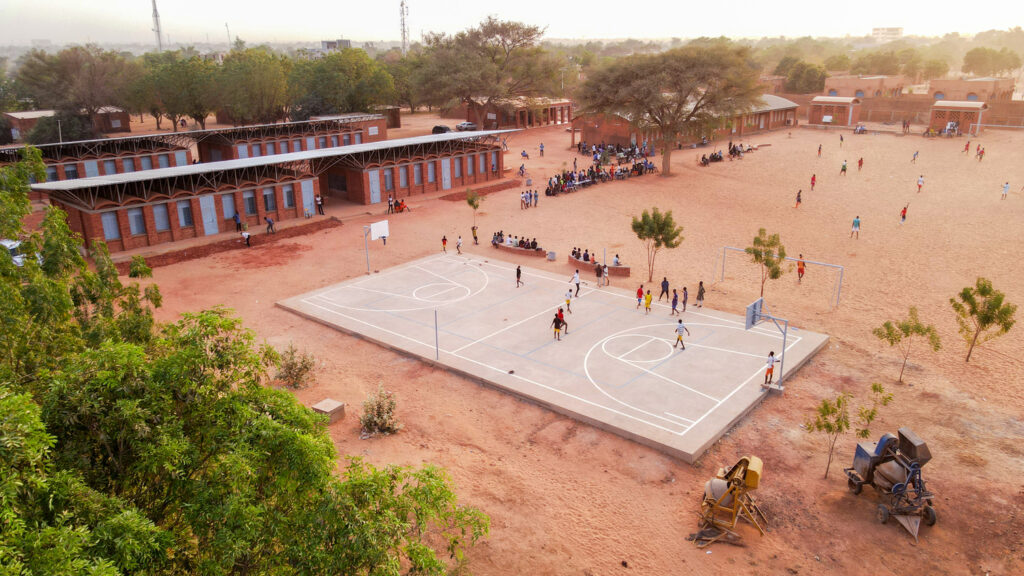
Our International Outreach Group provide engineering expertise on community projects that normally can’t access this kind of assistance. Our contributions are generally provided pro bono, with funding from the practice and the donation of time from staff. We often work on education and healthcare buildings, addressing fundamental needs such as water, sanitation, and shelter.
4. Does the practice publicly refuse to work with certain clients, suppliers or organisations on ethical grounds?
Our partnership of around 120 people is our highest decision-making body and our approach to ethical decisions is a process of continual discussion and response within the practice.
Project
1. Do the projects demonstrate deep engagement with local stakeholders and end users? For example, is there evidence that your project engagement goes beyond consultation towards co-design?
Our championing and delivery of soft landings commissions on a bunch of different projects moves from consultation towards co-design.
e.g. Agar Grove: Phase 1a completed in 2018. proof of concept that Passivhaus can be delivered at scale. Each phase has evolved and become progressively better and lower carbon. POE shows excellent energy performance and very happy and comfortable occupants.
e.g. Soil Association: enhanced end-user input through workshops.
In 2019, we were recognised by BSRIA as the Soft Landings Practitioner of the year at the inaugural awards. We continue to see Soft Landings and POE as important parts of delivering very high performing buildings.
The practice also delivers work experience opportunities to school students, typically in the 15-18 age range, which has previously been delivered by HR in conjunction with named supervising engineer(s).
The practice will continue to offer social value work opportunities across the offices on the 50:50 paid and voluntary basis.
Projects include Centre for Alternative Technology where mycelium insulation and local slate structural design are proposed.
2. Do your projects create connected and resilient places which positively contribute to their neighbourhoods and allow equality of access? For example, do your projects create economic opportunity, retain value locally and generate social value?
Our sustainability framework includes community, engagement and equity as key considerations alongside issues more established in industry as a focus of sustainability (such as energy use). We encourage clients to consider project benefits during the design and construction phases, not just the completed design, such as opportunities for co-design, education and training as part of the construction process. We encourage design teams to consider local sourcing, using local craftspeople, and local salvage yards to generate local economic opportunity.
3. Do the majority of your projects promote equity in society, and consider all people, not only the building inhabitants? For example, do your projects show due regard for workers within the supply chain and take active steps to avoid modern slavery?
We consider equity a fundamental aspect of sustainability. We encourage clients to consider wider society, and specifically how their proposals could widen access across the day/year and across society, to gain maximum benefit from the investment in development. We encourage clients to consider project benefits during the design and construction phases, not just the completed design, such as opportunities for co-design, education and training as part of the construction process.
We encourage clients to incorporate measures to reduce risk of modern slavery in the supply chain, in their construction contracts. We confirm our commitment against human trafficking and slavery of any form. As a Practice we are therefore committed to ensuring that we treat all members of the Practice, our suppliers, and other stakeholders in an open and transparent way and to satisfy ourselves that we only engage organisations whose treatment of their staff and own supply chain reflect our values. This includes professional services where we occasionally sub-contract part of the services we are appointed to provide.