
Submission by In Opera Group.
Being a good ancestor
Practice
1. Do you have a clearly stated purpose aligned with the planetary emergency? We’re looking for a bold ambition here, and a culture which recognises the need for long-term thinking.
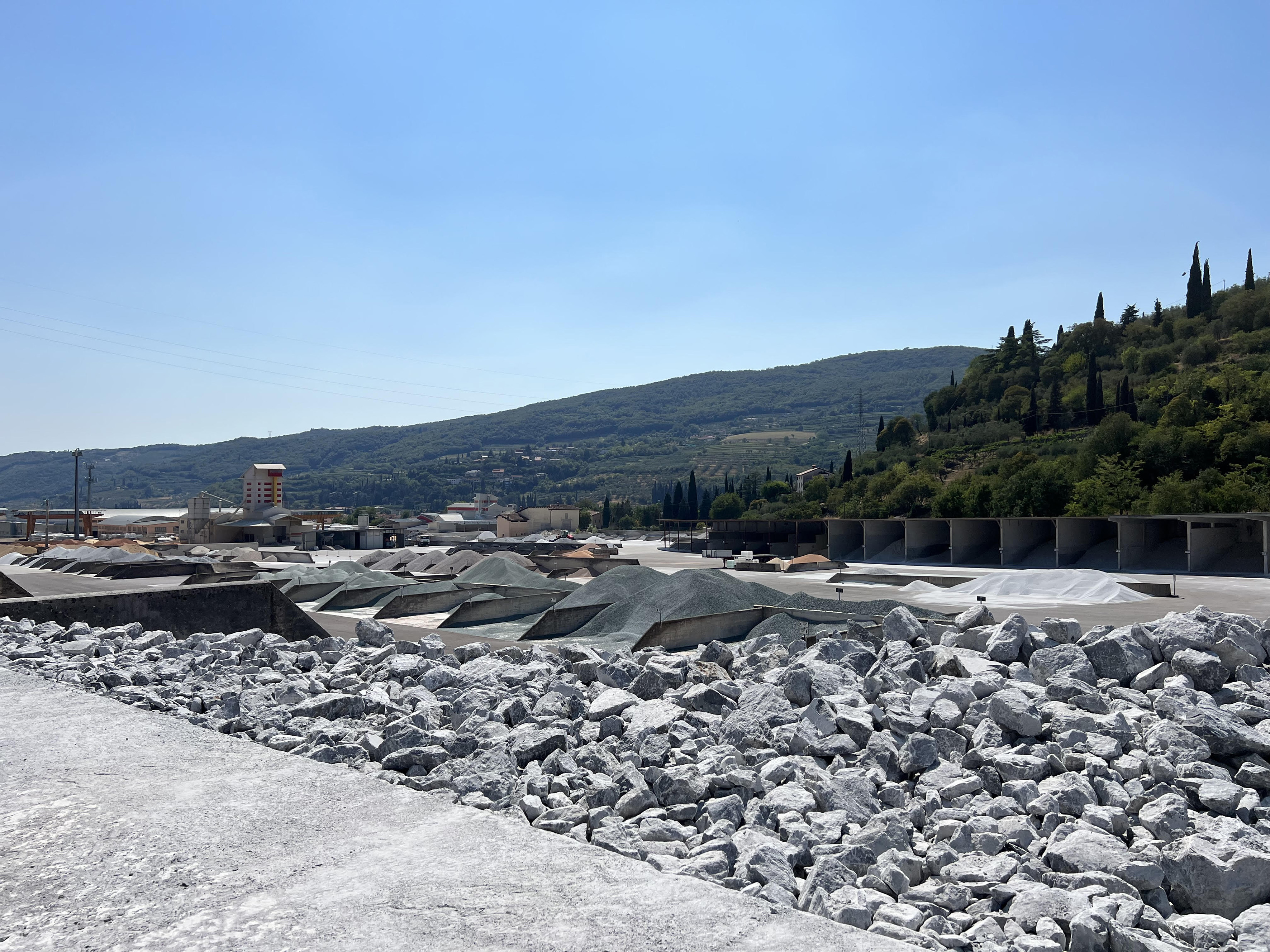
The planetary emergency strongly influences our choices in manufacture, process and operation. We invest in R&D and are about to launch an in-stu terrazzo that utilises a bio binder – plant oil, it’s been over 10 years in development, and supplied to Apple stores world-wide and other notable projects. The components are natural and the terrazzo is thin (a few mm) so can be overlayed on existing flooring systems. Our precast production, utilises approx 85% to 94% quarry waste within terrazzo slabs and blocks, reducing dependence on virgin extraction. The stone quarries we use have responsible sourcing. Our Porcelain tile and slab manufacturing systems operate on closed-loop principles, including zero wastewater discharge and increasing reliance on renewable and low-carbon energy sources such as photovoltaics and cogeneration. Our ambition is to contribute to a built environment that restores ecological balance, supports resource cycles, and prioritises long-term environmental performance over short-term consumption.
2. Do you have a clearly stated purpose aligned with the planetary emergency? We’re looking for a bold ambition here, and a culture which recognises the need for long-term thinking.
We embed our values in systems rather than individuals. Our governance, certifications, and operational processes ensure continuity. Environmental responsibility is applied consistently through frameworks such as ISO 14001, requiring ongoing measurement, accountability, and improvement. This ensures that sustainability cannot be diluted through leadership change. Knowledge is embedded in processes, enabling future leadership to inherit a clear mandate. Succession is therefore understood as stewardship of purpose, not simply transfer of ownership.
3. Do you share research and knowledge for the benefit of society and the wider world?
We consider transparency a collective responsibility. Through Environmental Product Declarations, we disclose lifecycle impacts to enable informed specification and challenge industry norms around material opacity. By aligning with recognised standards, we contribute to a shared framework for sustainable decision-making. Our work demonstrates how waste streams can become resources, offering a replicable model for circular manufacturing. We aim to support industry-wide learning, recognising that systemic change depends on open knowledge rather than competitive advantage. We work alongside other companies both in our factories and in our Design Hub, creating an environment where knowledge is celebrated and shared.
Project
1. Do you advocate for long-term thinking at the outset of work? Do you initiate work with long-term thinking and challenge clients? Also, can the organisation demonstrate that this approach has worked?
We prioritise long-term performance over short-term gain. Our materials are designed for durability, adaptability, and low maintenance, reducing lifecycle impact. We challenge clients to consider whole-life value through verified environmental data, encouraging decisions that account for future consequences. This reframes sustainability from compliance to responsibility, and positions materials as contributors to long-term environmental and social value.
2. Does your work take account of the future climate and the need for resilience?
We respond to climate change through material longevity, reduced carbon intensity, and resource efficiency. By integrating quarry waste and reducing reliance on virgin materials, we limit environmental degradation and embodied emissions. Our manufacturing processes minimise waste and energy demand, supporting climate mitigation. Our products are designed to perform over extended lifespans, contributing to resilient built environments capable of adapting to future conditions.
3. Does the majority of your work go beyond mitigating negatives and towards optimising positives?
We aim to create net-positive outcomes. Our processes transform waste into high-value resources, diverting materials from landfill and maintaining them within continuous cycles. Closed-loop water systems eliminate discharge, and renewable energy reduces fossil fuel dependence. These strategies move beyond efficiency toward regeneration, aligning production with ecological systems.
Co-evolving with nature
Practice
1. Do you use biophilia within your premises and/or do you regularly gather in natural settings?
We extend biophilia beyond visual or spatial expression, embedding it in systems thinking. Our processes reflect ecological cycles, where materials, water, and energy are continuously reused. This reflects a shift from separation to integration with natural systems.
2. Can you share examples of where you have considered nature in decision making?
We use ecological principles as a framework for decision-making and it’s nature who decides the colour of most of our terrazzo and natural stone, the production waste from which then goes back into the quarry to produce a new type of stone in millions of year’s time. Circular material flows, closed-loop water systems, and renewable energy adoption mirror natural processes. This approach reframes production as participation within ecosystems rather than extraction from them. We are launching a new product which uses a natural plant based oil for a binding agent rather than the more traditional cement or resin bases.
3. Are you supporting nature locally and nationally?
We reduce pressure on ecosystems by limiting extraction, reusing materials, and eliminating waste outputs. Our environmental management systems ensure measurable impact reduction and continuous improvement, contributing to wider ecological recovery. We have donated materials to a local park for their construction of a bug hotel.
Project
1. Can you demonstrate work that strives to match the performance of a mature ecosystem?
While industrial processes cannot fully replicate ecosystems, we move toward their logic. Our systems minimise waste and maintain resource cycles, reflecting principles of mature ecosystems where outputs become inputs.
2. Are you working on material stewardship?
We treat materials as part of a continuous cycle. By prioritising quarry waste and providing transparent lifecycle data, we support responsible specification and long-term accountability. We push for innovation and are exploring a new product with plant oil as a binding agent for terrazzo. For us stewardship means retaining value within the system and designing out waste.
3. Does the majority of your work demonstrate the use of biologically-inspired approaches such as Bioregionalism, Biophilia or Biomimicry?
Our processes reflect biomimicry through circularity and resource efficiency. By ensuring that materials are continuously reused, we align production with natural cycles and support regenerative design thinking.
Creating a just space for people
Practice
1. Do you have a progressive EDI policy and can you evidence many forms of diversity, which are welcomed and acknowledged, within your company/organisation?
We recognise that environmental and social sustainability are interconnected. Our organisational structures support inclusive, equitable, and fair working practices aligned with recognised standards. Our organisation is both international and multicultural.
2. Do you operate a no overtime culture, meet the living wage consistently, and stipulate a fair salary ratio between staff of all levels?
We are committed to fair, safe, and supportive working conditions. Structured systems ensure consistency, wellbeing, and equity across all roles.
3. Do you support charities, community groups, social enterprises, action groups and others through pro-bono work, charitable giving or in-kind donations?
We contribute to society by enabling more sustainable construction practices, supporting healthier environments and more resilient communities. We support both local and national charities.
4. Do you use an ethical framework to assess opportunities and/or supply chain partners and is them team consulted on these decisions?
Our ethical framework is embedded in our operational systems and certifications, guiding responsible decision-making across supply chains and production.
Project
1. Does your work demonstrate deep engagement with local stakeholders and end users?
We support informed decision-making through transparency and collaboration, enabling designers and clients to engage with environmental data and material impacts.
2. Does your work create connected and resilient communities which positively contribute to neighbourhoods and allow equality of access?
Our products contribute to durable, low-impact built environments that support long-term community resilience and accessibility.
3. Does the majority of your work promote equity in society, and consider all people, not only building inhabitants
By reducing environmental impact and supporting responsible resource use, our work contributes to broader societal equity and long-term wellbeing.