
Submission by Howells.
Being a good ancestor
Practice
1. Do you have a clearly stated purpose aligned with the planetary emergency? We’re looking for a bold ambition here, and a culture which recognises the need for long-term thinking.
In the context of the planetary emergency, our overarching and bold vision is to help deliver projects with benefits that go well beyond sites’ boundaries both spatially, demographically and over time. We endeavour to create diverse, civic and environmentally responsive neighbourhoods that balance density, public life and nature, where landscape, ecology and human experience come together to form resilient and engaging spaces that benefit thousands beyond the red line and will endure the test of time. From London City Island and Royal Wharf in London to Port Loop, Birmingham and Bray in Ireland, this approach has helped create neighbourhoods with distinctive characters but that have in common exceptional amount of space given back to nature reaching out to a much wider area in parallel to establishing critical connections to support local economies and a diversity of people that represent a just and fair society that belongs to all.
2. Do you have a clearly stated purpose aligned with the planetary emergency? We’re looking for a bold ambition here, and a culture which recognises the need for long-term thinking.
Our values and legacy are embedded in our design philosophy to create enduring projects that are lean in resource use, elegant and crafted in outlook to help enrich neighbourhoods and built with durability in mind. And we have witnessed the powerful impact of our projects that have facilitated people’s connection with nature and their community. As we just celebrated 35 years of practice, we are confident this legacy will endure and we regularly organise talks and walks for our staff to illustrate and reinforce our design values.
3. Do you share research and knowledge for the benefit of society and the wider world?
We strive to share our knowledge and put a great focus on young people. We hosted Young City Makers, part of Open City, introducing young people to architecture and city-making through hands-on workshops. We got them to ‘think like an architect’ working to a brief exploring themes of community, nature, and belonging, developing their ideas through drawing, collage, and model-making. We also regularly host an annual Summer School for 15-18 years old from across the West Midlands.
In 2026 we contributed amongst other events to a talk on the legacy of the Cathorpe Estate, or the Birmingham AA exhibition ‘Women in Architecture’. In April, in collaboration with NLA, we hosted a roundtable at our London studio, discussing the challenges of workplace retrofit projects, in light of both financial and carbon costs. In October we will speak at the Building for Future Conference about our transformative nature-led Eden Dock project.
Project
1. Do you advocate for long-term thinking at the outset of work? Do you initiate work with long-term thinking and challenge clients? Also, can the organisation demonstrate that this approach has worked?
Our overarching vision is to deliver urban and/or infrastructure benefits that reach out far beyond the redline and with enduring placemaking impact. At Royal Wharf/Riverscape, an out-of-bound disused dock infrastructure site was successfully transformed into a lively neighbourhood, the masterplan principles of which were subsequently adopted by the LB Newham as its wider development strategy. We sketched the river context several miles east and west of the site’s Thames frontage, analysing the tapestry of green spaces, community infrastructure and transport stretching from Canary Wharf to the Thames Barrier, which is far beyond the site’s high-value frontage. This design vision led to the creation of a neighbourhood with not just its high street and essential amenities but also new connections to the river and transport links, and one of the longest stretches of open green space along the Thames equally beneficial to adjacent communities and those living beyond.
2. Does your work take account of the future climate and the need for resilience?
Our projects address climate risks from the onset, not least storm, flood and overheating risks. For instance in our Bray masterplan in Ireland we shaped a new neighbourhood with a central park at its heart key to the town flood resilience. The two-hectare park helps manage stormwater from the nearby Wicklow Mountains that feeds into the River Dargle at the site southern edge. The park is designed to provide flood-storage capacity during extreme events modelled and tested to replicate Hurricane Charley’s severity. Stormwater is then channelled to the harbour. Retained mature trees maintain existing biodiversity whilst the town residents benefit from exceptional green and blue environments.
Resilience including adaptation to climate change is also one of the 4 pillars of ‘Our Future City’, a framework plan for Birmingham CC we helped develop through our design and placemaking expertise with a clear route map for the city’s zero-carbon future by 2040.
3. Does the majority of your work go beyond mitigating negatives and towards optimising positives?
This is our ambition! At Eden Dock we helped create a new natural environment that supports local biodiversity both under and above water whilst being truly transformative for the business community and the growing resident population. In Edgware our recently approved masterplan has transformed an area that had historically become dominated by car and air pollution, and severed access to civic infrastructure, with a poor life quality a reality for many. The masterplan creates not only new public realm, commercial, leisure and civic infrastructure but also exceptional links to Deans Brook Nature Park and a zero emissions transport hub. We engaged with local communities including the Pupils from Edgware Primary School (creating an exhibition with paintings, drawings and outstanding sculptures) and thanks to our collaboration with Make Space for Girls the masterplan includes truly inclusive public spaces with teenage girls in mind, incorporating safe seating, social areas and age-appropriate play.
Co-evolving with nature
Practice
1. Do you use biophilia within your premises and/or do you regularly gather in natural settings?
Several years ago we decided that we needed plants in our office in London where we enjoyed plenty of natural light. This was done without requesting a budget and has been the case since. This also encouraged people to bring in their own plants to put on their desk if so they wished. We recently moved to our new premises – also full of natural light – and the plants are still dotted around the space including in our boardroom and amongst our models.
2. Can you share examples of where you have considered nature in decision making?
No.
3. Are you supporting nature locally and nationally?
We often take part in activities around nature. Last year as part of Mental Health Awareness Week we contributed to the Wildflowers replanting project by the Royal Parks in Regents Park in London. When not actively supporting a project, nonetheless we encourage connections with nature and often our social events involve walking through parks or by the river to combine urban exploration with exposure to nature. This year for MHAW we organised an extended walk through the canal to King’s Cross stopping by Granary Square to take a look at the Dandelions Always Return art installation and enjoy lunch at the Canalside Green Steps.
Project
1. Can you demonstrate work that strives to match the performance of a mature ecosystem?
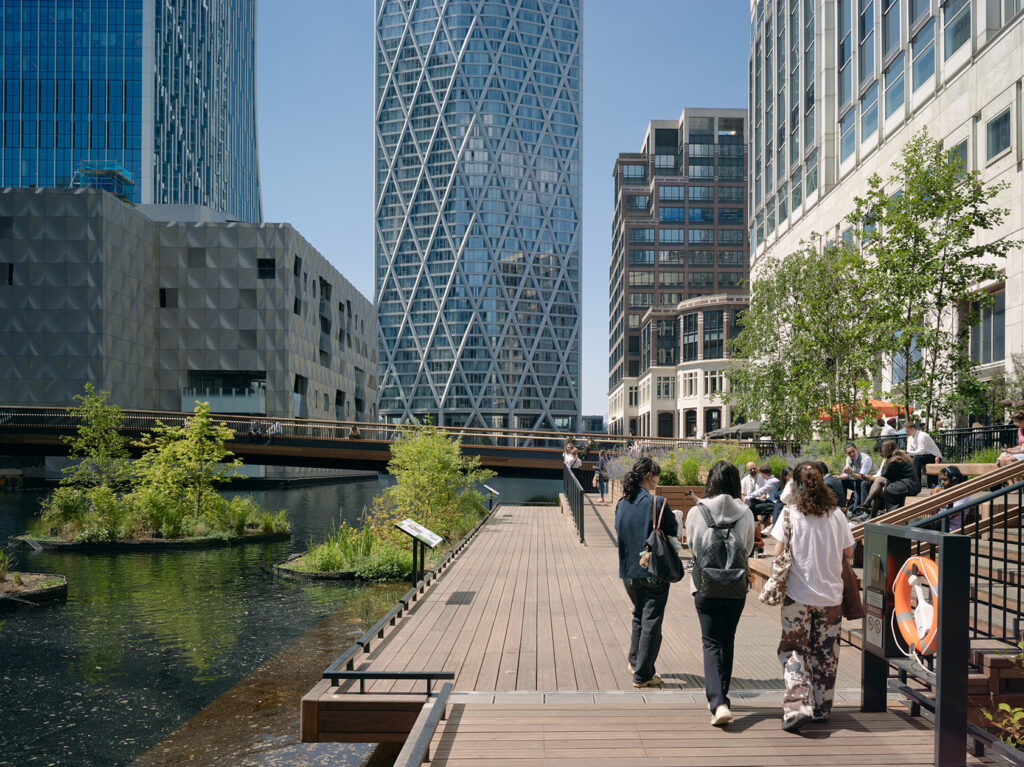
Wherever we are making intervention that involves nature we will always work with ecological consultants and landscape designers to design for a thriving natural environment that either supports and enhances existing mature ecosystems or will develop into one. The latter was done at Canary Wharf: Eden Dock is a nature-focused public amenity space that has been transformative for this hard-edged area serving both the surrounding business community and the growing number of residents. With 55% BNG it exemplifies a nature-led placemaking with floating islands and aquatic shelves, and pontoons with planting and trees besides and amongst benches for people to just sit and relax…; or accommodate nature-led educational activities. Another nature-led place-making oasis was created in Gloucestershire for a motorway service station where the project worked to respect the natural land levels and the existing ecosystem by being embedded within the site’s undulating topography.
2. Are you working on material stewardship?
No.
3. Does the majority of your work demonstrate the use of biologically-inspired approaches such as Bioregionalism, Biophilia or Biomimicry?
We would apply bioregionalism principles where relevant but biophilia is the approach that is most systematically adopted in our projects through the use of natural materials that are left exposed (stone, timber), extensive visual connections with plant-based and/or water-based natural settings (whether existing or created) and the creation of landscaped environments to enhance biodiversity. In addition, generous daylighting is a cornerstone of all our work. Once we considered putting nature at the centre of our projects to support people’s wellbeing. Nature is however so fundamental in addressing the current climate and biodiversity crises that we are celebrating seeing its role elevated even further in our work through measures such as food production, storm management or water savings street design.
Creating a just space for people
Practice
1. Do you have a progressive EDI policy and can you evidence many forms of diversity, which are welcomed and acknowledged, within your company/organisation?
We are proud of the diversity of our team which reflects the rich ethnicity of both London and Birmingham. Our EDI statement sets out how we ensure our ongoing commitment to equality and inclusivity. We have signed the NLA’s Diverse Leaders Pledge and the Future of London Speaker’s pledge to reinforce our commitment.
We monitor non-financial KPIs which includes diversity and also measures diversity in leadership roles (senior architect and above). This data is actively monitored by our People and Performance Manager, who reports to our quarterly Strategic Board where this information is reviewed, and targets are agreed.
We recognise the need to improve and/or maintain diversity and inclusion within the practice. We actively promote and advertise positions to all, including those from ethnic minority or disadvantaged backgrounds. All our vacancies are advertised on our own website and social media and through easily accessible websites such as LinkedIn and Indeed.
2. Do you operate a no overtime culture, meet the living wage consistently, and stipulate a fair salary ratio between staff of all levels?
Yes. We are signed up to the Living Wage Foundation as we believe that everyone who works for us deserves a wage that meets their everyday needs and therefore every member of our team, including people who join us for an internship or apprenticeship, will earn the Real Living Wage.
3. Do you support charities, community groups, social enterprises, action groups and others through pro-bono work, charitable giving or in-kind donations?
We love to support charities in many different ways! Over the last year we have supported Love Brum, Feedo Needo, B:Music, Open City, Ikon Gallery through donations of time, membership of Boards, requested items, and by raising money through charitable events. For LandAid, we organise an annual football and netball tournament and take part in their annual Sleep out to raise funds for the charity. Also every year we run the HD5K raising funds for Motor Neurone Disease. Our Sustainability Lead has been volunteering for Climate Emergency UK, a not-for-profit organisation that scrutinises councils on their climate pledges through published scorecards; as well as providing training for councillors and ordinary members of the public. Besides, we support the next generation of designers with our Summer Design School in Birmingham and we share our Birmingham office with Smart Works, an organisation that helps women in need get back into work.
4. Do you use an ethical framework to assess opportunities and/or supply chain partners and is them team consulted on these decisions?
No.
Project
1. Does your work demonstrate deep engagement with local stakeholders and end users?
We want to create neighbourhoods that last the test of time and fundamental to this are the diverse views of users and local stakeholders. In Salford the team consulted for over two years with local stakeholders on the 18-hectare masterplan. This led to ambitious proposals to deliver a holistic regeneration project for existing residents and businesses, as well as acting as a catalyst to redevelopment in the whole city. The project received the Salford Good Design Award in 2010. More recently in the large Edgware Town Centre, West London, stakeholder engagement was critical in shaping both brief and the masterplan. More than 150 engagement meetings and events were held over 175 hours, and 1,900 online contributions received after 30,000 visit to the consultation website, involving more than 3,300 local community members. Public exhibitions and targeted workshops included experts groups in the community as well as, crucially, youth engagement.
2. Does your work create connected and resilient communities which positively contribute to neighbourhoods and allow equality of access?
We think of all our projects as opportunities to create diverse, healthy, just and affordable communities with spaces that facilitate connections and a sense of belonging. One example is Port Loop, a newly created walkable and permeable neighbourhood 15-minute away from Birmingham Centre on foot, thanks to the creation of new towpaths. Knowledge economy, family life and recreational green and blue space accessible by every home, coexist alongside built heritage. At its heart is the layering of communal green spaces for different generations of users, as well as the curation of events that facilitate social networks such as outdoor cinema, festivals and arts events. A manifesto created with residents for living reiterates the kind of neighbourhood they want (in 2022 residents also elected their first Mayor), where kids can play outside until teatime, streets are green and pedestrian-friendly, and where homes adapt to people, not the other way round.
3. Does the majority of your work promote equity in society, and consider all people, not only building inhabitants
We think of our projects as a small part of an urban puzzle that needs to play a big part in allowing wider society to thrive. On Walworth Road our social housing and student accommodation-led project puts the community at its heart with a permeable ground floor given to a new public route, landscaped courtyard garden, and dedicated community space and kitchen, all active and meaningful contributor to public life bringing together local residents, students and the wider public.
Likewise, our approved masterplan for Edgware aims to unlock a site dominated by car where a lack of active travel infrastructure and air pollution, and the erosion of greenery, have impacted negatively on the quality of life there. Through a network of green, walkable streets and new public, retail and civic spaces, the project connects separated communities and facilities for the benefit of current and future generations in the wider area.