
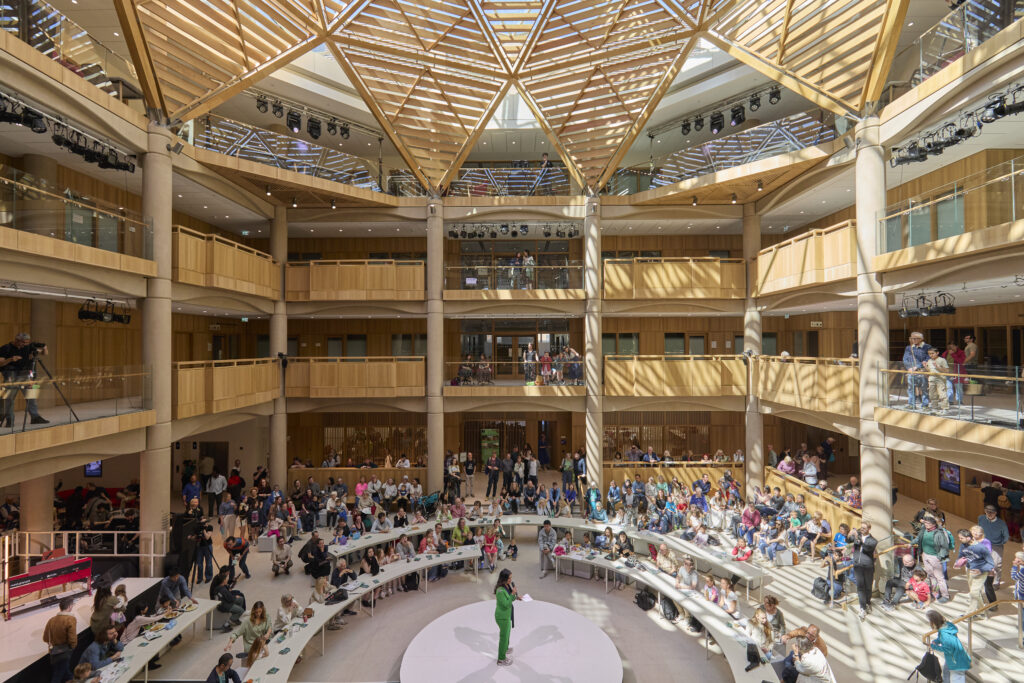
Submission by Hopkins Architects.
Being a good ancestor
Practice
1. Do you have a clearly stated purpose aligned with the planetary emergency? We’re looking for a bold ambition here, and a culture which recognises the need for long-term thinking.
We recognise that design has the greatest potential to influence carbon emissions and material depletion, which is why environmental thinking has been central to our practice for over 40 years. We use materials as efficiently as possible, expressing their natural qualities rather than concealing them beneath secondary finishes. Increasingly, we champion high-performance building envelopes, including Passivhaus standards, as demonstrated at the Schwarzman Centre for the Humanities, University of Oxford.
We also recognise that buildings must adapt — both to evolving uses and a changing climate. Our Inland Revenue building in Nottingham found new life as student accommodation for Nottingham University, while we are currently retrofitting our own Marylebone offices to meet future climate demands. Our flexible, modular design approach ensures changes with minimal disruption.
Looking ahead, our ambition remains to design robust, well-crafted buildings that respond intelligently to environmental challenges and the ever-evolving needs of the world around them.
2. Do you have a clearly stated purpose aligned with the planetary emergency? We’re looking for a bold ambition here, and a culture which recognises the need for long-term thinking.
Hopkins Architects is structured as an Employee Ownership Trust, placing the Practice in long term employee stewardship through an indirect ownership model. This creates a clear succession framework that protects the values, culture and legacy established by those who have built the Practice, while ensuring continuity beyond any single generation.
Our governance includes an Employee Council with elected representatives from every staff group, including Directors, Associate Directors, Project Architects, Architects, Part 1 and Part 2 Assistants, and Support Staff. The Council meets quarterly to raise staff priorities, gather feedback, and report to the Board, embedding our culture in daily decisions and long-term planning.
The Council has already delivered tangible improvements, including enhanced maternity and paternity provision, agreed core hours, a structured mentoring scheme, and improved break out spaces. Together, the EOT and representative governance safeguard independence, support succession, and keep the practice aligned with its founding principles.
3. Do you share research and knowledge for the benefit of society and the wider world?
We actively share knowledge across professional and academic platforms. Our technical approaches to low-energy design have been featured in the RIBA Journal as examples of best practice, while our involvement with NLA has enabled us to contribute to wider discussions on London’s evolving built environment, including large-scale urban and mixed-use projects.
The practice has also participated in RIBA lectures, talks and exhibitions, where partners and team members have shared insights on sustainability, design innovation and project delivery with practitioners, students and wider audiences. Several team members also teach alongside their practice roles, sharing professional knowledge and supporting the next generation of architects and designers.
We also publish technical and research-led articles through the journal section of our website, covering topics such as low-energy design, whole-life carbon, Passivhaus, adaptive reuse and responsible material strategies. These are shared through social media to make project learning accessible to the wider industry.
Project
1. Do you advocate for long-term thinking at the outset of work? Do you initiate work with long-term thinking and challenge clients? Also, can the organisation demonstrate that this approach has worked?
We seek to embed long-term thinking from the outset of projects, encouraging clients to consider design life, durability, operational performance and whole-life value alongside capital cost.
The Practice’s work for the Schwarzman Centre for the Humanities at the University of Oxford reflects a similar approach, supported by an institutional client with a long-term outlook. The Schwarzman Centre for the Humanities reinforces this through its Passivhaus ambition, prioritising energy efficiency, comfort and low operational carbon.
More recently, South Molton has applied whole-life thinking through adaptive reuse, retained listed buildings and façades, and reused materials, demonstrating how heritage, adaptability and circular design can reduce cost and carbon while supporting long-term asset value.
2. Does your work take account of the future climate and the need for resilience?
The Practice has consistently embedded resilience into its work, from pioneering modular systems to contemporary schemes that prioritise adaptability, resource efficiency and long-term environmental performance.
The Schwarzman Centre for the Humanities provides a strong recent example. Its Passivhaus design helps minimise energy demand, maintain comfort and support passive survivability during periods of extreme weather or energy disruption. By reducing reliance on active systems and prioritising a high-performance building fabric, the project is better equipped to maintain stable internal conditions over time. Early performance monitoring over winter has already indicated that the Centre’s heating system requires approximately half the energy of similar non-Passivhaus buildings on a pro rata basis.
The building is also designed for long-term adaptability, with a flexible column grid, well-distributed vertical service cores, raised access floors and servicing redundancy. Non-structural internal walls allow future reconfiguration, supporting changing user needs while reducing the need for significant future intervention.
3. Does the majority of your work go beyond mitigating negatives and towards optimising positives?
The majority of our projects move beyond mitigating harm by identifying opportunities to create wider environmental, social, and long-term value. Across our portfolio, this is demonstrated through low-energy design, adaptive reuse, circular material strategies, biodiversity, and enhanced wellbeing.
The Schwarzman Centre for the Humanities at the University of Oxford is a compelling example. Bringing together teaching, research, libraries, performance venues, and public engagement spaces around a public route and Great Hall, the scheme is certified as England’s largest Passivhaus building and the world’s first Passivhaus concert hall, achieving low-energy performance, occupant comfort, and significant civic value simultaneously.
At South Molton, the ambition extends beyond carbon reduction, combining adaptive reuse, heritage retention, circular material strategies, and landscaped terraces to create a more active mixed-use public realm. Together, these projects reflect a practice-wide commitment to treating sustainability and social value as integrated ambitions from the outset.
Co-evolving with nature
Practice
1. Do you use biophilia within your premises and/or do you regularly gather in natural settings?
Planting has been carefully integrated into both the office interior and the surrounding external spaces, creating a strong connection with nature. Inside, greenery helps to soften the workspace and create a more welcoming environment, while the external landscaping provides a calm and restorative setting.
Open-air seating is positioned within the planting scheme, offering comfortable areas for rest, informal conversations and meetings. Large areas of glazing bring generous natural light into the office and maintain clear visual connections with the outdoors, reinforcing a sense of openness and wellbeing.
The Practice also encourages opportunities to gather beyond the office, including project visits, study trips, walks, away days, softball and run club, as well as other informal team activities. These moments allow people to connect with one another in natural or outdoor settings, supporting wellbeing, reflection and shared learning while reinforcing the Practice’s wider interest in climate, landscape and place.
2. Can you share examples of where you have considered nature in decision making?
Within our Practice, this is also reflected in how people work. The company provides flexibility for employees to manage their time according to their needs, including the option to work remotely in response to workload, personal circumstances and seasonal demands. This supports wellbeing and acknowledges that people’s capacity and working patterns may vary throughout the year.
The Practice also organises regular social gatherings that include presentations and shared learning. These events provide opportunities to recognise and celebrate seasonal moments, including cultural festivals and traditions from the diverse nationalities represented within the workforce. In this way, the Practice supports a more inclusive studio culture while maintaining a connection to seasonal rhythms, community and place.
3. Are you supporting nature locally and nationally?
Across its projects, the Practice seeks opportunities to strengthen the relationship between people, buildings and nature. This is achieved through landscape-led design, planting, biodiversity enhancement, access to daylight and views, natural materials, and outdoor amenity spaces.
Within the office, we operate a tree-planting policy to help offset paper consumption. This is delivered through the National Forest, a 200-square-mile forestation project in the Midlands managed by a non-profit organisation. By linking paper use to tree planting, the practice creates a tangible response to resource consumption while supporting woodland creation and landscape restoration.
We also use Fruitful Office for twice-weekly fruit basket deliveries, available to all employees. The supplier was selected because much of its fruit is sourced from the UK and Western Europe, helping to reduce food miles. For every basket purchased, Fruitful Office supports the planting of a fruit tree in Malawi through the UK charity Ripple Africa.
Project
1. Can you demonstrate work that strives to match the performance of a mature ecosystem?
Biodiversity and ecological resilience are considered from the design stage, with project ecologists helping to identify opportunities for habitat creation, species support, sustainable water management and long-term ecological enhancement. Rather than treating biodiversity as a separate requirement, these measures are integrated into the landscape and building design.
At Haileybury SciTech, proposals include a wildflower green roof to support pollinators, enhancement of the existing pond to improve aquatic biodiversity, a new swale for sustainable drainage and habitat creation, and diversified tree planting across the site. Swift boxes and integrated bat boxes were provide nesting and roosting opportunities. Design-stage ecological calculations calculated over 17% total net gain in habitat.
Across the wider Eton sports facilities site, wider ecological measures include replacement tree planting, bat boxes, bat tiles, new privet hedgerows, species-rich grassland and sensitive lighting. The scheme is expected to deliver over 16% net gain in habitat area, alongside increased hedgerow habitat.
2. Are you working on material stewardship?
The Practice is actively increasing its expertise in whole-life material performance, supported by relevant digital tools and software. As part of this, Hopkins is implementing a tailored digital Materials Library with Materials Council, integrated with our existing physical library. The library identifies more sustainable material options, helping teams make informed specification decisions from the earliest design stages. This work is supported by sustainability guidelines that assist material selection in line with environmental and performance objectives, including embodied carbon, durability, reuse potential, maintenance and end-of-life considerations.
This broader commitment to whole-life material performance is reflected in projects such as South Molton, where the retention of existing façades, reuse of Portland stone, salvaged bricks and preservation of existing finishes demonstrate a practical approach to material conservation and reuse. The project shows how recognising existing material value early can reduce embodied carbon, waste and cost, while supporting circular design and construction.
3. Does the majority of your work demonstrate the use of biologically-inspired approaches such as Bioregionalism, Biophilia or Biomimicry?
No.
Creating a just space for people
Practice
1. Do you have a progressive EDI policy and can you evidence many forms of diversity, which are welcomed and acknowledged, within your company/organisation?
We have a progressive EDI approach, underpinned by our equal opportunities policy, which is designed to ensure that all employees are treated fairly, respectfully and without discrimination. We aim to create a workplace in which different backgrounds, perspectives and experiences are recognised, welcomed and valued.
To help address unconscious bias, we provide training for all employees, with mandatory sessions for senior management and anyone involved in recruitment. We also support staff through enhanced maternity and paternity policies, recognising the importance of family life and caring responsibilities.
We are proud participants in the ‘10,000 Black Interns’ programme and welcome an intern into the Practice each year to help tackle underrepresentation in the profession. We also offer financial support to employees undertaking a Level 7 Apprenticeship, helping to create more financially inclusive routes into architecture and supporting accessible education, professional development and long-term career progression for people from all backgrounds equally.
2. Do you operate a no overtime culture, meet the living wage consistently, and stipulate a fair salary ratio between staff of all levels?
We are committed to fair and responsible employment practices. All employees are paid at least the London Living Wage as a minimum standard. We monitor overtime carefully and, where appropriate, provide time off in lieu to support a healthy work-life balance.
To help ensure pay remains fair and competitive across all levels of the organisation, we benchmark salaries against industry standards on a regular basis. We also monitor and share the gender pay gap within the Practice as part of our wider commitment to equity, transparency and continuous improvement in pay practices.
3. Do you support charities, community groups, social enterprises, action groups and others through pro-bono work, charitable giving or in-kind donations?
Our Practice supports charities, community groups, social enterprises, educational organisations and wider community initiatives through charitable giving, in-kind support, pro-bono contributions and the sharing of staff time and expertise.
Each year, our Employee Council organises a staff poll to decide how a dedicated office donation is distributed, ensuring support is directed towards causes that matter to our employees.
Organisations we have supported include the London School of Architecture, the Architects Benevolent Society and Club Peloton, alongside a range of schools, universities and educational institutions. Examples include providing work experience for students from Abingdon House School in Marylebone, Westminster University, Westminster City Lions, and volunteering at St Mary’s Bryanston Square school.
4. Do you use an ethical framework to assess opportunities and/or supply chain partners and is them team consulted on these decisions?
We apply ethical considerations when assessing opportunities, collaborators and supply chain partners. This includes considering alignment with the practice’s values, sustainability ambitions, social impact, environmental performance and procurement responsibilities.
The team is consulted through project reviews, sustainability discussions, leadership input and internal meetings, ensuring that ethical considerations are not treated as separate from design, delivery and practice culture.
Project
1. Does your work demonstrate deep engagement with local stakeholders and end users?
Our projects demonstrate engagement with local stakeholders and end users, often going beyond consultation to involve users in shaping the brief, spatial organisation and long-term use of the building.
The Schwarzman Centre for the Humanities at the University of Oxford is a strong example. The project was developed through engagement with academics, librarians, students, staff, planning authorities, heritage groups and local residents. Internal user groups participated in workshops and presentations, helping to build shared ownership and inform the design of teaching, research, library, performance and public engagement spaces.
This process directly influenced the building’s flexible and multifunctional layout. Teaching rooms, performance venues, shared public areas and informal learning spaces were developed to support varied and evolving needs. The public ground-floor route and Great Hall were also shaped by the ambition to create a more open relationship between the University and the wider city.
This demonstrates engagement beyond simple consultation.
2. Does your work create connected and resilient communities which positively contribute to neighbourhoods and allow equality of access?
We seek to create connected and resilient places by improving access, strengthening local identity and supporting long-term social, cultural and economic value.
The Schwarzman Centre for the Humanities at the University of Oxford is a clear example. It brings together teaching, research, libraries, performance venues, exhibition and public engagement spaces within one academic and cultural hub. A public ground-floor route, centred around the Great Hall, creates a welcoming sequence of shared spaces where academic and public life can overlap.
The project supports equality of access through step-free routes, lifts, accessible WCs, Changing Places provision, gender-neutral toilets, quiet rooms, hearing enhancement, and support for captioning, audio description and BSL at selected events.
It also contributes wider social and economic value through public cultural programming, outreach to schools and community groups, and regional supply chains. During construction, 97% of companies involved were British-based, helping retain value locally and support wider economic resilience.
3. Does the majority of your work promote equity in society, and consider all people, not only building inhabitants
Our work seeks to promote equity by considering not only building users, but also wider communities, future occupants and those involved in project delivery.
This is reflected in the design of inclusive, accessible and welcoming environments, with step-free routes, accessible facilities, clear wayfinding, quiet spaces and, where appropriate, public-facing programmes that widen access to cultural, educational or civic resources.
The Schwarzman Centre for the Humanities at the University of Oxford is a strong example. It supports a broad range of users through publicly accessible cultural spaces, outreach facilities, Changing Places provision, gender-neutral toilets, hearing enhancement, and support for captioning, audio description and BSL at selected events.
Equity is also considered through responsible procurement. The practice asks subconsultants to confirm their services and activities are free from modern slavery, and expects all collaborators to uphold labour standards, ethical sourcing and supply chain transparency.