
Submission by Hamilton Hay Van Jonker.
Being a good ancestor
Practice
1. Do you have a clearly stated purpose aligned with the planetary emergency? We’re looking for a bold ambition here, and a culture which recognises the need for long-term thinking.
Hamilton Hay Van Jonker was founded in 2024 with the strategic aims of combining strong visioning and architectural design with in-house specialisms in conservation and environmental sustainability, recognising the imperative to optimise re-use of our existing built heritage and reduce emissions. Our aim is to help revitalise places, discover potential and conserve resources through developing a deep understanding of user needs and the sensitive contexts in which we work.
Our mission statement sets out that:
We are an integrated studio of architects, heritage consultants and sustainability specialists. Working with ambitious clients we develop inspirational projects which connect people to their environment, to their past, and to a shared sustainable future.
In the past year we have continued to develop our internal policies to reflect our office values, reflecting on ongoing projects openly as an office.
2. Do you have a clearly stated purpose aligned with the planetary emergency? We’re looking for a bold ambition here, and a culture which recognises the need for long-term thinking.
No.
3. Do you share research and knowledge for the benefit of society and the wider world?
The practice continually engages in research, with team members encouraged to internally share their current lines of enquiry amongst the office. Externally, team members contribute to local working groups – these are cross pollination events which encourage practice-to-practice knowledge sharing, including hosting conversations on EDI and architectural conservation.
The practice has continued to contribute to numerous speaking engagements, journal articles and other media on a range of topics. We provided commentary on local policy issues on challenges and opportunities relating to adaptation of heritage buildings and on issues of climate justice. This year, we have been collaborating with expert authors to illustrate HES’s GP6, a guide to working with traditional buildings.
Team members regularly contribute to education and career development through teaching and Part 3 examination Last summer we organised a highly successful Speed Mentoring event, where two dozen early-career architects got the chance to connect with built environment mentors.
Project
1. Do you advocate for long-term thinking at the outset of work? Do you initiate work with long-term thinking and challenge clients? Also, can the organisation demonstrate that this approach has worked?
We use the lens of heritage to understand the long-term vision of a project, as much of our work involves existing and listed buildings in sensitive historic contexts. We recognise the importance of these buildings to future generations and our role as custodians, sensitively altering fabric to ensure the spaces can become accessible and remain culturally relevant. We bring the same attitude to all of our projects, regardless of listed status, as pieces of future heritage.
We recently completed a strategic review of estate-wide energy use of 35 UK theatres, producing guidance on net-zero targets, industry best-practice and benchmarking. The research aim was to provide the client with information and tools to assist in strategic interventions with tangible carbon reduction potential, developing a holistic, long-term roadmap for energy reduction estate-wide. Delivery of projects often involves taking a long-term view and phased approach.
2. Does your work take account of the future climate and the need for resilience?
Much of our work involves the adaptation of existing buildings. We understand that our involvement is one chapter in the building’s history, and ensure we design in a way that facilitates future generations to continue to adapt the design. We work with clients to examine options for flexibility and adaptation given challenging constraints.
On one residential project, the client is carrying out much of the building work as a self-build. This has required an approach to detailing that is simple to construct and therefore alter and uses healthy building materials that the client can install themselves.
In a project for three retrofit Housing Association homes, we will be carrying out extensive thermal improvements including complete internal insulation. The construction is typical of the local area, making this an opportunity to develop a toolkit for future similar work throughout the city.
3. Does the majority of your work go beyond mitigating negatives and towards optimising positives?
We tailor our approach to meet the needs of a variety of scales of projects, but in doing so always strive to optimise opportunities for low-carbon solutions.
We are undertaking a Whole Life Carbon assessment for our project at Glasgow King’s Theatre to assess the project’s potential and benchmark energy use. The project is being tracked against the UK Net Zero Carbon Building Standard’s metrics for embodied and operational energy.
On smaller projects, we have used comparisons of embodied energy in key design elements to inform design decision-making, for example comparing & presenting various wall build-ups with different impacts to a private residential client.
Wherever possible the practice aims to use natural building materials, and we encourage clients to consider re-used materials.
In all of our projects we see the integration of heritage and sustainability as a route to optimising the positive outcomes.
Co-evolving with nature
Practice
1. Do you use biophilia within your premises and/or do you regularly gather in natural settings?
When choosing a location for the new office premises, the proximity of green space was an important deciding factor. Our office is situated next to the River Clyde in Glasgow, and 80 metres from the entrance to Glasgow Green, one of the city’s largest parks.
This offers staff a daily opportunity to experience the natural setting on our doorstep, as we recognise the importance of this on employee well-being. The proximity of this amenity also provides staff with the opportunity to make use of active travel networks along the river and through the park, providing a chance for wellbeing breaks and stress relief.
Our office hosts a weekly lunch made by colleagues every Wednesday, and we have regularly eaten this together as a picnic in the park, acknowledging the importance of the whole office taking breaks together and enjoying the outdoors.
2. Can you share examples of where you have considered nature in decision making?
We recently carried out a study for Dunoon Pier, a significant heritage asset affected by climate change, to find a sustainable future use rooted in community need. The project’s coastal location makes it particularly vulnerable to rising sea levels.
In all of our projects we carefully consider birds, bats and other wildlife, aiming to minimise disturbance and introduce new habitats where possible.
3. Are you supporting nature locally and nationally?
No.
Project
1. Can you demonstrate work that strives to match the performance of a mature ecosystem?
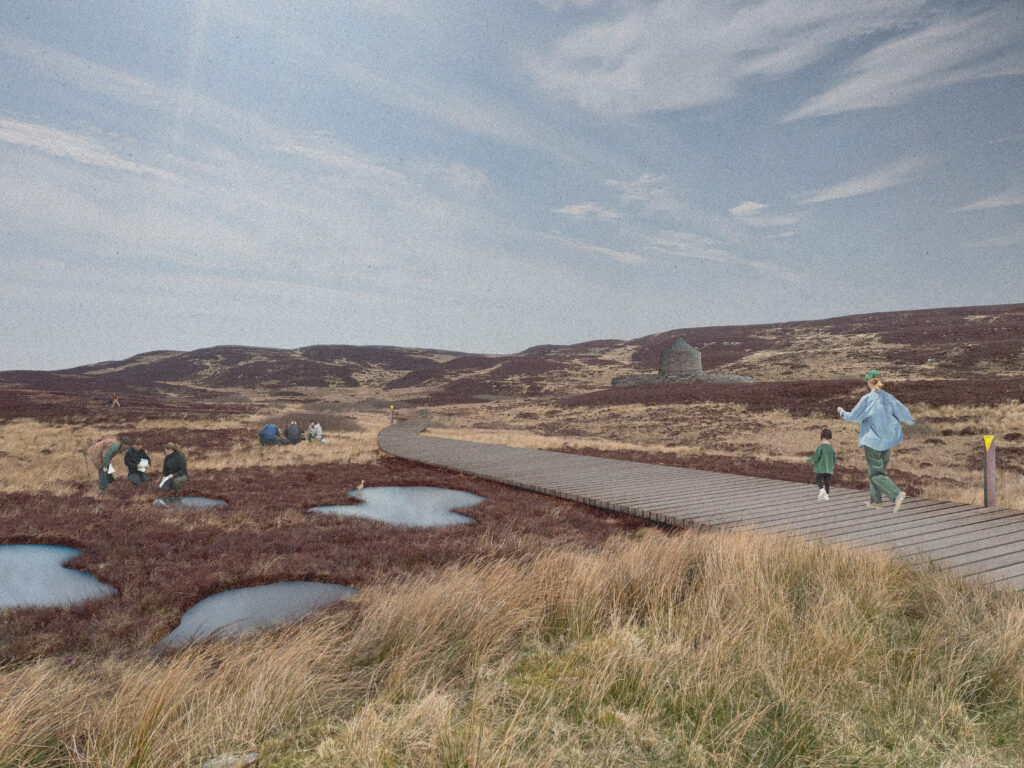
We are collaborating with a client in Caithness, Scotland to develop an experimental archaeology project exploring Iron Age building techniques, and a visitor attraction combining cultural heritage and traditional skills with nature stewardship and biodiversity enhancement initiatives.
The project is situated on a large site comprising a diverse mixture of nationally significant habitats, including peatland, a few kilometres from the Flow Country UNESCO World Heritage Site. We are developing site strategies for the project supported by ecologist input, to locate visitor facilities on the site that avoid sensitive habitats.
The project also seeks to improve previously disturbed agricultural land, and achieve Biodiversity Net Gain in line with Highland Council’s “Biodiversity Enhancement Planning Guidance” through a range of techniques – including restoring key wetland and riparian habitats, and proposed technical interventions to promote suitable water vole habitat for example, which are a red-listed species.
2. Are you working on material stewardship?
As a burgeoning practice, we have not built up a library of materials or evidence of built projects, but as part of our company ethos it is our intention to promote responsible material use going forward. Our long-term aspiration is to avoid petrochemical-based materials for applications where natural, circular or lower-impact alternatives exist.
As part of the King’s Theatre project, the team is exploring the possibility of re-using materials such as structural timber and brickwork on-site as part of the new construction elements. The project is at early design stages, but our Whole Life Carbon Assessment will assess the potential viability and benefits of this to the client and wider stakeholders.
At a much smaller scale, our Muthill Garden Room project has incorporated stone from demolition of a small lean-to into the design of the new extension.
In our monument restoration projects we are only specifying natural, heritage products.
3. Does the majority of your work demonstrate the use of biologically-inspired approaches such as Bioregionalism, Biophilia or Biomimicry?
As a new practice, we are not at a stage of answering for all our projects, but an example of a biophilic approach we have taken is on our Muthill Garden Room project, a residential extension to an existing sandstone villa. The client’s house has a mature garden setting, but the house has limited connection the outdoors and lacks natural daylight.
The project brief was to open up the house to the garden via a new living space, and create opportunities for accessible indoor-outdoor living, to allow the client to enjoy the house and garden in later life. This generates greater opportunities for visual and non-visual connections with nature.
The project will minimise disturbance to the natural habitats found in the garden through lower impact construction (e.g eliminating ground-bearing slabs), and including bat and swift boxes in the new construction to encourage wildlife to inhabit the structure.
Creating a just space for people
Practice
1. Do you have a progressive EDI policy and can you evidence many forms of diversity, which are welcomed and acknowledged, within your company/organisation?
Recruitment:
We use a blind recruitment process, diverse interview panels, and offer support/adjustments during application and interview stages.
Advocacy and wider support:
One of our directors is a trustee of Open Plan Scotland – a volunteer led advocacy and support network for all who identify as LGBTQIA+ and study or work across architecture in Scotland.
We also offer active support for graduate recruitment, work experience, and paid internships for underrepresented groups. We plan events covering key areas such as Equality Diversity & Inclusion, Wellbeing, and Mentoring.
Other policies:
We are committed to The Maternity Pledge and the company is dedicated to supporting family transitions. We promote a mentally healthy workplace and our EDI policies cover Menopause, Returning to Work after maternity/adoption leave, and the ‘Equally Safe’ initiative.
2. Do you operate a no overtime culture, meet the living wage consistently, and stipulate a fair salary ratio between staff of all levels?
The practive is committed to addressing gender pay gaps, ensuring fair and equal pay through salary bandings.
As a new practice we are still in the process of establishing formal recognition for this, but we are committed to evidencing this in practice; we are in the process of achieving accreditiation with Living Wage Scotland.
We offer flexible working to all employees and can evidence this through the wide range of working patterns at all levels within the company.
3. Do you support charities, community groups, social enterprises, action groups and others through pro-bono work, charitable giving or in-kind donations?
The practice is a supporter of Architects Benevolent Society, a charity that provides a wide range of support to the architectural community and their families. One of our directors is an Ambassador of the ABS. Last summer, the practice organised a second “Speed Mentoring” event in Glasgow, following on from a successful inaugural event in 2024. The event brought together early career architects with a wide range of construction professionals from diverse backgrounds whilst fundraising for ABS.
A Director provides voluntary support to Open Plan Scotland as a trustee, whilst another director is a trustee of Glasgow Building Preservation Trust and voluntary mentor and assessor for the RIAS Conservation Accreditation scheme.
4. Do you use an ethical framework to assess opportunities and/or supply chain partners and is them team consulted on these decisions?
No.
Project
1. Does your work demonstrate deep engagement with local stakeholders and end users?
Community consultation and engagement has been successfully used on a number of projects. At St Giles’ Cathedral in Edinburgh we have identified and consulted with a range of different stakeholders and user groups – including trustees, staff, volunteers and the congregation. Their input is ongoing, and we are planning on hosting further one-on-one drop-in sessions for interested parties to have their voice heard – we feel this is particularly important in a space which has so much meaning to so many people. Additionally, volunteers got the chance to assist with documenting and sorting archaeological finds from a recent dig.
At the King’s Theatre, we gathered oral histories of the building through interviews with long-serving staff and actors.
2. Does your work create connected and resilient communities which positively contribute to neighbourhoods and allow equality of access?
King’s Theatre is a lynchpin in the Glasgow entertainment economy, vital to the local context, and is a venue with a wide socio-economic reach. It is rife with accessibility issues for both visitors and performers, and resolving these to provide equality of access is paramount to the project.
The project resolves the venue’s technical issues to accommodate a wider variety of shows, helping protect the venue’s long-term economic viability. Ensuring the venue can continue to as a touring production house maintains the cultural relevance of a nationally significant building for future generations.
We are working with St Giles’ Cathedral in Edinburgh to improve the experience for the 1.2 million annual visitors. Space in the Cathedral is limited due to its prominent city-centre location. The project addresses accessibility, interpretation, community outreach, education and social space throughout the building.
3. Does the majority of your work promote equity in society, and consider all people, not only building inhabitants
We are committed to upholding ethical business practices and ensuring that modern slavery, human trafficking, and forced labour have no place in our operations or supply chains. We maintain a Modern Slavery Policy, which recognises our responsibility to ensure that as a small architectural practice, we work with other organisations to promote humane working conditions across the supply chain.
While our direct risk is low, we remain vigilant in assessing and mitigating any potential risks within our industry and supply chains. We strive to collaborate with reputable suppliers who adhere to fair labour practices and comply with all relevant legislation.
The practice is dedicated to continuous improvement in this area. We encourage transparency, ethical sourcing, and accountability, and we remain committed to raising awareness and acting against modern slavery in all its forms.