
Submission by Grimshaw.
Being a good ancestor
Practice
1. Do you have a clearly stated purpose aligned with the planetary emergency? We’re looking for a bold ambition here, and a culture which recognises the need for long-term thinking.
This is taken from our website “Across four decades our holistic approach to sustainable development has encompassed the full scale of economic, social and environmental impacts.
Today more than ever we know that an increasing population and finite resources present a unique challenge, and our response addresses ways to move towards a regenerative environment that connects carbon, water, biodiversity, energy, a circular economy and health and wellbeing to create a resilient and adaptable way of life”.
2. Do you have a clearly stated purpose aligned with the planetary emergency? We’re looking for a bold ambition here, and a culture which recognises the need for long-term thinking.
The partners of the practice have a succession plan in place which focusses on maintaining the integrity of the practice and its values. The Chairman and Group Managing Partner are the owners of the plan. The practice is also committed to developing future leaders by nurturing emerging talent through mentoring, professional development, and increased responsibility across the organisation.
3. Do you share research and knowledge for the benefit of society and the wider world?
The practice actively shares research, tools, and knowledge to support wider industry progress and societal benefit. This includes contributing to a free online platform focused on the decarbonisation of new and existing buildings, which is now used by over 8,000 users across 109 countries.
The practice also collaborates with industry and research organisations to advance collective learning and best practice. This includes participation in initiatives such as the UK Net Zero Carbon Buildings Standard, the EU-funded CIRCuIT project focused on circular construction, and ongoing engagement with Living Future Europe.
Project
1. Do you advocate for long-term thinking at the outset of work? Do you initiate work with long-term thinking and challenge clients? Also, can the organisation demonstrate that this approach has worked?
The practice advocates for long-term thinking from the outset of every project by challenging the project brief, its justification, and opportunities for reuse before considering new construction. All projects are reviewed against regenerative design principles, with regular design reviews used to assess progress against sustainability and performance targets.
The practice prioritises longevity, adaptability, circular design, and the reuse of existing assets over demolition and rebuild wherever possible. This approach has been successfully demonstrated across a range of projects, including the adaptive reuse of a former 1970s furniture factory into an award-winning educational building, as well as major infrastructure, cultural, manufacturing, and commercial projects.
Project outcomes have included extending asset life, reducing embodied carbon, integrating renewable energy systems through whole-life value assessments, and supporting more informed decision-making through industry tools and guidance.
2. Does your work take account of the future climate and the need for resilience?
The practice designs with future climatic conditions and long-term resilience as a core consideration. This is especially significant for transport and infrastructure projects with design lives of 100+ years. A regenerative design framework is applied across all work, embedding adaptation, flexibility, and resilience from early concept stages through to delivery.
Design approaches include planning for future expansion, prioritising adaptable building systems, and using offsite manufacturing to improve quality, reduce waste, and increase durability. Climate risk and resilience assessments are also undertaken on major projects to inform design decisions, including consideration of long-term environmental, geological, and operational risks.
Recent work has incorporated strategies such as passive resilience measures, future-proofed infrastructure capacity, biodiversity integration, and enhanced public realm connectivity to support climate adaptation over multi-decade horizons.
3. Does the majority of your work go beyond mitigating negatives and towards optimising positives?
The practice’s net zero carbon framework is aligned with the 1.5°C Paris Agreement pathway and incorporates commitments such as the RIBA 2030 Climate Challenge and Architecture 2030. A structured carbon management process is used to support whole-life carbon reduction across projects aiming for positive outcomes wherever possible.
Furthermore, our regenerative design approach goes beyond carbon reduction to actively seek positive outcomes, including improved environmental performance through retrofit, reuse, and lifecycle extension of existing assets. Our projects aim to catalyse wider benefits for local communities by linking project outcomes with positive socio-economic co-benefits that go beyond the project brief. Projects are assessed against performance targets and are designed to optimise long-term environmental, social, and economic value.
This approach has been demonstrated through retrofit and refurbishment works that has upgraded existing buildings to meet or exceed 2030-aligned performance targets, avoiding the need for new-build alternatives and reducing whole-life carbon impacts.
Co-evolving with nature
Practice
1. Do you use biophilia within your premises and/or do you regularly gather in natural settings?
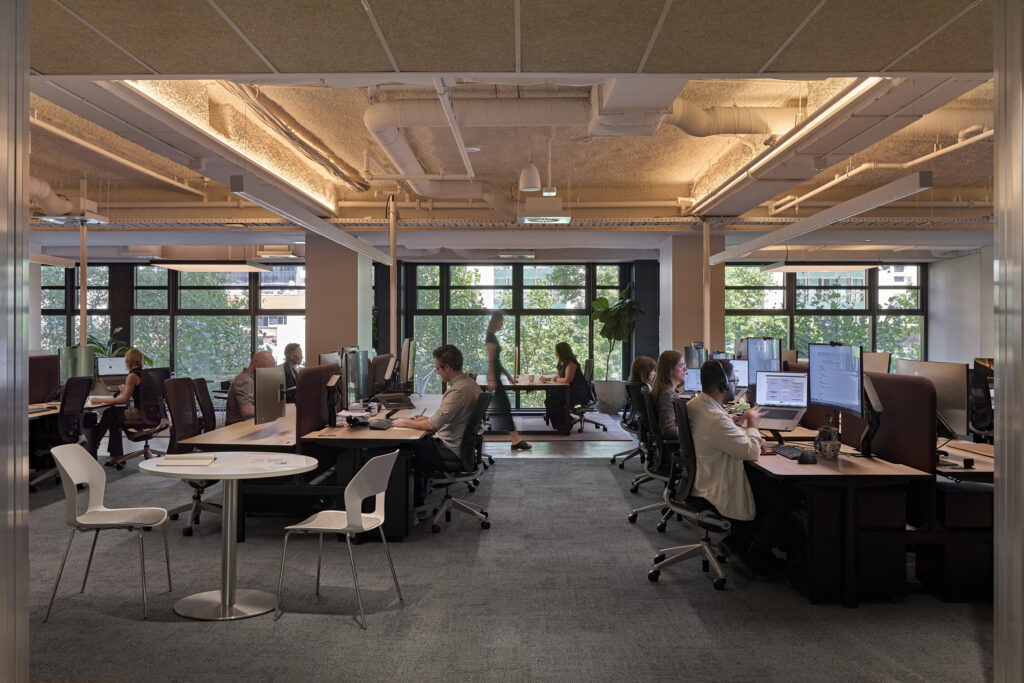
Biophilic principles are integrated into all studio environments through carefully selected potted plants that improve air quality and strengthen connection to nature, daylight, and the use of natural materials such as wood , colours, and textures that support health and wellbeing of staff and visitors alike.
Recent studio refurbishments have further developed this approach, embedding biophilia more explicitly within workspace design. Existing offices include naturally daylit communal areas, atriums with glazed rooflights providing uninterrupted ever-changing views of the sky that connect occupants to seasonal rhythms, alongside shared gathering spaces designed to support collaboration, wellbeing, and flexible working environments.
Our upcoming London studio relocation will continue in this direction, with increased access to natural light, prioritisation of materials with low environmental impact and recycled content, and retention and reuse of existing building fabric to reduce embodied carbon while enhancing occupant experience.
2. Can you share examples of where you have considered nature in decision making?
Nature is considered an active stakeholder in decision-making, with ecological impact of development informing whether a project is pursued or not. Opportunities to protect and enhance local biodiversity and ecosystems are prioritised, and partnerships are avoided where activities are actively harmful to the environment.
This approach is embedded in our design work through use of biomimicry and nature-based and nature positive design principles. Our design strategies draw on natural systems, cycles, and forms to inform both spatial organisation and environmental performance, from large-scale infrastructure to cultural and civic buildings.
Examples include designs inspired by coastal, desert, and forest ecologies, where natural rhythms, adaptive systems, and ecological native species-specific strategies inform form, façade, and environmental response to integrating sensitively to the site context. These approaches support enhanced user experience while strengthening connections between people and the natural environment.
3. Are you supporting nature locally and nationally?
The practice supports nature at both local and national scales through commitments, advocacy, and design work. This includes recognising the biodiversity crisis through industry initiatives such as Architects Declare and supporting global calls to reverse nature loss through membership of Business for Nature. We are also supportive and refer to the work of the UKGBC’s Biodiversity and Environmental Net Gain.
In design practice, biodiversity is promoted through integrated landscape strategies and nature-positive planting schemes that enhance local ecosystems and ecological connectivity for flora and fauna.
The practice is also leading the design of many major botanical garden projects internationally, which act as living collections and long-term genetic repositories for plant species. These projects support conservation, research, and education, helping to safeguard biodiversity for future generations while increasing public engagement with nature.
Project
1. Can you demonstrate work that strives to match the performance of a mature ecosystem?
The practice is beginning to embed principles aligned with ecosystem performance through commitments to net biodiversity gain across major infrastructure and development projects. Biodiversity net gain is integrated as a key objective within regenerative design approaches, alongside broader environmental and carbon targets. This is evidenced on projects through implementation of industry-recognised biodiversity measurement tools to meet statutory evidence requirements and project level ambitions.
While direct replication of mature ecosystem performance is an emerging area of focus, projects are designed to enhance ecological value through habitat creation, landscape integration, and long-term ecological management strategies. Several projects across different typologies are currently on track to achieve measurable biodiversity net gain outcomes.
2. Are you working on material stewardship?
The practice is actively engaged in material stewardship through research, knowledge-sharing, and application on live projects. This includes published insight papers on healthy materials, which support more informed material selection by highlighting environmental, health, and lifecycle considerations.
Material selection is guided by a whole-life carbon approach, prioritising low-carbon, low-waste, and responsibly sourced materials. We are currently conducting research which explores innovative solutions such as bio-based materials, high recycled content products, and reusable systems supported by material passports.
This work is complemented by efforts to develop more structured internal knowledge systems that connect research outputs with project delivery, enabling more consistent lifecycle assessment and alignment with evolving regulatory standards.
3. Does the majority of your work demonstrate the use of biologically-inspired approaches such as Bioregionalism, Biophilia or Biomimicry?
The majority of our projects are designed with nature in mind and embed biophilic principles to support human wellbeing and strengthen connections to the natural environment.
Biomimicry and other biologically inspired approaches are used more selectively to suite the scope of the project and its context, but feature in several of our notable projects across different typologies where there is an opportunity to influence ecological restoration and rejuvination. In these cases, natural systems, forms, and processes have informed design strategies to improve environmental performance, efficiency, and resilience.
Overall, nature-inspired thinking is an embedded part of the design approach, with increasing application of biophilic, biomimetic, and landscape-led principles across the portfolio.
Creating a just space for people
Practice
1. Do you have a progressive EDI policy and can you evidence many forms of diversity, which are welcomed and acknowledged, within your company/organisation?
The practice has a structured and progressive equality, diversity, and inclusion (EDI) approach supported by formal policies applied across employees, subconsultants, and contractors. This is reinforced through an 8-point diversity action plan that helps embed inclusion across recruitment, workplace culture, and project delivery.
Diversity and inclusion are further supported through internal networks focused on accessibility, neurodiversity, and broader inclusion, providing spaces for dialogue, support, and continuous improvement. Flexible working arrangements and workplace adjustments are also in place to enable individuals to work to their full potential.
An internal EDI group (“Umbrella”) hosts regular initiatives, events, and awareness activities to promote a culture of belonging and representation across the organisation.
2. Do you operate a no overtime culture, meet the living wage consistently, and stipulate a fair salary ratio between staff of all levels?
The practice is a London Living Wage Employer and is committed to fair pay and economic inclusivity across the organisation. Pay equity is monitored, with ongoing efforts to reduce the gender pay gap and promote transparency and fairness in remuneration practices.
A formal time off in lieu (TOIL) policy is in place to ensure that additional hours are recognised and unpaid overtime is actively minimised. Flexible and hybrid working arrangements further support work–life balance and accommodate diverse personal needs.
Inclusion is reinforced through employee-led initiatives, mentoring programmes, and regular learning activities focused on equity, diversity, and inclusion, alongside structured training on unconscious bias and participation in wider industry wellbeing forums.
3. Do you support charities, community groups, social enterprises, action groups and others through pro-bono work, charitable giving or in-kind donations?
The practice supports charities, community groups, and social enterprises through a combination of structured initiatives, partnerships, and employee-led volunteering. Alongside wider charitable engagement, a dedicated foundation has been established to extend social impact, with a focus on improving access to architecture and design careers for young people, particularly those from underrepresented backgrounds. This is delivered through mentoring, workshops, and educational outreach programmes that help students explore creative pathways and progression into further education and employment.
In addition, a formal volunteering policy enables staff to dedicate a proportion of paid working time to community and charitable activities, supporting engagement with local initiatives and broader social causes. This helps ensure that social value is embedded not only in project outcomes but also in day-to-day professional practice, encouraging staff participation in positive community impact.
4. Do you use an ethical framework to assess opportunities and/or supply chain partners and is them team consulted on these decisions?
The practice applies an ethical framework to assess both project opportunities and client relationships, ensuring alignment with organisational values and long-term environmental and social responsibility. This includes consideration of a client’s commitment to sustainability, governance, and broader societal impact, with some opportunities declined where they are not aligned with these principles.
Priority is given to projects that demonstrate clear benefits for local communities, economies, and ecological restoration. Where clients have limited awareness of regenerative approaches, the practice often seeks to engage constructively to support improved decision-making and outcomes.
This approach is underpinned by formal policies, including anti-bribery and modern slavery commitments, and is supported by internal consultation processes to ensure decisions are informed by a range of perspectives within the organisation.
Project
1. Does your work demonstrate deep engagement with local stakeholders and end users?
The practice demonstrates strong engagement with local stakeholders and end users in all projects, particularly in urban design and masterplanning work where co-design approaches are increasingly embedded.
Engagement typically involves structured consultation with local communities, user groups, and relevant interest groups to inform design development and ensure projects respond to local context and needs. In certain geographies, this includes recognition of Indigenous knowledge frameworks and cultural approaches, such as the ‘Intergenerational Act’ in Wales.
In education and civic projects, engagement is often extended to include end users such as teaching staff and institutional representatives, helping to shape functional and experiential outcomes. The practice also advocates for moving beyond consultation towards genuine co-design, working with clients to embed these processes where possible to improve long-term project outcomes.
2. Does your work create connected and resilient communities which positively contribute to neighbourhoods and allow equality of access?
The practice consistently seeks to create connected and resilient communities, with social value embedded as a core objective across all project types and scales. This includes improving access to education, culture, leisure, and transport, with the aim of supporting more inclusive and equitable neighbourhoods.
While the interpretation of “resilient place” varies by context, most projects are designed to strengthen local connections and contribute positively to wider regeneration objectives. This is often reflected in masterplanning and infrastructure work where long-term investment in public realm, connectivity, and accessibility is a key driver.
Recent work includes major urban regeneration and transport-led projects where social value metrics across multiple boroughs have been aligned with project vision, supporting circular economy principles and wider community benefit.
3. Does the majority of your work promote equity in society, and consider all people, not only building inhabitants
The practice is committed to promoting equity across society, extending beyond building users to include wider communities and project stakeholders. Social equity considerations are embedded within the design process through structured stakeholder engagement, helping identify opportunities to support inclusive outcomes and establish measurable social value objectives.
This responsibility extends across the full project lifecycle and supply chain. Due diligence processes are in place for subconsultants, including requirements to confirm ethical and modern slavery compliance, supported by alignment with relevant management systems and regulatory standards.
A clear commitment to tackling modern slavery underpins procurement and supplier engagement, supported by training, policy review, and audit processes to ensure risks are identified and managed.
Beyond project delivery, a dedicated foundation supports equitable access to education and career pathways in architecture and design, with a focus on underrepresented groups.