
Submission by Cladmate Facade Systems Ltd.
Being a good ancestor
Practice
1. Do you have a clearly stated purpose aligned with the planetary emergency? We’re looking for a bold ambition here, and a culture which recognises the need for long-term thinking.
Cladmate Facade Systems Ltd exists to transform the built-environment from a net consumer of ecological resources into a net restorer of them. Our founding purpose, embedded in our company mission, is to ensure that every building we touch delivers measurable, lasting benefit to the natural world — not merely reduced harm.
We recognise that facades represent one of the largest untapped interfaces between buildings and ecosystems. Through our NestClad range — the UK’s only integrated biodiversity solution for rainscreen cladding — we have operationalised this purpose into a commercially viable, technically rigorous product that makes regenerative design the default, not the exception.
Our culture demands long-term thinking at every level: products are designed for 60-year building life spans, ecological contributions are monitored in real time, and commercial decisions are assessed against their impact on urban biodiversity for decades to come. We are building a company we want our successors to be proud of.
2. Do you have a clearly stated purpose aligned with the planetary emergency? We’re looking for a bold ambition here, and a culture which recognises the need for long-term thinking.
Cladmate has a clear and evolving succession approach designed to protect both ownership continuity and the regenerative values embedded within the company. While currently founder-led, our ecological mission, technical methodologies, and strategic processes are formally documented to ensure that institutional knowledge is transferable and not dependent on a single individual.
Our commitment to open-source habitat design further safeguards this legacy by placing NestClad specifications within the wider conservation and design community, ensuring long-term accessibility beyond future ownership changes. We are also developing governance mechanisms that embed biodiversity and regenerative principles into the company’s constitutional framework, preventing deviation from our core purpose.
Knowledge-sharing is embedded across the organisation through cross-disciplinary staff training in ecological and technical practices, creating resilience through distributed expertise. In parallel, partnerships with organisations such as the Bat Conservation Trust provide external accountability and continuity, reinforcing our long-term regenerative mission independently of leadership transition.
3. Do you share research and knowledge for the benefit of society and the wider world?
Cladmate actively shares research and knowledge as a matter of principle. Our NestClad habitat specifications — chamber dimensions, entrance aperture sizes, installation height requirements, orientation guidance, and internal surface material specifications for each of the three product families (Bird Nest CMM-BR-N, Bat Roost CMM-BF-R, Bee Nest CMM-BE-C) — are published openly on our website at https://cladmate.co.uk/Nestclad/.
The live monitoring data collected from NestClad installations, including IoT sensor readings for temperature, humidity, and species activity captured via installed cameras, is shared with our ecological partners including the Bat Conservation Trust. This real-world performance evidence is made available to contribute to the wider evidence base for integrated biodiversity building products.
Our structural calculations (Abacus Contractors Design Services, ref. AB25-05-CM-CA-004 and AB25-05-CM-CA-012) are available to design teams on request, removing a common barrier to specification. We also contribute to industry events and publications to accelerate the broader adoption of regenerative facade design.
Project
1. Do you advocate for long-term thinking at the outset of work? Do you initiate work with long-term thinking and challenge clients? Also, can the organisation demonstrate that this approach has worked?
From the outset of every project discussion, Cladmate challenges clients and design teams to embed measurable biodiversity contribution into their facade specification. We begin with a site ecology briefing — identifying target species likely to benefit from the building’s location, aspect, and proximity to green corridors — before recommending which NestClad product combination will deliver the greatest ecological gain.
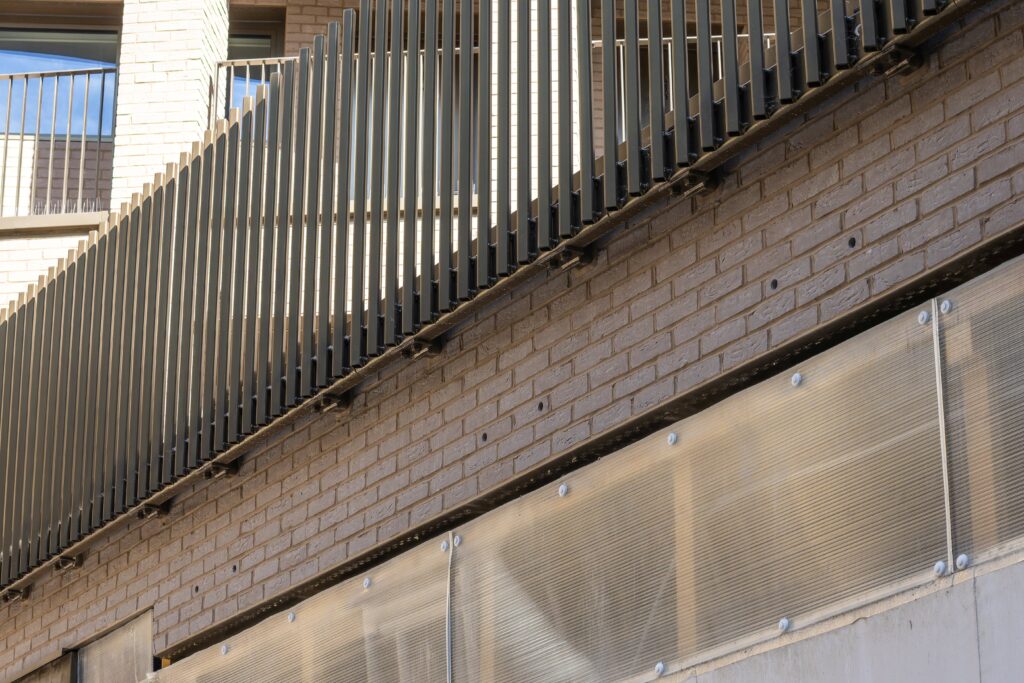
On the Trego Road project, this approach worked demonstrably. The client initially engaged Cladmate for a standard CMS40 MF brick slip cladding specification. Through long-term thinking advocacy at the design stage, Cladmate introduced the NestClad system, integrating Bird Nest (CMM-BR-N), Bat Roost (CMM-BF-R), and Bee Nest (CMM-BE-C) units within the facade. The result is the UK’s first monitored integrated biodiversity brick slip cladding installation, delivering mandatory Biodiversity Net Gain without program delay or material cost premium.
2. Does your work take account of the future climate and the need for resilience?
NestClad products are designed explicitly for the future climate. UK urban temperatures are projected to rise significantly over the next 60 years, placing additional thermal stress on cavity-nesting species that depend on thermally stable microhabitats. The NestClad Bat Roost (CMM-BF-R) uses 5mm natural slate lining — a material with excellent thermal mass — to maintain stable roosting temperatures as external conditions change.
The stainless-steel outer housing (Grade 304, 1.5mm) is corrosion-resistant and dimensionally stable across the full range of projected UK climate scenarios, including increased driving rain intensity and temperature cycling. The lime-based inner coatings used across the NestClad range manage moisture vapor without trapping condensation — critical as humidity profiles shift.
The live IoT monitoring infrastructure installed at Trego Road actively tracks internal habitat temperatures and humidity, generating longitudinal data that will inform future product development as climate conditions evolve. This feedback loop embeds climate resilience into our design iteration process.
3. Does the majority of your work go beyond mitigating negatives and towards optimising positives?
Every NestClad installation goes beyond mitigating negatives to actively regenerating urban ecological networks. While most building products aim to reduce harm — lower embodied carbon, reduced water use, better insulation — NestClad creates new habitat that did not previously exist and would not exist without deliberate design intervention.
The Trego Road installation introduces three simultaneous habitat types within a single facade system: nesting for cavity-dependent birds including swifts (a UK Species of Conservation Concern), crevice roosting for bats (all UK species protected under the Wildlife and Countryside Act 1981), and nesting for solitary bees (critical pollinators, over 250 UK species). Each unit is a net positive addition to the urban ecosystem.
Our commercial model reinforces this: a portion of proceeds from every NestClad Bat Roost unit is directed to the Bat Conservation Trust, extending the regenerative impact beyond the building envelope to national conservation programs. This is not mitigation — it is restoration.
Co-evolving with nature
Practice
1. Do you use biophilia within your premises and/or do you regularly gather in natural settings?
Cladmate’s premises incorporate living elements that reflect our commitment to the natural world we design for. Our workspace includes indoor planting chosen to support pollinator species, and we regularly gather in outdoor settings for team meetings and design reviews — a deliberate practice to maintain connection with the natural environment that underpins our products.
Our design team makes regular site visits to NestClad installations specifically to observe species activity, reinforcing the lived relationship between our work and the ecology it supports. These visits are not inspections — they are moments of learning, where observing a bat emerging from a CMM-BF-R unit, or a mason bee investigating a CMM-BE-C aperture, directly informs how we develop the next product iteration.
2. Can you share examples of where you have considered nature in decision making?
Nature is present in every significant decision Cladmate makes. Our product development process begins not with engineering constraints but with ecology: what does this species need to thrive? Chamber dimensions, entrance aperture sizes, internal surface textures, orientation requirements, and installation heights for all three NestClad product families (CMM-BR-N, CMM-BF-R, CMM-BE-C) were derived from ecological research and validated with species conservation experts.
Our partnership with the Bat Conservation Trust — where Cladmate is an Official Roost Partner — means that bat welfare requirements are embedded in our Bat Roost product specification and reviewed by conservation professionals. This is nature informing design, not design accommodating nature as an afterthought.
Commercial decisions are assessed against biodiversity impact: we will not supply NestClad units to projects where installation guidance (orientation, height, proximity to artificial light) cannot be met, because a poorly positioned unit delivers no ecological value. Nature’s requirements set the terms.
3. Are you supporting nature locally and nationally?
Cladmate supports nature both locally and nationally through its commercial activities and charitable commitments. Every purchase of a NestClad Bat Roost (CMM-BF-R) generates a direct financial contribution to the Bat Conservation Trust, supporting national bat population monitoring, habitat restoration programs, and public education. A portion of profits from all NestClad products is directed to charities dedicated to safeguarding natural habitats.
Locally, NestClad installations create new urban habitat nodes that connect to existing green infrastructure — hedgerows, trees, gardens, and waterways — supporting species movement through the urban matrix. The Trego Road installation in particular was sited and oriented with reference to local ecological mapping to maximise connectivity with nearby habitats.
Our open-source design commitment means that any organisation, anywhere in the UK, can access NestClad habitat specifications to design compatible products — multiplying the national impact of our ecological research without restriction
Project
1. Can you demonstrate work that strives to match the performance of a mature ecosystem?
The TregoRoad NestClad installation is designed to perform as a component of a mature urban ecosystem, not merely a gesture towards one. The three product types collectively address the habitat requirements of three ecologically distinct guilds —avian cavity-nesters, crevice-roosting chiropteran, and ground-nesting Hymenoptera — that together represent the diversity of a functioning urban-habitat mosaic.
The CMM-BF-R Bat Roost has capacity for up to 20 crevice-dwelling bats, replicating the colony sizes found in mature natural roosts. The CMM-BR-N Bird Nest provides the same cavity geometry and thermal stability as the weathered stone and timber cavities that swift, sparrow, and starling populations have historically relied upon. The CMM-BE-C Bee Nest uses natural materials calibrated to the nesting preferences of UK solitary bee species.
Live cameras and IoT-sensors verify actual ecological performance — species occupancy, activity frequency, internal temperature and humidity — providing quantitative evidence that the system is matching, not merely approximating, mature ecosystem function.
2. Are you working on material stewardship?
Cladmate approaches material-stewardship with the same rigor we apply to ecological-design. The NestClad product range is built from materials chosen for their longevity, recyclability, and ecological-compatibility. Grade-304 stainless-steel(1.5mm, welded construction) is indefinitely recyclable and requires no surface treatment over its service life. Natural-slate(5mm, used as bat roost lining) and limestone(10mm base in bird nest units) are durable, inert, and quarried mineral materials with low-embedded processing energy.
All NestClad units are designed for disassembly at end of building life, enabling habitat modules to be recovered and reused independently of the surrounding cladding assembly. This separates the ecological asset from the construction asset, allowing the habitat to outlast the building.
The BBA-certified CMS40-MF-Brickslip-Cladding-System into which NestClad integrates uses fired clay Brickslip — a material with a 60-year minimum design life, negligible maintenance requirements, and full recyclability as a mineral-aggregate at end of life. Material stewardship is embedded in the specification, not added on.
3. Does the majority of your work demonstrate the use of biologically-inspired approaches such as Bioregionalism, Biophilia or Biomimicry?
NestClad is fundamentally a biomimetic-product range. Each of the three habitat types is designed by studying and replicating the natural-conditions that target species have evolved to require, rather than imposing arbitrary-human design preferences upon them.
The (CMM-BF-R)BatRoost mimics the narrow-crevice environments — between roof-tiles, in tree-bark fissures, behind hanging bark — that pipistrelles and brown long-eared bats favor. The inclined natural-slate entry replicates the angle and texture of natural entry points. The roughened internal-slate surface mimics the grip of natural roost-substrates.
The (CMM-BR-N)BirdNest replicates the cavity dimensions and nest-cup geometry of the natural holes and crevices in aged masonry and timber that swifts, sparrows, starlings, and black redstarts have used for millennia. The (CMM-BE-C)BeeNest uses natural materials with the aperture diameters and tunnel depths that UK solitary-bee-species select in the wild.
This is biomimicry applied to building products: learning from nature to create habitats that work because they speak nature’s own language.
Creating a just space for people
Practice
1. Do you have a progressive EDI policy and can you evidence many forms of diversity, which are welcomed and acknowledged, within your company/organisation?
Cladmate maintains a formal Equality, Diversity and Inclusion Policy (PO.06.01), reviewed annually since 2021 and embedded across recruitment, training, promotion and career development. The policy covers all protected characteristics under the Equality-Act2010 and is actively supported by senior leadership.
Our team of 11 demonstrates meaningful diversity within a historically under-represented sector. Women comprise approximately 36% of our workforce — significantly above construction and façade engineering industry averages — while colleagues from 4–6 nationalities contribute diverse cultural perspectives and professional experiences that strengthen innovation and regenerative thinking.
Our recruitment processes are specifically designed to remove barriers to entry. Job descriptions are reviewed for exclusionary language, applicants are assessed solely on merit, shortlisting involves multiple assessors where possible, and reasonable adjustments are made to support individual needs.
As Cladmate grows, we remain committed to monitoring representation, reviewing practices annually, and ensuring our team reflects the diversity of the communities and ecosystems our buildings serve.
2. Do you operate a no overtime culture, meet the living wage consistently, and stipulate a fair salary ratio between staff of all levels?
Cladmate operates on the principle that staff wellbeing is inseparable from the quality and integrity of our regenerative work. All employees currently earn above the London Real Living Wage, reflecting our belief that fair pay is foundational to staff wellbeing, organisational resilience and long-term sustainability. While not yet formally accredited by the Living-Wage-Foundation, achieving accreditation is a near-term objective. Salaries are reviewed annually to ensure they remain fair, competitive and proportionate across all levels of the organisation.
We do not operate an overtime culture. Product-development, testing and project delivery are intentionally planned to be achievable within normal working hours, recognising that rested and valued employees create stronger ecological outcomes. Where exceptional circumstances require additional time, employment contracts ensure all extra hours are compensated transparently at the employee’s standard rate, with no expectation of unpaid overtime.
As Cladmate grows, we are committed to further formalising transparent pay-ratio reporting and equitable-governance structures.
3. Do you support charities, community groups, social enterprises, action groups and others through pro-bono work, charitable giving or in-kind donations?
Cladmate’s charitable model is integral to its commercial structure, not peripheral to it. A portion of the proceeds from every NestClad Bat Roost (CMM-BF-R) unit sold is donated directly to the Bat Conservation Trust, supporting national bat conservation programmes. A further portion of overall NestClad profits supports charities dedicated to safeguarding natural habitats more broadly.
Our open-source design commitment represents a significant in-kind contribution to the wider design community and conservation sector: by making NestClad habitat specifications publicly available, we donate the intellectual capital of our ecological research to any organisation wishing to adopt or adapt it for the benefit of UK biodiversity.
We actively support the development of Biodiversity Net Gain policy literacy among design professionals and planning authorities through participation in industry events, publications, and direct engagement with local planning teams — contributing pro-bono knowledge transfer that accelerates the adoption of integrated biodiversity design across the industry.
4. Do you use an ethical framework to assess opportunities and/or supply chain partners and is them team consulted on these decisions?
Cladmate applies an ethical framework to all significant commercial decisions, including the assessment of supply chain partners, project clients, and specification opportunities. Our framework is anchored in three questions: does this relationship advance ecological regeneration; does it treat all people involved fairly; and does it contribute to or undermine the long-term mission of the company?
Supply chain partners are assessed against their environmental credentials, labour practices, and alignment with our values. We prioritise UK manufacturing to support domestic employment and reduce transportation embodied carbon. Our stainless steel and natural slate suppliers are assessed for responsible sourcing credentials.
The team is consulted on significant ethical decisions. Where a project opportunity raises concerns — for example, where installation constraints would result in NestClad units being placed in positions that deliver no genuine ecological benefit — the team has the authority to recommend declining the specification.
Project
1. Does your work demonstrate deep engagement with local stakeholders and end users?
NestClad’s development has been shaped by deep engagement with the end users of the habitats it creates — not human occupants, but the species that depend on it. Cladmate has worked directly with the Bat-Conservation-Trust to validate the (CMM-BF-R)BatRoost against the welfare and roosting requirements of target bat-species. This represents ecological end-user research: understanding the needs of the building’s non-human inhabitants with the same rigor applied to human occupancy.
For the Trego-Road project, local ecological context was integrated into the NestClad specification: habitat unit types, quantities, positions, and orientations were determined with reference to the surrounding urban landscape and the species most likely to benefit. This is local-stakeholder engagement extended to the ecological community.
The installation of live-cameras and IoT-sensors means that the building’s ecological performance is continuously monitored and reported, creating an ongoing feedback loop between the building and its non-human users — the most direct form of post-occupancy engagement possible.
2. Does your work create connected and resilient communities which positively contribute to neighbourhoods and allow equality of access?
NestClad installations contribute directly to the ecological resilience of the communities surrounding the buildings they serve. Urban biodiversity — bees, bats, and birds — provides essential ecosystem services that benefit all residents: pollination of urban food-growing, natural pest control by bats, and the psychological wellbeing benefits of connection with urban wildlife that are well-documented in public health research.
The Trego Road development sits within an urban context where natural habitat has been progressively reduced by development pressure. The NestClad installation creates a new node in the urban ecological network, connecting to nearby green corridors and contributing to the habitat connectivity that allows species to survive and move through the city.
These benefits are equally accessible to all members of the surrounding community — the pollinator support provided by NestClad bee nests benefits every garden and allotment within foraging range, regardless of proximity to the building. Ecological equity is embedded in the product’s function.
3. Does the majority of your work promote equity in society, and consider all people, not only building inhabitants
Cladmate’s work is explicitly designed to deliver ecological equity — providing the benefits of urban biodiversity to all people in a neighbourhood, not only the occupants of the building. The ecosystem services generated by NestClad installations — pollination, natural pest-control, urban-cooling through increased ecological activity, and the mental-health benefits of living alongside thriving wildlife — extend outward from the building into the surrounding community.
By integrating biodiversity contribution into the building-fabric itself, NestClad removes the dependency on private gardens, green roofs, or accessible green space that characterises most urban biodiversity interventions. A resident without a garden benefit from the solitary-bee population supported by a NestClad installation three streets away. This is regenerative design as a public good.
Our commitment to making NestClad specifications open-source means that the knowledge required to design integrated biodiversity buildings is freely available to architects, developers, and communities regardless of budget — promoting equity in access to regenerative design expertise.