
Submission by Collective Architecture.
Being a good ancestor
Practice
1. Do you have a clearly stated purpose aligned with the planetary emergency? We’re looking for a bold ambition here, and a culture which recognises the need for long-term thinking.
We are redefining what a thriving and holistic architectural practice can be – for society, the planet, and each other. As a 100% employee-owned business and registered cooperative, we place people and planet at the centre of both our projects and practice culture.
This is underpinned by our sustainability strategy, Towards a Regenerative Practice, co-authored by colleagues across our studios and peer reviewed by external experts including Prof. Fionn Stevenson, and Scott McAulay of the Anthropocene Architecture School. The strategy defines what regenerative practice means for Collective, alongside clear actions, metrics, responsibilities and timelines covering operational energy, embodied carbon, biodiversity, climate justice, health and wellbeing.
We recognise regeneration as a long-term transition requiring accountability, collaboration and continual learning. Progress is monitored through practice-wide OKRs, annual reviews and project outcomes. Whilst being reflective, we also celebrate successes, such as clients adopting approaches that go beyond compliance towards positive social and environmental impact.
2. Do you have a clearly stated purpose aligned with the planetary emergency? We’re looking for a bold ambition here, and a culture which recognises the need for long-term thinking.
Our succession plan is embedded within our legal structure. The Collective Architecture Employee Trust holds 100% of shares on behalf of current and future colleagues, ensuring ownership is passed between generations rather than concentrated in individuals. All eligible colleagues are beneficiaries who can elect trustees to the EOT. When our directors were appointed in 2022, they nominated candidates and the interview shortlist was determined by that ballot.
Our Articles of Association require directors to promote positive social and environmental impact and meet the B Corp mission lock standard in full. This embeds our purpose within company law, ensuring future leaders cannot redirect the practice away from its founding values.
Alongside trust ownership, our Pathways programme develops future leaders from the practice, helping colleagues build the skills and confidence needed to take on governance and leadership roles.
We see ourselves as stewards of the practice for future generations, not its owners.
3. Do you share research and knowledge for the benefit of society and the wider world?
Our studio operates as an urban salon where we actively invite others to exchange ideas on the future of architecture, conservation, planning and low-energy design. In 2025 we launched a public roundtable series beginning with City Guardians: Champions of Community, Place and Nature, chaired by Fran Williams (AJ Technical Editor), bringing together local authorities, developers, academics, housing associations and industry bodies. Subsequent events have explored energy inequality and the reuse of existing buildings.
We regularly share lessons from practice, and learn from others at national and international events, including the 2026 International Passivhaus Conference, where we presented post-occupancy learning from two Passivhaus projects.
Alongside this, we are collaborating with the University of Edinburgh on a Retrofit Patternbook for Scotland’s housing typologies. It will be released under a Creative Commons licence to ensure the research is freely accessible and can support retrofit and regeneration at scale.
Project
1. Do you advocate for long-term thinking at the outset of work? Do you initiate work with long-term thinking and challenge clients? Also, can the organisation demonstrate that this approach has worked?
We believe our work should transcend generations and respond not only to immediate client priorities, but to the rights of future generations to access nature, thrive locally, and live within healthy, climate-resilient communities.
Our planning work on Gavieside Village secured validation as an NPF4-leading masterplan that integrates ecology, active travel, blue-green infrastructure, 2,800 homes, a neighbourhood centre, primary school, and commercial spaces — embedding walkable neighbourhoods, biodiversity corridors and resilience from the outset.
Our philosophy shapes our approach to existing buildings: we champion retrofit-first and challenge demolition-led briefs. At Woodside, three multi-storey towers were originally slated for demolition, but were saved through resident engagement and retrofitted to EnerPHit standard whilst extending their lifespan by at least 60 years. Building on this success, we are now working with several clients on retrofit projects, including two Category A-listed brutalist towers in Edinburgh designed to improve comfort, reduce energy demand and retain embodied carbon.
2. Does your work take account of the future climate and the need for resilience?
We design projects to support resilience over decades, not just immediate needs, considering future scenarios including heavier rainfall, flooding, overheating, water scarcity, coastal erosion and biodiversity loss.
Our Granton Waterfront Framework was conceived as a long-term climate-resilient regeneration strategy rather than a conventional masterplan. It integrates a 10-hectare flood-resilient coastal park, blue-green infrastructure and adaptive waterfront planning to address sea-level rise, biodiversity loss and future climate pressures while supporting a low-carbon, walkable community designed to evolve over time.
This approach is echoed in our Seven Lochs Design Guide, where landscape and ecological restoration form the foundation for regeneration. The guide strengthens flood management, biodiversity networks and green infrastructure across the Seven Lochs area through connected wetlands, active travel and nature-based solutions that help communities adapt to heavier rainfall, habitat loss and rising temperatures while improving long-term environmental resilience.
Both frameworks are designed to evolve as environmental conditions change.
3. Does the majority of your work go beyond mitigating negatives and towards optimising positives?
We occupy the creative space between idealism and pragmatism, using our collective business model to shape places that actively restore social, ecological and economic systems rather than simply minimise harm.
Our Ladyfield masterplan demonstrates this approach at scale, reconnecting fragmented landscapes through green corridors and biodiversity networks, integrating productive landscapes and active travel infrastructure, and creating opportunities for low-carbon living that improve both environmental performance and public health. By linking housing, education, healthcare, ecology and local employment around The Crichton and Dumfries town centre, the project generates long-term social and ecological value while strengthening the capacity of the place to sustain communities and natural systems over time.
This thinking also informs our retrofit work. A recent peer review for a client’s mixed-tenure retrofit programme reframes retrofit not as compliance or risk reduction, but as an opportunity to improve wellbeing, reduce energy inequality, strengthen climate resilience and create long-term civic value.
Co-evolving with nature
Practice
1. Do you use biophilia within your premises and/or do you regularly gather in natural settings?
Nature is embedded within our studios and our culture. Our workplaces were intentionally chosen for their connection to landscape and water, with extensive internal planting, natural cross-ventilation, abundant daylight and views of seasonal change. In Glasgow, colleagues overlook one of the city’s few intensively planted green roofs, while in Leith the studio looks across the Water of Leith towards the Firth of Forth and Pentland Hills.
We regularly gather outdoors as part of everyday practice. Teams take collective lunches along the Water of Leith, and in nearby green spaces, while lunchtime walks, organised cycling and charity fundraising rides encourage regular interaction with nature.
Connection to place also informs how we learn and collaborate. Walking and cycling tours of our own and other practices’ projects create opportunities to experience landscapes, neighbourhoods and buildings firsthand, helping us better understand the relationship between people, place and nature.
2. Can you share examples of where you have considered nature in decision making?
Nature informs decisions from the outset of our projects rather than being considered after key choices have been made. At Bilbohall, ecology shaped the masterplan from Stage 0, with ecologists, landscape architects, engineers and the local authority collaboratively iterating proposals around ten times to maximise biodiversity outcomes whilst remaining deliverable within a social housing budget.
This approach extends to larger-scale regeneration. At Granton Waterfront, a climate-resilient coastal park and blue-green infrastructure network became the organising framework for development. Buildings were positioned back from the coastline to prioritise long-term ecological resilience, flood adaptation and biodiversity rather than maximise development potential.
Our commitment is reinforced through our Water Journey, Ecology & Biodiversity strategy, which embeds biodiversity and water metrics into project appraisal, promotes nature-based solutions and ensures ecological thinking informs decisions across the practice, from policy and advocacy to project delivery, helping nature become a driver of design rather than a constraint.
3. Are you supporting nature locally and nationally?
We support nature through industry leadership, project delivery and long-term partnerships. We are members of the Scottish Ecological Design Association (SEDA), one of our colleagues sits on the board of BE-ST, and another is Building with Nature accredited.
Locally, our projects actively support nature recovery. At Bilbohall, biodiversity enhancement extended beyond the site boundary through wetland planting, invasive species removal and new sluice dams designed to improve local wader habitats and strengthen ecological networks beyond the site.
Our work with the Findhorn Foundation demonstrates how we support nature at a strategic scale. Developed through extensive engagement with the local community and stakeholders, the framework embeds coastal resilience, biodiversity enhancement and environmental stewardship into the future evolution of the ecovillage, helping balance housing, economic development and climate adaptation with the protection of natural assets.
Our Water Journey, Ecology & Biodiversity strategy embeds biodiversity and water metrics into project appraisal.
Project
1. Can you demonstrate work that strives to match the performance of a mature ecosystem?
At Bilbohall, ecology shaped the project from Stage 0, with the architecture designed to support landscape and habitat systems rather than the other way around. Working collaboratively with ecologists, landscape architects, engineers, Moray Council and the contractor, the proposals were iterated around ten times to maximise biodiversity outcomes while remaining deliverable within a social housing budget.
The landscape strategy integrates planted SUDS basins, rain gardens, extensive native planting, meadow habitats, hedgerow corridors and species-supporting measures including swift boxes, bat and bird boxes, hedgehog corridors and habitat piles. Water flows were redesigned to provide ecological benefit to adjacent wetlands, supported by off-site wetland planting, invasive species removal and new sluice dams to improve local wader habitats.
Baseline ecology and species surveys informed the design from the outset, while a 30-year management plan ensures long-term stewardship through habitat maintenance, pesticide-free management and ongoing ecological resilience.
2. Are you working on material stewardship?
We care for the materials that already exist. Across our retrofit, refurbishment and conservation projects, we document and appraise existing fabric, challenging clients to retain, repair and upgrade before considering replacement. At the Royal Observatory Edinburgh, this includes upgrading the fire performance of original timber doors and lath-and-plaster ceilings with ornate cornicing rather than removing them.
Where materials cannot be retained, we work with industry partners to support circular reuse. Working with Saint-Gobain and the City of Edinburgh Council, redundant glazing from tower blocks is being redirected back into float-glass production rather than entering the waste stream. At Cables Wynd House and Linksview House this is expected to divert 49.5 tonnes of glass from waste.
Our restoration of Ellisland marks a step change in our use of bio-based materials, including structural timber, hemp and diathonite insulation, limecrete and natural lime render, supporting lower-carbon construction, healthier materials and regional supply chains.
3. Does the majority of your work demonstrate the use of biologically-inspired approaches such as Bioregionalism, Biophilia or Biomimicry?
No.
Creating a just space for people
Practice
1. Do you have a progressive EDI policy and can you evidence many forms of diversity, which are welcomed and acknowledged, within your company/organisation?
Our EDI approach is grounded in evidence and is actively developing. Our 2025 EDI Survey (89% response rate) gives us a detailed, benchmarked picture of who we are and how we can improve.
As a 100% employee-owned practice, our transparent, open payscale eliminates individual pay negotiation and removes a common source of bias. Gender balance across our practice is 52.5% female and we maintain that balance across all age bands. At Director level, 60% are female. Our LGBTQIA+ representation is 12%, three times the industry and census figure of 4%. First-generation university attendees make up 44% of our team, and 66% attended state non-selective schools.
Our newly established EDI Working Group is focusing on where we can improve, such as closing our ethnic diversity representation gap. Our EDI data is used to shape action, not just report on progress, and we are committed to continually improving year on year.
2. Do you operate a no overtime culture, meet the living wage consistently, and stipulate a fair salary ratio between staff of all levels?
Our approach to pay and working hours is built on transparency and fairness. We are accredited Real Living Wage employers, with our salary floor pegged to the current rate of £13.45/hour. Our fully open payscale sets salaries by role and experience across the practice, removing individual negotiation and a common source of bias.
The ratio between our highest salary and salary floor is approximately 2.3:1, which is exceptionally tight for a professional services practice. The payscale is reviewed twice yearly against industry benchmarks and cost of living. Every colleague received at least one pay increase in 2025.
Our culture is to avoid overtime wherever possible; where it is required, it is compensated through paid overtime or time off in lieu. Our 2025 Colleague Engagement Survey found that 95% agree our policies discourage unsustainable working hours, 90% are satisfied with hybrid working flexibility, and 70% achieve a good work-life balance.
3. Do you support charities, community groups, social enterprises, action groups and others through pro-bono work, charitable giving or in-kind donations?
Social value is embedded within our practice, not managed as a contractual obligation. We set aside an annual budget for pro-bono activity and actively track delivery through a live Community Benefit Tracker, tracking delivery and impact.
In 2025-26 alone we delivered 38 community benefit activities spanning education, employability, environmental benefit, community engagement and local economic impact across Scotland. Specific examples include work experience placements for pupils through the WorkIt scheme; a design project engaging 30 Falkirk High School students in town centre regeneration, delivered in partnership with Women in Property; 6.5 days of pro-bono architectural services to Firpark School in North Lanarkshire; and careers presentations to primary school pupils on architecture and the built environment.
We raised £1,500 for Venture Scotland, which supports young people across Scotland, alongside engagement with young ambassadors.
Our practice aligns with B Corp principles, reflecting our commitment to social responsibility, environmental performance and ethical governance.
4. Do you use an ethical framework to assess opportunities and/or supply chain partners and is them team consulted on these decisions?
Our approach to ethical decision-making operates at the level of practice culture rather than a formal screening document. As a 100% employee-owned practice, project and client decisions are made collectively, with colleagues at all levels able to raise concerns through open forums and shared governance structures. Our values – participation, sustainability and social equality – are publicly stated and consistently applied, shaping the work we pursue.
Our approved supplier list requires evidence of anti-slavery policies, Living Wage commitments and responsible business practices. Our Environmental Purchasing Policy sets clear expectations across all procurement categories, prioritising FSC-certified materials, low-carbon alternatives, ethical sourcing and suppliers with strong sustainability credentials. We also require contractors to follow sustainable waste management practices.
We are currently developing an ethical client framework with defined principles and decision-making criteria. In the meantime, our employee-owned governance model, values-led culture and procurement requirements ensure ethical considerations inform decisions across the practice.
Project
1. Does your work demonstrate deep engagement with local stakeholders and end users?
Participation is within our DNA. As a registered co-operative, we see engagement not as consultation, but as a collaborative process of shaping places with everyone in society.
Building on extensive engagement for Glasgow’s Liveable Neighbourhoods Tranche 3, we are now working with a locally embedded community organisation to transform long-term vacant land into a new Community Square. Partnering with an organisation already trusted within the neighbourhood has allowed engagement with a broader demographic through existing local networks and programmes.
Community workshops established the project’s core design principles, while a forthcoming programme of co-design with local teenagers will shape outdoor social spaces, play opportunities and a new mural. Long-term stewardship is also embedded within the project through a newly established Community Development Trust. This will work alongside residents and the Council to programme, manage and help maintain the space beyond completion, and strengthen community ownership, confidence and local decision-making.
2. Does your work create connected and resilient communities which positively contribute to neighbourhoods and allow equality of access?
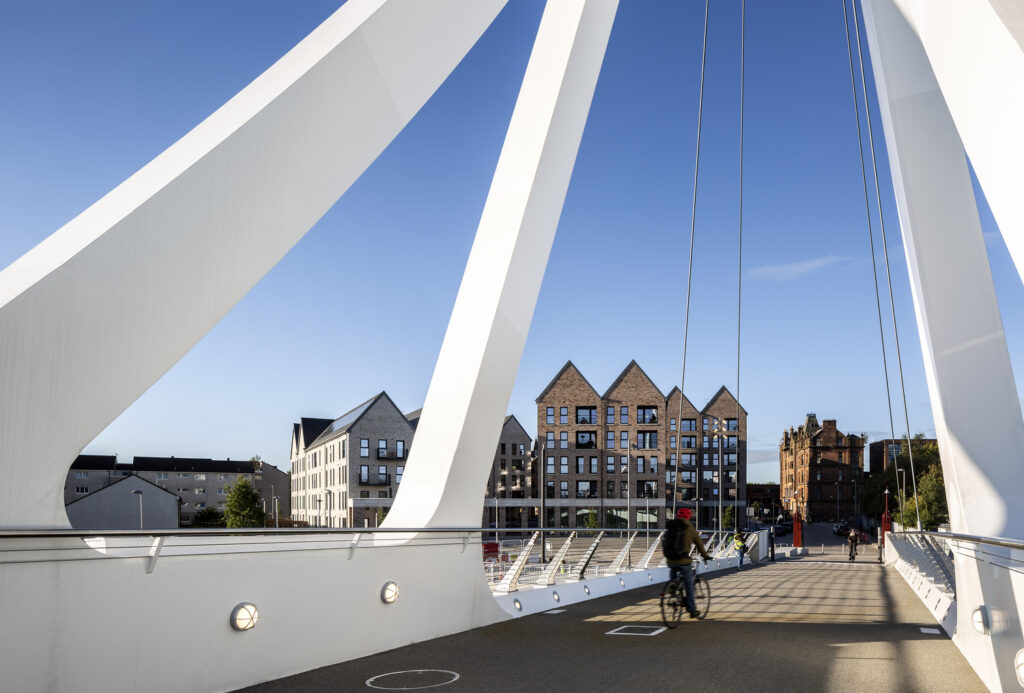
Our Water Row masterplan redresses historical spatial inequity by reconnecting Govan to its waterfront and the rest of the city. Delivered alongside the new Govan-Partick active travel bridge, it reconnects two disparate communities of Glasgow. Affordable homes and shopfronts activate public realm, re-establishing Govan Cross, and demonstrating how development can reconnect Glasgow with the Clyde.
At Ladyfield, we’re working with The Crichton Trust, local communities and stakeholder partners to deliver a masterplan for 300 mixed-tenure homes embedded within the landscape. Designed around active travel, ageing in place and intergenerational living, the site will become an open parkland for the community of Dumfries, promoting wellbeing, affordability and long-term resilience.
In Craigend, a community-identified need has shaped proposals for a neighbourhood centre that improves accessibility, safety and local identity. Long-term stewardship is embedded through partnerships between residents, community organisations and the Council, ensuring the space evolves with local needs over time.
3. Does the majority of your work promote equity in society, and consider all people, not only building inhabitants
Equity is embedded within our inclusive business model and is fundamental to our practice. We bring communities together, build consensus, celebrate difference and foster agency. This ethos underpins projects including Liveable Neighbourhoods, Granton Waterfront Framework, and Ladyfield.
Whilst we have developed expertise in shaping places with everyone in society, we collaborate with specialists to deepen our understanding and improve outcomes for projects and communities. We work with child advocacy experts, A Place in Childhood, to embed the views and rights (UNCRC) of children and young people in our projects.
Collaboration with Make Space for Girls has enabled us to explore place-based gender inclusivity from project inception through to design, delivery, and stewardship.
These collaborations, alongside engagement with other organisations, including the Edinburgh Access Panel, help to remove barriers to participation and foster a sense of belonging, continually challenging assumptions to create places that are more inclusive, accessible and equitable.