
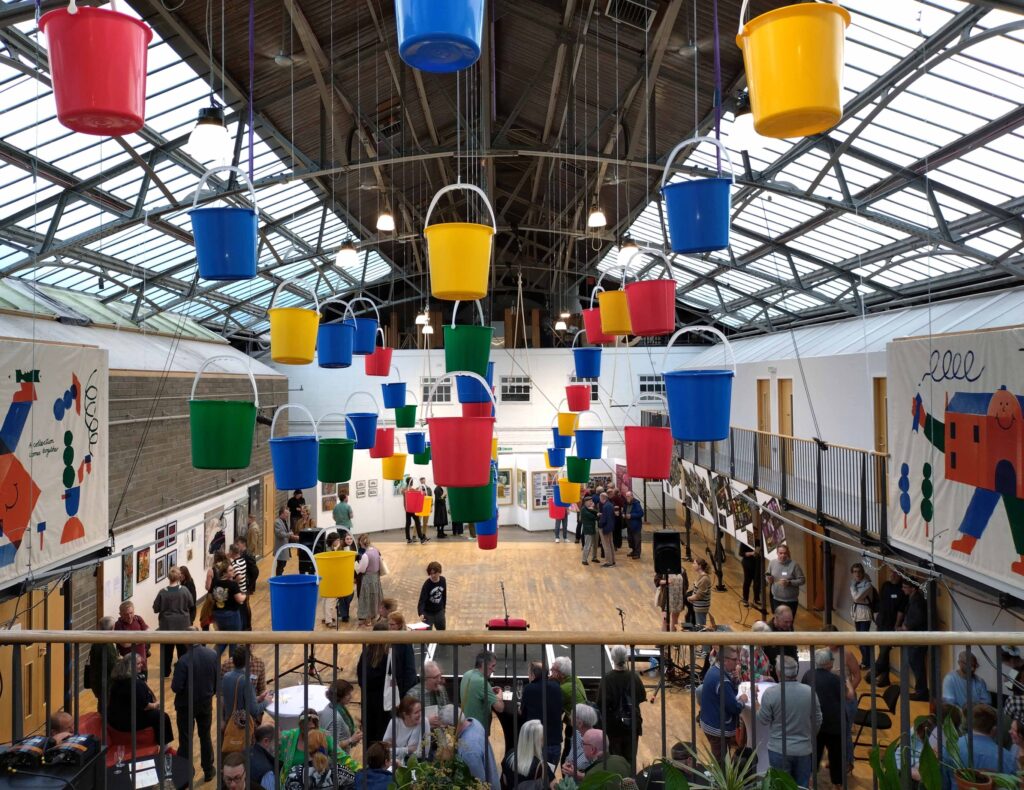
Submission by City Architecture Office.
Being a good ancestor
Practice
1. Does the practice have a clearly stated purpose aligned with the planetary emergency? We are looking for a bold ambition here, and a practice culture which recognises the need for long-term thinking. For example, a strong mission, a theory of change, or a sustainability roadmap.
Integrity, quality, sustainability and social conscience are the key principles of the City Architecture Office (CiAO). These principles are applied to actively respond to the planetary climate emergency. CiAO has a strong interest in sustainability and a design approach to building that has a respect for place and tradition.
2. Does the practice have a clear succession plan, which passes on ownership and protects the values and legacy of those who built and contributed to the practice? For example is the practice an employee owned trust.
No.
3. Does the practice share research and knowledge for the benefit of society and the wider world? For example, you regularly carry out post occupancy evaluation and share information with others.
No.
Project
1. Does the practice advocate for long-term thinking at the outset of projects? Do you initiate projects with long-term thinking and challenge the client on design life? Also, can the practice demonstrate that this approach has worked with a shorter or longer design life, or an innovative approach to financing or payback period?
For example, At the Drill Hall Arts Centre, all the specified materials are selected for ecological performance and the structure is demountable for future adaptation. It was the first building in Scotland to be heated & ventilated from a NIBE air source & exhaust air heat recovery system. Wet solar panels provide DHW.
2. Do your projects take account of the future climate and the need for resilience? For example, do the projects demonstrate flexibility, design for adaptation, design for disassembly, non-deterministic solutions, or demountable structures.
CiAO projects range from the change of use & regeneration of redundant buildings to new-build thermally efficient properties. Specification of materials and renewable energy technologies are integrated into the design process. The practice refers to the UKGBC web database of sustainable building products. The practice has assisted clients to obtain grants for renewable technologies through SCHRI and the Energy Savings Trust. CiAO has practical experience of working with MCS certified products and installers.
3. Do the majority of your projects go beyond mitigating negatives and towards optimising positives? For example, are they meeting or exceeding the RIBA 2030 Challenge.
No.
Co-evolving with nature
Practice
1. Does the practice use biophilia within the office or regularly host meetings and retreats in natural settings? For example do you have extensive planting within the office or rely on natural patterns and imagery for stress relief or quiet areas.
No.
2. Can the practice share examples where it has considered nature in decision making? For example by having a nature proxy to encourage eco-centric decision making, using natural systems as inspiration for the company structure, recognising the seasonal nature of people’s capacity and workload or celebrating equinoxes and solstices together.
The practice Director has participated in the productions and annually celebrated Beltane Fire Festival, in Edinburgh.
3. Is the practice supporting nature locally and nationally? For example, does the practice support local gardens, gardeners, planting programmes, rewilding programmes or advocate for changes in legislation to protect nature.
The practice has over 20 years actively nurtured and maintained a shared amenity garden that adjoins the office. Staff are encouraged to use the outdoor space and connect with nature in this green pocket, throughout the seasons.
Project
1. Can the practice demonstrate projects which strive to match the performance of a mature ecosystem? As a minimum this would mean achieving biodiversity net gain.
Biodiversity net gain is achieved at our Saline Affordable Housing. A village green with a mature Lime tree is at the heart of the estate. Perimeter woodland belt and hedgerows were retained, to support diverse species including bats and breeding birds.
A SUDs pond, A wild flower meadow, tree and shrub planting within the scheme promote further biodiversity.
2. Is the practice working on material stewardship? For example, evidence could be shown through repeated use of low carbon materials, extensive material libraries and research or publications supporting responsible use of materials and elimination of waste.
No.
3. Do the majority of projects demonstrate the use of biologically-inspired approaches such as Bioregionalism, Biophilia, Biomimicry, Ecomimicry (also referred to as Ecosystems Thinking, Industrial Ecology or Industrial Symbiosis) or BioTRIZ?
No.
Creating a just space for people
Practice
1. Does the practice have a progressive EDI policy and can you evidence many forms of diversity, which are welcomed and acknowledged, within the practice?
No.
2. Does the practice operate a no overtime culture, meet the living wage consistently, and stipulate a fair salary ratio between staff of all levels?
Yes, the practice adheres to the principle of a no overtime culture, it meets the living wage consistently, and has a fair salary ratio between staff of all levels.
3. Does the practice support charities, community groups, social enterprises, action groups and others through pro-bono work, charitable giving or in-kind donations?
Yes, staff participate in sponsorship fundraising events supporting charities such as Parkinsons UK, SAMH.
4. Does the practice publicly refuse to work with certain clients, suppliers or organisations on ethical grounds?
No.
Project
1. Do the projects demonstrate deep engagement with local stakeholders and end users? For example, is there evidence that your project engagement goes beyond consultation towards co-design?
At the Saline Affordable Housing, a clear need for social housing was identified from a housing needs consultation CiAO conducted with local residents. This was included as a priority in the community action plan. From this potential sites were identified, community engagement events held and a masterplan developed. A local Housing Association was contacted, shown the findings and a partnering relationship established to pursue the development. Local people were given priority for the mixed tenure affordable units.
2. Do your projects create connected and resilient places which positively contribute to their neighbourhoods and allow equality of access? For example, do your projects create economic opportunity, retain value locally and generate social value?
For example, Saline housing has successfully creates connected and resilient place that positively contributes to the neighbourhood. It created economic opportunity, retained value locally and generated social value by expanding the village settlement boundary, allowing local families to live in Saline by alleviating housing scarcity and not be priced out ot town. In turn, the local primary school role has risen and local businesses supported.
3. Do the majority of your projects promote equity in society, and consider all people, not only the building inhabitants? For example, do your projects show due regard for workers within the supply chain and take active steps to avoid modern slavery?
Yes.