
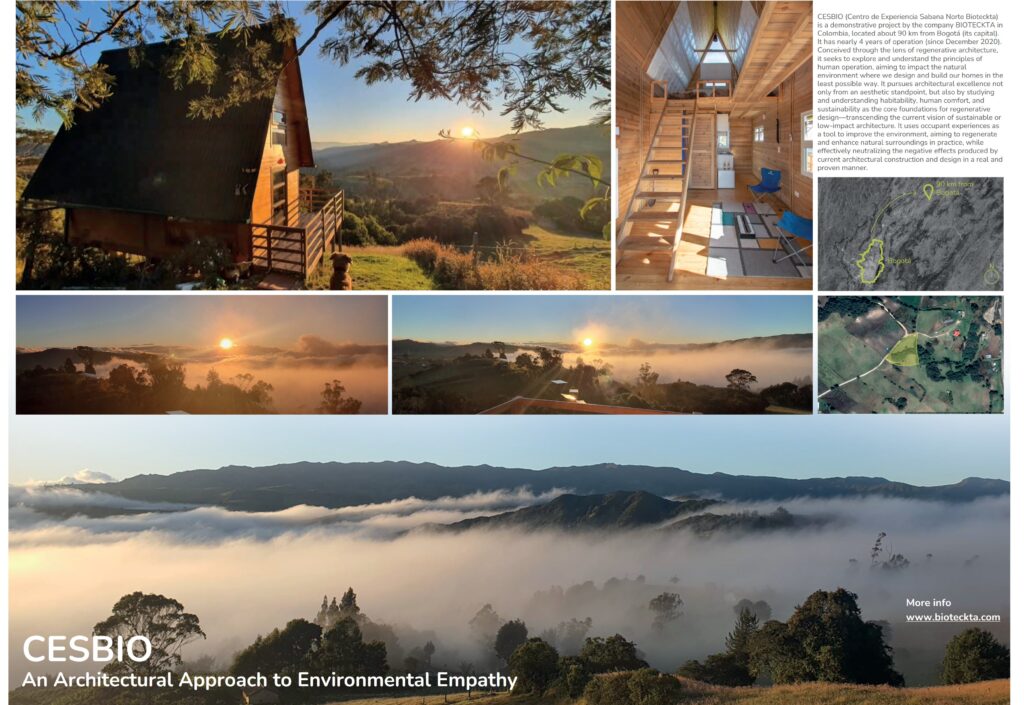
Submission by BIOTECKTA.
Being a good ancestor
Practice
1. Do you have a clearly stated purpose aligned with the planetary emergency? We’re looking for a bold ambition here, and a culture which recognises the need for long-term thinking.
We are pioneers in the pursuit of regenerative architecture in Colombia, transforming novel ideas into future realities through innovative solutions for tomorrow. CESBIO stands as one of our leading breakthroughs. It represents more than a shift in construction practices; it demands an operational evolution in mindset to build a genuinely powerful regenerative architecture across the Latin American region.
Our goal is to awaken a collective consciousness. This movement is not just about saving the planet—it is a declaration of human survival. Consider this: by integrating a phytoremediation wetland to process greywater, a simple act like washing dishes is completely transformed. Anyone using it will immediately feel they are nurturing nature rather than contributing to global pollution. That is a true shift in mindset. That is the essence of CESBIO: Designing buildings that live in profound empathy with the environment.
2. Do you have a clearly stated purpose aligned with the planetary emergency? We’re looking for a bold ambition here, and a culture which recognises the need for long-term thinking.
CESBIO is more than just a construction blueprint—it is a lifestyle. Every operational detail is carefully tailored to ensure a truly regenerative and sustainable living experience; we call this ‘environmental empathy.’
For the last five years, our project has transformed challenges into possibilities, strengthening the community’s sense of unity. I will not say this is an easy or fully completed goal just yet, but we are cultivating a powerful vision where all stakeholders can prosper. Then raw material suppliers , have contribute with tecnology and materials and Today, we have two families in th region ( Bogotá Savannah ) deeply involved in different areas of the project, and we look forward to welcoming many more in the near future. To keep this vision alive for future generations, we are actively seeking visionary partners and investors who share our passion and are ready to replicate these practices, expanding our collective footprint across the region.
3. Do you share research and knowledge for the benefit of society and the wider world?
We have actively participated in numerous seminars, national congresses, and prominent academic forums, proudly presenting our work to academia and the wider construction industry to showcase our advancements in research and technology transfer.
Our breakthroughs have taken center stage at key industry events, including winning the speakers’ forum at the Primera Cumbre de Inteligencia Artificial Camacol 2025 , La ruta camacol Verde 2025 and presenting at the Envolum Summit 2026 , alongside various high-level academic symposiums. Through these platforms, we continue to bridge the gap between AI-driven innovation, bioclimatic data, and real-world regenerative applications. Our project has been documented over the last 5 years so that, by fostering further cooperation, it becomes possible to drive a real change in mindset through regenerative architecture.
Detailed documentation of our research papers, event galleries, and presentation highlights can be explored further in the Media and Press section of our website.
Project
1. Do you advocate for long-term thinking at the outset of work? Do you initiate work with long-term thinking and challenge clients? Also, can the organisation demonstrate that this approach has worked?
Yes, CESBIO is a living experience of sustainable architecture that has now spanned 5 years as part of the operational and innovation area where people work monday to friday, demonstrating that regenerative architecture is a reality for the near future. At CESBIO, we advocate for long-term thinking from the outset by treating the planet as a living organism, designing with radical respect and true empathy to reverse the negative impacts of construction.
We actively challenge our clients to embrace this mindset. Initially an exclusive experience for corporate clients, CESBIO pushes developers to look beyond basic sustainability by immersing them in a completely off-grid, autonomous system. Now, we are expanding this live experience so more people can understand firsthand how it works. In the near future, we are extending this opportunity to purpose-driven tourism, seeking diverse economic sustainability strategies to maintain this initiative and include a wider community in the process.
2. Does your work take account of the future climate and the need for resilience?
CESBIO tests the most challenging climatic conditions at our high-altitude site in the rural Bogotá savanna. As professionals specialized research center, its core objective is to prove the operational viability of regenerative architecture under these highly demanding conditions. By demonstrating absolute self-sufficiency, we aim to inspire the construction industry to develop advanced systems centered around true environmental empathy and responsible resource management.
We hope more of the low-cost and some high tech , off-grid technologies and bioclimatic strategies validated here can be seamlessly applied to global housing projects. This is precisely why gaining visibility is vital to powering our proposal; being featured in this prestigious index represents one of our most important opportunities to share these real-world advancements. Through this platform, we can confidently bridge the gap between applied scientific research and scalable, regenerative architecture that actively restores the natural world.
3. Does the majority of your work go beyond mitigating negatives and towards optimising positives?
Regenerating a century-old cloud forest, optimizing habitats for native birds in the roof, and actively restoring local biodiversity are just some of the extraordinary environmental milestones we have already achieved. At CESBIO´s living laboratory, our work goes far beyond theoretical sustainability; we are actively reversing the ecological damage caused by historical, indiscriminate farming and cattle ranching in the Bogotá savanna.
By transforming this degraded landscape into a thriving, balanced ecosystem, we have proven that architectural development can coexist with nature to foster ecological healing. These milestones serve as living proof that our regenerative principles work in practice. To scale this impact and inspire the global construction industry to adopt true environmental empathy, gaining visibility through this prestigious index is essential. This platform offers an unmatched opportunity to showcase our proven advancements and advocate for a future where architecture restores the planet.
Co-evolving with nature
Practice
1. Do you use biophilia within your premises and/or do you regularly gather in natural settings?
We seamlessly integrate biophilic design across every internal view of CESBIO, embedding nature into every corner of the premises. We actively believe that the natural environment is not merely an aesthetic inspiration, but a powerful neuro-architectural tool capable of healing and restoring the human mind. On a personal level, living within this project has profoundly restored my inner peace and fostered a deep sense of unity within my family.
However, maintaining a continuous, immersive connection with a living ecosystem is not without its challenges. Managing an off-grid, nature-integrated home involves significant maintenance and consistent surveillance. To address this, we actively gather and collaborate with our local neighbors within these natural settings. This community-driven approach ensures the security and upkeep of the house, proving that true biophilia fosters not just ecological harmony, but deep social resilience.
2. Can you share examples of where you have considered nature in decision making?
Every design choice is rooted in environmental empathy, prioritizing nature at the core of our decision-making. One of our most challenging yet impactful decisions was implementing a dry composting toilet system instead of a traditional septic tank. This bold choice completely eliminates blackwater contamination, safeguarding the delicate groundwater and soil of our century-old Fog forest. CESBIO operate completely off-grid. By harvesting 100% of our rainwater and generating all our energy from the sun, we actively respect the planet’s finite resources. This make a profound difference !! Ensuring our human footprint moves beyond mere mitigation, actively harmonizing with the living ecosystem. By treating the natural environment as a primary stakeholder in every operational choice, we prove that regenerative architecture can sustainably thrive in balance with nature.We avoided hard paved walkways; instead, access paths blend seamlessly with the landscape, inspiring the best way to arrive at the project without impacting the environmen
3. Are you supporting nature locally and nationally?
Protecting a 1500 sq century-old fog forest is perhaps our most important goal, serving as the foundation for how we support nature both locally and nationally. At CESBIO, we actively restore biodiversity by letting nature revitalize itself through strictly limited human activity. Locally, we have transformed degraded agricultural land on the Bogotá savanna into a thriving ecological sanctuary, optimizing habitats for native bird species and flora that had been displaced by historical farming.
Nationally, our company scales this local impact by using CESBIO as a living laboratory to pioneer open-source, regenerative data. By sharing our advancements in bioclimatic design and off-grid technologies across major national forums and academic congresses, we provide the wider Colombian construction industry with a proven blueprint. We demonstrate that development can actively heal regional ecosystems, inspiring a nationwide shift toward radical environmental empathy.
Project
1. Can you demonstrate work that strives to match the performance of a mature ecosystem?
We completely avoid mechanical space heating systems because our advanced building envelope effectively retains thermal energy all year round. Instead, we integrate cutting-edge Phase Change Materials (PCMs) to capture and store solar heat, acting as a highly efficient passive heating solution.
Beyond these microclimatic architectural innovations, our positive impact on the surrounding ecosystem is fully quantifiable. Through dedicated restoration efforts, our century-old cloud forest has increased in total area by at least 30%. Furthermore, our structure has seamlessly merged with nature; several native bird species now return annually to nest directly on our roof in a dedicated upper space. These verifiable milestones are just a few of the concrete, real-world facts that the CESBIO project can confidently showcase, proving that thoughtful, we combine low-cost and high tech in the most efficent way to regenerative design can successfully eliminate reliance on the traditional grid while actively reviving local biodiversity.
2. Are you working on material stewardship?
No.
3. Does the majority of your work demonstrate the use of biologically-inspired approaches such as Bioregionalism, Biophilia or Biomimicry?
Yes, our entire portfolio demonstrates the profound application of Bioregionalism, Biophilia, and Biomimicry. Operating on the premise that the planet is a living organism, we practice strict Bioregionalism by tailoring our building sciences to local microclimatic demands, ensuring our structures adapt perfectly to their regional ecosystems.
Furthermore, Biophilia and Biomimicry serve as functional frameworks. We embed biophilic design across every internal view, using nature as a neuro-architectural tool to enhance human well-being. Simultaneously, our engineering mimics nature’s closed-loop efficiency through low-impact, off-grid technologies. This includes using advanced building envelopes and Phase Change Materials (PCMs) to passively retain thermal energy, harvesting 100% of our rainwater, and deploying dry composting toilets that protect groundwater.
By treating the environment as a primary stakeholder, our work bridges the gap between AI-driven bioclimatic innovation and real-world, regenerative applications that actively heal local biodiversity.
Creating a just space for people
Practice
1. Do you have a progressive EDI policy and can you evidence many forms of diversity, which are welcomed and acknowledged, within your company/organisation?
Yes, OUR COMPANY maintains a progressive Equity, Diversity, and Inclusion (EDI) policy, firmly believing that creating equitable spaces for all people is the most powerful catalyst for societal change. We actively evidence diverse forms of inclusivity within our organization, with a team composed of at least 55% women in managerial, coordination, and operational roles.
Our social commitment manifests through tangible inclusion.Nowadays a proud young woman Country folk is coordinating operations. We proudly integrate single mothers into our workforce, actively supporting them as vital contributors to our technological and architectural breakthroughs. Furthermore, our EDI framework heavily incorporates marginalized communities by actively hiring personnel from local rural areas to serve directly within the CESBIO project. By bridging the gap between cutting-edge AI innovation and local rural talent, We ensures that the transition toward a regenerative future is socio-economically inclusive, honoring and elevating the community that safeguards our surrounding ecosystems.
2. Do you operate a no overtime culture, meet the living wage consistently, and stipulate a fair salary ratio between staff of all levels?
Our company ensuring we consistently meet the legal rules in Colombia and guarantee a dignified, competitive living wage for all team members. According to local regulations, our compensation structure is designed to reflect the technical expertise and social value each individual brings to our regenerative projects, from our engineering specialists to our rural operational staff. In adition we support 50% of superior studies for emloyyes with at least 4 years in the compay.
While adhering strictly to Colombian labor laws regarding standard working hours, we actively foster a balanced, efficient culture that prioritizes human well-being. We treat our human capital with the same “environmental empathy” we apply to our architecture, recognizing that professional excellence is achieved through sustainable workloads rather than systemic overtime. By valuing our rural personnel and single mothers alongside our technical leadership, we ensure that our economic success is shared fairly and transparently across the entire organization.
3. Do you support charities, community groups, social enterprises, action groups and others through pro-bono work, charitable giving or in-kind donations?
No.
4. Do you use an ethical framework to assess opportunities and/or supply chain partners and is them team consulted on these decisions?
No.
Project
1. Does your work demonstrate deep engagement with local stakeholders and end users?
No.
2. Does your work create connected and resilient communities which positively contribute to neighbourhoods and allow equality of access?
Yes, our work actively builds connected and resilient communities by fostering localized socio-economic ecosystems. Because the CESBIO laboratory is located in a rural area of the Bogotá savanna, we implement a strict regional hiring policy, deliberately employing personnel exclusively from this immediate area. By embedding local employment and training directly into our core operations, we positively contribute to the long-term social fabric of our neighborhood.
This deliberate approach ensures true equality of access to cutting-edge green industries for marginalized rural workers who are typically excluded from high-tech architectural advancements. Furthermore, actively involving local families in the project’s continuous stewardship and ecological monitoring creates a highly resilient, close-knit network of shared responsibility. Ultimately, we transform local residents into the primary leaders of their own natural landscape, proving that true regenerative architecture serves as a powerful tool that empowers families, enhances neighborhood resilience, and bridges deep urban-rural inequalities.
3. Does the majority of your work promote equity in society, and consider all people, not only building inhabitants
No.