
Submission by Allford Hall Monaghan Morris.
Being a good ancestor
Practice
1. Do you have a clearly stated purpose aligned with the planetary emergency? We’re looking for a bold ambition here, and a culture which recognises the need for long-term thinking.
AHMM has continued to publish its annual carbon emissions report as part of its commitment to SBTi.
Although not a requirement of the SBTi, the report also includes the upfront carbon emissions of AHMM’s projects that achieved practical completion in the reporting periods, with a reduction trajectory target based on the upfront carbon intensity of AHMM’s 2022 buildings and working to LETI 2030 targets. The 2024 project emissions data shows that the projects we completed in that year were more carbon intensive on average than previous years. This highlights the need for continued scrutiny and progress in reducing upfront carbon.
https://www.ahmm.co.uk/expertise/sustainability/ahmm-carbon-emissions/
2. Do you have a clearly stated purpose aligned with the planetary emergency? We’re looking for a bold ambition here, and a culture which recognises the need for long-term thinking.
In November 2025 seven directors joined AHMM’s Executive Board joining the founding directors as an expanded executive leadership team.
The practice continues to be majority owned by an Employee Ownership Trust. Elections took place for the new Employee Trustees to join the Trust board. The current Trustees are Peter Morris, Jonathan Hall, Patricia Ribeiro, James Ellender and Graeme Nuttall (independent Chair). The Trustees are, in turn, supported by an EOT Working Group made up of staff from across the practice.
3. Do you share research and knowledge for the benefit of society and the wider world?
AHMM has continued to share research and knowledge with the wider industry.
Most recently, AHMM collaborated with the design team of urbanest Battersea to produce a report, ‘Urbanest Battersea: The Passivhaus Story’.
The report begins with an introduction to the Passivhaus standard and its critical role in meeting Net Zero targets by 2050 followed by a detailed analysis of urbanest Battersea compared to two other AHMM projects, to demonstrate how Passivhaus design reduces whole life carbon by reducing operational energy demand.
https://www.ahmm.co.uk/expertise/sustainability/urbanest-battersea-the-passivhaus-story/
Project
1. Do you advocate for long-term thinking at the outset of work? Do you initiate work with long-term thinking and challenge clients? Also, can the organisation demonstrate that this approach has worked?
AHMM’s proposals for Landsdowne House in Berkley Square replace an existing inefficient (but not very old) building.
The existing building was constrained by an inefficient layout of multiple structural cores, compounded by low floor to ceiling heights. In contrast, the redeveloped Lansdowne House has generous floor plates with an independent, centralized core. In the future, this core may be reconfigured or replaced without requiring wholesale demolition.
The innovative ‘sway’ frame creates a structural solution not dependent on the core for shear stability, making the building infinitely adaptable.
Openable windows provide fresh air, and enhanced floor to ceiling heights maximise daylight penetration, allowing a positive impact on the wellbeing of building users while enabling the building to adapt to a changing climate.
The new building is designed to last for generations to come, and to achieve the highest possible standards for sustainability and wellbeing, targeting BREEAM Outstanding and WELL Platinum.
2. Does your work take account of the future climate and the need for resilience?
Our in house ‘Sustainability Toolkit’ (a design workshop carried out with every project team at key project stages) includes a category for ‘Climatic Design’.
This involves developing passive architectural strategies for today’s climate and using future weather files, to test for thermal comfort levels in the future. Our iterative design process refines details like window to wall ration, reveal depths and shading to optimise thermal gains.
We then work with our design team collaborators to develop servicing strategies that can adapt over time. Frequently incorporating on floor plant as this can be more efficient in operational energy terms but can also facilitate easier and less wasteful upgrades in the future.
3. Does the majority of your work go beyond mitigating negatives and towards optimising positives?
AHMM’s in house Building Performance Team has recently updated its internal benchmarking dashboard to allow teams to easily compare the average upfront carbon intensity in relation to various industry and AHMM internal benchmarks to aid our project teams with understanding the wider context of their specific targets. The database will be updated regularly with the most recent project data with the view to include operational energy and facade carbon intensity in a future update.
Co-evolving with nature
Practice
1. Do you use biophilia within your premises and/or do you regularly gather in natural settings?
The rooftop of our London office offers a biophilic space which employees and guests can use as they wish. The space has hosted several sketching workshops, as well as CPD talks when the weather allows. It is regularly used by students when visiting the studio for work placements, career events and the AHMM Summer School.
Similarly in the Bristol studio, a gardening group has been set up to maintain the external balcony space which is used when weather allows for meetings and informal gatherings. The studio’s plants are cared for by Plantcare to ensure they are well maintained and clippings offered to employees to cultivate their own plants too.
The practice also encourages employees to take volunteering days which are often outdoor activities in natural setting such as tree planting, gardening or animal care days.
2. Can you share examples of where you have considered nature in decision making?
Several recent housing projects have been designed around a central community green or garden allowing for interaction, play and leisure on the doorsteps of each dwelling.
On one project on the south coast, a protected ecological zone was central to the decision making of the project as the development needed to work with the existing landscape and protect the habitats of this ecological zone.
3. Are you supporting nature locally and nationally?
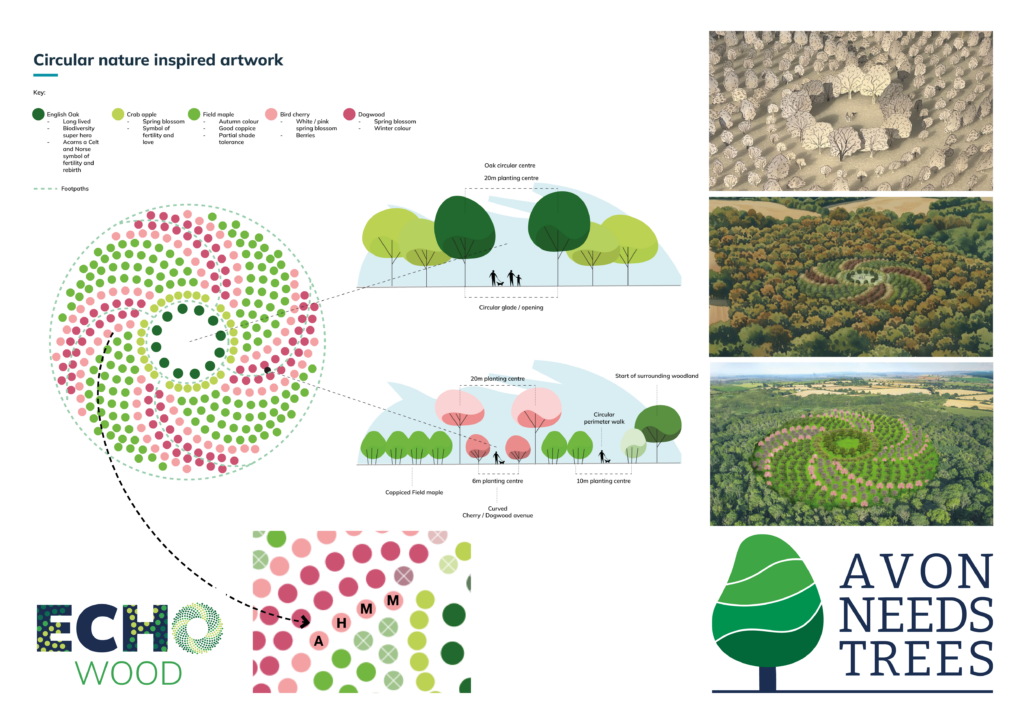
For the first time, AHMM marked National Tree Week with a donation and sponsorship of four cherry trees in the newly created Echo Wood, a collaborative artwork with Avon Needs Trees and artist Luke Jerram. This living artwork will be made of 35 trees, sited on the Lower Chew Forest, Somerset.
On a smaller scale, at Mason & Fifth Westbourne Park, a hotel led development in west London, a local artist was commissioned to create a bug hotel, 3D printed from recycled coffee cups and symbolising a shared, temporary habitat for both non-human and human residents. This is located in the publicly accessible waterfront pocket park promoting ecological awareness and coexistent.
Project
1. Can you demonstrate work that strives to match the performance of a mature ecosystem?
No.
2. Are you working on material stewardship?
AHMM continues to maintain its bespoke materials library with a recent reorganisation to include an expanded natural materials section, including regenerative/renewable plant-based products and natural stone. These are now also more prominently displayed within the library space. AHMM have also worked on reducing the plastic samples, prioritising recycled/recyclable plastics and sustainable alternatives to more harmful materials like PVC.
3. Does the majority of your work demonstrate the use of biologically-inspired approaches such as Bioregionalism, Biophilia or Biomimicry?
The practice strives to include biophilic elements and concepts in our work.
Often this centres around the inclusion of location appropriate planting and a natural material pallet to give building users site of and contact with nature.
Most recently this approach was employed at Metropolis, a retrofit and extension of an early Seifert building in West London. The design used a visually exposed CLT superstructure to extend the existing building and provide each new floor with generous external space lined with deep planting beds filled with a mix of plants and shrubs that will change through the seasons, connecting users with the rhythms of nature.
Creating a just space for people
Practice
1. Do you have a progressive EDI policy and can you evidence many forms of diversity, which are welcomed and acknowledged, within your company/organisation?
The updated ED&I Annual Report 2025 was published in early 2026 highlighting the ED&I Working Group activities. The publication was accompanied by a workshop session to discuss the development and the EDI programme within AHMM.
AHMM also took part in the RIBA EDI National Work Experience week hosting 16-28 year olds from underrepresented backgrounds over a week long programme with the aim to improve social mobility and diversity in the profession.
AHMM has also collaborated with Creative Dimensions Trust, The Academy of Real Assets and Shape My City programme in Bristol with the aim to open new paths into the industry.
2. Do you operate a no overtime culture, meet the living wage consistently, and stipulate a fair salary ratio between staff of all levels?
AHMM continues to be an equal opportunity employer, celebrating 10 years as a Living Wage Foundation accredited employer in 2025.
The practice is also a contributor to the Islington Living Wage Action Group promoting the principles to other businesses in the borough.
AHMM has also published its Gender Pay Gap (GPG) figures for 2025 which showed a significant reduction in our median GPG, falling to its lowest level since 2017.
Alongside the GPG, for the first time AHMM also internally published its Ethnicity Pay Gap (EPG) figures, with the view to build transparency and improvements in the future.
3. Do you support charities, community groups, social enterprises, action groups and others through pro-bono work, charitable giving or in-kind donations?
Now in its 10th year, AHMM’s Partnerships Group has continued to support VCSEs donating £129,230 to 117 causes and collectively undertaking 1,719hours of employer supported volunteering in 2025.
The practice supported three pro bono projects completing the new kitchen for charity Migrateful in Bristol, a revamp of the community café and shop at St Luke’s Community Centre in London and redesigning the studio space for The Bike Project in London. The practice has also supported preparing planning applications for a community hub in Somerset and a community swimming pool in Bristol.
As part of National Tree Week, AHMM sponsored four trees which form part of a living artwork made from 365 trees in the Echo Wood, Lower Chew Forest, Somerset. This is the first time the practice has marked National Tree Week, building on our work with Avon Needs Trees and the Partnerships Group’s work to tackle the climate crisis.
4. Do you use an ethical framework to assess opportunities and/or supply chain partners and is them team consulted on these decisions?
Suppliers are asked a series of question relating to their own environmental policy, performance, monitoring and carbon reduction plans.
We ask about certification – ISO 14001 or similar – and measured outcomes – carbon emissions or energy use intensity as well as general ambitions and attitude in policy documentation.
While not all suppliers are able to provide certification, asking the question begins a conversation with our suppliers about the importance of looking at their own environmental performance.
Project
1. Does your work demonstrate deep engagement with local stakeholders and end users?
AHMM has been working with St Matthew’s Primary School as part of Open City’s Young City Makers programme, which connects schools with architects, engineers, planners, and designers to explore how cities are shaped.
Pupils in years 4 and 5 have taken part in this creative programme based on our project at 1 Victoria Street, located close to the school.
The programme has included drawing and modelmaking workshops, encouraging pupils to think imaginatively about how cities are shaped and the role of architecture in their communities. It also included a visit to the Barbican, giving the children the opportunity to experience a significant architectural landmark firsthand. Through these activities, the programme has supported meaningful engagement with the local community, helping young people develop confidence, creativity and a stronger understanding of the city around them.
2. Does your work create connected and resilient communities which positively contribute to neighbourhoods and allow equality of access?
From the outset, AHMM’s design process thinks beyond the boundaries of the site to create connected and resilient communities. At 76 Southbank, the reinvention of Denys Lasdun’s building has transformed a once defensive, inward looking building into a fully accessible, pedestrian-focused place. The design improves both the building and its wider setting, opening new fully accessible public routes to the river and reshaping its relationship with the public realm.
Similarly, in Bristol the Assembly campus is sewn into the city with permeable routes and gardens that allows the public to move through via the restored historic street, Cheese Lane. This is to be further enhanced by the local authority with new pedestrian and cycleway links between Cheese Lane and Avon Street, which will heal the historic grain that was disrupted by the construction of Temple Way.
3. Does the majority of your work promote equity in society, and consider all people, not only building inhabitants
The recently completed 1 Broadgate demonstrates how design goes beyond building inhabitants with the creation of a multifunctional arcade. This inclusive public amenity with facilities for commuters, visitors, families and a Changing Places facility, which is only the third of its kind in the UK. The facility emerged from a collaboration with the University of East London, challenging students to design the space and giving them the opportunity further develop their concept through the main contract with a work placement.
AHMM continues to work as an RIBA Chartered Practice, maintaining high levels of honesty, competency and professionalism and adherence to the RIBA Code of Practice.
The practice has a published Anti-Slavery and Human Trafficking Statement on the website, and our in-house Legal team continue to check contracts, statements, polices and terms and conditions not only for our architectural projects but all supplier, contractors and person providing services to AHMM.