
Submission by Allies and Morrison.
Being a good ancestor
Practice
1. Do you have a clearly stated purpose aligned with the planetary emergency? We’re looking for a bold ambition here, and a culture which recognises the need for long-term thinking.
As architects and urbanists, our practice has a simple, clear purpose: to create elegant, inclusive, and resilient buildings, places, and cities rooted in their context. We shape environments where businesses thrive and communities flourish, pursuing lasting impact by elevating sustainability in the built environment.
To achieve this, we focus on three priorities:
- Evolving our portfolio: Leveraging insights from cross-disciplinary research, environmental analytics, and consultation with peers and communities to elevate our design responses.
- Practising what we preach: Tuning our operations, following our SBTi-aligned decarbonisation pathway, and responsibly offsetting residual carbon emissions to manage our impact on people and the planet.
- Making our best contribution: Focusing on sustainability at the neighbourhood scale.
Utilising decades of experience in regenerative placemaking – most notably at Queen Elizabeth Olympic Park and King’s Cross – we align social, environmental, and commercial value to deliver long-term, systemic change.
2. Do you have a clearly stated purpose aligned with the planetary emergency? We’re looking for a bold ambition here, and a culture which recognises the need for long-term thinking.
For us, succession is non-transactional: equity is not bought or sold, but passed on through stewardship in alignment with our collective culture and mission. New partners are appointed to our Limited Liability Partnership (LLP), with a clear mandate of collegiate decision-making and long-term guardianship, prioritising the ethos of the practice over short-term gain.
A formal succession covenant, embedded in our partnership agreement, ensures transparency and consistency across generations to safeguard the continuity of our culture and values which include a commitment to creatively address our planetary challenges. This has enabled the appointment of twelve new partners in the past decade. Profit distribution also extends beyond the partnership, reinforcing our belief in shared success and collective value creation. This structure allows us to honour the legacy of those who built the practice, while cultivating space for emerging leaders to shape its future with integrity, purpose, and continuity.
3. Do you share research and knowledge for the benefit of society and the wider world?
Research: Our approach is fuelled by research. We partner with bodies like Historic England (Complex City), the GLA (designing towards net-zero), the OPDC (Good High-Density study), and clients like GPE (digital strategies to unlock circularity) to generate meaningful, applicable, and accessible knowledge.
A compelling example is our Climate Change Group’s 2025 cross-disciplinary research into barriers to lower-carbon, indigenous stone construction in the UK. This has already been applied to active projects, including Harlow Bandstand, unlocking immediate impact.
Knowledge-sharing: These insights are shared through conferences, talks, exhibitions, and publications. Our annual ‘Citymakers’ conference brings experts together to explore forces shaping our urban environment. In 2025, it focused on how public-private partnerships can continue to unlock the futures our cities and communities need – ‘places of negotiation’. Importantly, we marry these investigations with youth workshops, school outreach, and work experience that help forge educational pathways to bring fresh insights into our industry.
Project
1. Do you advocate for long-term thinking at the outset of work? Do you initiate work with long-term thinking and challenge clients? Also, can the organisation demonstrate that this approach has worked?
Working at a neighbourhood scale necessitates long-term thinking, broadening site and programme boundaries to understand the wider urban systems framing each project. To effectively articulate opportunities and advocate for positive change, we developed Climate in Place™, a proprietary methodology embedding sustainability into masterplanning. This structured, context-driven approach draws from decades of sustainable placemaking to ensure every design decision contributes to environmental and social regeneration.
Key examples include our Olympic Legacy Masterplan, which harnessed 2012 Olympic investment to transform a post-industrial backwater into London’s largest new park in 150 years, overlaying pedestrian infrastructure to connect communities and lay enduring foundations for East London’s regeneration.
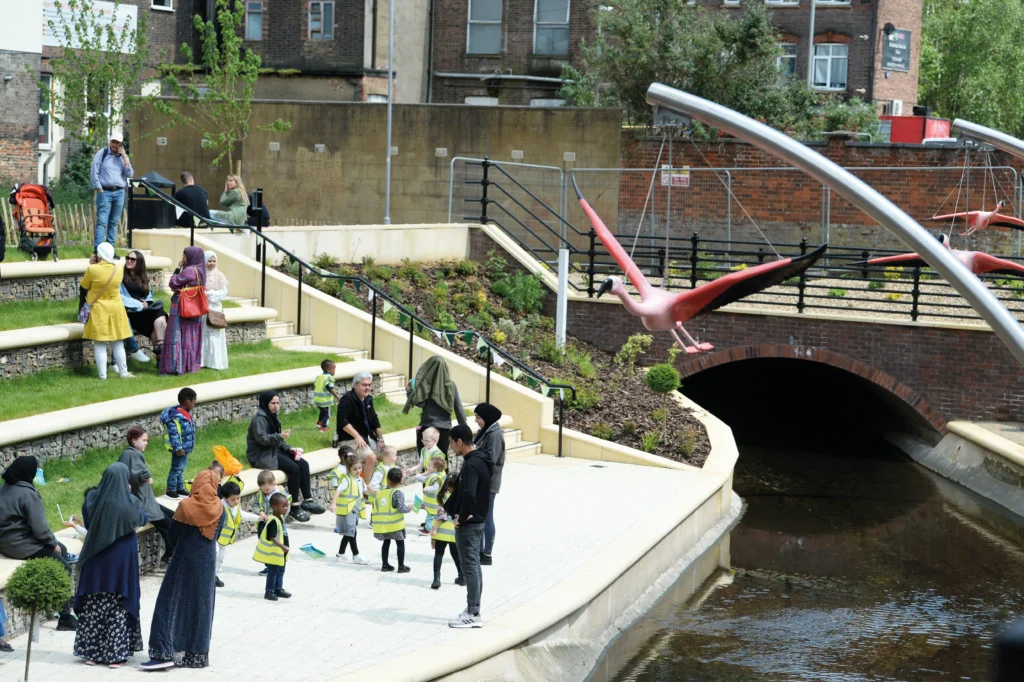
Similarly, our Luton Town Centre Masterplan enabled the de-culverting of the River Lea, harnessing a latent green asset to improve air quality, reduce urban heat, manage surface water, enhance biodiversity, and create 215m of new waterfront pocket parks that entice residents back to the centre.
2. Does your work take account of the future climate and the need for resilience?
Climate resilience and longevity are at the core of our design approach, informing robust, adaptable solutions at the building scale to both predictable and unforeseen changes.
At an urban scale, the challenge is more complex and the solutions more impactful. We develop a clear understanding of climate risk by harvesting macroscale insights, utilising predicted climate change mapped against the Köppen-Geiger climate classification, alongside tailored microclimate analysis using digital tools like Orbital Stack, Forma and bespoke Grasshopper scripts. These data-driven insights directly inform design solutions, leveraging building form, urban morphology, and nature-based solutions to ensure neighbourhoods are equipped to manage heat, water, and pollution over coming decades.
Our international projects are informed by in-house ‘climate design guides’. These provide local climatic analyses, covering wind, air temperature, relative humidity, UTCI, and precipitation, provide anecdotal insights into how places ‘feel’, and summarise vernacular solutions deployed locally to deliver passive comfort.
3. Does the majority of your work go beyond mitigating negatives and towards optimising positives?
Our urban-scale projects offer the most compelling opportunity to move from doing ‘less bad’ toward ‘net-positive’ solutions, aligning social, environmental, and economic value to deliver meaningful impact.
However, this must also be delivered at the building scale. To monitor the performance of our built portfolio, we manage a live project tracker, assessing each project’s sustainability potential from ‘business as usual’ to ‘exemplar’ to calibrate ambition, track progress, and hold ourselves accountable. Our strategy targets shifting our portfolio toward a majority of pioneering projects aligned with the UKNZCBS, RIBA 2030 Challenge, and beyond, but not by focusing on previously progressive clients, instead we aspire to have a greater impact. Target conventional briefs by aligning sustainability with long-term commercial value – reinforced with Post Occupancy Feedback, which we complete on all built UK projects, to elevate conventional briefs toward ambitious environmental and social outcomes, and driving systemic industry improvement in the process.
Co-evolving with nature
Practice
1. Do you use biophilia within your premises and/or do you regularly gather in natural settings?
No.
2. Can you share examples of where you have considered nature in decision making?
No.
3. Are you supporting nature locally and nationally?
No.
Project
1. Can you demonstrate work that strives to match the performance of a mature ecosystem?
No.
2. Are you working on material stewardship?
No.
3. Does the majority of your work demonstrate the use of biologically-inspired approaches such as Bioregionalism, Biophilia or Biomimicry?
No.
Creating a just space for people
Practice
1. Do you have a progressive EDI policy and can you evidence many forms of diversity, which are welcomed and acknowledged, within your company/organisation?
No.
2. Do you operate a no overtime culture, meet the living wage consistently, and stipulate a fair salary ratio between staff of all levels?
No.
3. Do you support charities, community groups, social enterprises, action groups and others through pro-bono work, charitable giving or in-kind donations?
No.
4. Do you use an ethical framework to assess opportunities and/or supply chain partners and is them team consulted on these decisions?
no.
Project
1. Does your work demonstrate deep engagement with local stakeholders and end users?
No.
2. Does your work create connected and resilient communities which positively contribute to neighbourhoods and allow equality of access?
No.
3. Does the majority of your work promote equity in society, and consider all people, not only building inhabitants
No.