
Submission by We Made That.
Being a good ancestor
Practice
1. Does the practice have a clearly stated purpose aligned with the planetary emergency? We are looking for a bold ambition here, and a practice culture which recognises the need for long-term thinking. For example, a strong mission, a theory of change, or a sustainability roadmap.
As a Certified B Corporation our company articles of association set out our actions beyond profit, and to “have a material positive impact on society and the environment”. We work exclusively for the public sector and charities and are committed to delivering public good. This legal commitment locks us in to evolving how the business operates and addresses our profound economic, societal and planetary challenges. It is closely tied to our mission, purpose and decision-making.
We first certified as a B Corporation in 2021. In 2024, we have been through our recertification process with external analysts to independently verify our impact all over again. We achieved a whopping 46% uplift in our measured positive impact.
2. Does the practice have a clear succession plan, which passes on ownership and protects the values and legacy of those who built and contributed to the practice? For example is the practice an employee owned trust.
Our current business and impact plan sets out a range of ‘succession scenarios’, which include possible transition to an employee owned trust. These scenarios have been appraised against our mission/ purpose (including protecting: Community, Customers, Environment, Workers and Governace). Shaped by these scenarios, we achieved a 39% increase in our impact through governace, ethics and transparency across a three year period.
Demonstrating this impact this has involved taking great care in how and why we work with sub-consultants, with particular attention paid to working with local partners, and on-boarding processes which ensure they are compatible with our commitments to accreditations such as the Living Wage and Mayor of London Good Work Standard. Being able to evidence these ways of working led to a substantial increase in our measured impacts.
3. Does the practice share research and knowledge for the benefit of society and the wider world? For example, you regularly carry out post occupancy evaluation and share information with others.
Across the last three years we have published annual Impact Reports and shared lessons with others. This has heightened our drive to contribute to wider influence and commit resources to improving the sector. We’ve done so by sharing knowledge, including:
- As founding members of the London Practice Forum (LPF), a group of architectural practices, who champion high ethical and sustainable standards and promote best practice in the built environment.
- As one of ten ‘Town Architects’ within the Mayor of London’s two-year pilot scheme, part of the £1.25m Local Growth Capacity Support Programme, that will utilise built environment expert knowledge to deliver Good Growth for Londoners.
- Across 7 design advocacy roles including review panels, regional and national roles to champion positive change.
- Through a year-long academic partnership with Professor Clare Rishbeth to explore participatory methods in urban design practice, funded by Arts and Humanities Research Council UK.
Project
1. Does the practice advocate for long-term thinking at the outset of projects? Do you initiate projects with long-term thinking and challenge the client on design life? Also, can the practice demonstrate that this approach has worked – with a shorter or longer design life, or an innovative approach to financing or payback period?
We’ve been stepping up our social value innovation as one of four organisations to build social value maturity through this two-year programme.
Social Value Portal’s first Social Value Accelerator Programme represents an important next step in maximising our social value impact and leadership in delivering social value in the built environment. This has included training for our team through the Social Value Academy and provides access to the Social Value Portal’s tools to benchmark both our projects and our own additional social value as an organisation. Data on our social value performance is being reported back to us on a quarterly and annual basis, enabling us to validate our commitments and sharpen our understanding of the scale and nature of our impact. Access to new data on our social value performance and improved fluency with quantifiable indicators will help us prioritise social value commitments to maximise the benefit we deliver.
2. Do your projects take account of the future climate and the need for resilience? For example, do the projects demonstrate flexibility, design for adaptation, design for disassembly, non-deterministic solutions, or demountable structures.
All our projects go through an internal environment review at inception where we review our brief and scope against our clients stated climate policies and commitments. We focus on how targets to reach net zero or address the biodiversity are reflected in our project brief and seek to strengthen these commitments where possible, often broadening engagement beyond the core client team.
This process has led to clear, long term decision making, such as addressing extreme heat risk informed by Met Office projections to 2050 and 2080 and recent research on the impact of extreme heat event of July 2022. For example, through community engagement this includes the identification of ‘cool routes’ in Croydon town centre, linking important social and transport infrastructure to ensure the town centre remains accessible and inclusive during hot spells in the future through clear guidance for green infrastructure, shade structures and material specification.
3. Do the majority of your projects go beyond mitigating negatives and towards optimising positives? For example, are they meeting or exceeding the RIBA 2030 Challenge.
We work extensively with public authorities to unlock existing buildings to offer vital support for thriving local communities and restoring nature. We track these impacts.
Creating sustainable cultural infrastructure that meet the needs of local communities is an important focus of our work. This incorporates borough wide mapping of cultural infrastructure needs and opportunities, such as in Wigan, and the early case making to enable existing buildings to be bought back into use and offer vital services to local communities, such as in Pitsea and Catford.
Our work in re-imagining existing infrastructure also seeks to look for positive opportunities far beyond the red line. In Lewisham and Bristol City Centre we have developed schemes that re-purpose multi-storey car parks and other infrastructure to enable low carbon urban logistics. These projects not only find creative viable uses for existing buildings but also unlock healthy, sustainable infrastructure for local communities and businesses.
Co-evolving with nature
Practice
1. Does the practice use biophilia within the office or regularly host meetings and retreats in natural settings? For example do you have extensive planting within the office or rely on natural patterns and imagery for stress relief or quiet areas.
No.
2. Can the practice share examples where it has considered nature in decision making? For example by having a nature proxy to encourage eco-centric decision making, using natural systems as inspiration for the company structure, recognising the seasonal nature of people’s capacity and workload or celebrating equinoxes and solstices together.
No.
3. Is the practice supporting nature locally and nationally? For example, does the practice support local gardens, gardeners, planting programmes, rewilding programmes or advocate for changes in legislation to protect nature.
We have an internal Environmental Management framework that helps us set, measure and monitor practice-based objectives in order to achieve regenerative outcomes. This draws on the B Impact Assessment, is complemented by tracking against the UN Sustainable Development Goals, and is shaped by expert support from external specialists such as ReLondon, Architects Declare Practice masterclasses and Architects Climate Action Network.
Within this framework, our climate toolkit sets out ways in which we support ecology and biodiversity, including actions for ecological regeneration impacts on physical and mental health and creation of green jobs.
Project
1. Can the practice demonstrate projects which strive to match the performance of a mature ecosystem? As a minimum this would mean achieving biodiversity net gain.
Through our projects we have secured mechanisms that ensure nature thrives. We have developed forward thinking policies to shape the delivery of a new community of up to 5,500 homes in London’s Green Belt to support Enfield’s local plan. Our work extended the site area to include over 100ha of green infrastructure, re-imagining the function the green belt provides through interventions such as river re-naturalisation, new woodland planting and water management.
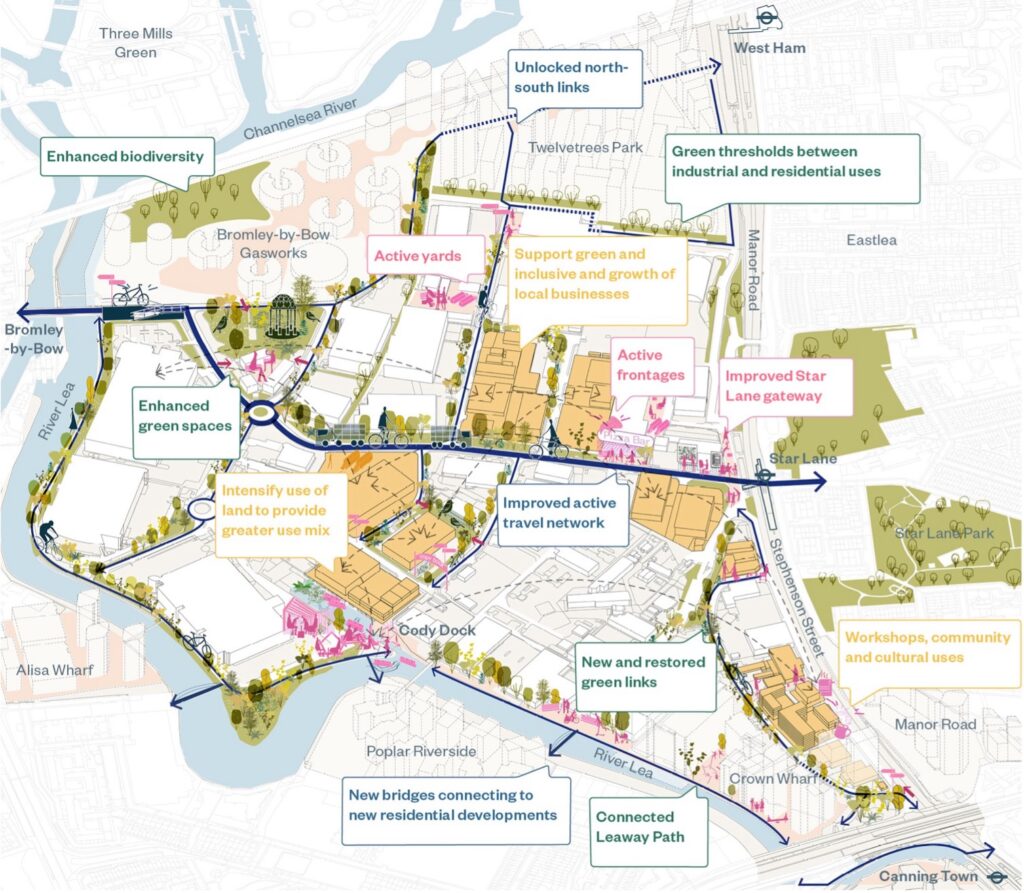
This practice of jumping scales to explore how a site can play an important role in a larger ecology is also important to our work in Canning Town. Here we worked with local businesses and the Council to restore the ecology along the River Lea and stitch together a more continuous network of green infrastructure within a large industrial area. In addition to new infrastructure we also identified opportunities for local businesses and organisations of collaborate on maintenance regimes to create more biodiverse, characterful and accessible public realm across the area.
2. Is the practice working on material stewardship? For example, evidence could be shown through repeated use of low carbon materials, extensive material libraries and research or publications supporting responsible use of materials and elimination of waste.
In addition to embedding circular principles within our design projects, we are also setting out strategic interventions that are needed to create the infrastructure to make material re-use possible. In Canning Town and Green Mile we have worked closely with local businesses to identify over 30 actions to deliver a more circular economy within and beyond a high street and large industrial area. These actions range from opportunities to share resources and re-use materials between businesses, through to planning for the space and infrastructure needed to support material re-use across the borough and wider city. We have also developed a ‘retrofit triage’ tool to inform strategic decision making around growth and retrofit potential within town centres. This is vital to ensure high level assumptions around retrofit and future capacity for growth are balanced at the earliest opportunity.
3. Do the majority of projects demonstrate the use of biologically-inspired approaches such as Bioregionalism, Biophilia, Biomimicry, Ecomimicry (also referred to as Ecosystems Thinking, Industrial Ecology or Industrial Symbiosis) or BioTRIZ?
No.
Creating a just space for people
Practice
1. Does the practice have a progressive EDI policy and can you evidence many forms of diversity, which are welcomed and acknowledged, within the practice?
We have a structured Equalities, Diversity and Inclusion policy and action plan. We provide educational opportunities, work placements, pro-bono consultancy services to third-sector organisations, finacial contributions and self-start initiatives like the RE–SET–GO programme.
We’ve had a real focus on sharpening our processes for equity and inclusion, led by our Head of People. We want to help correct the biases that plague our industry. In 2024 this involved 91 days of team knowledge sharing and skills sessions, supported by a participatory budget of over £16,000, directed by our Employee Forum. Achieving the Mayor of London’s Good Work Standard accreditation tested the ways in which we are directly contributing to a fairer and more inclusive economy where all can access good jobs with good conditions, in fair, healthy and inclusive workplaces.
Where others have failed to narrow the gender pay gap, we’ve made progress in re-addressing this balance with a -5.2% gender pay gap in favour of women, driven by women at senior leadership levels. Whilst we’re proud that our team continues to be majority-female and our other diversity statistics are ahead of much of the industry, we recognise that we can still improve upon this.
2. Does the practice operate a no overtime culture, meet the living wage consistently, and stipulate a fair salary ratio between staff of all levels?
We are committed to delivering public good, and this progressive attitude is reflected in the way we empower our team. This is supported by our dedicated Head of People – a progressive role for a practice of our scale – and recognised through our accreditations as Living Wage and Mayor of London’s Good Work Standard employer. Our ‘Transparent Pay and Competencies Framework’ was developed by co-designing and refining the attributes we value as a team. This process included 60 hours of team feedback and workshop time, development of 20 core competencies per role, 18 other skills and experience-based competencies and 5 engagement and professional development focused competencies.
This is underpinned by a clear culture of healthy working hours, flexible and supported return-to-work journeys, Time Off In Lieu and actively tracking overtime. In 2023 it was 2.4% overtime vs. industry benchmark that is ten times that (23%).
3. Does the practice support charities, community groups, social enterprises, action groups and others through pro-bono work, charitable giving or in-kind donations?
We provide community space for local organisations, patronage and funding for educational charities such as New Architecture Writers, pro-bono consultancy services to third-sector organisations, finacial contributions to charities and self-start initiatives like the RE–SET–GO programme.
In 2025, we have commenced hosting our first research residency at our London studio, as part of our ‘Right to Place’ initiative, which offers researchers dedicated time and free studio space to advance their independent work on themes of rights, spatial justice, cities and regeneration. Emerging from the grassroots Save Soanes campaign in Tower Hamlets, the Save Soanes Research and Advocacy Team brings together a powerful coalition of community advocates, youth workers, artists, built environment professionals, and policy experts to protect the at-risk community centre. It is conceived as a generous act to deepen enquiry, exchange ideas, and contribute to critical discussions on spatial justice.
4. Does the practice publicly refuse to work with certain clients, suppliers or organisations on ethical grounds?
We work exclusively for the public sector and charities. All projects (and clients) are appraised for Social value; Environmental impact; Provenace of finace; Destination of profits; Human rights record. We have robust supply-chain processes too. As part of our contract start-up processes as a B Corp, appointed sub-consultants provide details on ownership diversity, social and environmental impact. This enables us to take evidence-led decisions on our supply chain makeup and identify areas for proactive attention. This has also enabled us to raise with our specialist suppliers where securing team members with different lived experiences is needed. We are committed to leveraging our operational spending with a local, independent and impactful supply chain. We have a stated target to support spending with local and independent suppliers. In 2024 this included £526,000 supply chain spend with local independent suppliers.
Project
1. Do the projects demonstrate deep engagement with local stakeholders and end users? For example, is there evidence that your project engagement goes beyond consultation towards co-design?
81% of our projects involved a collaborative public process. 4,700+ people engaged directly with our project development processes, including 163 events, stakeholder workshops and seminars enabled us to reach wider communities in 2024. Our participatory efforts also included deeper community research methods for understanding the experiences of safety of women, girls, and gender-diverse people in London. We piloted new models of participation in a project commissioned by Transport for London and the Mayor’s Office for Policing and Crime: Women’s Safety Audit Pilots. We worked collaboratively with 47 citizen researchers across 5 locations, providing a paid opportunity to test innovative methods for collecting data on public safety. The goal was not only to understand how women and gender-diverse people experience public spaces, but also to ensure these insights are integrated into future decisions on urban design, policy, and engagement. Paying the researchers for their time and contributions was important to value local knowledge and community perspectives and ensure active participation, building community cohesion beyond the life of the project.
2. Do your projects create connected and resilient places which positively contribute to their neighbourhoods and allow equality of access? For example, do your projects create economic opportunity, retain value locally and generate social value?
Safety in public spaces is a fundamental right, yet many women, girls, and gender-diverse people in London still feel unsafe in their daily environments. Providing flexibility in how these spaces were studied enabled people from all backgrounds to participate, including young neurodiverse people, a new mum, and retired residents. The use of citizen science in women’s safety audits broke new ground:
- 47 community researchers hired and paid London Living Wage for all training and activity.
- 270 hours of training given to women and girls aged 17-78 to support the audit process.
- 84% of community researchers felt empowered to make a change in their community as a result of taking part
In the evaluation of the process one of the community researchers said “It’s given me purpose, belief, I wasn’t aware this stuff went on… it’s a reminder of hope that there are people willing to bring about change.”
3. Do the majority of your projects promote equity in society, and consider all people, not only the building inhabitants? For example, do your projects show due regard for workers within the supply chain and take active steps to avoid modern slavery?
80% of our projects served under-served communities in 2024.
We take a structured approach to our mission, ethics, accountability and transparency to ensure equitable impact. This means engaging our team, clients and the community in achieving that mission, as well as dedicating time and resources to achieving it
Our impact is evaluated through approaches to equitable governace, balancing the influence of different stakeholders and holding leadership accountable for social and environmental commitments. Best practices include establishing a foundation for ethical decision-making, transparency, fostering trust, and reinforcing collective commitment to positive societal impacts.
As part of our contract start-up processes as a B Corp, appointed sub-consultants provide details on ownership diversity, social and environmental impact. This includes compliance – such as avoiding modern slavery or exploitation – and enables us to take evidence-led decisions on our supply chain makeup and identify areas for proactive attention.