
Submission by White Arkitekter.
Being a good ancestor
Practice
1. Does the practice have a clearly stated purpose aligned with the planetary emergency? We are looking for a bold ambition here, and a practice culture which recognises the need for long-term thinking. For example, a strong mission, a theory of change, or a sustainability roadmap.
White Arkitekter was founded in 1951 in Gothenburg by Sidney White with the aim to improve society through architecture. Our company mission ‘We enable sustainable life through the art of architecture’ was formally introduced into our business plan in 2019, building on a longstanding commitment to social and environmental sustainability. Our vision that ‘All our architecture is climate neutral through design excellence’ was updated in the 2024-27 business plan to include ‘regenerative’ and supported by our 2030 roadmap ‘our strategy for a climate positive future’ and the business plan goals and indicators including: climate neutral and circular architecture; health and social values; emissions from our practice, and nature based solutions.
2. Does the practice have a clear succession plan, which passes on ownership and protects the values and legacy of those who built and contributed to the practice? For example is the practice an employee owned trust.
The practice founded in 1951 has already achieved succession from its founders, and as an entirely employee-owned company will continue in the legacy already created. We have strong values that permeate our business and our actions which are continuously reviewed and nurtured through the hours we dedicate to ‘our culture journey’. Together we own and vote on the development of the company, share in the profits, and choose to reinvest into the company allowing funds for an internal research network ‘White Research Lab’ with grants available to support innovation in our work and help our clients achieve more sustainable outcomes.
3. Does the practice share research and knowledge for the benefit of society and the wider world? For example, you regularly carry out post occupancy evaluation and share information with others.
We see development of knowledge as fundamental to our culture to develop ourselves, our sector and society at large. With the R&D programme’s overall theme of Informed Design we want to emphasise both the possibilities and necessity that knowledge from different disciplines informs decisions and to helps push the boundaries of architecture. We publish 5-10 research journals and/or white papers per year, to share the outcomes of our research, with 269+ research papers currently available internally. These range from informing healthcare design, to light, to building circularity etc. We also regularly speak at industry events to share learnings. The London office hosts its own quarterly public event series called REFINE to provide platforms for knowledge share on key topics, over this last year we have brought together a range of speakers to discuss how the Government and hit its housing construction targets and do so in a sustainable way.
Project
1. Does the practice advocate for long-term thinking at the outset of projects? Do you initiate projects with long-term thinking and challenge the client on design life? Also, can the practice demonstrate that this approach has worked – with a shorter or longer design life, or an innovative approach to financing or payback period?
We are convinced that with sustainability as a driving force, we can create long-term values for the project, society and the planet.
We do challenge clients on design life, for example on the Lumi project our client’s brief was to demolish the existing building (tailor made for the Swedish Food Agency in 1970s) and replace that a new building aiming for high sustainability standard such LEED platinum. We however convinced the client that retrofit was a better alternative with a long-term perspective financially and regarding climate mitigation and a circular approach. Part of this was highlighting the financial time cost for construction with retrofit allowing much quicker downtime / re-opening. Lumi is now one of Sweden’s most ambitious re-use projects and in addition to saving approximately 80 percent of the frame and the entire foundation, everything that is practically feasible is reused down to the plasterboard.
2. Do your projects take account of the future climate and the need for resilience? For example, do the projects demonstrate flexibility, design for adaptation, design for disassembly, non-deterministic solutions, or demountable structures.
Our projects are designed with future adaptability in mind, both with regards to flexibility of use, and adaptation to changing climate. The Sara Culture Centre project in Skelleftea was designed together with stakeholders in the community to allow greater co-use of space, with the circulation patterns allowing for changes of use in the future. Water management is a theme across many of our projects (as critical for life). For example, as our cities expand, so does the need to clean the dirty water from them and protect them from flooding. The new stormwater pond at Exercisfältet in Uppsala solves both problems, while contributing to biodiversity and creating a place where people can socialise, relax and exercise. The pond is designed at its minimum to create amenity for leisure activities, swimming etc. During storm water surges the landscape becomes an extension of the pond with planting suited to these wet conditions.
3. Do the majority of your projects go beyond mitigating negatives and towards optimising positives? For example, are they meeting or exceeding the RIBA 2030 Challenge.
We conduct LCA on all our projects as part of our workflow to inform design decisions. Set as a precedent from our Swedish market where ‘climate declarations’ are a legal requirement of projects. As such, even the most complex projects, are achieving or improving on RIBA 2030 targets. The Velindre Cancer Centre outside of Cardiff, is achieving 690kgCO2e/m2 whole life carbon, which improves upon the RIBA 2030 whole life target of 750kgCO2e/m2 for offices, the closest comparable typology for which targets are provided. White Arkitekter has developed their own methodology PEPP (Positive Energy Planning Process) as part of EU research for the EU SET-Plan 100 Positive Energy Districts by 2025, guiding clients in co- creating attractive and energy-positive districts and neighborhoods. White Arkitekter developed the roadmap for Uppsala Business Park as a Positive Energy District in a collaboration between the municipality, the local electricity network operator and property owners.
Co-evolving with nature
Practice
1. Does the practice use biophilia within the office or regularly host meetings and retreats in natural settings? For example do you have extensive planting within the office or rely on natural patterns and imagery for stress relief or quiet areas.
Our offices look to create a deep connection to nature through planting, natural materials and views out. In London office the retrofit focused on a simple palate of light wood, combined with extensive indoor planting, and a deep green wall in the meeting room. The Uppsala office’s timber structure is fully exposed, in Gothenburg teams meeting to exchange plants and seeds and Stockholm with views onto the sea has a roof terrace contains planters for food growing and Beehives that produce our own honey.
An internal competition run each year allows a team member to partake of a free holiday in a rural retreat nature based setting.
2. Can the practice share examples where it has considered nature in decision making? For example by having a nature proxy to encourage eco-centric decision making, using natural systems as inspiration for the company structure, recognising the seasonal nature of people’s capacity and workload or celebrating equinoxes and solstices together.
We have flexible working hours to recognise seasonality, with employees able to start and finish work earlier in the summer to benefit from the longer evening. We recognise the summer solstice in midsummer celebrations in the office, led by the Swedish national holidays, and have a Lucia ‘fika’, a celebration of light around the winter solstice in December.
Our 2023 contribution to the Venice Biennale titled ‘One Hundred and Fifty Thousand Trees’ – unpacks our recent timber project, exploring building technology, material supply chains and their impact on the forests from which it was built. Sara Kulturhus, completed in 2021, is a symbol for sustainable timber architecture and a perfect case study for interrogation. Using carbon as an agreed measure and currency, the Workshop exhibition format allows us to unpick the politics of ‘zero carbon’ and point towards positive new forms of practice which work in balance with the environment.
3. Is the practice supporting nature locally and nationally? For example, does the practice support local gardens, gardeners, planting programmes, rewilding programmes or advocate for changes in legislation to protect nature.
We climate offset our operations emissions (which have already been reduce to a meet SBTi goals through policies prioritising train travel and vegetarian catering) to a specified forestry project in Kenya, chosen as we have presence in Nairobi with a team member living there and leading work in East Africa. In addition, we are involved in c/o City, which is a non-profit association that pursues issues related to urban ecosystem services: develop and disseminate tools and methods for the integration of ecosystem services in planning and construction; make visible the economic and ecological benefits of ecosystem services in cities; create forums for knowledge dissemination and collaboration internationally.
We are also involved in Eco Forestry Association, a non-profit association developing international criteria and standards for ecological forestry.
Co-owners are also active in supporting nature locally with one of the London team volunteering in habitat management and conservation for CoLC.
Project
1. Can the practice demonstrate projects which strive to match the performance of a mature ecosystem? As a minimum this would mean achieving biodiversity net gain.
We strive to improve a projects ecosystem in two ways:
- We aim to develop regenerative landscapes alongside our buildings, employing whole-system thinking to create resilient and equitable systems that harmonise the needs of society with the integrity of nature. Examples of this includes new stormwater ponds in public spaces, public parks along shores with focus on restoring and integrating new biotopes and lastly master plans in mono-functional landscapes which enrich biodiversity.
- Through our Positive Energy Districts and Neighborhoods we help whole areas to be self-reliant where users produce more energy than they consume–striving for energy positivity alongside regenerative urbanism, aspiring to reflect the resilience of mature ecosystems. We have developed a unique Positive Energy Planning Process (PEPP) to enable the development, co-creation, and integration of stakeholder collaboration, circular strategies, and nature-based thinking to build energy-efficient, climate-adaptive neighborhoods and energy roadmaps.
2. Is the practice working on material stewardship? For example, evidence could be shown through repeated use of low carbon materials, extensive material libraries and research or publications supporting responsible use of materials and elimination of waste.
With a strong track record of using low carbon natural materials, primarily centered around timber, but in the last 5 years we have been working towards ‘right material, right place’. The Velindre Cancer Centre is pioneering the use of biobased material in healthcare. We have worked extensively across stakeholders / supply-chain to bring alternative materials and finishes that are natural, non-toxic and allow for less chemicals in cleaning. These include hempcrete, timber frame, natural linoleum, lime and clay plasters, and have share our materials research widely including at European healthcare design events.
Crichton Centre in Dumfries is another scheme for which we have researched natural materials for a rammed earth proposal for the cultural archives.
Our dedicated Wood research network published white papers, including our ‘wood for health’ research that looks to the potential for timber in healthcare in different situations, identifying appropriate treatments and finishes for different hygiene classes.
3. Do the majority of projects demonstrate the use of biologically-inspired approaches such as Bioregionalism, Biophilia, Biomimicry, Ecomimicry (also referred to as Ecosystems Thinking, Industrial Ecology or Industrial Symbiosis) or BioTRIZ?
No.
Creating a just space for people
Practice
1. Does the practice have a progressive EDI policy and can you evidence many forms of diversity, which are welcomed and acknowledged, within the practice?
Yes we have an EDI policy and an agenda on improving diversity in the industry. We perform strongly on gender diversity with a high degree of females in senior leadership positions, including the CEO. The latest statistics show 56% of employees are women
We also have broad cultural diversity in the office, although we are lacking in senior team cultural diversity. Our strategy to increase diversity in the London team has been successful over the past years, with diversity of staff from different religious backgrounds, and countries across Europe, Africa and India.
We create inclusive and supportive workplaces for example, in our Stockholm office we have a quiet room with a bed, intended for employees needing rest for example during pregnancy.
2. Does the practice operate a no overtime culture, meet the living wage consistently, and stipulate a fair salary ratio between staff of all levels?
We meet living wage for all employees with a fair salary ratio between all levels. As an entirely employee owned company, and part of the Swedish system that is unionised – salaries are fair and moderated by unions. With the employee owned organisation model it means that the balance of profit share goes to all shareholders and all staff have the opportunity to purchase such shares, with 78% of employees being co-owners. We discourage overtime, and have a culture of respecting working hours, and flexibility.
3. Does the practice support charities, community groups, social enterprises, action groups and others through pro-bono work, charitable giving or in-kind donations?
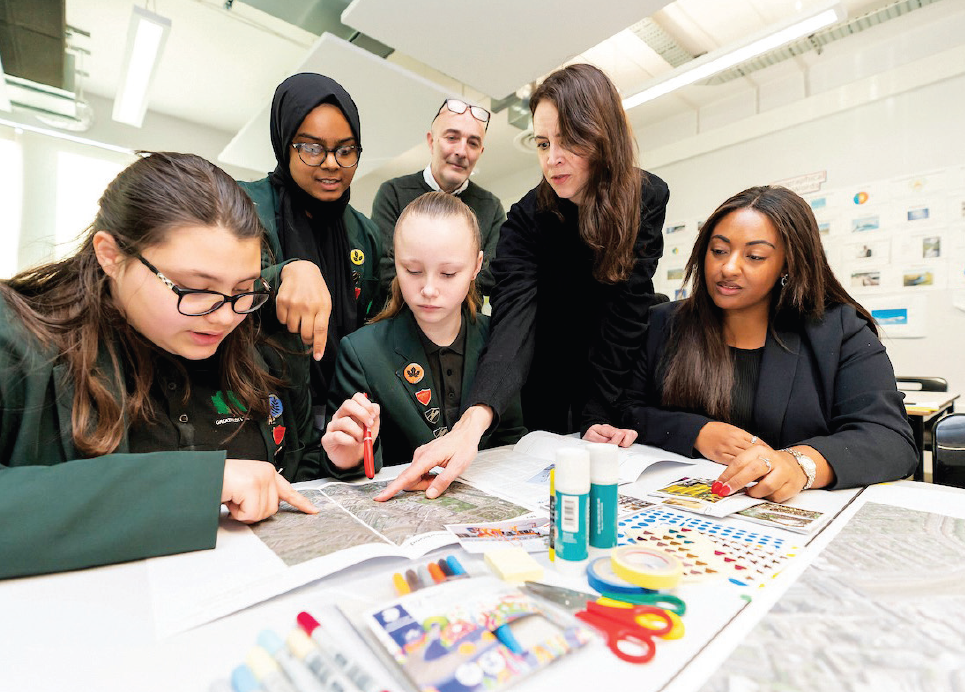
Internationally we support the Go Down arts centre in Nairobi, where we have a small office presence. We have initiated a learning programme to encourage greater diversity in the architectural profession by inviting 10 students a year from disadvantaged suburbs of Stockholm for work experience. We identified 5 municipal schools to work with, which show the combination of low average credit scores, low percentage of those qualified for upper secondary school programs and low percentage of parents with a post- secondary background. Each student is given a mentor for the week who supervises them through simple tasks and learning tools, the student has the opportunity to present to the office and receives a written certificate that they completed their studies at White. We have been doing this since 2012 with the Husby school with whom we have built a strong relationship.
4. Does the practice publicly refuse to work with certain clients, suppliers or organisations on ethical grounds?
We have a code of conduct that takes into account the freedom house list and transparency international, accordingly we openly do not do work in authoritarian countries including Saudi Arabia or China. Within internal work policy office leads have to review each client and countries against a code of conduct when undertaking bids as part of the risks assessment, including environmental and social sustainability.
Project
1. Do the projects demonstrate deep engagement with local stakeholders and end users? For example, is there evidence that your project engagement goes beyond consultation towards co-design?
Gascoigne won ‘best place’ through deep community engagement at an early stage, including schools workshops and design review panels with local people. Places for girls, developed practical methods for equitable architecture by giving girls an opportunity to design their ideal public space. The project comprised architects, social sustainability specialists, Stockholm-based theatre company UngaTur, teenage girls from youth council of Skarpnäck municipality, and local authority learning facilitators. Theatre featuring two teenage girls who are simultaneously constricted and set free by their urban environment opened-up dialogue with local politicians, planners and other stakeholders on public places from girls’ perspective. Moving to creation the teenage participants constructed models to represent a public space – by and for girls. This informed engagement with other urban design projects and developed a means of communication through theatre / festivals to engage community. Another looked at lighting in the urban realm to deal with issues of safety.
2. Do your projects create connected and resilient places which positively contribute to their neighbourhoods and allow equality of access? For example, do your projects create economic opportunity, retain value locally and generate social value?
We create positive and locally valued spaces. Social value is a large consideration especially with existing communities, focusing on landscape and ground level of urban design. E.g. on the Gascoigne Estate we designed porous courtyards that open out to existing housing. Anecdotally local residents ‘couldn’t believe their luck’ when they realised that the newly landscaped gardens and play areas facing their housing would not be closed off, and instead be treated all together as a new square. Similarly, at the Climate innovation district in Leeds, we have received great feedback on the success of social interaction created within the community through the open landscape design.
Our cultural buildings at Selma Cultural Centre in Gothenburg and Sara Kulturhus in Skelleftea are designed with the stakeholder community to create a place that forms a true place of pride in the town/city, for gathering, the arts and an extension of the living room.
3. Do the majority of your projects promote equity in society, and consider all people, not only the building inhabitants? For example, do your projects show due regard for workers within the supply chain and take active steps to avoid modern slavery?
Our projects are focused on promoting equity in society. Our recent housing schemes have delivered a high proportion of social housing (40%+) and one have delivered a significant proportion of the local authorities required social housing need. We also consider impacts on the construction individuals for example on our Project on the Leadership Centre in Nairobi, we devised a bespoke procurement agreement to promote local Kenyan contractors in the bidding instead of international contractors, similarly on the Velindre Cancer Centre we established at an early point a sustainable procurement policy written in to specifications, to use locally sourced materials to support the local economy.