
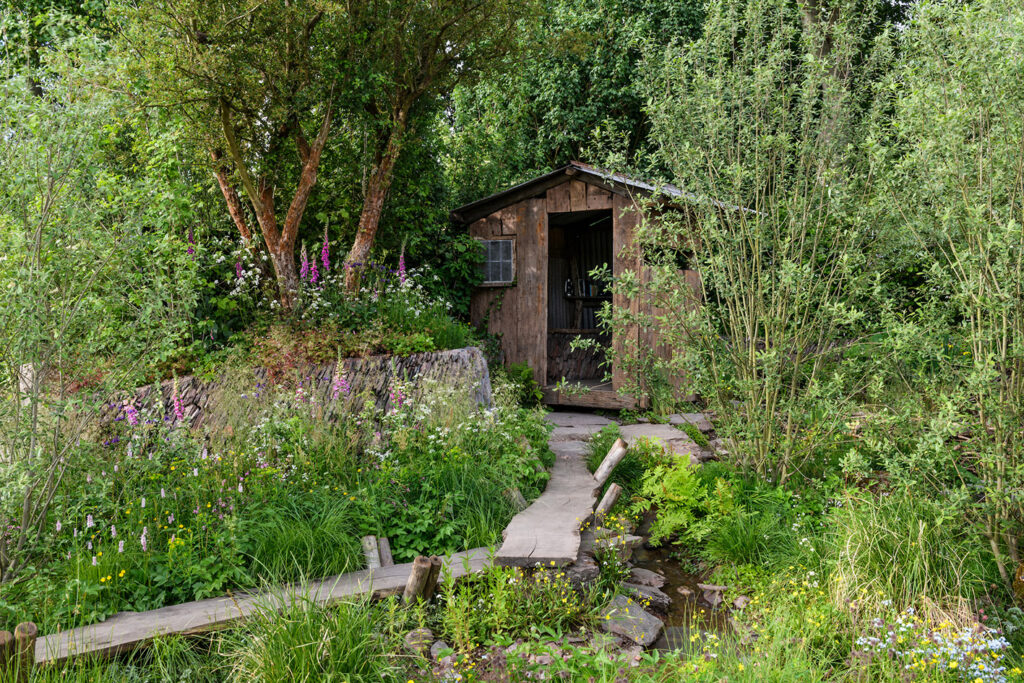
Submission by Urquhart & Hunt Landscape Design.
Being a good ancestor
Practice
1. Does the practice have a clearly stated purpose aligned with the planetary emergency? We are looking for a bold ambition here, and a practice culture which recognises the need for long-term thinking. For example, a strong mission, a theory of change, or a sustainability roadmap.
Our practice specialises in ecologically focused landscape design and our strong belief is that all architectural design should be landscape led. We endeavour to create designs that have a strong non-human inhabitant focus as well as human. Our design process starts with research on all local fauna/flora species that may be present and either affected by the work or can be designed for in a positive manner. On every project, urban or rural, we look at connectivity options for encouraging wildlife into the space. We are also exploring design based on a re-wilding approach where human activity is understood as key-stone species behaviour and are basing some of this on observations from two of our projects where beavers have been successfully re-introduced.
2. Does the practice have a clear succession plan, which passes on ownership and protects the values and legacy of those who built and contributed to the practice? For example is the practice an employee owned trust.
Yes/no. We are in the very early stages of exploring setting up the company as an employee partnership but this has not been formalised or significantly progressed yet.
3. Does the practice share research and knowledge for the benefit of society and the wider world? For example, you regularly carry out post occupancy evaluation and share information with others.
Our two directors regularly write for national magazines about garden design for wildlife. They also often give talks to other professionals, students and the general public about designing for biodiversity.
Project
1. Does the practice advocate for long-term thinking at the outset of projects? Do you initiate projects with long-term thinking and challenge the client on design life? Also, can the practice demonstrate that this approach has worked – with a shorter or longer design life, or an innovative approach to financing or payback period?
Our work includes the planting of a lot of trees which, by their nature, are a very long term commitment, but alongside these are planting medium term shrubs and many perennial species which tend to be more short lived. This dynamic nature of planting schemes requires good communication with clients and land managers, and also clear vision of the design intent. Nature is variable so the design intent must be flexible to accommodate this. Especially as we now find that we are trying to mitigate for climate change by using different planting substrates and plant species, all of which requires guiding our clients into a potentially different aesthetic than initially desired. We also encourage and advise our clients to garden organically and require our landscape contractors to avoid the use of herbicides and pesticides.
2. Do your projects take account of the future climate and the need for resilience? For example, do the projects demonstrate flexibility, design for adaptation, design for disassembly, non-deterministic solutions, or demountable structures.
Dealing with plants on a regular basis we are critically aware of the changing climate and how we can mitigate against this. Areas into which we are looking include using more aggregate based soil types reducing the need for watering – so called gravel bed planting. We are also very interested in the carbon capture possibilities of re-wilding processes and its potential to bolster biodiversity and give fauna climate related migration options to find suitable habitat. Soil health and resilience is also a key concern underpinning how our gardens are designed.
3. Do the majority of your projects go beyond mitigating negatives and towards optimising positives? For example, are they meeting or exceeding the RIBA 2030 Challenge.
Our internal stated aim is that our projects must result in more biodiversity after five years than before works commence. We do find this hard to monitor accurately given the cost of ecological reports which clients are happy to do at the start but less so once the project is completed. So we are interested in a key species indicator approach, where the presence of a particular species (flora or fauna) indicates improving biodiversity. For example the presence of a Man orchid (Orchis anthropophora) nine years on from the creation of a wildflower meadow. That species of orchid had not been seen on the site before but had come in due to the appropriate meadow management scheme being implemented.
Health and wellbeing are also core concerns in our practice – for both human and non-human occupants of the gardens. Human wellbeing is supported through proximity to plants and wildlife, as well as the careful and considered use of medicinal, nutritious and functional plants and microbiota in planting schemes and landscape management techniques.
Co-evolving with nature
Practice
1. Does the practice use biophilia within the office or regularly host meetings and retreats in natural settings? For example do you have extensive planting within the office or rely on natural patterns and imagery for stress relief or quiet areas.
We have regular team trips to well known gardens and also butterfly and bird watching outings. All members of the team spend a good proportion of their working time on site, in nature. We have a regular through flow of plants and bulbs in our studio due to the nature of our work.
2. Can the practice share examples where it has considered nature in decision making? For example by having a nature proxy to encourage eco-centric decision making, using natural systems as inspiration for the company structure, recognising the seasonal nature of people’s capacity and workload or celebrating equinoxes and solstices together.
Being based in the countryside and sharing values around nature and socio-historic nature culture, we note and participate in various rituals around solstices and equinoxes such as walks or gatherings. We recognise the importance of time spent outdoors for recharging our sense of calm and wellbeing. There is a deep sense of seasonality entwined in everything we do, both on a practical level in that we deal with plants, but also on a figurative and lifestyle level in that we respond to the seasons with the way we work and plan our out of office enrichment.
3. Is the practice supporting nature locally and nationally? For example, does the practice support local gardens, gardeners, planting programmes, rewilding programmes or advocate for changes in legislation to protect nature.
Yes, we support our local network of conservationists, ecologists, designers and growers through active participation in and organisation of events, talks and projects. We are active within local, national and international rewilding networks and we encourage connection between professionals and the public to increase the frequency and scale of nature and biodiversity led initiatives.
Project
1. Can the practice demonstrate projects which strive to match the performance of a mature ecosystem? As a minimum this would mean achieving biodiversity net gain.
Yes, all of our projects achieve biodiversity net gain and aim to exceed the standard 10% biodiversity increase through the preservation and creation of natural habitat features such as hedgerows and wildflower meadows. The gardens we create are intended to support biodiversity as much as the landscapes which surround them, and so all of our work is intended to operate as a mature ecosystem which is sustainable and which sustains wildlife.
2. Is the practice working on material stewardship? For example, evidence could be shown through repeated use of low carbon materials, extensive material libraries and research or publications supporting responsible use of materials and elimination of waste.
Yes, we undertake material inventories on site in order to design in their re-use and incorporation into the design for example in the form of build-ups or aggregates. Stone of high quality is reclaimed for use and stone and other materials of lesser quality are processed as aggregates or in-fill so as to minimise new material being brought onto site. Locally sourced, regional stone is used on all of our projects as well as responsibly and ethically sourced timbers. We opt for lime mortars instead of cement based mortars.
3. Do the majority of projects demonstrate the use of biologically-inspired approaches such as Bioregionalism, Biophilia, Biomimicry, Ecomimicry (also referred to as Ecosystems Thinking, Industrial Ecology or Industrial Symbiosis) or BioTRIZ?
Our core ethos as a practice is that as designers, we can support and protect the natural world through understanding how ecology works and how wildlife engineers its own environment. As humans, we are ecosystem engineers who have a direct impact on our environment and as a practice we aim to mimic and converse with this animal and plant led relationship with nature. When starting any project, we investigate the regional ecosystem, native species and traditional land based and architectural crafts of that specific area. Therefore all of our work can be seen as an extension and enhancement of the ecological set of relationships in which we find ourselves.
Creating a just space for people
Practice
1. Does the practice have a progressive EDI policy and can you evidence many forms of diversity, which are welcomed and acknowledged, within the practice?
Yes, the practice has an official EDI policy document which is shared with employees and which ensures our hiring practices do not uphold any form of discrimination. We have a diverse and multicultural workforce with colleagues from around the world, and an equal gender split with gender equality in salaries.
2. Does the practice operate a no overtime culture, meet the living wage consistently, and stipulate a fair salary ratio between staff of all levels?
Yes, we remunerate well above the living wage and we have fair salary ratios between staff of all levels.
Overtime is closely monitored and any discrepancies are addressed where necessary, such as the allocation of additional lieu days should overtime work occur in special and pre-agreed circumstances.
3. Does the practice support charities, community groups, social enterprises, action groups and others through pro-bono work, charitable giving or in-kind donations?
Yes, we actively engage in pro-bono work in our extended community. We also donate plants and services to charity. We embark on projects with our town council to improve public spaces, create community vegetable gardens and restore areas of wild habitat for education and recreation within our community. We also give talks and lectures to further environmental education and outreach in our community.
4. Does the practice publicly refuse to work with certain clients, suppliers or organisations on ethical grounds?
Our company principles and values have a direct impact on who we work with and who we use as suppliers, but we don’t make this public.
Project
1. Do the projects demonstrate deep engagement with local stakeholders and end users? For example, is there evidence that your project engagement goes beyond consultation towards co-design?
Yes, we actively engage with the end users of our gardens and landscapes, ensuring that a through line of intent is upheld from design to implementation and use. We play an active role in recruiting gardeners and maintenance teams who share a like minded approach to sustainability and the environment, ensuring the ongoing growth, ecological functionality and positive impact of our projects.
2. Do your projects create connected and resilient places which positively contribute to their neighbourhoods and allow equality of access? For example, do your projects create economic opportunity, retain value locally and generate social value?
Yes, our public projects uphold the ethos of community, equal access, social upliftment and enrichment though direct access to and engagement with nature. Our work which involves health and food growing provides economic opportunities for those tending and operating the gardens. Our public projects such as the Cambridge Mosque provide equal access to seasonal planting, spaces to rest and contemplate before or after worship, or simply as a place to seek respite and peace.
3. Do the majority of your projects promote equity in society, and consider all people, not only the building inhabitants? For example, do your projects show due regard for workers within the supply chain and take active steps to avoid modern slavery?
All of our projects promote equity for all people and environments. For example we source local stone and other hard materials and timber locally as far as possible, so as to avoid unregulated international trade or organisations which are harmful to humans or the natural environment.