
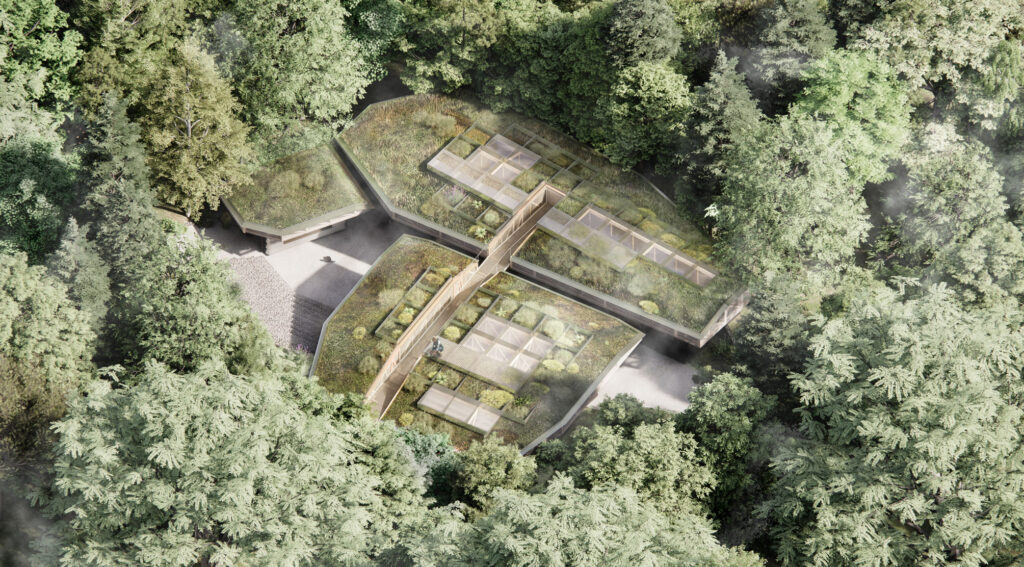
Submission by Unknown Works.
Being a good ancestor
Practice
1. Does the practice have a clearly stated purpose aligned with the planetary emergency? We are looking for a bold ambition here, and a practice culture which recognises the need for long-term thinking. For example, a strong mission, a theory of change, or a sustainability roadmap.
Unknown Works’s (UW) practice ethos aligns with the UN’s Sustainable Development Goals and local climate targets. Our work was awarded the inaugural RIBA Sustainable Development Award and as signatories of Architects Declare since 2020, we embed environmental integrity across every project. We hold Passivhaus accreditation and have integrated effective carbon-targeting tools and software throughout our workflow to ensure net-zero outcomes and enhanced thermal performance from the outset. Our studio culture and partnerships reflect a strong commitment to the circular economy, low-carbon construction, and systemic, long-term change.
2. Does the practice have a clear succession plan, which passes on ownership and protects the values and legacy of those who built and contributed to the practice? For example is the practice an employee owned trust.
UW fosters collective stewardship and knowledge sharing to secure our long-term future. As an emerging practice we are actively exploring inclusive ownership models to protect our founding values: environmental responsibility, community engagement, and resilient design. Our practice structure and internal professional development pathway are consciously designed to allow future leadership to evolve and strengthen this ethos; ensuring that long-term social and environmental responsibility remains an intrinsic core of the practice.
3. Does the practice share research and knowledge for the benefit of society and the wider world? For example, you regularly carry out post occupancy evaluation and share information with others.
As practitioners we must be open, accessible, and actionable. UW conducts field research, publishes post-occupancy evaluations, and contributes to open-source platforms. Our work for organisations like The Thousand Year Trust, Simbi Foundation, Vortex Foundation and the UNHCR have required us to conduct, share and iterate upon data gathered from post occupancy evaluations. Moreover we have been able to share these learnings via workshops and forums, formal institutional presentations and with similar practitioners in the field. Our work, from carbon-tracking tools to circular construction strategies, embeds regenerative principles into every project and helps drive collective industry progress.
Project
1. Does the practice advocate for long-term thinking at the outset of projects? Do you initiate projects with long-term thinking and challenge the client on design life? Also, can the practice demonstrate that this approach has worked – with a shorter or longer design life, or an innovative approach to financing or payback period?
Every project starts with whole-life thinking, we challenge clients to consider lifecycle performance, adaptability, and stewardship. Our designs prioritise disassembly, repurposing, and minimising embodied energy. Outcomes include modular, off-grid systems for mobile healthcare and education, and phased, low-carbon homes and public spaces. By reframing architectural value around stewardship rather than ownership, we foster resilience and adaptability across all scales.
2. Do your projects take account of the future climate and the need for resilience? For example, do the projects demonstrate flexibility, design for adaptation, design for disassembly, non-deterministic solutions, or demountable structures.
Climate resilience is built into our design ethos. Passive strategies, modular systems, and regenerative landscapes are standard. Projects like the Science Museum’s Climate Change Gallery, constructed out of 80% recycled materials, and the world’s first eucalyptus-pine CLT structure designed for disassembly demonstrate this approach. We work closely with authorities and consultants to exceed climate resilience and biodiversity targets, creating architecture that is future-proof and adaptive.
3. Do the majority of your projects go beyond mitigating negatives and towards optimising positives? For example, are they meeting or exceeding the RIBA 2030 Challenge.
Our projects actively regenerate ecological and social systems, not merely mitigate harm. We consistently exceed RIBA 2030 Climate Challenge benchmarks on projects, embedding carbon-negative materials, renewable energy, and circular economy principles. Projects like Europe’s first Temperate Rainforest Research Station, built from exclusively British-grown timber and bio-based materials, advance sustainable economies and ecosystems. Moreover, it goes beyond RIBA 2030 Challenge targets by prompting how supply chains and industry standards for procurement of materials may be improved with sustainability in mind. UW views architecture as a tool for regeneration – shaping futures rather than just meeting standards.
Co-evolving with nature
Practice
1. Does the practice use biophilia within the office or regularly host meetings and retreats in natural settings? For example do you have extensive planting within the office or rely on natural patterns and imagery for stress relief or quiet areas.
We take pride in our studio culture and its environment. The space is filled with natural light, and plants outnumber people. Natural materials shape the workspace. We cook for one another, eating seasonally and locally whenever possible. Major team retreats and key decision-making sessions take place during off-sites in woodlands, national parks, and gardens, such as Cabilla Eco Retreat.
2. Can the practice share examples where it has considered nature in decision making? For example by having a nature proxy to encourage eco-centric decision making, using natural systems as inspiration for the company structure, recognising the seasonal nature of people’s capacity and workload or celebrating equinoxes and solstices together.
Our organisational structure mirrors natural systems, adaptive, resilient, and responsive to change. At UW we also adjust work rhythms to promote wellbeing and minimise burnout. Our mindset ensures that both our internal processes such as and project outcomes are ecologically sensitive and sustainable. During warmer summer months we frequently organise open water swimming sessions at West Reservoir for the whole team, using it as a way to re-energise amongst a totally natural setting. For members of our team who have families, we offer flexible working hours and adapt to the changing rhythms of natural family life, including offering the ability to work from home or bring children into work; all with the goal of aligning the practice with natural systems of work and leisure.
3. Is the practice supporting nature locally and nationally? For example, does the practice support local gardens, gardeners, planting programmes, rewilding programmes or advocate for changes in legislation to protect nature.
We partner with rewilding charities and conservation specialists to embed nature-positive outcomes into and beyond our projects. UW actively seeks to improve biodiversity net gain where possible, regenerative land-use initiatives, and community-driven ecological resilience projects. We advocate for nature stewardship as an essential extension of architectural practice. We are currently conducting R&D projects focussed on optimising the supply chains and use of homegrown British timber in timber frame construction projects.
All our projects employ rich and biodiverse landscape proposals, focussing on seasonal vegetation and planting strategies that work with the local environment and climate.
Project
1. Can the practice demonstrate projects which strive to match the performance of a mature ecosystem? As a minimum this would mean achieving biodiversity net gain.
From the biodiversity-focused Rainforest Research Station to the Brightbox off-grid mobile hub, our designs go beyond sustainability to actively restore and enrich local ecologies. We aim to create built environments that function symbiotically within their wider ecosystems. We regularly collaborate with landscape designers, planting specialists, horticulturalists, arboriculturists, and ecologists.
2. Is the practice working on material stewardship? For example, evidence could be shown through repeated use of low carbon materials, extensive material libraries and research or publications supporting responsible use of materials and elimination of waste.
UW collaborates with leading research institutions, including Hooke Park, Bauhaus-Universität Weimar, and Xilonor, to advance the development of low-carbon, bio-based materials alongside low-energy forming and fabrication methodologies. We have created in-house tools for assessing the carbon impact of the materials we specify, enabling us to make informed and responsible design decisions. Innovation in this field is central to our practice; for example, our new hybrid eucalyptus-pine CLT structure, developed in partnership with Xilonor, exemplifies how regenerative material systems can meet the structural and performance demands of ambitious, sustainable design. We are committed to pushing the boundaries of material stewardship by collaborating closely with foresters, biodiversity specialists, researchers, suppliers, carpenters, and fabricators. Together, we’re developing innovative strategies to optimise the use of homegrown timber, supporting local economies and promoting environmentally responsible construction practices.
3. Do the majority of projects demonstrate the use of biologically-inspired approaches such as Bioregionalism, Biophilia, Biomimicry, Ecomimicry (also referred to as Ecosystems Thinking, Industrial Ecology or Industrial Symbiosis) or BioTRIZ?
We draw from ecosystems not for their appearance, but for their structural and functional intelligence. Our goal is to design built environments that are efficient, adaptive, and ecologically integrated. Projects such as the Armadillo shell structure, the living laboratory roofs at the Atlantic Temperate Rainforest Research Station, and the porous façade of the Beehive Theatre exemplify our use of biomimicry and systems thinking in architecture. By translating natural processes into design strategies, we create buildings that are both resilient and regenerative – able to respond to environmental stresses while contributing positively to their ecosystems. This approach fosters a deeper alignment between human-made systems and the ecological contexts in which they operate.
Creating a just space for people
Practice
1. Does the practice have a progressive EDI policy and can you evidence many forms of diversity, which are welcomed and acknowledged, within the practice?
UW has a robust Equal Opportunities Policy that actively promotes equity, diversity, inclusion, and access to opportunity. As a global practice, our team of 16 represents 12 different nationalities, reflecting a wide range of cultural and professional backgrounds. Through proactive recruitment, transparent feedback processes, and an empowering studio culture, we ensure that diverse perspectives meaningfully influence both the day-to-day work and the strategic direction of the practice.
2. Does the practice operate a no overtime culture, meet the living wage consistently, and stipulate a fair salary ratio between staff of all levels?
UW actively discourages overtime and consistently pays above the London Living Wage. Our internal salary structure is equitable and transparent, with a strong focus on maintaining fairness and minimising wage disparities across all levels. Salaries are reviewed annually against RIBA benchmarking data and are consistently set above these benchmarks.
3. Does the practice support charities, community groups, social enterprises, action groups and others through pro-bono work, charitable giving or in-kind donations?
UW provides pro-bono services to important foundations and charities such as the Simbi Foundation, Southall Black Sisters and the Vortex Foundation. We embed participatory design processes into live projects, working with community engagement and youth engagement experts. We give free educational workshops to children and we work closely with social enterprises, and community groups to extend our impact beyond architecture and prioritise social benefit.
4. Does the practice publicly refuse to work with certain clients, suppliers or organisations on ethical grounds?
Aligned with our Environmental and Ethical Policies, UW reserves the right to refuse partnerships that conflict with our values. We collaborate exclusively with partners committed to social and environmental responsibility.
Project
1. Do the projects demonstrate deep engagement with local stakeholders and end users? For example, is there evidence that your project engagement goes beyond consultation towards co-design?
Yes, our projects are grounded in meaningful engagement with local communities and stakeholders. We regularly collaborate with public engagement specialists to deliver targeted workshops that shape project outcomes. Recent work with the City of London and City of London Police included co-design sessions with residents and schoolchildren to address urban safety.
Our Brightbox initiative, supported by UNHCR, was co-developed with displaced communities to ensure relevance and empowerment. In the healthcare sector, we undertake extensive community surveys, polls, and workshops to inform our designs.
We also carry out detailed post-occupancy evaluations to assess the effectiveness and appropriateness of our solutions, enabling continuous improvement. This commitment ensures that our work is resilient, inclusive, and context-specific.
2. Do your projects create connected and resilient places which positively contribute to their neighbourhoods and allow equality of access? For example, do your projects create economic opportunity, retain value locally and generate social value?
We always strive to make a positive impact in our work. Our projects seek to strengthen local economies and social fabrics by embedding decentralised energy systems, working with local supply chains, and participatory governance. We have many clients that are our own immediate neighbourhood, at times offering pro bono services. We design for local value retention, equity, and long-term resilience.
3. Do the majority of your projects promote equity in society, and consider all people, not only the building inhabitants? For example, do your projects show due regard for workers within the supply chain and take active steps to avoid modern slavery?
We maintain rigorous ethical sourcing and fair labour standards, taking active steps to promote diversity and accessibility. Through transparent procurement, effective engagement and strong local relationships, we embed justice and equity throughout every stage of delivery.