
Submission by Useful Simple Trust.
Being a good ancestor
Practice
1. Does the practice have a clearly stated purpose aligned with the planetary emergency? We are looking for a bold ambition here, and a practice culture which recognises the need for long-term thinking. For example, a strong mission, a theory of change, or a sustainability roadmap.
Our 2024-2028 business plan sets our purpose to “blaze a trail in regenerating our built and natural environment to meet the needs of all people and the planet.” Inspired by Doughnut Economics, our vision shifts from provision to regeneration, recognising that the majority of our built and natural environment already exists, and much work is needed to transition to a zero carbon, resilient, and inclusive society.
Our 2025 Carbon Transition Action Plan outlines our path to achieving a Science-Based near-term target: a 46% reduction in emissions across all scopes by 2030 (from a FY 22/23 baseline), with residuals offset to align with SBTi’s 1.5ºC pathway. This year, we introduced our ‘Handprint’ process, assessing each project’s impact on a scale from degenerative to regenerative, aligned with the UN Sustainable Development Goals. We also reinvested almost 10% of our profit into pro-bono professional services, outreach activities and mission-aligned R&D.
2. Does the practice have a clear succession plan, which passes on ownership and protects the values and legacy of those who built and contributed to the practice? For example is the practice an employee owned trust.
Our founders went beyond the concept of an Employee-Owned-Business (EOB), establishing an Employee-Benefit-Trust (EBT) in 2008, gifting their shares in the business to create the Useful Simple Trust. The intention was for the Trust to evolve and continue to be trailblazing in the unpredictable future, through investment in the founding principles rather than individuals.
Becoming an EBT supports leadership succession and diversity by separating ownership from seniority and wealth. By providing transparency across all levels, our leadership teams consult, share information about the company, and spread responsibility that allows our employees to have a significant and meaningful stake in the business, as well as a say in how it’s run.
In addition to the embedded culture of mentorship and professional development, each year, the Trust delivers a company-wide training initiative focused on a topical theme, aligned with our mission (examples include Carbon Literacy, Critical Thinking, and Digital Skills).
3. Does the practice share research and knowledge for the benefit of society and the wider world? For example, you regularly carry out post occupancy evaluation and share information with others.
The Trust exists within a wider ecosystem of people trying to drive the sort of change that interests us all as individuals and as an organisation. We are actively involved in leveraging our expertise through collaborative networks, including contributing time to universities and industry bodies. In 2025, we published ‘Steel Reuse in Bridges’, a research piece co-funded with the ICE. We are currently disseminating it with the wider industry in an open-source fashion, co-creating next steps to move the industry forward in this important field.
Through our ‘Useful Giving’ initiative, team members have volunteered 30 hours of time to the charity Climate Ed, delivering climate literacy education courses to primary school children across London. We are also partnering with Swansea University to design and construct an innovative, sustainable bridge that uses low value timber and reduces deforestation and will be rolled out across 100 locations in rural Liberia by 2025.
Project
1. Does the practice advocate for long-term thinking at the outset of projects? Do you initiate projects with long-term thinking and challenge the client on design life? Also, can the practice demonstrate that this approach has worked – with a shorter or longer design life, or an innovative approach to financing or payback period?
This year, we launched our ‘Project Handprint’ process to assess projects on a scale from degenerative to regenerative. It evaluates energy, carbon, biodiversity, social equity, and resource use. Assessments are conducted at the start of projects, to identify regenerative opportunities, and again at the end to reflect on outcomes and capture lessons learned.
The process builds on a regenerative design tool we use with clients and design teams to shift the conversation from “doing less harm” to creating positive impact. It promotes whole-life costing over CapEx-only approaches, targets net carbon positive outcomes, supports biodiversity net gain, and prioritises adaptive reuse over demolition and new construction.
A standout example is the adaptive reuse of the 1950s Marks & Spencer HQ on Baker Street. By successfully advocating for refurbishment instead of demolition, we avoided 35,000 tonnes of CO2 emissions, demonstrating the tangible benefits of regenerative thinking in practice.
2. Do your projects take account of the future climate and the need for resilience? For example, do the projects demonstrate flexibility, design for adaptation, design for disassembly, non-deterministic solutions, or demountable structures.
We design against ‘lean start, long life and loose fit’ which translates as material efficiency, resilient structures and adaptive reuse. These are all key elements in designing for a future climate which is as volatile as it is unknown.
Material efficiency reduces our short-term consumption, leaving more resource available for future ancestors to adapt the built environment to their needs. Resilient structures can withstand stronger and more frequent climate events and allows future generations to retain and retrofit what we build. Adaptive reuse, made easier following a ‘systems’ approach to construction, ensures that, at the end of a structures ‘life’, the components/materials can be reused, repurposed or (worst case) recycled.
On a confidential project, we are using repurposed felled timber in a modular ‘kit-of-parts’ to create a viewing platform, designed for easy disassembly and relocation as the project evolves. Our lean approach enables efficient transport and reassembly with minimal waste.
3. Do the majority of your projects go beyond mitigating negatives and towards optimising positives? For example, are they meeting or exceeding the RIBA 2030 Challenge.
We have created a ‘handprint’ methodology to evaluate the regenerative or degenerative nature of our projects, aiming to understand if they go beyond minimising harm to actively creating positive impacts. Over several months, we piloted this process, conducting 11 preliminary assessments. This helps set a baseline for project impact and encourages discussions about broader opportunities.
Early findings reveal that while none of the projects are fully regenerative, none are entirely degenerative either. Instead, projects exceed sustainability in specific areas (such as operational energy efficiency and biodiversity) but often fall short in others like embodied carbon. The methodology fosters awareness and identifies where improvements can be made. Our goal is to collect this data consistently and use it to measure progress, helping us guide clients and the wider industry toward more regenerative practices over time. This marks an important step in shifting beyond traditional sustainability benchmarks.
Co-evolving with nature
Practice
1. Does the practice use biophilia within the office or regularly host meetings and retreats in natural settings? For example do you have extensive planting within the office or rely on natural patterns and imagery for stress relief or quiet areas.
Our office sits adjacent to Temple Gardens, where the gardening team share information about seasonal patterns throughout the year. We encourage staff to have ‘walking meetings’ where possible and regularly organise team lunches in the nearby gardens, including a recent celebration picnic to mark winning ‘B Corp of the Year’ at the British Business Awards.
Our Summer Party always involves a nature-based volunteering activity, and the leadership support an annual cycle/run to Kew Gardens, followed by a picnic and social. We also fund outdoor training programmes, including UKGBC Future Leaders and Change Accelerator, and the Constructivist Regenerative Design Lab.
Internally, we have several plants throughout the office, alongside conscious material choices like cork wall tiles and timber shelving. The concept of biophilia extends into the office layout, with a range of spatial qualities echoing that of the natural landscape, such as cave-like focus booths and larger zones for relaxing.
2. Can the practice share examples where it has considered nature in decision making? For example by having a nature proxy to encourage eco-centric decision making, using natural systems as inspiration for the company structure, recognising the seasonal nature of people’s capacity and workload or celebrating equinoxes and solstices together.
Our 2024-2028 business plan sets out our ambition for a ‘regenerative business model’, based on delivering impactful solutions on purposeful projects, for engaged clients, with profits reinvested in furthering our mission.
To support delivery of this plan, over the last year we have invested in a Critical Thinking training programme, led by Oli Broadbent (1851 Fellow in Regenerative Design) which all staff (including professional services and administrative roles) are invited to attend. The programme weaves in elements from systems thinking, regenerative design, and innovation strategy, and includes modules on ‘Working with Ecosystems’ and ‘Working with Living Cycles.’.
The programme is equivalent to 3 days of training per employee, so it represents a significant investment for us. We have committed to this because we believe it will not only help us thrive as a business but also develop the skills our industry needs to transition to a regenerative future.
3. Is the practice supporting nature locally and nationally? For example, does the practice support local gardens, gardeners, planting programmes, rewilding programmes or advocate for changes in legislation to protect nature.
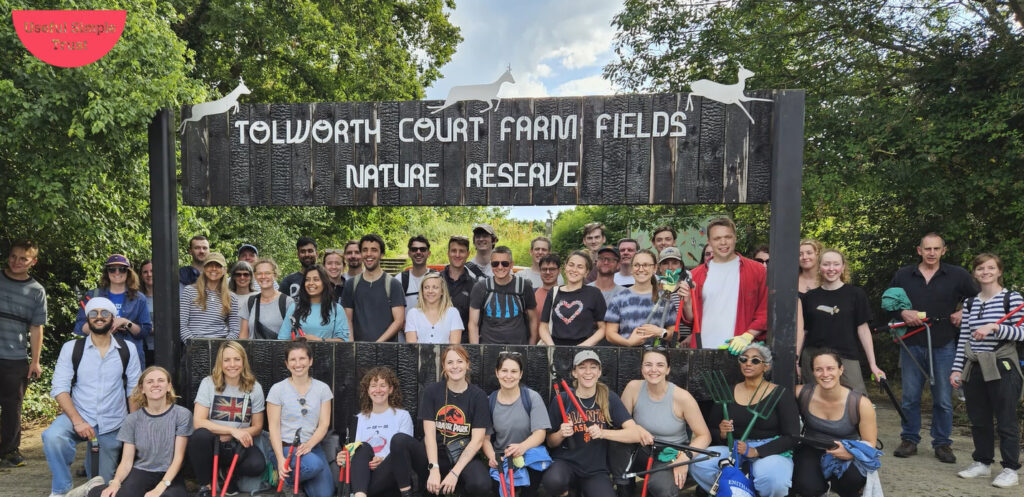
Each year we plan our Summer Party as an ‘away day’ which includes an element of nature-based volunteering. Examples from previous years include a day at the Bee Urban Centre in Kennington Park, where we helped restore a green roof, learned about beekeeping and labelled jars of honey, as well as carrying out general gardening tasks. Last year we visited Tolworth Farm Nature Reserve, a Rewilding Britain site where we carried out activities such as weeding, coppicing, scything and litter-picking, whilst learning about the impact and importance of national rewilding initiatives.
At a national and global level, our ‘Embodied Biodiversity Impacts of Construction Materials’ research is helping shift the dial on how we specify materials that support nature and biodiversity. Projects where nature is a key stakeholder include the Eden Project Dundee (granted planning permission earlier this year), where we are pioneering an innovative structural regenerative design process.
Project
1. Can the practice demonstrate projects which strive to match the performance of a mature ecosystem? As a minimum this would mean achieving biodiversity net gain.
The Global Centre of Rail Excellence (South Wales) is spearheading the sensitive regeneration of a former open cast mine in the Dulais Valley, the Tower of London Moat, where we are providing civil engineering and integrated water management services, and a Green Masterplan aligned with the Nature Positive Universities initiative, are three examples of bringing nature back into the urban landscape while creating high quality amenity.
We are also continuing work on the redevelopment of Gurnell Leisure Centre in West London. The site includes approx. 4ha of parkland area adjacent to the River Brent and within the floodplain. Proposals include enhancing the parkland area, introducing a variety of planted species, and the introduction of wetlands forming a key part of the drainage strategy, providing storage in flood events. Including large permanent water bodies, these wetlands will form thriving ecosystems and habitats within the site, to be enjoyed by the public.
2. Is the practice working on material stewardship? For example, evidence could be shown through repeated use of low carbon materials, extensive material libraries and research or publications supporting responsible use of materials and elimination of waste.
Our research into ‘The Embodied Biodiversity Impacts of Construction Materials’, is about material stewardship from the perspective of material sourcing and minimising the impact of extractive processes on planetary systems.
In addition to our contributions to the recent RIBA publication ‘Materials: An environmental primer’ and our research into the carbon associated with masterplanning infrastructure, we are active members of the Net Zero Bridges Group and members of the Infrastructure Client Group Low Carbon Concrete Accelerator Programme, which brings research into practice for large infrastructure clients in the UK. Our recently published study on reusing structural steel in bridges provides critical insights into overcoming key barriers to implementing circular economy principles in infrastructure projects.
As SKA Assessors, we have extensive knowledge of low carbon, responsible materials for fit-out and are building a library of high performing products. This resource informs our specifications and supports clients and contractors with their ESG mission.
3. Do the majority of projects demonstrate the use of biologically-inspired approaches such as Bioregionalism, Biophilia, Biomimicry, Ecomimicry (also referred to as Ecosystems Thinking, Industrial Ecology or Industrial Symbiosis) or BioTRIZ?
We recently provided strategic input and a report on Biophilic Design to the rail sector, to help design teams and clients to embed these principles in stations and network-wide buildings (including depots). The success of, and passion for, this research topic resulted in a continuation piece, considering the impact of introducing elements of biophilia across construction sites (with a particular focus on site offices, and amenity spaces).
These research initiatives are a great way to learn techniques which can be directly translated into our own design work. We consistently look for opportunities to instil biophilic principles in all our architectural projects, maximising opportunities for natural daylight, fresh air, natural materials, flowing forms, and biodiverse planting.
Creating a just space for people
Practice
1. Does the practice have a progressive EDI policy and can you evidence many forms of diversity, which are welcomed and acknowledged, within the practice?
Diversity is at the heart of the Trust Ethos, fueling our ability to develop innovative solutions in the built environment. Our Executive Board boasts 50% female membership and has been female-led since 2019. 40% of our leadership team are women, and we have made substantial progress in reducing our gender pay gap. We are committed to advancing EDI not only within our organisation but also across the industries we serve. By championing greater representation and fostering inclusion, we aim to amplify our impact and inspire meaningful change beyond the Trust.
In 2024, we provided Allyship Training to enhance our understanding of unconscious bias, and recognise and combat discrimination in an industry that is often widely criticised for its conscious bias.
We are currently participating in the “Royal Academy of Engineering’s Inclusive Leadership Programme”, a pioneering initiative to catalyse change towards greater inclusion at a systemic level across the engineering profession.
2. Does the practice operate a no overtime culture, meet the living wage consistently, and stipulate a fair salary ratio between staff of all levels?
We recognise that unpaid overtime is an issue in our industry, and we monitor the hours worked by staff to ensure that any regular or excessive overtime is identified, and steps are taken to provide support to staff in managing their time and workload.
Where it is necessary to work additional hours to meet business requirements, staff are encouraged to take Time Off In Lieu (TOIL). Junior to mid-level grade staff are also eligible for paid overtime at their normal hourly rate. We undertake monthly ‘snap polls’ as a pulse check of employee wellbeing, and an annual survey, as part of our wider wellbeing programme, to understand the reasons for, and frequency of, overtime. We are also an accredited Living Wage Employer and have a fair salary ratio limit of 1:10.
3. Does the practice support charities, community groups, social enterprises, action groups and others through pro-bono work, charitable giving or in-kind donations?
As a B Corp, Social Enterprise, and purpose-led organisation we are committed to solving social and environmental problems. In 2024 we allocated almost 10% of our profit towards our ‘Useful Trailblazing’ and ‘Useful Giving’, initiatives. By investing in pro bono and mission aligned R&D projects we have helped provide climate literacy training to primary school children in London, designed and installed a sustainable timber bridge in Liberia, carried out research into biophilic design for improved conditions on site for construction workers, and developed our ‘handprint’ assessment methodology for mapping all of our projects on a regenerative to degenerative scale.
In addition, we support ad hoc giving initiatives including providing paid time for employees to donate consultancy services for Maggie’s Centres, participate in design/quality review panels, work with institutions such as the ICE, CIBSE, the NIC, LETI, the UKGBC, NLA and Architects Declare.
4. Does the practice publicly refuse to work with certain clients, suppliers or organisations on ethical grounds?
No.
Project
1. Do the projects demonstrate deep engagement with local stakeholders and end users? For example, is there evidence that your project engagement goes beyond consultation towards co-design?
We seek to embed co-design in as many projects as possible, and advocate for more participatory approaches. We recently co-facilitated a series of co-design sessions with a developer client for a major regeneration project in Winchester. On other projects we have set up and administered a ‘citizens panel’ and a tenants’ panel’ – in these, groups of local community members are formed to attend a series of design conversations over an extended period, with participants paid a living wage for their time.
Another example of deep community engagement is our ‘river walks’ that we led on The Phoenix project, Lewes. These gave members of the local community the opportunity to meet with the engineering team in an informal setting, to discuss their concerns and learn more about the project, at a highly sensitive site.
2. Do your projects create connected and resilient places which positively contribute to their neighbourhoods and allow equality of access? For example, do your projects create economic opportunity, retain value locally and generate social value?
We have developed a regenerative design toolkit which translates the principles of doughnut economics to help our clients create spaces and places that are resilient to the risk of flooding and overheating, e.g. The Phoenix, Lewes. We work closely with clients to ensure that investment delivers inclusive outcomes with benefits beyond the site boundary. For example, our work designing and engineering footbridges has contributed to more connected and accessible places and allowed us to pioneer an approach to ‘post occupancy evaluation of infrastructure’, to monitor the impact of Chiswick Footbridge on the surrounding neighborhood.
Our work with local authorities and public institutions improves public space and encourages greater integration between different stakeholders within the community. For example, with a repeating university client, we are leading the architectural design of a building that supports educational needs, whilst offering community services including a café, exhibition space and business centre.
3. Do the majority of your projects promote equity in society, and consider all people, not only the building inhabitants? For example, do your projects show due regard for workers within the supply chain and take active steps to avoid modern slavery?
We take our organisational principle to “do our projects so they meet the needs of the present without compromising the ability of future generations to meet their own needs” seriously and have declined to work on projects, and clients, that do not align with our values and ethics.
Our Modern Slavery and Procurement policies set out how we expect our suppliers to adhere to our high standards of social, ethical, and employment practice, which we deploy through favouring B Corps, Social Enterprises, and suppliers from underrepresented groups, as well as those with transparent supply chains. For example, designing a kids’ activity area from 100% locally recycled post-consumer plastic for the Leeds Museum ‘Life on Earth’ gallery, and designing a garden screen using entirely reclaimed timber, sourced from a local primary school’s old roof and produced by a company whose ‘Wood to Work’ scheme supports individuals facing barriers to employment.