
Submission by RSHP.
Being a good ancestor
Practice
1. Does the practice have a clearly stated purpose aligned with the planetary emergency? We are looking for a bold ambition here, and a practice culture which recognises the need for long-term thinking. For example, a strong mission, a theory of change, or a sustainability roadmap.
Our sustainability strategies align with the UN Sustainable Development Goals (SDGs) and the Triple Bottom Line (TBL) framework, emphasising environmental, economic, and social impacts. Inspired by the UN Brundtland Commission Report (1987), we take a holistic approach, ensuring that all three pillars are integrated into every project. While achieving Net Zero is a priority, we recognise that true sustainability extends beyond carbon reduction. To address the planetary emergency effectively, we advocate for a broader perspective–one that includes biodiversity, social value, economic growth, community engagement, and climate resilience. We aim to complement a focus on carbon with our long-term vision that seeks systemic change balancing immediate climate action with a comprehensive sustainability vision. More information: ESG Report / Sustainability Manifesto.
2. Does the practice have a clear succession plan, which passes on ownership and protects the values and legacy of those who built and contributed to the practice? For example is the practice an employee owned trust.
Drafted by Richard Rogers in 1990, RSHP’s constitution enshrines a commitment to ethical practice and social good. Owned by a Charitable Trust, no individual owns any share in the value of the Practice. In this way, private trading and inheritance of shares is eliminated and any residual value is returned to society through the Charitable Trust. Value is not removed from the practice as individuals retire.
After reserves and tax, 20% of all profit is donated to charitable causes annually with the remaining profit divided between all staff according to publicly declared principles. Each employee directs their share of the charitable distribution to charities of their own choice. This instills an ethos of collective responsibility, satisfaction in the work we produce and a sense of wider social duty.
Since our charity began operation in 1993, we have distributed over £20.2million to more than 2000 registered charities. More information: https://rshp.com/practice/constitution/
3. Does the practice share research and knowledge for the benefit of society and the wider world? For example, you regularly carry out post occupancy evaluation and share information with others.
At RSHP, we believe that knowledge-sharing, and collaboration are key to addressing the climate crisis. We actively participate in educational outreach programs–from primary schools to PhD research–and engage with industry groups such as UKGBC, LETI and ACAN. We also support in-house research and development to advance sustainable practices. We have contributed to Post-Occupancy Evaluation (POE) research across many buildings, recognising their value in improving design performance and sustainability outcomes. Whilst the implementation of POE’s depends on clients and project-specific factors, we actively encourage their use and advocate for more widespread adoption. We have also published findings from projects, including International Towers Sydney and Crofts Street to share insights and best practices with the wider industry.
Project
1. Does the practice advocate for long-term thinking at the outset of projects? Do you initiate projects with long-term thinking and challenge the client on design life? Also, can the practice demonstrate that this approach has worked – with a shorter or longer design life, or an innovative approach to financing or payback period?
We advocate for long-term thinking from the outset of every project, ensuring that buildings are designed for durability, adaptability, and longevity. A key example of this is the Senedd Cymru (Welsh Parliament), which was designed for a 100-year lifespan. We also have extensive experience with Modern Methods of Construction (MMC), creating structures that can be easily disassembled and reassembled to extend their usability and minimise waste.
We are working with several clients on the retrofit of several buildings the practice designed up to 30 years ago. This allows us to test the flexibility and resilience of our original designs and provides valuable lessons for the future. By prioritising design life, adaptability, and sustainable construction, we challenge conventional thinking and help shape a built environment that can stand the test of time.
2. Do your projects take account of the future climate and the need for resilience? For example, do the projects demonstrate flexibility, design for adaptation, design for disassembly, non-deterministic solutions, or demountable structures.
We integrate climate resilience into our design approach, ensuring projects can adapt to future environmental challenges. The practice has pioneered flexibility, adaptability and demountability. Designing for disassembly and reassembly is a driving force for our architecture. RSHP’s portfolio includes numerous projects that embody these principles. A number of projects that have included Climate Resilience and Adaptation to Climate Change studies that have informed the design include Metro Tunnel Project (Melbourne), Atrio Tower (Bogotá), LSE Centre Building (London) and Heathrow Terminal 5. Our extensive portfolio includes a range of Modern Methods of Construction (MMC) housing projects and large-scale projects with extensive prefabrication including Mossbourne Community Academy, the Cancer Centre at Guy’s Hospital and The Leadenhall Building. All demonstrate forward-thinking strategies which enhance long-term usability, resource efficiency, minimise waste and provide resilience to climate change. By embedding non-deterministic solutions, we create buildings that can withstand and respond to an uncertain future.
3. Do the majority of your projects go beyond mitigating negatives and towards optimising positives? For example, are they meeting or exceeding the RIBA 2030 Challenge.
Our commitment to sustainability goes beyond reducing negative impacts, we strive to maximise positive outcomes in every project. While regional and client-specific factors influence each design, we remain dedicated to the principles of the RIBA 2030 Challenge and the AIA Climate Challenge. To track our progress, we systematically collect and evaluate sustainability data from both current and past projects. Several ongoing schemes are already meeting or exceeding RIBA 2030 targets. Notably, some historic projects achieved high sustainability performance standards well before such benchmarks existed. For instance, the Daimler Chrysler Office and Retail development, designed over 30 years ago, had an Energy Use Intensity of 75kWh/m²/yr, reflecting our long-standing environmental responsibility. The Barangaroo masterplan and International Towers Sydney were designed to be carbon neutral and water wise. The precinct was the first globally to achieve operational carbon neutrality and exports more water than it consumes.
Co-evolving with nature
Practice
1. Does the practice use biophilia within the office or regularly host meetings and retreats in natural settings? For example do you have extensive planting within the office or rely on natural patterns and imagery for stress relief or quiet areas.
We actively promote connections with nature by giving all employees equal access to spend weekends in a practice owned holiday home outside London that has a large garden, providing a retreat in a natural setting. This year, we hosted a rewilding event at the site, planting 45 trees and installed nine wildlife houses to enhance biodiversity and create a thriving natural habitat.
Our annual summer party takes place in Regents Park based around a favourite office past time of softball. This provides everyone an opportunity to gather in an informal outdoor setting.
Through these efforts, we foster well-being, encourage time in nature, and support ecological restoration beyond our workspace.
2. Can the practice share examples where it has considered nature in decision making? For example by having a nature proxy to encourage eco-centric decision making, using natural systems as inspiration for the company structure, recognising the seasonal nature of people’s capacity and workload or celebrating equinoxes and solstices together.
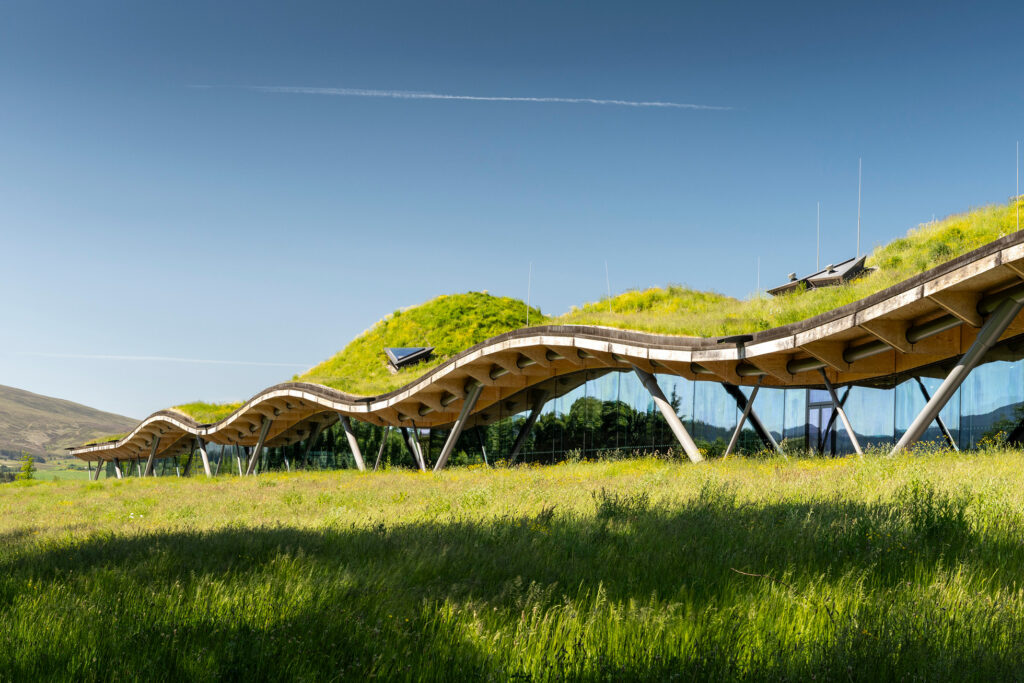
We integrate nature into our decision-making, particularly in our design approach. A notable example is Chiswick Park, where RSHP designed a master plan for 12 office buildings centred around a man-made park with a lake. This project prioritises biodiversity enhancement and social value, creating a workspace that fosters well-being and a strong connection to nature. Another key example is the Macallan Distillery and Visitor Experience which exemplifies using a nature-based system to boost biodiversity. A 13,620 m² green roof covers the entire site, integrating the building into the site with a native wildflower meadow, reflecting the local landscape and biome. Beyond individual projects, we continually explore ways to incorporate eco-centric decision-making and draw inspiration from natural systems, ensuring that our designs and workplaces support both people and the environment.
3. Is the practice supporting nature locally and nationally? For example, does the practice support local gardens, gardeners, planting programmes, rewilding programmes or advocate for changes in legislation to protect nature.
RSHP actively supports nature both locally and nationally. As a charity-owned practice, we allocate 20% of redistributed profits to charitable organisations, donating over £20.2 million since 1993. Many of these organisations focus on environmental and conservation efforts, such as Trees for Cities and WWF.
Internally, we hosted a tree-planting event this year at our employee-shared holiday home, where we planted 45 trees and installed nine wildlife houses to enhance biodiversity. We aim to make this an annual rewilding initiative to further restore the garden’s natural ecosystem. Additionally, as part of our annual carbon offsetting scheme, we invest in a diverse portfolio of carbon removal projects, including tree planting, to contribute to long-term environmental restoration and climate resilience.
Project
1. Can the practice demonstrate projects which strive to match the performance of a mature ecosystem? As a minimum this would mean achieving biodiversity net gain.
RSHP is committed to designing projects that enhance biodiversity and reflect the performance of mature ecosystems. We are currently delivering schemes across various regions that exceed the 10% Biodiversity Net Gain target. Our experience includes:
- LSE Centre Building: Incorporates ecological strategies with biodiverse rooftops, insect habitats, and rainwater harvesting. The highest roof is bio-solar with drought-tolerant, species-rich planting. Ecological value increased by 5.74, achieving a 10% gain and growing from 4 to 111 plant species
- Montparnasse Masterplan, Paris: Prioritises wayfinding, pedestrian access, and cycling, with over 1,000 trees and 10,000m² of green space to form an “urban forest” in a key Parisian district
- The Macallan Distillery, Scotland: Features a 13,620m² green roof fully covering the site, blending into a native wildflower meadow and boosting biodiversity
BBVA México Tower, Mexico City: Includes sky gardens every nine floors, offering outdoor communal spaces with panoramic views and biophilic benefits.
2. Is the practice working on material stewardship? For example, evidence could be shown through repeated use of low carbon materials, extensive material libraries and research or publications supporting responsible use of materials and elimination of waste.
RSHP champions material stewardship by reducing waste and embodied carbon through low-carbon, efficient design. We prioritise adaptable buildings with long-term value, favouring retrofit solutions and using Whole Life Carbon assessments to guide material choices. Designs are simplified to use fewer, lightweight, renewable materials, with key elements optimised to reduce high-carbon content. Design for Manufacture and Assembly (DfMA) enhances construction efficiency
Our legacy includes projects such as Daimler Chrysler Potsdamer Platz (30% carbon reduction), Senedd Cymru (100-year lifespan), Mossbourne Community Academy (major glulam structure), and LSE Centre Building (35% embodied carbon savings). We consistently employ Modern Methods of Construction (MMC), on housing projects including Crofts Street, Park View, and Y Cube, using pre-manufactured components to cut waste and improve efficiency.
Sustainability Lead Michelle Sanchez drives our circular economy approach as ACAN’s Circular Economy coordinator and UKGBC CE forum member, contributing to industry change and co-authoring publications including ACAN’s CE Design Guide.
3. Do the majority of projects demonstrate the use of biologically-inspired approaches such as Bioregionalism, Biophilia, Biomimicry, Ecomimicry (also referred to as Ecosystems Thinking, Industrial Ecology or Industrial Symbiosis) or BioTRIZ?
As an international practice, RSHP has developed a design approach that emphasises a deep understanding of the local communities, culture, nature, and climate of each site. This nature-inspired approach ensures that every project responds responsibly to its local environment, drawing on principles such as Bioregionalism and Ecosystems Thinking. By adapting our designs to local ecological and cultural contexts, we aim to create sustainable, resilient solutions that respect the natural world. This approach not only fosters a positive connection with the environment but also integrates nature-inspired strategies into our projects, from concept through to implementation.
Creating a just space for people
Practice
1. Does the practice have a progressive EDI policy and can you evidence many forms of diversity, which are welcomed and acknowledged, within the practice?
RSHP’s Equity, Diversity, and Inclusion (EDI) Group was formed by diverse employees to support RSHP’s core values, recognised as exemplary in the industry. Its mission is to build a strong support structure addressing key EDI elements and promoting inclusive design. The aim is to enrich our culture, bring diverse perspectives, demonstrate our commitment to inclusion, and represent the communities we serve while opening opportunities in the profession.
We have evolved recruitment to attract a broader range of students. Each year, we host events with candidates from 20 UK universities, offering insight into our work, values, team interactions, and portfolio submissions. From these, we have hired eight talented graduates. We also provide bursaries at seven UK universities and offer apprenticeships and training programmes.
RSHP publishes an annual ESG report outlining social responsibility policies. Our in-house EDI group meets monthly, and we run a biennial survey to support diversity. We maintain an Equity, Diversity & Inclusion Policy and an Equal Opportunities Policy.
2. Does the practice operate a no overtime culture, meet the living wage consistently, and stipulate a fair salary ratio between staff of all levels?
Our practice is committed to fostering a fair, balanced, and sustainable work environment. As stated in our constitution, we believe that work should not be an end in itself but part of a well-rounded life that includes leisure and personal growth. To uphold this principle, we carefully manage our office size and project selection
We operate a no overtime culture; however, when additional hours are occasionally required to meet deadlines, we ensure that employees receive lieu time in return. We consistently meet and exceed the London Living Wage, ensuring that all team members are fairly compensated. Additionally, we uphold a fair salary structure across all levels, guided by our equal pay policy. This ensures transparency and equity, fostering a supportive and motivated workplace. More information: https://rshp.com/practice/constitution/
3. Does the practice support charities, community groups, social enterprises, action groups and others through pro-bono work, charitable giving or in-kind donations?
RSHP’s constitution is based on a charity ownership. We allocate 20% of pre-distribution profit to charity organisations. RSHP has given over £20.2 million to charity since 1993, supporting over 2000 registered charities.
Members of staff also regularly participate in community outreach programmes and volunteer time with enterprises that aim to increase social mobility often providing careers mentoring to youth from underrepresented backgrounds.
We maintain strong links with Mossbourne Community Academy in Hackney, a school RSHP completed 20 years ago. The office contributes time to the school’s Architecture club, two members of staff are co-opted governors, and one is a trustee of the Mossbourne Charitable Foundation. More information: https://rshp.com/practice/charity/
4. Does the practice publicly refuse to work with certain clients, suppliers or organisations on ethical grounds?
The constitution proscribes working on certain projects, stating, “It has always been our aim to limit our work to that which is beneficial to society and, in particular, to exclude work related directly to war or the extensive pollution of our environment.”
In practice, this has also included discussion of the ethics of working with certain clients or in certain regions. More information: https://rshp.com/practice/constitution/
Project
1. Do the projects demonstrate deep engagement with local stakeholders and end users? For example, is there evidence that your project engagement goes beyond consultation towards co-design?
RSHP has extensive project experience of deep engagement with local stakeholders and end users. Key examples include Hammersmith and Fulham Civic Campus, a ‘ruthlessly inclusive’ zero harm scheme for which the team undertook extensive community engagement including co- design workshops. Other projects with extensive community end user engagement include the British Museum World Conservation and Exhibitions Centre, the Montparnasse Masterplan, LSE Centre Building, and the British Library Extension which is underpinned by a social value framework . We encourage clients to establish open communication channels between the design team and local communities, ensuring that our projects are tailored to the needs of the people they serve.
At RSHP, we believe that successful public spaces are built through strong community participation. Early engagement with stakeholders is essential for unlocking creative ideas and ensuring that the design contributes to successful placemaking. This collaborative approach helps us create spaces that truly reflect and serve the local community’s needs and aspirations.
2. Do your projects create connected and resilient places which positively contribute to their neighbourhoods and allow equality of access? For example, do your projects create economic opportunity, retain value locally and generate social value?
At RSHP, placemaking is central to our design philosophy, we create public spaces that support strong, resilient communities. We prioritise civic space in our projects, aiming to blur the boundaries between public and private realms while integrating indoor and outdoor environments to revitalise streets and encourage healthy living
Our designs aim to generate local economic opportunities and retain value within communities, fostering social benefit and supporting long-term neighbourhood growth. Projects such as International Towers Sydney, Chiswick Park, The Leadenhall Building, and Hammersmith and Fulham Civic Campus exemplify this commitment. These developments offer inclusive, connected spaces that ensure equality of access.
International Towers Sydney dedicates 50% of its site to public space and supports 50 community programmes. Hammersmith and Fulham Civic Campus, a listed building, will be transformed into a vibrant civic hub, pioneering co-design and community engagement. It showcases exemplary inclusive design, reflecting our dedication to creating meaningful, accessible spaces for all.
3. Do the majority of your projects promote equity in society, and consider all people, not only the building inhabitants? For example, do your projects show due regard for workers within the supply chain and take active steps to avoid modern slavery?
RSHP projects prioritise equity by engaging communities early, promoting inclusivity, and fostering collaboration. They consider all stakeholders, including workers in the supply chain, ensuring ethical practice, and actively working to avoid modern slavery. Their designs enhance public spaces, empower local residents, and create vibrant, accessible environments for everyone. For example, the British Library Extension project will support local education, jobs, and health through mentoring, workshops, incubator spaces, and community programs shaped by resident feedback. It aligns with 22 social value outcomes in Camden’s 2025 goals and is estimated to generate ££27.2m in social value during construction and over the first three years of occupation, including library tours and the establishment of a Community Advisory Group. The Hammersmith & Fulham Civic Campus development creates a community hub with flexible workspaces, a cinema, orchestra space, rooftop bar, café, art gallery, and a public square with biodiverse landscaping, alongside 204 residential units, with 52% for shared ownership and social rent homes.