
Submission by Scott Brownrigg.
Being a good ancestor
Practice
1. Does the practice have a clearly stated purpose aligned with the planetary emergency? We are looking for a bold ambition here, and a practice culture which recognises the need for long-term thinking. For example, a strong mission, a theory of change, or a sustainability roadmap.
A business that does not include sustainability in its plans will find it difficult to survive in a rapidly changing world.
As a practice our purpose is to enrich lives through the built environment, to create something fit for purpose but also beautiful, surprising, timeless, and to put people at the heart of the process. Our vision is to transform the industry and to create a better world. Behind this sits a sense of responsibility to our planet.
We acknowledge that every building we build has an impact on land use, resources, biodiversity and carbon. As architects and designers, we are uniquely placed to influence sustainable decision-making and thinking across the supply chain, and ensure the built environment has a positive impact on both people and the planet. This message is reinforced in our purpose, vision and value statement, our annual Business Plans and in our Sustainability Strategy.
2. Does the practice have a clear succession plan, which passes on ownership and protects the values and legacy of those who built and contributed to the practice? For example is the practice an employee owned trust.
This year Scott Brownrigg celebrates our 115-year anniversary. We are the oldest UK practice with continuous ownership. Effective leadership and vision combined with a proactive approach has enabled the practice to endure, evolve, and remain one of the leading architectural practices for over a century.
In 2021 we transitioned from an Employee Benefit Trust to an Employee Ownership Trust. A major milestone in our 115-year history, which has also seen the practice evolve from a Partnership to a Limited Company – a transition borne out of circumstantial survival of a recession that affected many practices, rather than a desire for structural change or transfer of ownership.
Becoming an EOT fundamentally aligned with our vision and strategy to support the next generation of ownership; provide the right platform for the business to succeed in the future; and help secure the legacy of Scott Brownrigg for future generations.
3. Does the practice share research and knowledge for the benefit of society and the wider world? For example, you regularly carry out post occupancy evaluation and share information with others.
Our purpose is to enrich and enhance lives through the buildings we create. Within Scott Brownrigg sits Design Research Unit. It is defined as the design conscience of the practice; there to continually raise the standard of our work and thinking by inspiring curiosity, creativity, and innovation. Leading by example and providing guidance to empower the next generation of designers to tackle the significant global challenges we face today.
Design Research Unit initiates and coordinates research across the practice and shares it publicly through our journal iA Intelligent Architecture. The journal has published 19 editions to date. We also support research in the wider industry, primarily through our support of the RIBA Scott Brownrigg Award for Sustainable Development, now in its’ second edition.
Project
1. Does the practice advocate for long-term thinking at the outset of projects? Do you initiate projects with long-term thinking and challenge the client on design life? Also, can the practice demonstrate that this approach has worked – with a shorter or longer design life, or an innovative approach to financing or payback period?
‘Adaptation and Resilience’ is one of our six sustainability themes. We hold sustainability workshops at all project stages, explore opportunities for reuse, and run a retrofit review on all projects that contain an existing structure on site.
Our design for Epping Wellness Centre is a great example of a solution that has been fundamental in securing funds for the client, New City College, while championing carbon efficiency. The future of the community-focused project was reliant on the partial sale of the site for residential development. Speed of construction was key to this, which was achieved using a quick to assemble timber kit-of parts structure. Providing the community with a unique new facility, while also achieving significant carbon savings when compared to use of steel
We also think beyond completion of a project, promoting Digital Twin technology as a tool with potential to support material passports, circular economy and operational efficiency.
2. Do your projects take account of the future climate and the need for resilience? For example, do the projects demonstrate flexibility, design for adaptation, design for disassembly, non-deterministic solutions, or demountable structures.
We have carried out numerous research projects and continue to research ways to ensure resilience of our projects in the future. A good example of this is the comparison of two Early Years centres within the grounds of St Mary’s and Blackridge Primary Schools in Scotland. Whilst spatially and functionally identical, each has been designed to different performance criteria.
Blackridge was the first publicly funded education facility designed and constructed to Passivhaus standards in Scotland. Its design provides a high level of occupant comfort while achieving up to 75% reduction in space heating requirements compared to the standard build, with lower carbon emissions and improved CO2e levels. St Mary’s was delivered to current Building Regulations standards and builds upon our Optimums School pedigree with measures to reduce carbon emission through efficient fabric design and optimized material use. A three-year comparison study and POE programme is underway for both projects.
3. Do the majority of your projects go beyond mitigating negatives and towards optimising positives? For example, are they meeting or exceeding the RIBA 2030 Challenge.
We work in diverse sectors in locations around the world and as a result, we’re not dogmatic in our approach to sustainability but rather try and explore the opportunity presented by the project and its location.
Using the UN Sustainable Development Goals, RIBA Sustainability Outcome Guide, and various sustainability certification schemes as a basis, we have identified six key sustainability themes that we review all projects against, and at all key stages. This helps to embed sustainable thinking into the design concept and encourages our teams to adopt a holistic approach by extending a project’s boundary and timeline.
We are currently establishing a baseline for all our key projects against our six sustainability themes so that we can measure and track improvements over time and promote best practice across all projects in the future.
Co-evolving with nature
Practice
1. Does the practice use biophilia within the office or regularly host meetings and retreats in natural settings? For example do you have extensive planting within the office or rely on natural patterns and imagery for stress relief or quiet areas.
We have plants in all of our studios which are cared for by staff, and annual initiatives to actively improve indoor and outdoor space as part of the wellness strategy within business.
We are fortunate that our large studios have access to external space. Our Guildford studio has good access to wide open green space and in our Covent Garden studio, we have an outdoor roof terrace which is extensively planted and well used by staff. With a range of seating areas, it provides a lovely space for outdoor meetings, is used regularly throughout the summer for staff lunches, and is a great venue for internally and externally facing events including our annual summer party.
2. Can the practice share examples where it has considered nature in decision making? For example by having a nature proxy to encourage eco-centric decision making, using natural systems as inspiration for the company structure, recognising the seasonal nature of people’s capacity and workload or celebrating equinoxes and solstices together.
We offer flexible working all year round, providing staff the opportunity to manage their own time around workload and personal commitments. We also offer remote working, and all staff are encouraged to take regular additional leave through accumulated time, which provides one day off every two months. We also consider temporary changes to working conditions to meet individual needs.
3. Is the practice supporting nature locally and nationally? For example, does the practice support local gardens, gardeners, planting programmes, rewilding programmes or advocate for changes in legislation to protect nature.
We have an established Community Involvement Programme through which staff can take a day’s paid leave to give back to the community in some way. This often involves local bio-diversity initiatives, from the design and building of a school garden, to tree planting and clean-up of local green spaces. In 2024 our team volunteered at Rosamund Community Garden in Guildford, planted trees at Bute Park in Cardiff, and helped with gardening at The Yard & Stockbridge Primary School in Edinburgh. Our team continues to seek out similar opportunities to support bio-diversity initiatives local to their studios.
Project
1. Can the practice demonstrate projects which strive to match the performance of a mature ecosystem? As a minimum this would mean achieving biodiversity net gain.
Biodiversity and Ecology is key theme in our sustainability review process; we have a group dedicated to promoting this and we aim to exceed Biodiversity Net Gain Targets on all projects.
Notable examples include Vista in London which was designed to respond to views across Battersea Park and maximize soft landscape. The project completed in 2018 with an abundance of green amenity space that acts like an extension of the park. More recently, our team specified one of Europe’s largest green walls to increase biodiversity on a data center located on a tight industrial site alongside a motorway.
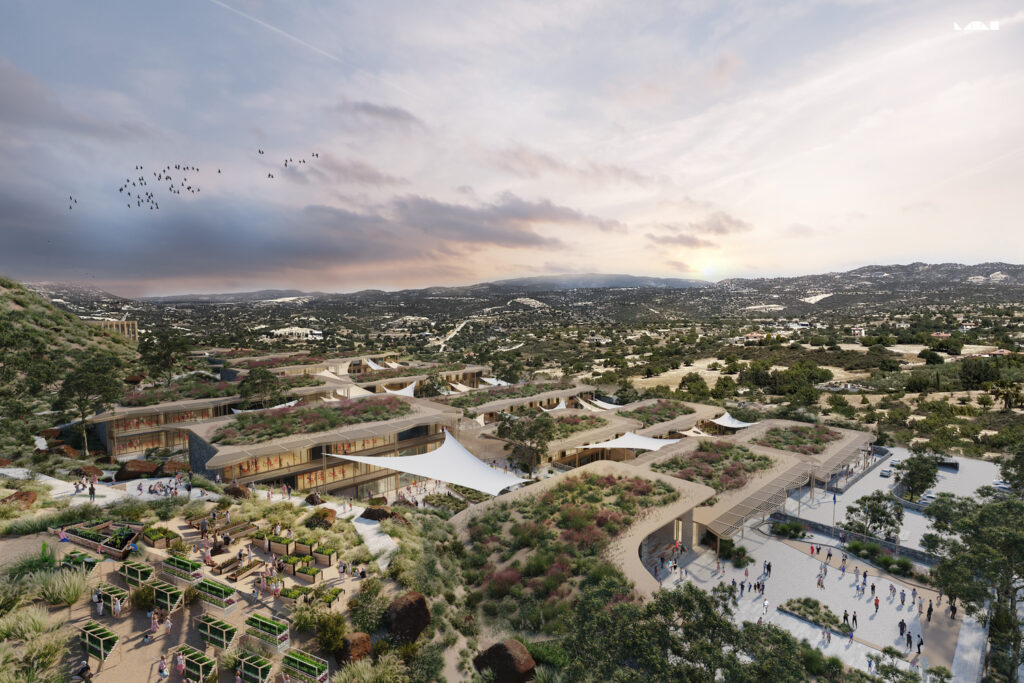
Our landscape-driven masterplan for The Island School in Cyprus seeks to sensitively integrate the development into a hillside site to provide a nature-led learning environment. One of the core design principles has been to retain and work with the natural landscape, enhancing developed areas with new planting and bio-diverse roofs.
2. Is the practice working on material stewardship? For example, evidence could be shown through repeated use of low carbon materials, extensive material libraries and research or publications supporting responsible use of materials and elimination of waste.
We recognise that every decision we make plays a pivotal role in shaping a sustainable future. We have conducted numerous research projects and written articles that explore the use of low carbon materials, new innovations and promote best practice.
Our ‘Office of the Future’ concept with Stora Enzo and ‘Future Labs: Net Zero Design Concept’ with Ramboll and Hoare Lea both looked to create optimum working environments that champion use of low carbon materials while meeting the health and wellbeing of occupants.
As part of our Intelligent Architecture publication, we explored some of the key challenges and provided insight into processes that can help make more informed material choices throughout a project’s lifecycle.
We can also demonstrate material stewardship through completed projects, and most recently through Epping Wellness Centre which promoted the use of a cross laminated timber structure, achieving significant carbon savings when compared to use of steel.
3. Do the majority of projects demonstrate the use of biologically-inspired approaches such as Bioregionalism, Biophilia, Biomimicry, Ecomimicry (also referred to as Ecosystems Thinking, Industrial Ecology or Industrial Symbiosis) or BioTRIZ?
No.
Creating a just space for people
Practice
1. Does the practice have a progressive EDI policy and can you evidence many forms of diversity, which are welcomed and acknowledged, within the practice?
Our diversity is our strength. As one of nine RIBA Practice role models and an EOT, our vision is to maintain a progressive environment where all employees can experience true ownership, have a voice, and contribute towards shaping the future of the practice. We have a comprehensive EDI policy, a dedicated Diversity Action Group, and a range of initiatives to support an inclusive working culture and environment across our studios. We are a Disability Confident Employer and have processes in place to ensure recruitment is transparent, fair and accessible.
Promoting access to the profession is an important value for us. We helped develop the Architecture Apprenticeship and were one of the first practices to support Blueprint for All. With our Future Talent Programme, RIBA Ambassador workshops, School Outreach programmes and as active members of the RIBA EDI Leadership group, we believe we are making a difference in this area.
2. Does the practice operate a no overtime culture, meet the living wage consistently, and stipulate a fair salary ratio between staff of all levels?
Creating an equitable environment where all staff feel valued is key for us. We offer flexible and remote working, and staff are encouraged to take regular additional leave through accumulated time, which provides one day off every two months. We also have a Fatigue Management Policy and monitor all staff overtime which is reported at our monthly Operations Board meetings. This allows us to identify if staff members may require additional support and address any areas of concern.
All salaries meet the living wage and are benchmarked to ensure fair renumeration as reviewed by our renumeration committee. All employees benefit from the EOT profit share distribution.
3. Does the practice support charities, community groups, social enterprises, action groups and others through pro-bono work, charitable giving or in-kind donations?
As a practice, we have established long-term relationships and regularly raise funds and donate time in support of charities whose values align with ours – matching funds raised through events organised by our Wellbeing and Charities Committee.
Through Our Community Involvement Programme (CIP), we volunteer our skills as designers through pro bono projects, volunteering in schools, clubs and charities to educate future talent and collaborating with local community groups. Last year, we volunteered over 462 hours in total. We are currently running two pro-bono projects; we have a long-term partnership with FareShare uplifting their “people” spaces and bringing volunteers together to make a mark on their space and provide design services to a community garden local to our Guildford office.
We also are members of Article 25’s ‘More than a Building’ programme, building upon previous collaborations where we helped design one of their first school projects in Burkina Faso.
4. Does the practice publicly refuse to work with certain clients, suppliers or organisations on ethical grounds?
We have a robust opportunities and bids gateway which reviews all potential projects against a set of categories which include Health and Safety, legitimate funding, ethics, conflicts of interest, and bribery and corruption. This gateway process enables us to assess whether the opportunity aligns with our values and public commitments, which includes the UN Global Compact. We are also one of nine RIBA Practice role models, defined by the RIBA as organisations that exercise a positive impact – on their people, their clients, the profession and wider society.’
Project
1. Do the projects demonstrate deep engagement with local stakeholders and end users? For example, is there evidence that your project engagement goes beyond consultation towards co-design?
Community engagement is vital. We encourage our clients to undertake early and inclusive dialogue that enables people to shape outcomes, be heard and have a sense of ownership for the final product – our workplace strategy service for example, helps commercial clients to create inclusive and resilient workplaces tailored to meet the needs of end users. This engagement is not a one-off exercise, but a continuous process embedded throughout the project.
We also seek to build long-term relationships with wider stakeholders and community groups to foster connections that extend beyond the life of the project. For example, the development of Wootton Science Park has embraced local input from the outset, with the creation of a communal hub featuring a gym and bistro and careful assessment of transport accessibility directly addressing community needs. These efforts aim to leave a legacy of social value, learning, and empowerment for future generations.
2. Do your projects create connected and resilient places which positively contribute to their neighbourhoods and allow equality of access? For example, do your projects create economic opportunity, retain value locally and generate social value?
Social value is embedded into our design process from the outset. We create engaging places that break down physical and social boundaries, inspire curiosity and feel welcoming for all. Seeking opportunities beyond the red line to support local initiatives and strengthen wider networks and public realm connections. Milltimber Primary School in Aberdeen, for example, was collaboratively designed to ensure pupils in the growing catchment area could attend their local primary school and to help unite the existing community of Milltimber with the new fabric of the Oldfold residential.
Our projects also aim to support economic growth at multiple levels. The recently complete Shinfield Studios in Berkshire for example, is the largest new-build film and TV studio campus in the UK. The project has created up to 3,000 jobs and is set to boost the creative industry in the UK and build on its global reputation for content production.
3. Do the majority of your projects promote equity in society, and consider all people, not only the building inhabitants? For example, do your projects show due regard for workers within the supply chain and take active steps to avoid modern slavery?
Our purpose is to enrich lives through the built environment, and our vision is to create a better world. We are an RIBA Chartered Practice, bound by the code of conduct, one of nine RIBA Practice role models,’ and signatories of the UN Global Compact (UNGC)
Equity + Social Value is one of our 6 key sustainability themes and is embedded into our processes for evaluating project opportunities, identifying and managing opportunities and risks on projects through sustainability reviews at every stage, championing stakeholder engagement and participation, and measuring outcomes through our sustainability benchmarking process. We report annually and publicly on our progress through the UNGC communication on progress and our own Corporate Purpose Report.
Our anti-slavery and human trafficking policy outlines our commitments to transparency in our approach to tackling slavery and human trafficking throughout our supply chains and this expectation in embedded in our supplier onboarding process.