
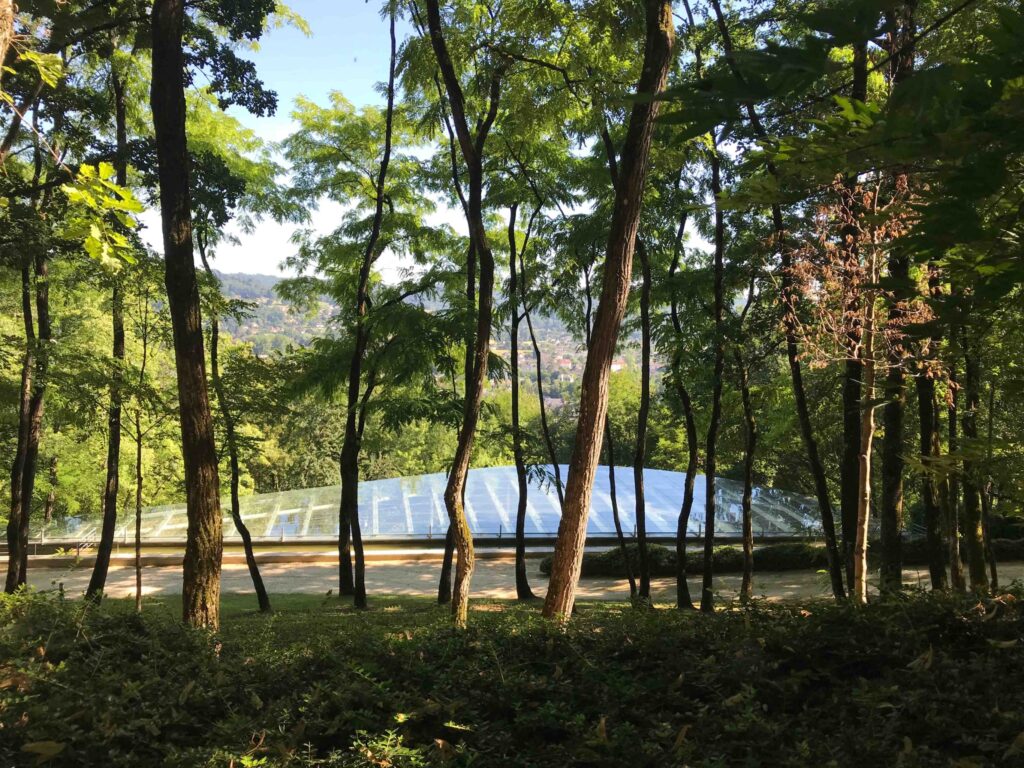
Submission by ritchie*studio.
Being a good ancestor
Practice
1. Does the practice have a clearly stated purpose aligned with the planetary emergency? We are looking for a bold ambition here, and a practice culture which recognises the need for long-term thinking. For example, a strong mission, a theory of change, or a sustainability roadmap.
“Consideration and care for the biosphere is essentially our practice’s design ethos.” Ian Ritchie. Ritchie studio’s stated ethos is that we serve society, and it is central to the way we design and practice architecture. For over 40 years we have collaborated with like-minded fellow professionals and others to deliver socially beneficial and ecologically sustainable projects in a responsible and ethical manner.
We have been committed to an environmentally sustainable design approach since the practice’s inception. Our projects testify to our philosophy not to waste, undertake responsible retrofit over new build construction, promote intelligent passive design methods, and to construct buildings that optimise carbon-free energy.
ritchie*studio established a sustainability roadmap in 2021. We are a signatory to Architects Declare and the RIBA 2030 Climate Challenge, since then we have been undergoing a continuous journey of improvement to not lose focus on the climate emergency and our impact upon it.
2. Does the practice have a clear succession plan, which passes on ownership and protects the values and legacy of those who built and contributed to the practice? For example is the practice an employee owned trust.
In 2021, Ian Ritchie Architects Ltd was renamed ritchie*studio. This signposted a move away from the singular founding director owned company to culminate in a transfer of 49% of the practice shares to employees, reflecting the commitment and amassed talent within the practice to continue to research, design and realise architecture. As new employees join the practice, each employee is invited to join the shareholding of the practice after five years of practice. This will eventually see our employees collectively holding the majority share.
Although the shareholders are responsible for taking key decisions, we have an open forum with all our employees, new and old to contribute to these decisions.
Along with valuing those who have continued in the practice, we also continue to support, and be supported by a collective intelligence and design network – ritchie net – of past employees who have gone on to establish their own practices.
3. Does the practice share research and knowledge for the benefit of society and the wider world? For example, you regularly carry out post occupancy evaluation and share information with others.
ritchie*studio actively shares knowledge on our projects, practice, research and theories and has done so since the practice’s inception.
Our practice website was established as a resource tool to openly share knowledge and research for all to access, serving a wider purpose more than a public front. It is home to our practice lectures and writings, all free to access and download, as well as full extracts of book contributions and critical reviews and extensive summaries of the 17 books we have published. We also share our research and knowledge on materials and processes from glass to gabions utilised in our World Firsts section on material research, development and their application.
We advocate for benchmarkable client satisfaction surveys as a BUS methodology partner.
Our architects teach, lecture and tutor at several universities across the UK and internationally, actively sharing our knowledge with the next generation of designers and place shapers.
Project
1. Does the practice advocate for long-term thinking at the outset of projects? Do you initiate projects with long-term thinking and challenge the client on design life? Also, can the practice demonstrate that this approach has worked – with a shorter or longer design life, or an innovative approach to financing or payback period?
ritchie*studio considers long-term thinking to be the cornerstone of every project.
We design with a long design life in mind and have instilled in all our clients the importance of adaptable space, low maintenance and robust materials to ensure long-term quality, utilising benchmarking from previous projects and initiatives like the RIBA 2030 Challenge to inform our clients.
A recently completed project in Malta used local concrete construction with an extended design life, integrated within the RC floor slabs is a thermally active building system utilising thermal mass to provide radiant coolth. The result is a thermally conditioned environment that uses no air conditioning. This resulted in lower in-use costs and operational carbon. Another example, a five-year temporary theatre for the RSC, designed for a long-term future use. The theatre was retrofitted by the practice in 2016 and continues as the RSC’s hub and production centre.
2. Do your projects take account of the future climate and the need for resilience? For example, do the projects demonstrate flexibility, design for adaptation, design for disassembly, non-deterministic solutions, or demountable structures.
All projects are designed for future adaptability to ensure the environmental and economic sustainability of the project. This includes designing buildings to last, easily adapted for a new use; to respond to changing climate, users, social and environmental needs.
The Sainsbury Wellcome Centre included continuous adaptation in the original brief with ‘plug and play’ servicing, and demountable prefabricated cladding. Adaptive reuse is considered in all our designs, and a current client brief we are preparing envisages a future-proofed mixed-use development in which all spaces are fully adaptable to new uses.
We instil in all our clients the importance of spatial adaptability and servicing flexibility for change of use. Areas of projects that are designed for adaptability use structures and systems that can be re-arranged to facilitate a new use.
All projects consider disassembly; many have and are being designed with bolted connections to facilitate future disassembly and reassembly.
3. Do the majority of your projects go beyond mitigating negatives and towards optimising positives? For example, are they meeting or exceeding the RIBA 2030 Challenge.
Our projects always strive to go beyond mitigation of negatives and towards optimising positives. UK based projects currently being designed and developed are benchmarked against the RIBA 2030 Challenge and/or the LETI 2030 targets with an aspiration to exceed these targets whenever possible.
We have also undertaken a retrospective analysis of a selection of projects which has revealed that these projects would have met their respective challenges i.e. RIBA 2020 challenge levels
We challenge our commercial clients to look beyond the financial cost of a project and consider a holistic approach. This includes advocating for the use of low embodied carbon materials, the use of passive methods to reduce operational carbon emissions, and the importance of landscape-led approaches to improve air quality and wellbeing of occupants.
In a recently completed mixed-use project in Malta we ensured that 50% of the site area was landscaped.
Co-evolving with nature
Practice
1. Does the practice use biophilia within the office or regularly host meetings and retreats in natural settings? For example do you have extensive planting within the office or rely on natural patterns and imagery for stress relief or quiet areas.
Our studio is surrounded by a green landscaped outlook for which all staff benefit, visible from every workspace, we look out on a beautiful, natural screen of trees, including Quercus robur fastigiata and bamboo all planted within the grounds of the office.
We have an external roof terrace with a green herb border, planted by our own ritchie*studio ‘gardening club’. The roof terrace hosts a large meeting table where our team can relax for lunch and hold meetings, or simply to have quiet space to break from general tasks or work in the open air. Our studio has many breakout quiet spaces including library and picture gallery. Ample levels of natural light bathe the studio internally, and the interplay of sunshine and shadows cast ever-changing patterns on the walls and floors. Our team are also encouraged to have planting around their workstations, several of whom have done so.
2. Can the practice share examples where it has considered nature in decision making? For example by having a nature proxy to encourage eco-centric decision making, using natural systems as inspiration for the company structure, recognising the seasonal nature of people’s capacity and workload or celebrating equinoxes and solstices together.
Our recent reorganisation of the company structure has extended ownership to the majority of the team to reflect the importance of collective action in the decisions and direction of the practice.
We have a clearly defined structure, however all practice members voices are treated equally and encouraged to ask questions and voice their opinions. Consequently, views on all aspects of the practice from design, to operations and strategies are developed and implemented in a non-hierarchical way. We host a weekly all-studio meeting as a formal setting for such discussion in addition to informal conversations.
We value all team members wellbeing, physically and mentally, emotionally and personally, to accommodate changing circumstances and operate a flexible working culture to balance work and family/personal lives. This encourages a more sustainable working environment.
When the studio hosts events and CPDs we operate a low-meat / vegetarian policy to encourage lower-carbon plant-based eating habits.
3. Is the practice supporting nature locally and nationally? For example, does the practice support local gardens, gardeners, planting programmes, rewilding programmes or advocate for changes in legislation to protect nature.
ritchie*studio has always worked in close collaboration with landscape designers, gardeners, horticulturists and arboriculturists throughout our projects. We advocate for landscape-led projects in our urban-scale projects to enhance the local biodiversity and ecological environment for people, plants and animals.
By working closely with landscape designers and ecologists we ensure that our work does not harm existing ecosystems and seeks to enhance sustainable landscape practices
Within our extended practice are landscape architects and a qualified forester, who also own a specialist plant nursery. This plant husbandry knowledge is integrated into our landscape-based projects.
Despite this we still believe that this is an area that we could and should do more to support nature more locally and nationally, we therefore will look to actively increase these local contributions in our projects and expand our own internal gardening club who are custodians of our herb garden.
Project
1. Can the practice demonstrate projects which strive to match the performance of a mature ecosystem? As a minimum this would mean achieving biodiversity net gain.
ritchie*studio developed a comprehensive strategic masterplan for 100 hectares of Merthyr Tydfil in South Wales, known as the Cyfarthfa Plan. Central to the plan was the theme of the natural environment and expanding it. A series of projects and programmes, from biodiverse landscape gardens and wild areas to environmental focused schools programmes and productive community gardens are all proposed as part of the project. The 20-year-long plan focuses on the original green valley which became ‘black’ through heavy industry black is becoming green again, noting how the natural landscape is slowly rejuvenating. Through the recently created Foundation, rewilding and other water and land biodiversity initiatives will well exceed statutory minimum BNG.
In Malta, an industrial area has been transformed into Trident Park which is now seen as exemplar of landscape-led design through its six landscaped courtyards and verdant northern perimeter.
2. Is the practice working on material stewardship? For example, evidence could be shown through repeated use of low carbon materials, extensive material libraries and research or publications supporting responsible use of materials and elimination of waste.
The practice has built up an extensive materials library over its 44 years in practice. Additionally, the practice has also developed many world firsts materials, products and systems in glass, metals, stone and light.
The practice has published articles on responsible materials including ‘Ritchie’s Recipe for Sustainability’ and ‘Values in a Changing World’ and AJ interview on materials.
We put responsible sourcing and use of materials at the forefront of our specifications ensuring sustainable timber sourcing and low VOC products. We work closely with our clients, industry and contractors to explore fabrication methods, material possibilities, incorporating all our experience, research and knowledge to develop improved material performance, new material possibilities, reducing the quantum of materials in buildings and mitigating climate impact as priority.
We are currently experimenting on the use of low-carbon materials such as caged and ground flint, rammed earth and incorporating CLT structures in our most recent buildings.
3. Do the majority of projects demonstrate the use of biologically-inspired approaches such as Bioregionalism, Biophilia, Biomimicry, Ecomimicry (also referred to as Ecosystems Thinking, Industrial Ecology or Industrial Symbiosis) or BioTRIZ?
Our projects utilise biologically-inspired approaches through their passive design principles. These are often hidden in the design rather than obviously apparent. We do not seek to emulate nature in its physical appearance but utilise nature’s excellent strategies and techniques.
Innovative thinking is what we do by thinking in parallel in the domains of engineering, landscape, art, music and poetry and architecture.
Many of the facades in our projects are designed from bioclimatic principles since the first bioclimatic facades in 1981 at the City of Science, Paris. A recently completed project in Malta uses vertical fixed ‘aerated’ shading solutions to shade the buildings’ windows, reducing heat gains and thereby reducing the cooling operational energy requirements while creating a wonderful non-linear play to animate the buildings surfaces.
Our project for Eagle Rock House in 1981 used air source heat pumps and solar thermal water collection which continue to function today.
Creating a just space for people
Practice
1. Does the practice have a progressive EDI policy and can you evidence many forms of diversity, which are welcomed and acknowledged, within the practice?
ritchie*studio has a progressive EDI policy as part of our employee handbook and clearly stated on our website across our ethical and employment policies. Our handbook is a fluid document that is continually updated to reflect changing practice. The handbook is issued to all team members to promote an inclusive environment.
We fully adhere to the Equality Act and are committed to diversity across the practice.
We are a signatory to the RIBA’s Inclusion Charter and Mayor of London’s Diversity Pledge and are actively involved in initiatives to improve diversity within the profession, this includes regular schools’ workshops for the Open City – City Makers programme, and as mentors for the RIBA Future Architects programme. We provide work placements, educational support and pro-bono services to several charitable organisations, including financial contributions.
Our studio has women shareholders in senior positions and LGBT+ staff members. We continuously seek to improve inclusivity.
2. Does the practice operate a no overtime culture, meet the living wage consistently, and stipulate a fair salary ratio between staff of all levels?
ritchie*studio has always distributed salaries fairly and proportionately between all staff reflecting experience, expertise and performance and give full consideration of the London living wage.
We have never allowed interns to work without a reasonable wage. We recognise the importance of rest, relaxation and family time and encourage a healthy work/life balance.
We recognise that working hours occasionally extend ahead of some critical deadlines, but we strive to reduce such occurrences.
We have weekly studio meetings attended by all staff which enables us as a company to prioritise and re-allocate resources during these busy periods. Our long tenures and low turnover stand as testament to us fostering a healthy work/life culture.
3. Does the practice support charities, community groups, social enterprises, action groups and others through pro-bono work, charitable giving or in-kind donations?
ritchie*studio regularly supports charities including Shelter and Crisis since 1997, and Koestler Arts prison arts charity.
We provide pro-bono work for such organisations as Open City to facilitate local schools workshops for the past 6 years and are a long term financial supporter of Thornton Education Trust who work to ensure young people’s voices are heard within our industry. We have also financially supported the Stephen Lawrence Day Foundation (now Blueprint for All) since inception and Article 25. Our staff members also provide professional mentorships pro-bono for local East London universities, and those for which they are alumni.
Our founding director Ian Ritchie is an ambassador for Global Returns Project, a member for 30 years of Scientists for Global Responsibility, a Patron of St Annes Hawksmoor300, seeking to restore the building and provide cultural and community spaces within, and advisor to the Backstage Trust funding the performing arts.
4. Does the practice publicly refuse to work with certain clients, suppliers or organisations on ethical grounds?
We publicly declare that we will not accept commissions that we consider may irrevocably damage the environment, involve military activity or the marketing of civilian firearms, undermine successful democratic or indigenous social structures, or engage with countries, authorities or companies that are known to be party to the abuse of human rights or that contravene international treaties, promote adult entertainment, predatory lending, tobacco, and other addictive drugs. This is part of our Ethical Policy published on our website.
Although not a relevant organisation under the Modern Slavery Act, we also operate an Anti-Modern Slavery Policy. Accordingly, are ensure we are aware of and fully consider potential clients’, project funders’ and subcontractors’ policies and ethics in relation to labour protection and we do not take commissions or enter contracts where either is questionable.
Project
1. Do the projects demonstrate deep engagement with local stakeholders and end users? For example, is there evidence that your project engagement goes beyond consultation towards co-design?
We actively seek to involve local stakeholders and project end users throughout the design process. We go beyond the basics of consultation to genuine engagement. All projects map the key stakeholders and ensure regular contact and discussions. We develop day-in-the-life scenario maps with all end users to fully capture user requirements.
In the Cyfarthfa Plan project we held youth creative workshops with primary and secondary schools, including local youth groups, as well as public events to discuss local culture and needs. A series of 2-day workshops were also held with representatives from major groups/societies including history, creative arts, Welsh culture, local naturalists and educators to fully capture the voice of the town. These groups were then involved through the development of the plan, returning at key points to discuss and design further detail. This process is something we actively adopt in all our urban planning and architecture projects.
2. Do your projects create connected and resilient places which positively contribute to their neighbourhoods and allow equality of access? For example, do your projects create economic opportunity, retain value locally and generate social value?
Our stated ethos is that we serve society, and it is central to the way we practice architecture. We collaborate with like-minded professionals and others to deliver socially beneficial and ecologically sustainable projects in a responsible and ethical manner.
Our projects always contribute positively to surrounding communities, are well connected and create resilient places economically whilst retaining their value and increase social opportunities. This is demonstrated in the many strategic plans we have developed including for Cyfarthfa and Belfast Historic Docks, as well as completed projects in Malta, namely the Old Brewhouse and Trident Park where private land is opened for public-use for the first time in a series of courtyard gardens with event spaces for public and community use. On site construction is imminent for the Commemorative Bridge over the Liffey in Dublin which will connect pedestrians and cyclist with the Dublin greenway via the National War Memorial Gardens.
3. Do the majority of your projects promote equity in society, and consider all people, not only the building inhabitants? For example, do your projects show due regard for workers within the supply chain and take active steps to avoid modern slavery?
ritchie*studio only works on projects with due consideration for all people, including contractors and their workers. We have rejected and resigned from projects where clients have disagreed with our design values, and do not work in regions of conflict or where governments’ abuse environmental and human rights.
We recognise that Modern Slavery does occur within the construction industry, predominantly in the construction labour sector and in the production, manufacturing and material resourcing sectors. We help to combat this by providing our staff with the knowledge to spot signs of Modern Slavery on construction sites, to understand specific sector and country risks in relation to project specifications, to undertake due diligence in relation to all material and product specifications, including manufactured products, no matter their origin, and to advise our clients of the risks within the sector which can increase with ‘cut-price’ cost competitiveness.