
Submission by We Made That.
Being a good ancestor
Practice
1. Do you have a clearly stated purpose aligned with the planetary emergency? We’re looking for a bold ambition here, and a culture which recognises the need for long-term thinking.
We work exclusively for public sector bodies and charities because we recognise the climate emergency as a crisis of spatial justice. The impacts of ecological breakdown are felt most acutely by the vulnerable, while the resource use driving it remains structurally unequal. Our role is to bridge this gap, using our expertise to guide public institutions in delivering a just transition that prioritises fairness alongside decarbonisation.
Our mission is legally locked into our company’s articles of association as a Certified B Corporation, requiring us to deliver material positive impact on society and the environment as a unified objective. This accountability is not static; our 2024 recertification confirmed a 46% uplift in measured impact. By operating as a purpose-driven partner to the public sector, we use long-term thinking to ensure that urban development serves the collective good rather than private interest, directly addressing the systemic drivers of planetary and social inequality.
2. Do you have a clearly stated purpose aligned with the planetary emergency? We’re looking for a bold ambition here, and a culture which recognises the need for long-term thinking.
Long-term thinking shapes our practice’s future, not just our projects. Developing our current business plan involved succession planning as part of a formal, transparent, and collective conversation within the practice. Rather than treating it as a private matter for senior leadership, we have shared five appraised succession scenarios with the whole team, including Employee Owned Trust and protecting our “mission lock”.
Each of these scenarios are appraised against a balanced scorecard that weighs social and environmental impact as heavily as financial viability – ensuring our mission is the primary filter for any future ownership decision. Alongside that, we continue our commitment to being a Living Wage Employer and Mayor of London Good Work Standard accredited, putting employee needs at the centre of our decision-making processes.
3. Do you share research and knowledge for the benefit of society and the wider world?
In 2025, we published ‘Rights to Place: Delivering Spatial Justice in UK Cities’ with Key Cities. Through surveys, interviews and roundtables from Salford to Southend, and Bristol to Coventry, we explored how fairness can underpin the governance of urban spaces.
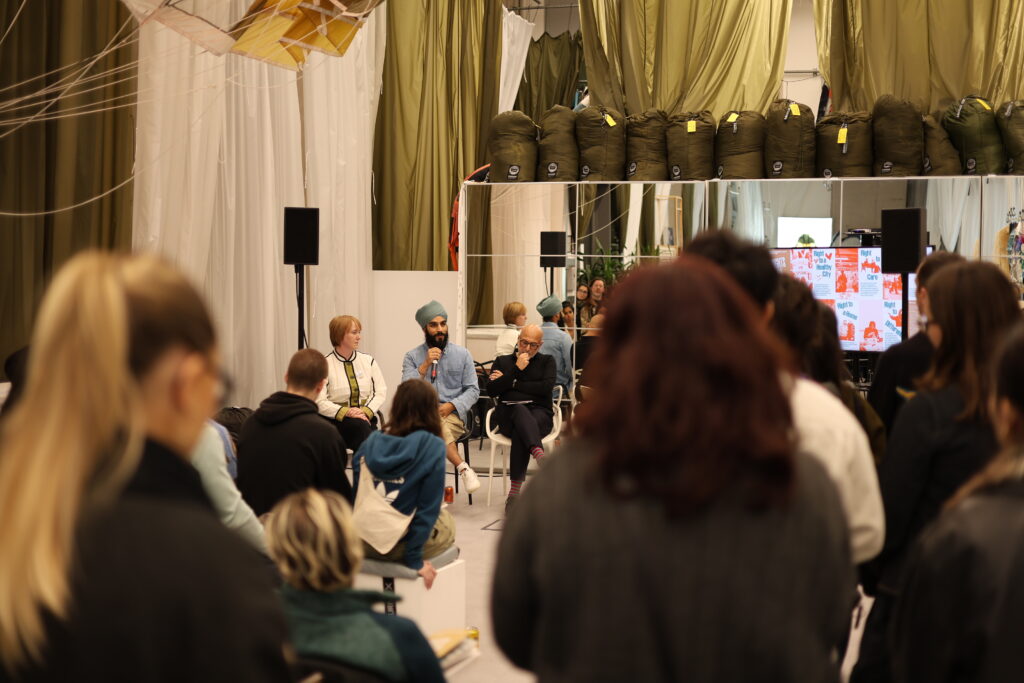
We amplified this at our London event, ‘Who’s right, what right, and where’s that right?’, where policy-makers, academics and industry leaders debated the report’s themes through sharp provocations.
Additionally, we organised a ‘Research in Place’ residency that attracted over 60 applications, welcoming independent researchers exploring spatial justice, regeneration and circularity. In summer 2025, the Save Soanes Research and Advocacy Team joined the residency, driving their campaign to secure a long-term future for an ecological education centre in Tower Hamlets. Through conversations at the studio and Soanes Centre, we reflected on tensions between community and council stakeholders, and how power might be contested or shared to safeguard the centre’s future.
Project
1. Do you advocate for long-term thinking at the outset of work? Do you initiate work with long-term thinking and challenge clients? Also, can the organisation demonstrate that this approach has worked?
Long-term thinking requires engaging those living with our decisions. In developing proposals for a new town of up to 20,000 homes in Enfield, we held workshops with Youth Council members aged 16 to 17. We explored how their needs shift over 50 years, prioritising the tangible ‘must get rights’ of the neighbourhood design critical in longer timescale to 2150. Their priorities, spanning climate resilience, safety and belonging, informed the masterplan guidance that will govern delivery for decades.
In 2025, our projects addressed strategic gaps in material re-use. Drawing lessons from our ‘on the ground’ action in projects in Bexhill and Newham, we convened a group from across industry and including the London Doughnut Economy Coalition to propose 30 actions for the GLA to deliver the physical, digital and institutional infrastructure London needs to scale up construction material re-use in response to the London Plan consultation.
2. Does your work take account of the future climate and the need for resilience?
At inception, all our projects are reviewed against current local climate impacts and future scenarios, accounting for the long-term nature of many of our projects. Our urban integration work for the DLR extension to Thamesmead identifies permanent and temporary infrastructure consistent with the multi-decade construction period for the project and station surrounds, whilst also planning for likely climate scenarios into the later half of the 21st century.
In Malmö, our work on the Trollhättan 6 redevelopment with ‘Team Superlokal’ similarly prioritised resilience. By choosing adaptive re-use over demolition and retaining the site’s structural skeleton, we transformed a former office into a mixed-use community while cutting embodied carbon by 74% compared to the UK residential average. It demonstrates that the most resilient buildings are often the ones we don’t have to build from scratch.
3. Does the majority of your work go beyond mitigating negatives and towards optimising positives?
We need more bold practices moving beyond ‘less harm’ and towards outcomes that prioritise planetary emergency responses. Our commitment to the climate emergency is embedded across all strands of our work, from research to delivery. In 2025, 81% of our projects continued to rethink or adapt uses on ‘brownfield’ and ‘grey belt’ sites. We consistently align resilient public infrastructure with social equity, ensuring environmental improvements such as climate adaptation provide direct, tangible benefits to the communities most impacted by urban inequality.
In Croydon, we addressed extreme heat risk by designing a network of ‘cool routes.’ These link essential social and transport infrastructure through strategic greening and shading, ensuring town centres remain accessible and inclusive during heat events.
Similarly, our work at Cody Road in Newham is turning a previously car-dominated environment into a connective asset, prioritising resident health, safety, and accessibility as a fundamental part of the London’s green transition
Co-evolving with nature
Practice
1. Do you use biophilia within your premises and/or do you regularly gather in natural settings?
No.
2. Can you share examples of where you have considered nature in decision making?
No.
3. Are you supporting nature locally and nationally?
Supporting nature recovery means working at multiple scales simultaneously. Through our ‘Research in Place’ residency programme, we provided sustained support to the Save Soanes Research and Advocacy Team, whose campaign to protect an ecological education centre in Tower Hamlets represents precisely the kind of grassroots nature advocacy that benefits from professional backing.
We actively challenge project scopes to maximise ecological value. We successfully embedded a 100-hectare rewilding and flood strategy into the Crews Hill and Chase Park masterplan and are currently delivering green corridor improvements at Cody Road in Newham. The project bridges the gap between hard infrastructure and ecology by deploying nature-based features that turn isolated industrial pockets into thriving, climate-responsive green corridors along the River Lea.
Our Climate Champion continues active engagement with specialist working groups including Architects Climate Action Network and the London Doughnut Economics Coalition – to keep pace with emerging practices in delivering nature-based solutions.
Project
1. Can you demonstrate work that strives to match the performance of a mature ecosystem?
Our work on the spatial framework for Crews Hill and Chase Park in Enfield has evolved significantly to address climate emergency. One of two New Towns in London to provide over 21,000 homes, will integrate a borough-level landscape strategy that includes rewilding agricultural land, managing river catchment flood risk, and enhancement of ecological corridors along the M25 buffer, railway SINCs, and existing watercourses.
The ambition is not to mitigate the ecological impact of new development but to use settlement-scale investment as a catalyst for landscape-scale nature recovery, delivering valley parks, green links, and productive natural habitats that function as a mature, interconnected ecosystem.
2. Are you working on material stewardship?
At a strategic scale our work in Canning Town identified the sites and infrastructure needed to scale up material re-use whilst developing business networks to facilitate the re-use of material locally. We are now delivering public realm projects in the area that make use of these networks to maximise material re-use.
Our contribution to Trollhättan 6 in Malmö applies this thinking at its most rigorous. Following the LFM30 roadmap for climate-neutral construction, the project retains the structural foundations, columns, and cores of an existing office block and car park, achieving an embodied carbon performance 74% below the UK residential average across 18,000m² of mixed-use space.
At Wigan Pier, the argument is differently weighted but equally clear. Ending more than 15 years of vacancy in a heritage building, the adaptive reuse strategy simultaneously recovers embodied carbon, preserves material memory, and creates infrastructure designed to remain purposeful for the next century.
3. Does the majority of your work demonstrate the use of biologically-inspired approaches such as Bioregionalism, Biophilia or Biomimicry?
No.
Creating a just space for people
Practice
1. Do you have a progressive EDI policy and can you evidence many forms of diversity, which are welcomed and acknowledged, within your company/organisation?
In 2025, we turned the lens of our ‘Right to Place’ framework on ourselves, asking similar questions of our studio culture that we ask of the places we design. Who has access, who progresses, and whose voice shapes decisions?
We have a structured Equalities, Diversity and Inclusion policy and action plan, led by our Head of People, who supports educational opportunities, work placements, and pro-bono consultancy for third-sector organisations. Our Employee Forum directs how we invest in the team, allocating 864 hours of knowledge sharing, professional development, and skills sessions in 2025, alongside 67 days dedicated to social and environmental impact improvement.
The results of this sustained investment are visible in our team composition, which continues to improve against industry benchmarks: 59% female, 24% BAME, 12% LGBTQIA+ and 6% disabled. Two team members were promoted to Associate roles in 2025, reflecting a genuine commitment to progression from within.
2. Do you operate a no overtime culture, meet the living wage consistently, and stipulate a fair salary ratio between staff of all levels?
Protecting fair employment standards in a competitive market isn’t just ethical, it’s essential. Our commitment to a no-overtime culture, transparent pay and Living Wage is not simply a policy position but a practice-level discipline that supports access to good jobs with good conditions, in fair, healthy and inclusive workplaces.
Our Good Work Standard accreditation from the Mayor of London provides independent, annual verification of our workplace standards. This external accountability is important as it ensures that our commitments are tested as consistent evidence.
Our salary frameworks always go through a feedback process with the whole team and continues to be reviewed through that same collective process. Flexible working supported return-to-work journeys, parental leave policies and Time Off In Lieu are the practical mechanisms that sustain a healthy culture at We Made That. Our overtime rates are tracked and reported honestly.
3. Do you support charities, community groups, social enterprises, action groups and others through pro-bono work, charitable giving or in-kind donations?
We maintain our resolve for impact through social value commitments and pro-bono contributions targeting organisations advancing spatial justice and public good. We support the New Architecture Writers (N.A.W.), who support a free programme for emerging and under-represented design writers of colour. In 2025, we delivered student work experience and youth workshops from Weston-super-Mare to Newham, empowering the next generation and reinforcing every citizen’s stake in their city’s future.
Our ‘Research in Place’ residency programme that ran from 2025 through to 2026, offered researchers free studio space and dedicated time offered by members of the team to develop and shape independent work on spatial justice and regeneration. The residency hosted the Save Soanes Research and Advocacy Team, supporting their campaign to protect an ecological centre in Tower Hamlets and later we hosted Joanna Dong, whose research explored participatory approaches to food, heritage and regeneration at the Royal Docks in Newham.
4. Do you use an ethical framework to assess opportunities and/or supply chain partners and is them team consulted on these decisions?
100% of our clients are public, third sector or charities. This strategic focus ensures our expertise remains dedicated to the public good and provides a clear boundary for project selection, based on quality and the purpose it will serve. We evaluate every potential commission against our core mission, ensuring our work supports social value, environmental responsibility and community benefit.
We apply these same standards to our consultant teams. As part of our B Corporation contract processes, we require sub-consultants to provide information on their ownership, diversity and social and environmental impact. This helps us ensure that the project teams we assemble are aligned with our practice values. Where we identify gaps, we view them as opportunities for dialogue and improvement. By choosing partners who share our commitment to positive impact, we ensure our projects are delivered by teams as invested in social and environmental outcomes as we are.
Project
1. Does your work demonstrate deep engagement with local stakeholders and end users?
Our engagement models continue to evolve. We ensure our focus is on deep community participation, seeking on-the-ground insights about high streets and neighbourhoods and to make sure that lived experience directly shapes decision making in our project areas. In 2025, we held 330 events, workshops, and interviews, a significant increase in direct community touchpoints, with over 1,700 people contributing to project development across the UK.
Quality of participation is as important as scale for us. In Clacton and Bexhill, we held summits and youth workshops to revive local pride and economies. In Bristol, we designed a Public Art and Cultural Activation Toolkit that empowers residents, artists, and community groups, developers, cultural organisations to co-create projects that transform neighbourhoods with public art and cultural activities. In London, we partnered with the Greater London Authority to integrate lived experience into strategic policy and the upcoming London Plan.
2. Does your work create connected and resilient communities which positively contribute to neighbourhoods and allow equality of access?
Connection and resilience are created through long-term investment frameworks, not just singular interventions. Our Place Plans for Clacton and Bexhill-on-Sea guided £20 million of Pride in Place investment in each town, shaped by engagement with over 600 residents and 70 local businesses. Both plans address health inequality, skills deficits, and town centre decline as interconnected challenges rather than separate workstreams.
In Bexhill, which includes one of the 10% most deprived neighbourhoods nationally, our framework directly addresses barriers to movement, vacancy, and the absence of visible provision for young people, through active travel improvements, heritage-led public realm, and structured youth engagement.
In Canning Town, our strategic framework creates 500 metres of new riverside walkway and 1.3 kilometres of green corridors, connecting a large industrial area to surrounding neighbourhoods and making the River Lea accessible to thousands of residents for the first time.
3. Does the majority of your work promote equity in society, and consider all people, not only building inhabitants
In 2025, 72% of our projects directly served underserved communities. This is the measure by which we most honestly evaluate whether we are starting to fulfil our purpose of doing public good.
Our ‘Rights to Place: Delivering Spatial Justice in UK Cities’ report, published in 2025 with Key Cities, translates this commitment into a practical framework for policymakers through a call to collective action. The five interconnected rights, to a Healthy City, to a Home, to Care, to Difference, and to a Voice, open up a conversation about what good cities should look like. The five accompanying calls to action give practitioners, policymakers, and commissioners specific starting points for change.
Supply chain standards are applied consistently. Sub-consultants are required to demonstrate compliance with fair labour standards and provide evidence of social and environmental impact, ensuring commitments to equity extend across the full network of organisations that deliver our projects.