
Submission by Tuckey Design Studio.
Being a good ancestor
Practice
1. Do you have a clearly stated purpose aligned with the planetary emergency? We’re looking for a bold ambition here, and a culture which recognises the need for long-term thinking.
Founded 25 years ago, our studio was established on a commitment to reuse and retrofit at a time when the industry prioritised new construction. We believe existing buildings hold character, patina and material richness, that deserve to be respected, celebrated and reinterpreted. Retrofitting not only reduces waste and improves long-term environmental performance, but also creates architecture that is more responsive to its context. Each of our projects begin with a survey of materials present on site to identify what can be reused, salvaged or recycled.
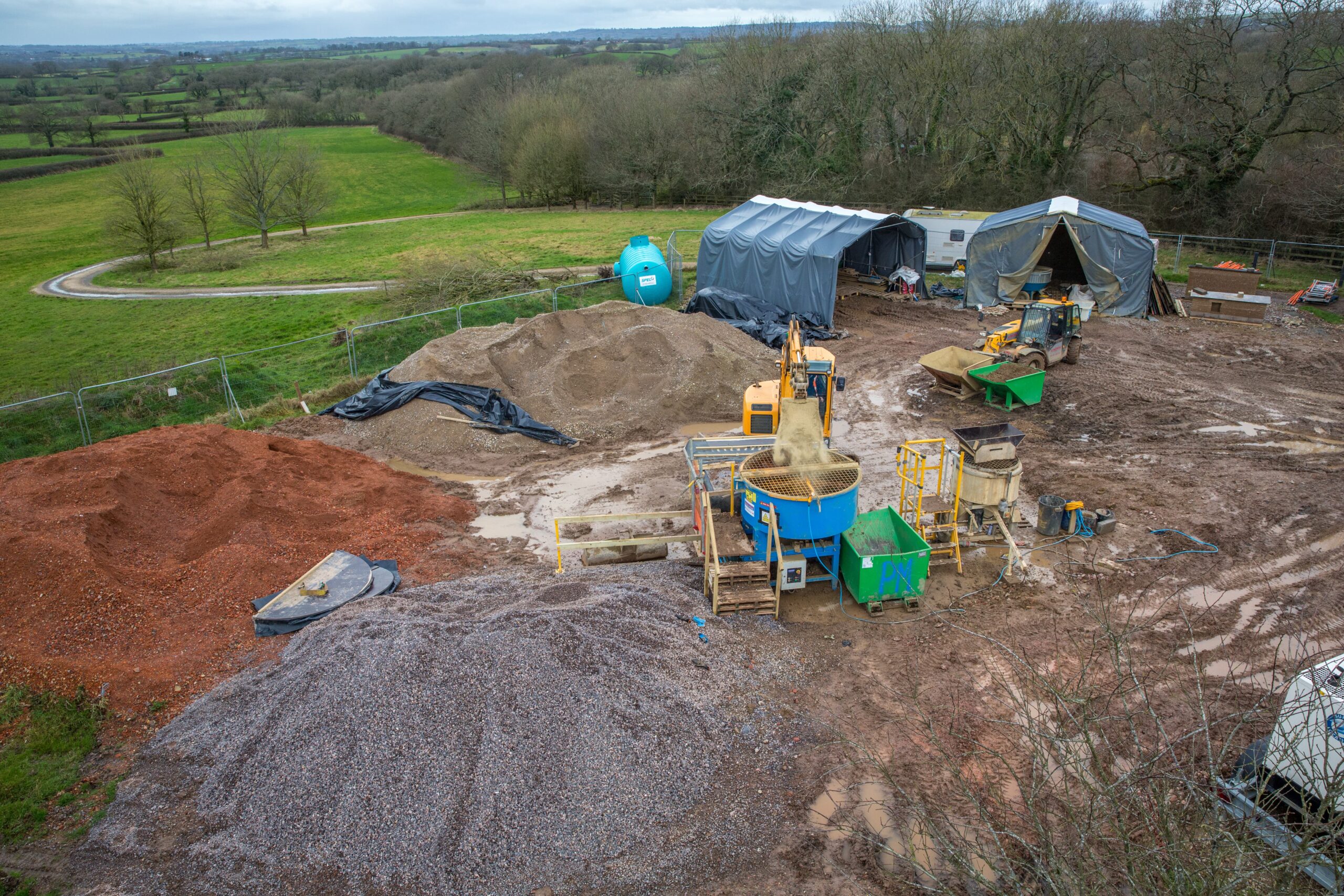
This ethos also shapes our new-build work through sustainable construction methods and the reliance of local materials. Our recently completed Rammed Earth House in Wiltshire exemplifies this approach, using a mix of site-worn clay, demolition aggregate from former outbuildings, limestone gravel from a neighbouring quarry and water to create a low-impact, contextually sensitive home.
2. Do you have a clearly stated purpose aligned with the planetary emergency? We’re looking for a bold ambition here, and a culture which recognises the need for long-term thinking.
While we don’t yet have a formal succession plan in place, we are actively building the foundations for a sustainable future that protects our practice’s values and legacy. Over the past two years, we have intentionally expanded our associate team’s leadership responsibilities, including financial oversight and business development, to create a more distributed leadership model. In the future, we envisage exploring long-term ownership structures, including an employee ownership trust, as part of our commitment to regenerative practice principles both in our work and our business structure.
3. Do you share research and knowledge for the benefit of society and the wider world?
We carry out a post occupancy evaluations following the completion of our projects and publish these findings in awards submissions and wider press. We are consistently finding alternative and innovative ways to improve thermal envelopes of existing buildings through sustainable insulation methods and pushing the insulation capabilities of materials such as rammed earth & cork for new-builds.
We regularly give presentations, lectures and workshops to universities, institutions and conferences, sharing our knowledge and expertise in working with existing built in fabric, in the UK, continental Europe and the US. Over the past year we’ve spoken at the Detail Climate Forum in Dusseldorf about our approach to climate-conscious architecture, discussed the potential of rammed earth at the British Ceramics Biennial in Stoke-on-Trent following the completion of our collaborative Playscape as part of the exhibition, and presented at Oxford Brookes University about natural materials and their wider application in practice.
Project
1. Do you advocate for long-term thinking at the outset of work? Do you initiate work with long-term thinking and challenge clients? Also, can the organisation demonstrate that this approach has worked?
At the start of every project, we carry out a ‘Stage 0’ in which we gather data of the existing site, including annual sunlight hours, rainfall, temperature, topography, soil type, and natural materials. This informs the design for future extremities in weather brought by climate change. When data has been gathered we then challenge our clients about what legitimate sustainable-minded design principles can be taken forward. This is best illustrated in our recent homestead in Wiltshire formed from clay excavated from the site.
We come to each project with an open mind to reclamation. We see each site, regardless of location, type or use, as a record of activity over time. Existing buildings contain a wealth of materials which are too often seen as ‘waste’. We find value in these materials and question what can be given a new use, reducing the environmental impact of the existing building’s life cycle.
2. Does your work take account of the future climate and the need for resilience?
Our expertise lies in the adaptation of the existing, so our own interventions follow this principle. On a project in Somerset, we restored a grade II listed wool hall and retrofitted an adjacent uninspired 1980’s extension, inserting courtyards into the plan which helped for natural cross ventilation. The fragmented plan we introduced not only improved passive cooling during increasingly hot summers but also made for a flexible family home where a subsidiary studio could be altered into bedrooms if needed.
Retail projects, such as our Malin+Goetz London boutiques, are designed with modularity and adaptation in mind. Waste is high in the retail sector, with competition in attracting consumers to the high street leading to the redressing of stores every few years. We therefore devise lightweight demountable elements, providing the opportunity to reorientate the store in future or the raw material can be repurposed when taken apart.
3. Does the majority of your work go beyond mitigating negatives and towards optimising positives?
The studio’s objective is for all projects to achieve net zero carbon by 2030. By 2026, at least 50% of projects will have their carbon impact tracked through Small Carbon at the end of each work stage, while all new projects are reviewed for circularity and biodiversity performance.
Our team believes in “doing more good” rather than simply “doing less bad.” We prioritise local craftspeople and collaborators to strengthen a project’s connection to its context while reducing carbon emissions. Suppliers, consultants and contractors are challenged from the outset to move beyond “business as usual” and adopt more sustainable approaches.
This mindset has already delivered strong results on a recent residential project currently on site. The housebuilder implemented an almost zero-waste policy, encouraging carpenters, bricklayers and electricians to proactively identify opportunities for improvement rather than present problems, creating a more collaborative and environmentally responsible construction process.
Co-evolving with nature
Practice
1. Do you use biophilia within your premises and/or do you regularly gather in natural settings?
We frequently hold meetings outside on our picnic benches and regularly conduct trips all together to get some space away from the bustle of city life. Examples include a CPD at the Cork House in Windsor, a sustainability workshop in Salisbury and a camping trip to London’s green belt.
Recently we made a whole team trip to Sutherland in northern Scotland, getting the sleeper train from London. We hiked up Ben Loyal with conservation guides at WildLand, conducted volunteering to restore a remote bothy and visited local artist Lotte Glob. These experiences help shape how we approach our design work.
Our London studio is adorned with cacti and aloe vera, while our first floor windows flanked with lavender planter beds and a herb garden.
2. Can you share examples of where you have considered nature in decision making?
We are recognised for our use of natural materials, with local landscapes, resources and ecosystems actively shaping our design decisions. Wherever possible, we work with local craftspeople and materials to support regional knowledge, reduce transport impacts and strengthen the connection between buildings and their surroundings. Examples include local chestnut and oak in a restored farmstead in northern Italy, on-site clay used for the monolithic walls of our Rammed Earth House in Wiltshire, and reclaimed terracotta incorporated into a chapel-to-home conversion in rural Devon.
This ecological mindset also informs our studio operations. We use recycled paper stock, glass bottle milk deliveries and solar-powered electricity, while revising our travel policy to reduce environmental impact.
Staff wellbeing is supported through flexible working, including two remote days per week and two fully remote weeks annually. By combining ecological thinking with a people-focused culture, we aim to create healthy, resilient and sustainable ways of working.
3. Are you supporting nature locally and nationally?
Our west London studio is located on a quiet residential street where, in 2024, we transformed unused parking spaces into planters for over 20 trees, creating a mini boulevard that benefits both employees and local residents. We also successfully advocated for additional bike storage, encouraging more sustainable travel in the area.
Twice a year, we publish a physical newsletter printed on recycled stock, exploring materials and the work of artists, architects, chefs and scientists connected to them. A recent edition featured a visit to Royal Botanic Gardens, Kew and an interview with Dr Peter Gasson about the composition and cultivation of bark. The publication supports local practitioners and charities while sharing their work with our readership.
We also collaborate with landscape designers who champion biodiversity, rewilding and the use of natural, locally sourced materials across projects of all scales.
Project
1. Can you demonstrate work that strives to match the performance of a mature ecosystem?
We are currently developing three masterplans that combine building retrofit with rewilding and landscape restoration. In rural Belgium, we are collaborating with BC Architects & Studies to transform a derelict tannery into an eco-retreat, cultural hub and hotel. Located within an area of outstanding natural beauty, the site has suffered river pollution from years of industrial runoff. A regenerative planting strategy is proposed to remove contaminants and restore biodiversity.
On the shores of Loch Ness, we are upgrading a local pub into a restaurant, creating a new bakery and constructing a sauna along the loch. Working with Tom Stuart-Smith, these elements will be connected through a rewilding landscape scheme.
Our Rammed Earth House also prioritised rewilding, meadow restoration and habitats for bats and birds, exceeding biodiversity targets before they became mandatory.
2. Are you working on material stewardship?
We regularly contribute to publications that incentivise low carbon and natural materials. For example, our Rammed Earth House features in the RIBA ‘Materials : An Architectural Primer’ book which offers a guide on material principles and of the environmental impact they can have. Our Cornish Longhouse also recently featured in ‘New Naturals: Inspired Interiors for Sustainable Living’ due to its use of locally sourced Delabole slate, breathable lime plaster and oak beams.
Our studio is housed within a converted Victorian London pub, with the beer vaults in the basement repurposed into sample libraries. Here we sort and keep sustainable and responsibly sourced samples that we use regularly on our projects. For example, Honext board, Troldekt composite panelling and reclaimed timber samples.
3. Does the majority of your work demonstrate the use of biologically-inspired approaches such as Bioregionalism, Biophilia or Biomimicry?
Many of our projects are situated within dramatic and rural landscapes, such as the Norwegian arctic circle, the shores of Lake Michigan, the Austrian alps and the rolling pasture of Somerset. Following years of neglect and deterioration many of the buildings we encounter have been reclaimed by nature. We find solutions to make these buildings habitable for humans again but not to the detriment to flora and fauna. We’ve incorporated ‘bat hotels’, built in bird boxes to facades and planted wildflower meadows around building perimeters for animal trails to foster biodiversity in these settings.
We’ve used organic matter in projects such as Ecococon blocks for the conversion of an agricultural shed to archive studio in Wiltshire, hay ‘strocks’ for a winery in the South Downs, cork for a wellness retreat in Piedmont and hempcrete on a family home in Surrey.
Creating a just space for people
Practice
1. Do you have a progressive EDI policy and can you evidence many forms of diversity, which are welcomed and acknowledged, within your company/organisation?
Yes we have an Equality Policy (equivalent to an EDI policy) in our Quality Management System.
We are a diverse studio with all of us coming from varying backgrounds. We have employees from Italy, Japan, Latvia, Ireland, Portugal, Afghanistan, India, Scotland and England making for a wonderfully vibrant and creative place to work.
As a creative studio we’re conscious that not everyone has to come through the ‘traditional’ means of architectural training. Some of our current employees have backgrounds in social anthropology, psychology, interior design, fine art, illustration and landscape architecture.
Our senior team is 2:3 male:female, including British, European and Asian representation. We take part in panel talks, events, careers day to be advocates for inclusivity in architecture.
We regularly open our London studio to the public, with a disabled access lift and WC available. Our ‘Building on the Built’ lecture series is free and open to all.
2. Do you operate a no overtime culture, meet the living wage consistently, and stipulate a fair salary ratio between staff of all levels?
We meet and exceed the London living wage consistently. Considerations include performance (individual and practice), market rate benchmarking, and inflation. An end-of-year bonus is consistent across all levels. There is gender parity of monetary renumeration, and we have enhanced family friendly policies.
Our studio operates on a no overtime culture with mechanism in place to ensure projects have the necessary resources required and therefore if it should occur it is a rare exceptions on deadlines and the senior team will see that individuals are allowed to recouperate.
3. Do you support charities, community groups, social enterprises, action groups and others through pro-bono work, charitable giving or in-kind donations?
In 2010 we launched an annual social enterprise initiative offering pro bono architectural support to projects that improve public value. Open to schools, arts organisations, charities and community groups, the aim is to increase access to early-stage design input such as consultations and feasibility studies, helping strengthen neighbourhood prosperity and quality of life. Projects to date include a renovation proposal for the Deaf Action headquarters in Edinburgh, an archive studio for Royal Festival Hall, and the interior remodelling of Acland Burghley School, which introduced a library, T Level facilities and studio spaces praised for their impact on teaching and learning.
We also delivered a rammed earth Playscape in Stoke-on-Trent for the British Ceramics Biennial, working with local communities, artists and the University of Staffordshire on a reduced-fee basis to ensure delivery within a limited budget.
4. Do you use an ethical framework to assess opportunities and/or supply chain partners and is them team consulted on these decisions?
We operate within a clear ethical framework that informs the selection of clients, suppliers and collaborators, considering environmental impact, social value, labour practices and alignment with our values around sustainability, equity and responsible development. Where a commission conflicts with these principles, we would not proceed and decline the collaboration.
Grounds for refusal include human rights concerns, exploitative or unsafe labour practices, significant environmental harm, illegal activity, corruption, or any conduct that compromises staff wellbeing or professional integrity.
Given the long-term, collaborative nature of architectural work, we also maintain internal procedures to address challenges constructively during design and delivery, ensuring wellbeing and professional standards are upheld throughout a project.
The studio is committed to a safe, respectful working environment. All staff undertake annual training on harassment, discrimination and professional boundaries. This framework enables us to engage with complex projects while maintaining consistent ethical standards across both external relationships and internal culture.
Project
1. Does your work demonstrate deep engagement with local stakeholders and end users?
We recently took part in a community consultation to develop our proposals to reinvent a town centre in the town of Rainham. This open discussion is very helpful in pinpointing what is lacking from a current building and how it can be enhanced.
Our Playscape was co-designed with University students, artists and local volunteers. Students were involved from the outset, sketching ideas, making tiles and ramming earth. This interaction forms a public space made by local people and enjoyed by local people.
Earlier this year we completed the second public consultation in the village of Dores by Loch Ness in Scotland. Local feedback is then compiled and implemented in tweaking the practical elements of the scheme, such as bin storage, paking orientation and signage.
2. Does your work create connected and resilient communities which positively contribute to neighbourhoods and allow equality of access?
We completed an the archive studio in the Southbank Centre, London, which made thousands of artworks and documents readily accessible to the public having been in storge for years prior. Since completion an estimated 4 million people per year visit the building, with the archive an integral cog in making the building more accessible and engaging to locals and tourists.
Our RIBA award winning Horris Hill Theatre is a new-build CLT auditorium for a school in Berkshire. As well as plugging the gap for a much-needed space devoted to creative arts for the school, the building is now also used for local theatre group performances, presenting itself as an economic asset of the school and being highly valued by the surrounding villages as a cultural hub.
3. Does the majority of your work promote equity in society, and consider all people, not only building inhabitants
Our studio has a zero tolerance approach to modern slavery and abuse on site, both verbal and physical. Beyond the project brief, we pride ourselves in a holistic culture championing diversity, accommodating accessibility and fair labour.
We work with collaborators and clients who have similar values to our own when it comes, to diversity, pay, craft, quality and attention to detail. We’ve worked on school buildings, charity headquarters, restaurants, hotels, cultural venues, shops and residences all of which are owned by respectable and kind clients who we maintain close relationships to this day.
As part of our office procedures and the drive to uphold standards, we require all consultants, contractors and collaborators we work to complete a QA questionnaire, which asks very specific questions about their policies towards Environmental Management, Health & Safety and Discrimination. This is reviewed by each project lead and associate, before proceeding to work with them.