
Submission by tp bennett.
Being a good ancestor
Practice
1. Do you have a clearly stated purpose aligned with the planetary emergency? We’re looking for a bold ambition here, and a culture which recognises the need for long-term thinking.
At TP Bennett, our 14 Principal Members have committed to making TP Bennett the “go-to” practice for sustainability in architecture and interior design, with an embedded sustainability process driving all decisions to create thriving places for people and planet. We design projects guided by four key sustainable principles: Environment, Health & Wellness, Equity, Diversity & Inclusivity, and Social Value. Supported by leadership, our team of 14 in-house sustainability experts works to integrate these principles into projects while upskilling design teams. We are joining the Science Based Targets initiative (SBTi) and further developing our net zero roadmap aligned with the Paris Agreement to limit global warming to 1.5°C. This includes ambitious near-term carbon reduction targets and long-term strategies for Scope 1-3 emissions. Following our acquisition of Bluehaus Group in 2025, we are aligning a unified approach to sustainability through cross-company targets, processes and training, ensuring meaningful, measurable climate action across our global practice.
2. Do you have a clearly stated purpose aligned with the planetary emergency? We’re looking for a bold ambition here, and a culture which recognises the need for long-term thinking.
Founded in 1921 by Sir Thomas Bennett and incorporated as an LLP in 2005, the practice has a clear, actively managed succession strategy that protects its legacy while enabling future growth. The LLP comprises over 50 Members, including 13 Principal Members, working across specialist studios united by a vision of climate‑resilient, high‑quality design. This integrated structure underpins leadership continuity and the transfer of knowledge and values.
Succession planning is embedded and forward‑looking, with timelines aligned to retirement horizons and a focus on developing high‑performing individuals for future leadership roles. The process is governed through our board structure, forming part of the governance section of board packs and reviewed at every board meeting to ensure it remains rigorous, relevant, and up to date. Recent appointments demonstrate this approach, including three Principal Members moving into studio leadership roles and a fourth promoted to Chief Commercial Officer, reinforcing a dynamic, sustainable leadership model.
3. Do you share research and knowledge for the benefit of society and the wider world?
TP Bennett actively supports the decarbonisation of the built environment by promoting sustainable practices such as our recent publication ‘Making Space’ – a manifesto that challenges commercial office buildings to integrate spaces for uses by the community and charity partners. TP Bennett contributed to the industry working group for the UK Net Zero Carbon Buildings Standard, benchmarking research on the important aspect of upfront carbon in Cat B office fit outs.
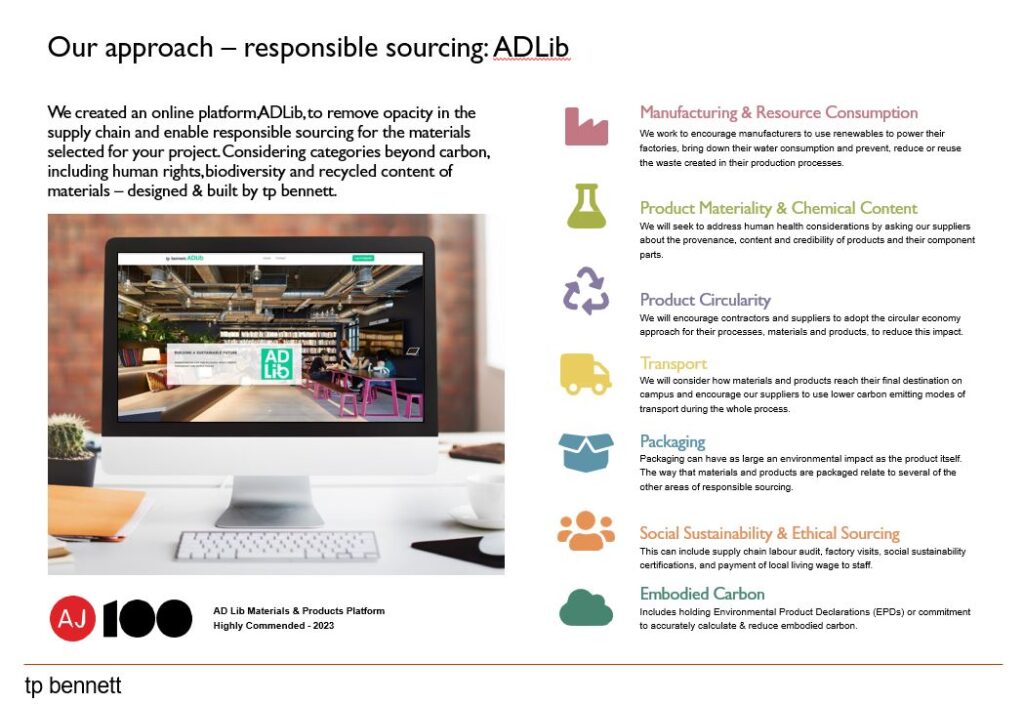
The practice shares insights on topics such as climate resilience and circular economy principles by contributing to roundtables, industry articles and conferences. Collaborations with academia include regular guest lectures to provide case studies and further encourage innovation from upcoming graduates. Aware of the industry’s environmental and social impact from material specification, we have created an in-house web-based materials library platform ‘AD Lib’, facilitating responsible sourcing across our projects. We plan to launch this for wider industry use later this year.
Project
1. Do you advocate for long-term thinking at the outset of work? Do you initiate work with long-term thinking and challenge clients? Also, can the organisation demonstrate that this approach has worked?
TP Bennett advocates for long‑term thinking at the outset of projects, embedding measurable Sustainability Key Performance Indicators into design briefs, to be tracked as the design progresses to occupation and beyond. We prioritise early‑stage decisions with software tools that balance whole‑life carbon and operational performance and use sustainability accreditation frameworks to achieve measurable outcomes. Our bespoke internal resources provide structured sustainability guidance across topics to support design decisions.
We pragmatically challenge clients to adopt sustainable approaches. For example, at an adaptive reuse project in the City of London, we retained 61% of the original Art Deco structure, reducing embodied carbon and preserving heritage, while incorporating renewable energy, recycled materials and biodiversity features. At Cornerstone in Woking, we collaborated with the client to invest in durable, high‑quality materials for long‑term value, reimagining an existing commercial building for residential use. These projects demonstrate our commitment to creating lasting environmental and community value.
2. Does your work take account of the future climate and the need for resilience?
TP Bennett’s work prioritises future climate resilience through mitigation and adaptation strategies embedded in the design process with software tools that drive data‑led decision‑making. Our early‑stage tools inform design strategies to address challenges like solar overheating in urban conditions, incorporating passive design principles with balanced glazing ratios. Our projects are informed by iterative WLC assessments, such as The Langfield, London, which undertook extensive surveys revealing much of the existing structure was unsafe despite an aspiration for retention. The proposal features sub‑dividable floorplates, an optimised façade and low‑embodied‑carbon materials assessed against a hierarchy of certifications to optimise future flexible uses on the site.
Projects with a future‑focus like 11–12 Wellington Place, Leeds achieved the UK’s first NABERS 5‑star rated office building and set the standard for net zero carbon in operation, as well as providing enhanced thermal comfort and air quality for occupants against future weather scenarios.
3. Does the majority of your work go beyond mitigating negatives and towards optimising positives?
TP Bennett goes beyond mitigating negatives through a structured approach to defined sustainability deliverables that the whole design team can collaborate on. Our ISO14001 practice‑wide Sustainability process aligns project goals with reduced environmental and social impact while providing opportunities for positive contributions to communities and planet.
We created bespoke resources to integrate sustainability into every stage of design, covering strategies like passive design, energy efficiency, material reuse, biophilic design and social value initiatives. These tools guide Sustainability Plan Workshops, enabling tailored solutions for each project. The Sustainability Plan process creates a feedback loop, informing future training targeted to address knowledge areas where greater expertise is needed.
By leveraging certifications, we deliver measurable outcomes aligned with global standards and the UN Sustainable Development Goals. Projects like Windmill Green, Manchester showcase our commitment to wellbeing, inclusivity and community value, ensuring our work delivers lasting positive impacts for people, communities and the environment.
Co-evolving with nature
Practice
1. Do you use biophilia within your premises and/or do you regularly gather in natural settings?
TP Bennett incorporates biophilic principles throughout our offices, for example in London with planting in most meeting rooms and on every floor. Natural materials and textures create a calming, inspiring environment aligned with the 14 Patterns of Biophilia.
To support mental health and wellbeing, staff participate in initiatives organised between our Wellbeing ERG and groups like our local BID Better Bankside for nature walks, as well as wider industry initiatives like Architects softball league and JLL triathlon. We also support volunteering with the Outward Bound Trust, where team members join young people on week‑long nature‑led excursions to build confidence and resilience. These activities benefit participants and staff, fostering personal growth and connection with nature.
Additionally, we provide a dedicated wellbeing space in the office, designed with calming colours and textures, which can be used for prayer, parenting or as a quiet space to recharge, supporting mental health and overall wellbeing.
2. Can you share examples of where you have considered nature in decision making?
As a Sustainability team we set our annual goals using frameworks from nature, starting with a ‘Goals garden’ and widening our perspective to a team ‘Goals tree’ to review our starting point and ideal end‑of‑year scenarios shaped by interconnected natural systems. This framework was developed by Megan Fraser of Future Led climate coaching.
As a business we consider seasonal rhythms in decision‑making, recognising how natural cycles impact wellbeing and productivity. We have a mandatory office closure over Christmas to encourage rest and family time. In January, we shift our event focus toward enhanced wellbeing with a ‘Wellbeing week’. These talks and prompts support colleagues who may find the darker winter season more challenging for mental health, supported with Vitality health checks. In summer, we scale back events and training so staff can spend more time with family and friends. This seasonal approach helps foster a balanced, nature‑informed working culture.
3. Are you supporting nature locally and nationally?
For the first time on a project, we are embedding metrics to measure embodied biodiversity within material specification, with a view to extending this approach in future projects and sharing learnings across the wider industry
We strive to embed stretch targets on projects for biodiversity net gain in external areas. In interiors we use the Terrapin Bright Green research on the ‘14 Patterns of Biophilia’ in our projects to widen the lens of natural systems in our designs.
We engage with our London office’s Better Bankside Business Improvement District for planting workshops in the community and with our Wellbeing Employee Resource Group for events. Through our connection with client Wates Residential, members have volunteered in Barking and Dagenham with the initiative ‘Keeping Barking Clean’. These events occur throughout spring and summer and include litter picking in community parks and helping the ‘Friends of Phoenix Park’ maintain the community garden.
Project
1. Can you demonstrate work that strives to match the performance of a mature ecosystem?
We strive to align our projects with the performance of mature ecosystems by embedding sustainable land use and ecology principles into our design process. Projects including Stonecutter, London, and Windmill Green, Manchester, demonstrate this approach, incorporating urban greening, biodiversity features, and resource efficiency.
However, we recognise that more needs to be done to support our ecosystem, therefore, to evolve our approach, we’ve restructured our sustainability workshops at the outset of every project to address the 9 UN RIBA Sustainable Outcomes, including sustainable land use and ecology. We’ve developed targeted crib sheets that provide design strategies and client focused questions to ensure these principles are considered. This section of the tool encourages designers to explore opportunities and strategies for biodiversity enhancement, biophilic design, land use optimisation and post-occupancy ecological surveys, to create a project that can support natural ecosystems, while contributing positively to the built environment.
2. Are you working on material stewardship?
We are trialling material passports across projects, documenting data such as material origin, composition, durability and potential for reuse or recycling. This approach supports adaptability, facilities management and a circular economy. We advocate for stakeholder engagement as people occupy a building to better understand the provenance of selected materials. For example, the BCO study fit‑out project for ANZ’s London office prioritised the circular economy with circa 80% reused materials and was designed for future disassembly. There was an approach to sharing this exemplar with stakeholders through a sustainability narrative on ANZ’s intranet translating carbon accounting and savings.
Additionally, we developed AD Lib, an online materials library that tracks and shares material data, streamlining sustainable material selection and fostering industry collaboration. We plan to share this platform externally later in the year year. These initiatives demonstrate TP Bennett’s commitment to material stewardship and driving innovation in sustainable design and construction.
3. Does the majority of your work demonstrate the use of biologically-inspired approaches such as Bioregionalism, Biophilia or Biomimicry?
At TP Bennett, we conduct sustainability workshops at the outset of every project to embed biophilic and biodiversity principles, offering guidance on biophilic design, biodiversity enhancement, and sustainable construction methods. For example, we recently incorporated 12 out of 14 Patterns of Biophilia, including fragrant walls, biomorphic ceiling designs, natural materials, distributed planting, and lighting schemes mimicking natural patterns, enhancing well-being and connection to nature.
We also track compliance with Biodiversity Net Gain (BNG) and the London Plan Urban Greening Factor, integrating features like green roofs, wildlife corridors, eco-habitats, and SuDS. Sustainable materials, such as FSC-certified timber, are prioritised through our AD Lib materials library, supporting ecological protection and circular economy principles.
A notable retrofit project in Canary Wharf uses biomimicry inspired by a forest, with the design reflecting the journey from tree roots to the canopy, weaving this concept into every detail to celebrate nature.
Creating a just space for people
Practice
1. Do you have a progressive EDI policy and can you evidence many forms of diversity, which are welcomed and acknowledged, within your company/organisation?
Our EDI policy reflects our commitment to creating a culture where every individual feels valued, included and empowered to contribute their best. Compliant with the Equality Act 2010 and Worker Protection Act 2023, the policy addresses nine protected characteristics, all implemented across the organization.
Key initiatives include annual EDI surveys, inclusive leadership and allyship training and active Employee Resource Groups (ERGs). These ERGs have championed policies now implemented, such as menopause leave and equal partner leave.
Recruitment practices feature accessible job ads, diverse selection panels and accommodations for candidates with disabilities. Our senior‑led EDI Panel monitors workforce diversity, pay‑gap metrics and policy alignment with company values. TP Bennett prioritises psychological safety, inclusive design and equal opportunities, demonstrating commitment to D&I in all aspects of work. Embedding EDI principles from recruitment, to leadership and design, to delivery, creates a culture in which people and creativity thrive.
2. Do you operate a no overtime culture, meet the living wage consistently, and stipulate a fair salary ratio between staff of all levels?
TP Bennett does not encourage regular overtime to support employees with their work/life balance. Tp Bennett have a commitment to equitable treatment of employees. The organisation ensures fair access to employment, development, and progression opportunities and complies with equality legislation, including fair pay practices.
Our policy supports equity in compensation by monitoring workforce data and pay gap metrics through annual reporting including gender pay gap reporting. Our median gender pay gap stands significantly below the architecture industry average and ranks us as having the smallest disparity among the UK’s major architectural practices. We measure and benchmark gender and we are working towards ethnicity pay gap measurements to increase equity and pay parity. The organisation also ensures that its recruitment and employment practices are fair and transparent, with job roles clearly defined and assessed based on objective criteria.
3. Do you support charities, community groups, social enterprises, action groups and others through pro-bono work, charitable giving or in-kind donations?
TP Bennett actively supports charities, community groups and social enterprises through initiatives. The organisation’s CSR (Corporate Social Responsibility) programme overlaps with its EDI goals, focusing on supporting underrepresented communities and fostering social impact.
Key examples include collaborations with organisations like RIBA EDI Leaders and the Mayor’s Fund for London to deliver employability and work‑experience programs for students from state schools in under‑resourced areas to increase diversity in the industry.
We have had great success with pro bono projects, our most recent being a new office fit‑out for Pan Arts, an arts‑for‑social‑change charity. They moved into a 1920s TP Bennett building, Camelford House, Vauxhall, and we were able to facilitate £480,000 worth of fit‑out work between our teams and industry partners we brought on board. This means their charitable funds can be invested in the programmes they deliver with vulnerable groups in wider London in enhanced facilities.
4. Do you use an ethical framework to assess opportunities and/or supply chain partners and is them team consulted on these decisions?
TP Bennett employs an ethical framework to guide decision-making and assess opportunities and supply chain partners, integrating sustainability, equity, and ethical considerations. Suppliers must first pass the grounds for exclusion requirements of the Procurement Act 2023. A comprehensive supplier due diligence questionnaire covers EDI considerations including adherence to fair pay & conditions, modern slavery abolition and non-discrimination. TP Bennett is a certified Living Wage employer, and these requirements are extended to the supply chain. Clients and opportunities are assessed on the grounds of controversial industries, jurisdictions and source of funding.
The AD Lib questionnaire enables in-depth assessments of environmental sustainability to evaluate and compare material credentials on projects, while and supplier practices are reviewed to ensure alignment with ethical and sustainability goals.
These measures ensure that TP Bennett’ is guided by ethical principles, creating an inclusive and sustainable culture while maintaining accountability across its supply chain and business practices.
Project
1. Does your work demonstrate deep engagement with local stakeholders and end users?
TP Bennett’s work demonstrates a commitment to engaging with stakeholders and end users, with an exemplar in our shortlisted entry for the NLA ‘Hope in the Square’ design competition for a public square in Peckham. As the design brief was for a space for young people, we engaged with Southwark students from the Living Bankside Academy in a summer workshop in our offices to hear what they wanted to be incorporated in a public space. We followed this up with workshops with them, and subsequently with the public in Peckham, to better understand the aspirations for youth inhabiting this public space, as well as the constraints and challenges faced by locals. This approach informed the design proposals and the biophilic approach in collaboration with Greenwood‑Hill landscape architects. This consultative and evidence‑based approach ensured the design was aligned with actual user needs, creating functional and inclusive environments.
2. Does your work create connected and resilient communities which positively contribute to neighbourhoods and allow equality of access?
We have projects developed with community uses at the centre such as Hounslow High Street Quarter and Ealing Filmworks.
For these projects we focused on public‑realm activation and integration of shared spaces that foster social value and inclusivity. This approach evolved through stakeholder engagement and reflects awareness of the role architecture plays in creating environments that bring people together and support community well‑being.
Additionally, the sustainability team have created guidance on Inclusivity and Accessibility that has been peer‑reviewed by the Centre for Accessible Environments. This is available for teams to assist with designing spaces to accommodate diverse needs, including those of neurodivergent individuals and people with disabilities, promoting equality of access. Collaboration is central to this approach, with input from the EDI Panel and ERGs fostering diverse perspectives to drive innovation and inclusivity. With the addition of an Inclusivity specialist to our teams, we advance further with best‑practice resources.
3. Does the majority of your work promote equity in society, and consider all people, not only building inhabitants
TP Bennett’s work actively promotes equity in society by considering the needs of all individuals, not just building occupants. We undertook research entitled ‘Making Spaces’, which focussed on the different ways that our clients can facilitate community uses within their commercial buildings. This has raised awareness of the greater opportunities for social value in the design, and we engage with clients at early stages to discuss these opportunities.
Furthermore, TP Bennett’s emphasis on inclusivity extends beyond workplace projects to public realm and community-focused initiatives, where we integrate shared spaces and social value elements to foster equality and inclusion. By embedding equity, diversity, and inclusion into its design processes and community engagement efforts, TP Bennett creates projects that thoughtfully consider the broader societal context and contribute to a more equitable and inclusive society.