
Submission by Tate+Co.
Being a good ancestor
Practice
1. Does the practice have a clearly stated purpose aligned with the planetary emergency? We are looking for a bold ambition here, and a practice culture which recognises the need for long-term thinking. For example, a strong mission, a theory of change, or a sustainability roadmap.
Since our foundation in 2007, we have been working within a Regenerative Design Framework. This is centred around three elements; reducing carbon/energy in our work, improving biodiversity/nature in our projects and aligning our design process to create positive outcomes for people/communities. Our framework overlays the standard RIBA Stages to ensure we prioritise positive outcomes across these three fronts.
For example, we use One Click LCA to measure a project’s whole life carbon.
We have extensive experience of integrating nature within our projects and are clear in terms of who we work with to achieve this. All our projects include comprehensive stakeholder consultation within the design process.
We are happy to share our company Production Manual where the additional measures we have built into our design process are defined.
Our ambition is that all our work will achieve positive outcomes across the three elements as mentioned, ideally measured against hard metrics.
2. Does the practice have a clear succession plan, which passes on ownership and protects the values and legacy of those who built and contributed to the practice? For example is the practice an employee owned trust.
We are working hard to create a new generation of leaders that will, in the longer term, take over the practice and take the company into the future.
Our team is growing and new colleagues are sharing and developing our ethos and contributing to our culture of inclusion and like-minded ambition.
In addition to architectural and CPD training, we train our team in business skills such as business development and presenting and to be ‘Future leaders’. We also undertake 1:1 business coaching.
We are in the process of implementing a structured, company-wide profit share scheme which necessitates regular, all-team financial updates. We are in consultation with the team and our legal and financial advisors as to what the most appropriate structure of the company should be in the long-term.
The conclusion of this process may be that we become an Employee-Owned Trust but this is part of the ongoing discussion.
3. Does the practice share research and knowledge for the benefit of society and the wider world? For example, you regularly carry out post occupancy evaluation and share information with others.
We proactively share our knowledge and experience whenever we can. An example of this is the ‘Knowledge Hub’ on our website. The entire team is involved in addressing the questions we receive. https://tateandco.com/knowledge-hub/ .
We deliver talks and participate in panel discussions and seminars that consider how we, as an industry, can improve our approach to Regenerative Design. This includes our ‘In the City’ events where we ask thought leaders from diverse disciplines to consider how key, positive outcomes can be achieved within the urban environment. Gathering in the City is a recent example of one such event and an audio of the conversation can be found here Catch up with the conversation.
Jerry has taught at UCL and Kansas State University. His work focused on how to build using sustainable, natural materials. His work also included a series of student building projects for the Dartmoor Arts Week. https://tateandco.com/projects/dartmoor-arts/.
Project
1. Does the practice advocate for long-term thinking at the outset of projects? Do you initiate projects with long-term thinking and challenge the client on design life? Also, can the practice demonstrate that this approach has worked – with a shorter or longer design life, or an innovative approach to financing or payback period?
As part of our Regenerative Design approach, we seek to create multiple positive outcomes for our clients, projects and their communities.
Around a third of our client-base comes from the charity sector and they are generally looking to pass on assets to future custodians. Another third comprises educational institutions who share a similar structure and mission. These clients’ projects have an extended horizon when compared to the UK legal, 60-year lifespan.
Our residential work can be more challenging; private clients envisage longer-term ownership whereas developers have difficulty in financially structuring the promotion of long-term, positive outcomes.
Generally, we seek clients such as Keyland/Yorkshire Water who retain the majority of land around a development and therefore maintain an extended interest. We are currently working with Igloo Regeneration and The Crown Estate on Knutsford; a new form of government-backed housing scheme that will promote a long-term attitude towards residential development.
2. Do your projects take account of the future climate and the need for resilience? For example, do the projects demonstrate flexibility, design for adaptation, design for disassembly, non-deterministic solutions, or demountable structures.
Our design process ensures future flexibility and climate resilience. We use PHPP as part of our assessment of operational energy in projects and this includes ensuring that future climate change and overheating are accounted for in the external envelope specification and design.
As part of our Regenerative Design process, we ensure our designs are adaptable. At York St John University Creative Centre we have laid out multiple future scenarios for the main teaching block. To support this, we designed a clear span structure with modular servicing.
We generally prioritise pre-fabricated, ‘dry’ construction methods, normally timber frame and, if possible, seek to reduce or remove concrete from our designs, replacing with steel micropiles wherever possible. This means many of our delivered projects can be removed/disassembled/substantially reused.
We are working with Airclad (https://www.aircladx.com/ ) to create a demountable and reusable construction system to provide accommodation that can be re-used across many sites.
3. Do the majority of your projects go beyond mitigating negatives and towards optimising positives? For example, are they meeting or exceeding the RIBA 2030 Challenge.
We seek to ensure our projects deliver multiple, positive outcomes and exceed the RIBA 2030 Challenge targets whenever possible.
The majority of our residential projects are of Passivhaus standard and meet the 35 kwh/sqm/yr operational carbon requirement. We maximise the use of timber frame and natural materials.
We have been creating projects that substantially improve biodiversity for many years; the Creative Centre for York St John University produced a 53% BNG improvement figure in a central York City site.
Another example of a project producing multiple positive outcomes is the Esholt Positive Living project for Yorkshire Water. (https://tateandco.com/projects/esholt-keyland-developments/ )
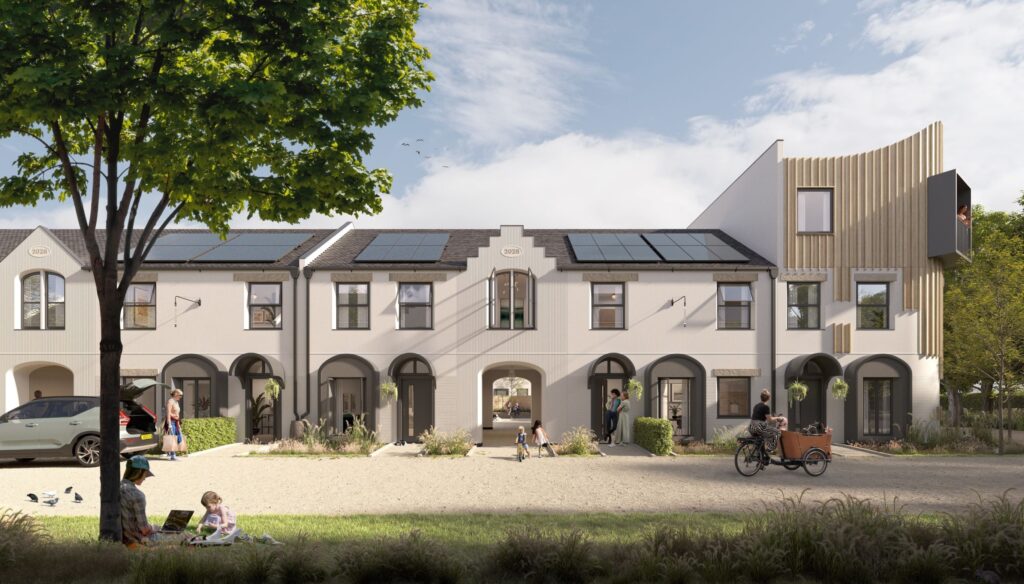
The Knutsford housing scheme in Cheshire is targeting ambitious embodied carbon levels of less than 300kg CO2/m² and operational energy use at 35kWh/m²/year. The development aims for a minimum 15% biodiversity net gain, on-site renewable energy generation, and alignment with the Passivhaus standard.
Co-evolving with nature
Practice
1. Does the practice use biophilia within the office or regularly host meetings and retreats in natural settings? For example do you have extensive planting within the office or rely on natural patterns and imagery for stress relief or quiet areas.
Our office in Dalston, which you can see on our website (https://tateandco.com/about/) was taken on as a bare shell and since then we have been creating an environment that reflects our love of nature.
All fixed elements in the office, including the storage, screens and shelving, are constructed from FSC certified OSB boards which have a natural timber finish. Planting is integrated into all of these elements. We worked with horticulturalists at the Eden Project on the selection of these plants, generally choosing forest floor species that thrive in indoor environments.
There is a sheltered, communal courtyard outside our office where we generally have lunch as a team, weather permitting! We regularly have office ‘away-days’ and these are generally split 50/50 between cultural activities in London and getting a train out to enjoy a walk in the countryside.
2. Can the practice share examples where it has considered nature in decision making? For example by having a nature proxy to encourage eco-centric decision making, using natural systems as inspiration for the company structure, recognising the seasonal nature of people’s capacity and workload or celebrating equinoxes and solstices together.
Integrating nature into our work is a vital part of our mission and we have sought to create a working environment where nature is fundamental to all decision making. We have created an office environment which maximises team connection with nature; we have extensive bicycle parking and encourage cycling to work through the cycle to work scheme and free bike servicing; the team has biodiversity training. We share space with / have team-building sessions with landscape architects.
Our handbook sets out working policies that allow the team to work as flexibly as possible. We hold regular team forums to ensure that everyone can input into our company structure and direction. Whilst not direct natural inspiration, our team has a sensibility towards nature and has so established parameters to develop a healthy work setting.
We have not integrated natural systems within the company structure as this is still work in progress.
3. Is the practice supporting nature locally and nationally? For example, does the practice support local gardens, gardeners, planting programmes, rewilding programmes or advocate for changes in legislation to protect nature.
A significant proportion of our work is for local authorities and charitable organisations who are seeking to promote preservation, protection and connection with nature. Our clients include; the Eden Project, The National Trust, The Scout Association, two Wildlife Trusts (Bedford, Cambridge & Northampton and Cornwall), The Zoological Society of East Anglia, The Birling Estate, The Royal Parks and three ongoing park renewal projects for Barnet Council, Bromley Council and The London Borough of Waltham Forest.
We are advocates for the protection of nature and its integration into our urban environment. Our event, ‘Nature in the City,’ considered just that. (https://tateandco.com/nature-in-the-city-listen-to-our-most-recent-event/. We also write articles that explain how Biodiversity Net Gain is measured. https://tateandco.com/answers/what-is-biodiversity-net-gain/.
In our office, we have created a significant amount of space for planting. We have also worked with our neighbours to help create a rooftop sky garden which helped them secure planning permission from Hackney Council. https://www.brunswickeast.london/.
Project
1. Can the practice demonstrate projects which strive to match the performance of a mature ecosystem? As a minimum this would mean achieving biodiversity net gain.
A significant proportion of our work is for local authorities and charitable organisations who are seeking to promote preservation, protection and connection with nature. Our clients include; the Eden Project, The National Trust, The Scout Association, two Wildlife Trusts (Bedford, Cambridge & Northampton and Cornwall), The Zoological Society of East Anglia, The Birling Estate, The Royal Parks and three ongoing park renewal projects for Barnet Council, Bromley Council and The London Borough of Waltham Forest.
We are advocates for the protection of nature and its integration into our urban environment. Our event, ‘Nature in the City,’ considered just that. (https://tateandco.com/nature-in-the-city-listen-to-our-most-recent-event/. We also write articles that explain how Biodiversity Net Gain is measured. https://tateandco.com/answers/what-is-biodiversity-net-gain/.
In our office, we have created a significant amount of space for planting. We have also worked with our neigbours to help create a rooftop sky garden which helped them secure planning permission from Hackney Council. https://www.brunswickeast.london/.
2. Is the practice working on material stewardship? For example, evidence could be shown through repeated use of low carbon materials, extensive material libraries and research or publications supporting responsible use of materials and elimination of waste.
We have a series of standard clauses in our material specification process that ensures responsible sources of materials, ranging from the use of FSC/PEFC timber to an absolute ban on PVC.
We have ongoing projects looking to use super-local sourcing to ensure a detailed understanding of material provenance. These include a cabin/lodge tourism development for the Birling Estate in a Chestnut Coppice where we are going to use coppiced timber from the site itself to construct the 25 lodges. (We will be working with the roundwood expert Ben Laws and the timber specialists Xylotek.)
We are also working on a housing scheme with Igloo Regeneration and The Crown Estate where we will construct Hempcrete houses made from hemp grown on 60Ha adjacent to the site itself, with an on-site factory to allow local pre-fabrication and sourcing of other materials and labour.
3. Do the majority of projects demonstrate the use of biologically-inspired approaches such as Bioregionalism, Biophilia, Biomimicry, Ecomimicry (also referred to as Ecosystems Thinking, Industrial Ecology or Industrial Symbiosis) or BioTRIZ?
Our practice was formed through an interest in biologically-inspired processes and since then our work continues to strive to meet this ambition. We genuinely believe that this is a rich territory for the creation of ideas that will help deliver a regenerative future for our built environment.
Our work seeks to demonstrate our thorough understanding and deep appreciation of natural systems and how these can be harnessed to create a virtuous circle of resources within a project.
Our commitment to a biologically-inspired approach can be identified throughout our portfolio and is something we are pursuing in depth in our Esholt Positive Living project, https://tateandco.com/projects/esholt-keyland-developments/, and will be realising soon in a permaculture-inspired, new-build house and garden in Easton, Suffolk.
Creating a just space for people
Practice
1. Does the practice have a progressive EDI policy and can you evidence many forms of diversity, which are welcomed and acknowledged, within the practice?
Yes; we have a progressive Equality, Diversity and Inclusion Policy in our Handbook which is issued to all team members prior to them starting at the practice so that they understand fully our commitment, requirements and expectations.
As well as this, we have a number of other policies, such as a Menopause Policy, which demonstrate our commitment to making our workplace as inclusive as possible.
We are actively involved in a number of initiatives to improve diversity in the architecture profession, including regular school workshops with the RIBA Ambassadors programme and working with the Grimshaw Foundation for which Jerry Tate is a trustee (https://www.grimshaw.foundation/ ).
2. Does the practice operate a no overtime culture, meet the living wage consistently, and stipulate a fair salary ratio between staff of all levels?
We do not encourage overtime and carefully manage our resourcing to ensure that deadlines and workloads are controlled to avoid this if at all possible. Detailed / regular / ongoing resourcing is a priority.
We have a TOIL Policy (Time Off In Lieu) which stipulates that any additional time spent working beyond the standard week is compensated for.
We are a certified Living Wage Employer.
In terms of wages across different levels, there are clear salary bands that are set out in our Handbook and we discuss these in terms of fairness as a team on a regular basis.
Our monthly “Town Hall” sessions provide an open forum for everyone to discuss efficiencies and opportunities. At these sessions, we learn from each other; from practical and past experience and the exploration of fresh ideas.
We are working towards setting up a profit share scheme in the future..
3. Does the practice support charities, community groups, social enterprises, action groups and others through pro-bono work, charitable giving or in-kind donations?
We work with Open City, the RIBA and the Grimshaw Foundation, of which Jerry is a trustee, to regularly deliver educational workshops for children and outreach programmes. In particular these are focused on schools in diverse or disadvantaged communities as, through this work, our aim is to improve the diversity of those entering the profession.
We are supporters of the London Neighbourhood Scholarship programme where, as a group of practices, we financially support diverse students through their university architecture training.
We support Crisis.
As a side note we also actively encourage our team to participate in charity cycle rides and fun-runs etc, through time off and financial support, all of which help raise many thousands of pounds for charity each year.
4. Does the practice publicly refuse to work with certain clients, suppliers or organisations on ethical grounds?
We are members of the London Practice Forum. The London Practice Forum’s charter mandates that members assess a potential client’s, consultant’s, contractor’s or supplier’s stance on social value, environmental impact, finance sources, profit allocation and human rights record prior to accepting commissions or engaging with them.
This guideline does not restrict member practices working in specific geographic regions, nor is it prescriptive on the type of work accepted, but rather provides an ethical framework to follow to ensure alignment with the LPF principles.
Certain clients, suppliers or organisations will not align with the LPF principles and therefore we would not work with them, but this would be assessed on an individual basis.
Project
1. Do the projects demonstrate deep engagement with local stakeholders and end users? For example, is there evidence that your project engagement goes beyond consultation towards co-design?
Our projects require extensive engagement with local stakeholders, end-users and the local community. Our local authority work particularly demonstrates our commitment to this level of engagement.
For Low Hall Sports Ground, for the London Borough of Waltham Forest, we worked with the consultation specialists Urban Symbiotics to undertake community consultation through events, local stalls at the market and an online social media campaign. The information gained was used to generate the brief for the site and inform the design.
When we commenced work on the Esholt Positive Living Project, the local community was against a residential development but after extensive community consultation, we designed a scheme which included many of their ideas to create genuine, positive community outcomes including additional green spaces or better connectivity through the site to a local transport. Overwhelming local community support for the scheme assisted in the securing of full planning consent in 2021.
2. Do your projects create connected and resilient places which positively contribute to their neighbourhoods and allow equality of access? For example, do your projects create economic opportunity, retain value locally and generate social value?
We aim to create projects which deliver a positive contribution to their neighbourhoods and local area on multiple levels.
As part of our design process, at RIBA Stage 1 we undertake extensive research on the local area in terms of connectivity and sustainable transport, biodiversity and ecology and local economic centres. This means that as part of our design, we can create meaningful positive outcomes, building on the resources already available on the site.
At RIBA Stage 2 we produce a materials map of the local area, nominally an 80-mile radius but sometimes larger depending on the site. This enables us to assess what materials, suppliers and sub-contractors are available nearby and allows us to make meaningful, early material specification decisions. Whilst this is partly to create a lower embodied carbon outcome, it also ensures that the economic benefits of a development are maximised in terms of the local impact.
3. Do the majority of your projects promote equity in society, and consider all people, not only the building inhabitants? For example, do your projects show due regard for workers within the supply chain and take active steps to avoid modern slavery?
As mentioned, all of our projects are designed to have the widest positive impact possible, beyond simply serving the needs of the buildings’ inhabitants.
This includes providing as many broad social and community benefits as possible such as creating jobs in the local supply chain, improving local economic opportunities, providing meaningful and publicly accessible community spaces and creating improved sustainable transport links through our sites and developments.
In terms of the conditions of workers on our construction sites, we always operate as the CDM and BSA Principal Designers for our projects and are therefore deeply involved in ensuring that contractors create safe and equitable working environment. This also includes completing background checks on all potential contractors and subcontractors, where we check their record and commitment to avoiding modern slavery.