
Submission by SvN Architects + Planners.
Being a good ancestor
Practice
1. Does the practice have a clearly stated purpose aligned with the planetary emergency? We are looking for a bold ambition here, and a practice culture which recognises the need for long-term thinking. For example, a strong mission, a theory of change, or a sustainability roadmap.
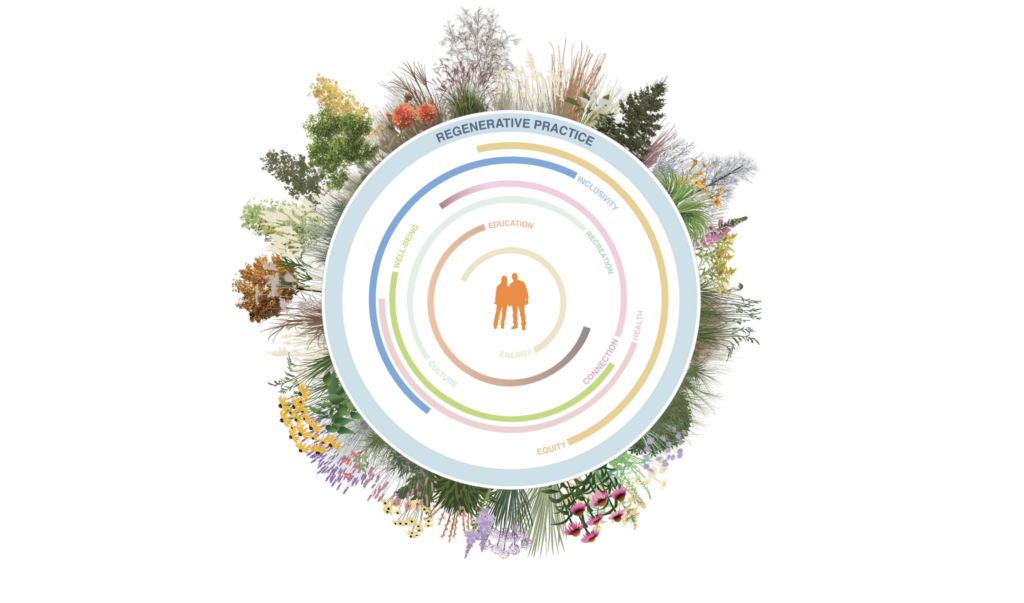
SvN is a Regenerative Practice.
The Regenerative Practice was established to reinforce our capacity to solve the most
critical issues of our time, including climate change, biodiversity loss, and societal inequity
There is no formula for achieving these aims, but there is an approach: a set of tactics that can increase the depth and quality of our work, enabling continuous improvement and learning. The Regenerative Action Plan (RAP) was set forth to guide the firm towards this vision.
Our mission is to create great places that support and enhance life, allowing people to thrive and nature to flourish. We strive to reinforce our capacity to solve the most critical issues of our time, including climate change, biodiversity loss, and societal inequity. There is no formula for achieving these aims, but there is an approach: a set of tactics that can increase the depth and quality of our work, enabling continuous improvement and learning.
This approach starts with a shift in mind-set, a holistic perspective that acknowledges that everything is connected. Our role is to strengthen these connections by pushing for beneficial systemic change, leveraging our collective capacity to make positive contributions to the social and ecological systems in the world around us.
2. Does the practice have a clear succession plan, which passes on ownership and protects the values and legacy of those who built and contributed to the practice? For example is the practice an employee owned trust.
No.
3. Does the practice share research and knowledge for the benefit of society and the wider world? For example, you regularly carry out post occupancy evaluation and share information with others.
Every material is carefully chosen.
Project
1. Does the practice advocate for long-term thinking at the outset of projects? Do you initiate projects with long-term thinking and challenge the client on design life? Also, can the practice demonstrate that this approach has worked – with a shorter or longer design life, or an innovative approach to financing or payback period?
We base our design work on two key strategies:
- We build relationships:
We foster meaningful connections based on a deep understanding of our context, creating mutually-beneficial relationships focused on:
Place: We should carefully consider the places we work on or within – going beyond the “site” to amplify the potential of the social and ecological systems that surround us at all scales of design
People: We should always consider the impact of – or our impact on – human relationships, seeking to align, engage and collaborate with our clients, communities, and colleagues. These people will provide diverse and sometimes even opposing perspectives; but we should aim to harness these relationships to productively shape our work.
- We design for the long-term:
We acknowledge that the places we help create will evolve over time, and that our role is merely a starting point; our actions today should leave the world in a better state for future generations. As we design, we aim to embed qualities of agency, stewardship, and adaptability in our work, creating places that are beautiful, that people want to care for far into the future.
2. Do your projects take account of the future climate and the need for resilience? For example, do the projects demonstrate flexibility, design for adaptation, design for disassembly, non-deterministic solutions, or demountable structures.
We actively consider the future climate and the critical need for resilience in our projects. Our design philosophy emphasizes flexibility and adaptation, ensuring our plans can evolve in response to future conditions, including the impacts of climate change. We strive to create resilient communities capable of withstanding environmental stresses. Our adaptive reuse work exemplifies this, breathing new life into existing structures and minimising resource consumption.
Our commitment to the 4Rs – reduce, reuse, recycle, retrofit – reflects an ethos that considers material lifecycles. A key example is our Lawrence-Orton project, which revitalises an aging residential building through adaptive reuse, adding a new community centre and daycare designed with resident input. Refurbished courtyards and façade elements improved safety and accessibility, transforming underused spaces into vibrant communal areas. The phased project emphasises sustainability and resident well-being.
3. Do the majority of your projects go beyond mitigating negatives and towards optimising positives? For example, are they meeting or exceeding the RIBA 2030 Challenge.
Our projects aim to go beyond mitigation toward positive impact by using Donut Economics as a guide. Through this strategy, we have developed a framework that aims to balance social and ecological goals, prioritizing the following topics:
A stable climate on Earth is crucial for ensuring the well-being, safety, and prosperity of current and future generations. Healthy ecosystems support life on Earth human and non-human alike, by providing clean air, fresh water, food security, and habitat.
We can’t take care of the Earth if we don’t take care of each other. All people deserve the chance to thrive on this planet. Social equity and inclusion are essential for fostering a just society where all individuals have equal access to opportunities and resources, promoting a sense of belonging and community. Connectivity and responsibility further enhance this framework by encouraging interaction, collaboration and accountability among individuals, ensuring that our collective actions contribute positively to the well-being of all members of society.
Co-evolving with nature
Practice
1. Does the practice use biophilia within the office or regularly host meetings and retreats in natural settings? For example do you have extensive planting within the office or rely on natural patterns and imagery for stress relief or quiet areas.
No.
2. Can the practice share examples where it has considered nature in decision making? For example by having a nature proxy to encourage eco-centric decision making, using natural systems as inspiration for the company structure, recognising the seasonal nature of people’s capacity and workload or celebrating equinoxes and solstices together.
Ecological considerations and the integration of nature are significant factors influencing our planning and design decisions. Our work often goes beyond minimizing environmental harm to actively seeking ways to enhance ecological value and build in resilience based on natural principles. The Trent Lands plan, in particular, serves as a strong example of a project where nature’s well-being is a central tenet guiding our decision-making process.
Our Trent Lands and Nature Areas Plan (Trent University) project explicitly places nature at the forefront of our decision-making. The entire plan is centered around the long-term stewardship of the university’s significant natural areas. It prioritises ecological preservation, nature-inclusive development, and regenerative agriculture. The integration of Anishinaabeg principles further emphasises a deep respect for and understanding of the natural environment in shaping the future of the lands. This serves as a form of “nature proxy” by prioritising ecological health and indigenous knowledge in land-use planning.
3. Is the practice supporting nature locally and nationally? For example, does the practice support local gardens, gardeners, planting programmes, rewilding programmes or advocate for changes in legislation to protect nature.
No.
Project
1. Can the practice demonstrate projects which strive to match the performance of a mature ecosystem? As a minimum this would mean achieving biodiversity net gain.
No.
2. Is the practice working on material stewardship? For example, evidence could be shown through repeated use of low carbon materials, extensive material libraries and research or publications supporting responsible use of materials and elimination of waste.
We prioritise material stewardship, as highlighted in our “Upfront Carbon Façade Materials Guide.” This guide, a practical tool for Ontario’s large-scale buildings, emphasizes the critical upfront carbon emissions (product stage A1-A3) inherent in façade material selection.
Recognising that these early-stage emissions constitute a significant portion of a material’s embodied carbon and offer architects considerable influence, our approach, detailed in the guide, advocates for informed decisions from the outset. By focusing on large-scale residential led buildings, the guide supports climate-conscious urban development within Ontario’s specific regulatory and material context, prioritising regional availability to reduce transportation emissions and promote circularity.
Through comparative Life Cycle Analysis, we empower designers to select low-carbon, bio- and geo-based alternatives over harmful, petroleum-based products. This initiative underscores our commitment to responsible material use and a more sustainable built environment, minimizing environmental impact and contributing to a circular economy, consistent with the principles outlined in our guide. We pledge at a minimum to undertake a LCA for all architecture projects at the Design Development stage and highly encourage early decision making to include the upfront carbon of any building design.
3. Do the majority of projects demonstrate the use of biologically-inspired approaches such as Bioregionalism, Biophilia, Biomimicry, Ecomimicry (also referred to as Ecosystems Thinking, Industrial Ecology or Industrial Symbiosis) or BioTRIZ?
Landscape First Approach
SvN distinguishes itself by making landscape the primary organising element in its projects, influencing everything from environmental performance to public realm development and long-term community value. Unlike competitors who treat landscape as an afterthought or visual filler, SvN integrates it into the core design process. Everything is about the landscape and public realm – the way shadows are cast, stormwater is captured, and services are provided to buildings. This approach not only optimizes site functionality but enhances user experience and environmental resilience.
This approach to design is most evident in the Salinas Bahamas project, a “systems-based regenerative design” endeavouring to rehabilitate a 10,000-acre industrially damaged area. The project integrates the unique ecology and cultural insights of the Bahamas, dedicating a substantial portion of the site for ecological restoration, aiming to create robust and biodiverse ecosystems that mirror natural coastal environments.
The central focus of the restoration efforts is on re-establishing the intrinsic connection between land and water, alongside developing models for comprehensive habitat restoration. This underscores a commitment to long-term environmental stewardship, striving for a regenerative future in harmony with the natural world.
Creating a just space for people
Practice
1. Does the practice have a progressive EDI policy and can you evidence many forms of diversity, which are welcomed and acknowledged, within the practice?
SvN Architects + Planners is fostering a just, equitable, diverse, and inclusive (JEDI) work place. This is achieved through consistent communication, education, and training on topics such as community building and Truth and Reconciliation. Ongoing learning opportunities support the inclusive culture at SvN.
SvN values respect for Indigenous knowledge, evident in their partnerships with First Nations groups. Cultural sensitivity is promoted through training on land acknowledgments and Truth and Reconciliation, fostering a workplace environment that is aware and respectful of diverse cultures and histories.
2. Does the practice operate a no overtime culture, meet the living wage consistently, and stipulate a fair salary ratio between staff of all levels?
No.
3. Does the practice support charities, community groups, social enterprises, action groups and others through pro-bono work, charitable giving or in-kind donations?
We demonstrate charitable commitment through annual donations, pro-bono work and partnerships that enhance community well-being. For instance, SvN contributed to the Two Steps Home non-profit by designing compact, energy-efficient cabins made from sustainable materials to provide temporary shelter for Toronto’s unhoused population. These cabins include basic amenities and are arranged around shared communal facilities to foster community support. SvN’s design focuses on rapid, low-cost construction and adaptability, allowing the cabin communities to be relocated as sites are developed for permanent housing, addressing homelessness with safe, dignified interim solutions.
4. Does the practice publicly refuse to work with certain clients, suppliers or organisations on ethical grounds?
As SVN, we operate under an evolving ethical policy that dictates specific project types we will not pursue. This commitment extends to the extraction of unconventional fossil fuels, such as tar sands and shale oil, as well as the development of new greenfield oil projects and any undertakings directly involving coal extraction, processing, or combustion. Furthermore, we refrain from engaging in “mega fossil projects” that are projected to exceed 1 gigaton of CO2 equivalent emissions.
Recognising the importance of biodiversity conservation, we will not participate in projects that negatively affect critical habitats unless stringent international standards, like the IFC Performance Standards, are adhered to and a demonstrable net positive outcome for biodiversity can be achieved.
In alignment with global efforts towards peace and security, we uphold a zero-tolerance policy concerning projects associated with controversial weapons, including cluster munitions, landmines, and chemical and biological weapons. This ethical framework reflects our dedication to responsible and sustainable practices within the built environment.
Project
1. Do the projects demonstrate deep engagement with local stakeholders and end users? For example, is there evidence that your project engagement goes beyond consultation towards co-design?
Our design efforts are guided by Donut Economics – a model that defines human success as a system where society’s needs are met without overshooting Earth’s ecological ceiling. It challenges traditional growth-centric economic thinking by emphasising the need for balance between social foundations and environmental boundaries. Using this model, we can identify a subset of core social and ecological goals that align with our regenerative practice and guide the way that we work.
An example of this is The Trent Lands & Nature Areas Plan framework that guides a ratified plan of action for a healthy ecosystem. The Plan also enables the University, the City of Peterborough and the Michi Saagiig First Nations to act as overarching environmental stewards for designated lands remaining within various forms of public and private ownership.
The SvN-led plan instils Anishnaabeg principles, Indigenous spaces, and placemaking techniques defined in collaboration with the Michi Saagiig First Nations. Its ultimate evolution led to a landscape-first approach that promotes opportunities for both students and the greater community for learning, discovery and co-creation of future innovations and research that will help fight our present-day climate crisis.
2. Do your projects create connected and resilient places which positively contribute to their neighbourhoods and allow equality of access? For example, do your projects create economic opportunity, retain value locally and generate social value?
Our projects at SvN aim to create connected and resilient places with equitable access to housing and public infrastructure. We prioritise physical and social connectivity through walkable streets, transit integration, and inclusive public spaces, and fostering belonging for all residents.
We work across the housing spectrum from shelters that help people experiencing homelessness, through supportive housing for those in need, seniors housing, affordable housing and market rental and ownership housing.
We enhance the resilience of every project through sustainable design and green infrastructure, creating stable environments that align to the goals of the Regenerative Practice. Our projects integrate into existing neighbourhoods by engaging communities, understanding needs, and providing accessible amenities.
3. Do the majority of your projects promote equity in society, and consider all people, not only the building inhabitants? For example, do your projects show due regard for workers within the supply chain and take active steps to avoid modern slavery?
No.