
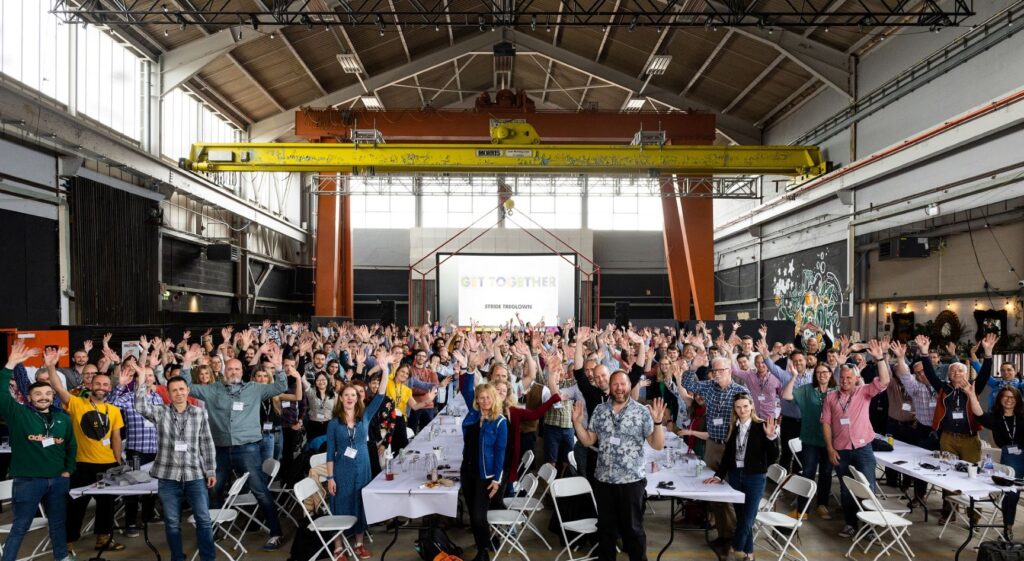
Submission by Stride Treglown.
Being a good ancestor
Practice
1. Does the practice have a clearly stated purpose aligned with the planetary emergency? We are looking for a bold ambition here, and a practice culture which recognises the need for long-term thinking. For example, a strong mission, a theory of change, or a sustainability roadmap.
As a B-Corp we are committed to ‘take action to combat the climate crisis and its impacts… and demonstrate environmental stewardship and contribute to the circular economy in our operations and value chain.’
We have signed up to Science Based targets (SBTi) since 2021, committing us to a roadmap for a 50% reduction in carbon emissions by 2030 and a 90% reduction by 2050.
In terms of our work, our Sustainability Ambassador network have developed the following mission for the practice:
‘To inspire hope. To collaborate with our project partners and local communities in using design, construction and development processes to make the world a better place.
To imagine, find solutions and work urgently towards an ecologically regenerative future, where we are respecting our planetary boundaries and enabling nature, people and communities to flourish. To create healthy, uplifting and beautiful places that promote joy, wonder, distinctiveness, social equity and prosperity.’
2. Does the practice have a clear succession plan, which passes on ownership and protects the values and legacy of those who built and contributed to the practice? For example is the practice an employee owned trust.
We became one of the first UK architectural practices to embrace employee ownership in 2014. This year marked our official transition to an Employee Ownership Trust (EOT) model. The EOT model places all company shares in a trust held for every employee, both current and future.
The move to an EOT gives our employees a stronger voice in how we run the practice and ensures we remain independently owned with the freedom to make decisions driven by our values rather than external shareholder pressures. In the words of our Chair, Pierre Wassenaar, “This transition is a natural complement to our B Corp status and progresses our commitment to creating a practice where everyone has a genuine stake in our collective success. It formalises what we’ve always believed, that our people should share in the rewards they help create.”
3. Does the practice share research and knowledge for the benefit of society and the wider world? For example, you regularly carry out post occupancy evaluation and share information with others.
In the spirit of Architects Declare commitment:
‘share knowledge and research on an open-source basis’, last year we published 4 ‘Emergency’ design guides:
- Maximising biodiversity Through Design
- Health & Wellbeing Designed-In
- Transitioning to Net Zero Carbon
- Towards a Circular Built Environment
These guides stem from the awareness that amid the plethora of available information on sustainability, much of it is unwieldy and complex, and therefore often inaccessible or impractical for those immersed in the day-to-day planning, design, and management of projects. These freely downloadable guides condense this knowledge for the practical benefit of the industry.
We have bespoke qualitative POE processes ‘Inhabitant’ and ‘Impact Analysis’ which explore residents’ experiences of living and working in schemes that we design. The results are forthcoming and will be shared publicly on our website.
We also have upcoming UKRI-funded research in collaboration with Cardiff University focused on citizen-led assessments of living in low-carbon homes.
Project
1. Does the practice advocate for long-term thinking at the outset of projects? Do you initiate projects with long-term thinking and challenge the client on design life? Also, can the practice demonstrate that this approach has worked – with a shorter or longer design life, or an innovative approach to financing or payback period?
In our ‘Towards a Circular Built Environment’ design guide one of the early questions we pose is: ‘Is the expected building lifespan LONG or SHORT?’ For short lifespans (under 25 years) we encourage designing for disassembly and reuse but for long lifespans we encourage designing for longevity or transformation, with following guidance for each. An example where we’ve achieved this is on our Neighbourhood North retrofit project in Bristol, where soffits and services are left exposed, maximising flexibility of future use and the ease of replacing fittings.
2. Do your projects take account of the future climate and the need for resilience? For example, do the projects demonstrate flexibility, design for adaptation, design for disassembly, non-deterministic solutions, or demountable structures.
Oasis Academy School in Bristol will meet a huge need for a Secondary school in the central St Phillips Marsh district of the city. The challenge is that the only site available to accommodate a school in this area is susceptible to flooding (flood zone 3a), particularly in a changing climate. We overcame this with a resilient-focused design, accommodating 1800 pupils in a smaller building footprint, going up to 4 storeys. An accessible undercroft void and extensive site greening provide space for the adjacent feeder canal to flood. Elevated walkways provide safe dry access in a flood event and simultaneously offer up the waterside for improved public access.
3. Do the majority of your projects go beyond mitigating negatives and towards optimising positives? For example, are they meeting or exceeding the RIBA 2030 Challenge.
While we have signed up to RIBA 2030 Climate Challenge we have struggled to get clients to adopt this on projects, and this is still something we are working on.
However a net positive approach is something that we continue to advocate for on our projects. In our Transitioning to Net Zero bitesize guide we set out a ‘Regenerative thinking. Going beyond zero’ 10 point approach, in which we explore moving from a ‘doing less bad’ philosophy to reversing harm through positive, restorative impact.
We have spoken at numerous events about positive impact, which aligns very much with our BCorp status, and we are developing another bitesize guide called ‘Degenerative to Regenerative. How can we shift to positive impact building materials.’
Co-evolving with nature
Practice
1. Does the practice use biophilia within the office or regularly host meetings and retreats in natural settings? For example do you have extensive planting within the office or rely on natural patterns and imagery for stress relief or quiet areas.
Several years ago, recognising the value of biophilic design, we set aside a budget for all our offices to introduce planting. Our Bath office has been transformed with large plants dotted throughout the space. All of our visitors comment on the attractive atmosphere and employees have said that they can’t imagine the space any more without them. In Bath we also drew some wall art – a mural of a large, silhouetted tree branch in our main meeting room, which as much as providing a calming biophilic backdrop to the meeting space, it also represents ‘nature at the board room table’, a reminder for everyone in meetings that nature is also a stakeholder.
Many of our offices have outside meeting spaces and outdoor meetings are encouraged. Our company-wide get-together this year will be a festival-type event with lots of activities planned in a field and woodland setting north of Bristol.
2. Can the practice share examples where it has considered nature in decision making? For example by having a nature proxy to encourage eco-centric decision making, using natural systems as inspiration for the company structure, recognising the seasonal nature of people’s capacity and workload or celebrating equinoxes and solstices together.
We did explore last year the idea of representing ‘Nature on the Board’ in the same way that the eco beauty company Faith in Nature have put this into place. However we felt, for now, that this sentiment is formally covered in by our BCorp commitments. We were the first large architect practice to certify as a B Corp in 2021 and in 2022 we changed our Articles of Association so that the Board are legally required to run the business for the benefit of our members as a whole and to have a material positive impact on society and the environment, including nature.
Our members are exclusively our employees, as an Employee Ownership Trust now owns the business. And we aim to be as flexible as possible with people’s working patterns, with many of our staff choosing to work 4 days weeks, some just during the 6 months around summer.
3. Is the practice supporting nature locally and nationally? For example, does the practice support local gardens, gardeners, planting programmes, rewilding programmes or advocate for changes in legislation to protect nature.
Last year, working with a number of other environmental campaign groups like Extinction Rebellion and the Red Rebels, our head of sustainability instigated a mock funeral for nature in the streets of Bath to raise greater awareness that the State of Nature had recently published their findings saying that the UK is one of the most nature-depleted countries in the world. Almost 1000 participants took part in the highly choreographed event that received coverage in all the main papers and inspired 5 other Funerals for nature events, in Sydney, Tasmania, Boston, Lisbon and Gothenburg. The intention was to send a powerful SOS message for nature by creating a visual spectacle, that would in equal measures shock and inspire onlookers
On a smaller and more practical scale we have pro-bono projects with Mousehole Wild Bird Hospital and Sanctuary in Cornwall, More Trees B&NES, Bath city farm, as well as doing office planting sessions with 9-trees.
Project
1. Can the practice demonstrate projects which strive to match the performance of a mature ecosystem? As a minimum this would mean achieving biodiversity net gain.
Biodiversity improvement is one of our key focuses. The majority of our Landscape design team are now trained Building with Nature assessors and last year we produced our ‘Maximising Biodiversity Through Design’ design guide. This year we have set out targets of minimum 30% BnG on projects, at least 30% or more of our landscape design commissions to be Building with Nature accredited, and at least 30% of the site area on our projects to be dedicated to nature. These are all in support of the UN / Wildlife Trust 30by30 campaign.
On some projects we’re achieving very high BnG scores, like on our Filton Road student housing scheme in Bristol where we’re hitting 8,691% BNG.
We are currently working on three education / research projects for the National Nature Reserves where biodiversity improvement are naturally important priorities. And we’re keen to roll out our learnings from these projects across the business.
2. Is the practice working on material stewardship? For example, evidence could be shown through repeated use of low carbon materials, extensive material libraries and research or publications supporting responsible use of materials and elimination of waste.
We are developing a bitesize guide called ‘Degenerative to Regenerative. How can we shift to positive impact building materials’, in collaboration with the University of Bath’s Centre for Regenerative design and Engineering for a Net positive World (RENEW). This follows our bitesize guide ‘Towards a Circular Built Environment’ last year. We have some notable projects which demonstrate excellence in material stewardship. Gwynfaen near Swansea is an ultra-low carbon housing development and LETI pioneer project. The project prioritises materials that are low in embodied carbon and locally sourced, including structural timber and cladding sourced exclusively from Welsh forests. Timber cassettes are fabricated just 13 miles from the site and use biobased insulation wood-fibre and cellulose insulations. We have since launch a Welsh Tai ar y Cyd Pattern Book promoting timber frame construction with Welsh-grown, sustainably sourced timber and bio-based insulation and airtight detailing to reduce embodied and operational carbon.
3. Do the majority of projects demonstrate the use of biologically-inspired approaches such as Bioregionalism, Biophilia, Biomimicry, Ecomimicry (also referred to as Ecosystems Thinking, Industrial Ecology or Industrial Symbiosis) or BioTRIZ?
We certainly wouldn’t claim that these approaches are embedded in all our projects, yet. But they’re themes that are beginning to get traction. Our head of sustainability was a speaker at the inaugural Biophilic Design conference at the Barbican last year and was also a headline speaker at Biophilic event in Bath. We are working on a very heavily biophilic-influenced housing project in Anglesey right now, with earth-sheltered homes clustered around a series of shared garden spaces. Return visits to our Met office HQ have seen how the building and landscape are harmonising, with 500 different species of plant, animal, insect and fungi recorded on the site. Our Glyn Coch school also has holistic thinking, with outdoor learning spaces, natural materials, green roofs and rain gardens and will be NZC in operation, passivhaus, Building with Nature standard and the 1st school in Walkes to be WELL certified.
Creating a just space for people
Practice
1. Does the practice have a progressive EDI policy and can you evidence many forms of diversity, which are welcomed and acknowledged, within the practice?
We have an inclusion and diversity strategy that we instigated in 2020 and have been working towards during the last 5 years. Recent successes have included creating an internal employee inclusion group (Stride Together), signing up to the Bristol Equality Charter, Manchester’s Good Employment Charter, Accredited Living Wage Employer, Disability Confident, increasing employee engagement from 2016 to now, providing training on sexual harassment, harassment, and victimisation across all our 9 studios with all employees, delivered inclusive leadership training across our senior leadership and middle leadership group.
We conduct an engagement survey and an inclusion survey every two years, and the recent responses show that 98% of employees either agree or strongly agree that they feel welcome and belong in our studios (2% neither agreeing or disagreeing). In the survey individuals can anonymously disclose demographic information based on some of the 9 protected characteristics including gender, sexuality, ethnicity / race, disability, religion and nationality.
2. Does the practice operate a no overtime culture, meet the living wage consistently, and stipulate a fair salary ratio between staff of all levels?
We do have overtime in our practice, due to the competitive nature of the industry. We ensure those individuals then have time back via our flexi-day policy or toil policy and we monitor this over a 17 week period to ensure that peaks and troughs are managed and people are not working excessive hours. This is explained in our Hybrid, Agile, and Flexible Working Guidance and our Reward Strategy. Both documents have been shared with employees.
We are an accredited living wage employer across the UK and this is also monitored. We do not stipulate a fair salary ration between staff of all levels but the difference between the highest paid individual and the lowest paid individual in the practice is 6.6 times. This is from a Board Director to a new starter.
3. Does the practice support charities, community groups, social enterprises, action groups and others through pro-bono work, charitable giving or in-kind donations?
We prioritise providing expert business advice through our annual pro bono programme. We aim to provide £50,000 of in-kind pro bono support to local community projects and charities. In 2023, we contributed over £28k of support to projects including ones like the Mousehole Wild Bird Hospital and Gympanzee charity, providing support and leisure activity facilities to disabled children and their families.
Since it began we have donated £22,688 of grants to local community groups and charitable organisations by our Quartet foundation. Recently we supported Branches Out which provides free weekly Forest School “stay and play” groups.
We support other programs offering pro bono programmes including LandAid.
Our employees are allocated 2 days each year to provide and engage with local charity and voluntary groups. In 2023, our people contributed over 638 hours of time providing support to charities such as sowing wildflower meadows with West Bristol Climate Action.
4. Does the practice publicly refuse to work with certain clients, suppliers or organisations on ethical grounds?
Whilst we believe in tolerance and viewpoint diversity, we also need to be consistent and evidenced in our decisions of what projects we work on – to avoid charges of double standards or hypocrisy, and to protect our reputation. Therefore, we treat every potential project on a case-by-case basis, reviewing evidence to inform our decisions. We are currently updating our Ethics Policy, Go/NoGo process and other guidance, which uses the current B Corp guidance for companies with clients in controversial industries as a non-binding guidance framework
When this is completed, we will update our public disclosure as part of our B Corp listing and update our website.
Project
1. Do the projects demonstrate deep engagement with local stakeholders and end users? For example, is there evidence that your project engagement goes beyond consultation towards co-design?
Our new pathfinder primary school at Glyn-coch will embed the wellbeing of the end user into the design. In our in-depth ‘Impact Analysis’ engagement, we work with communities to define what wellbeing means at a local level, and identify design leverage points to create positive impact as defined by local people. During RIBA stage 1, several brainstorming workshops were held with staff groups to gain a thorough understanding of the school operation
During stage 2, students were able to interrogate the concept through use of virtual reality headsets, providing feedback on the emerging design. Beyond the pupils, the school and local authority reached out to local people in a range of media, providing opportunity for them to have a voice. Community evening forums were hosted at half-termly intervals, inviting community groups to contribute to the development of the design, and in particular, community facilities that we sought to incorporate.
2. Do your projects create connected and resilient places which positively contribute to their neighbourhoods and allow equality of access? For example, do your projects create economic opportunity, retain value locally and generate social value?
In Paintworks in Bristol we have created an entirely car-free mixed use creative quarter which encourages residents to interact with local creative businesses and each other in shared amenity spaces and pedestrianised streets.
Our Caerphilly masterplan is transforming the town centre into a diverse and thriving place. We have supported small businesses grow with the introduction of 28 shipping containers and 15 outdoor market stalls. The project aimed to provide £20,698 of impact, and through collaboration with clients, partners and local community groups delivered in excess of £57,000.
Our Impact Analysis initiative centres around what ‘wellbeing’ means in local contexts. In our Glyn-coch project, engagement showed that residents’ experiences of ‘wellbeing’ centred around service provision, community relationships and safety and security. This is influencing conversations with the council client about how to co-locate services within the school to strengthen social relations, create economic opportunities, and generate social value.
3. Do the majority of your projects promote equity in society, and consider all people, not only the building inhabitants? For example, do your projects show due regard for workers within the supply chain and take active steps to avoid modern slavery?
Our social value strategy prioritises Better Places, Empowered People and Resilient Partnerships. We see this as an opportunity to have a positive, regenerative impact.
Our practice is rooted in 9 regions across the UK and the relationships we hold with those we work with have stretched over decades and our locally resident employees best understand the community context influencing our project work.
The Procurement Principles guidance aims to shape how we work with our supply chain to generate shared positive impact. The guidance clarifies any business we purchase from, partner with, subcontract with or interact with sets clear expectations about our ESG aspirations. Our go / no go evaluation process for reviewing potential project opportunities that evaluates whether the scope aligns with our strategy and values. This approach considers the purpose and profitable balance a project brings and its potential considerations to the wider society and environment.