
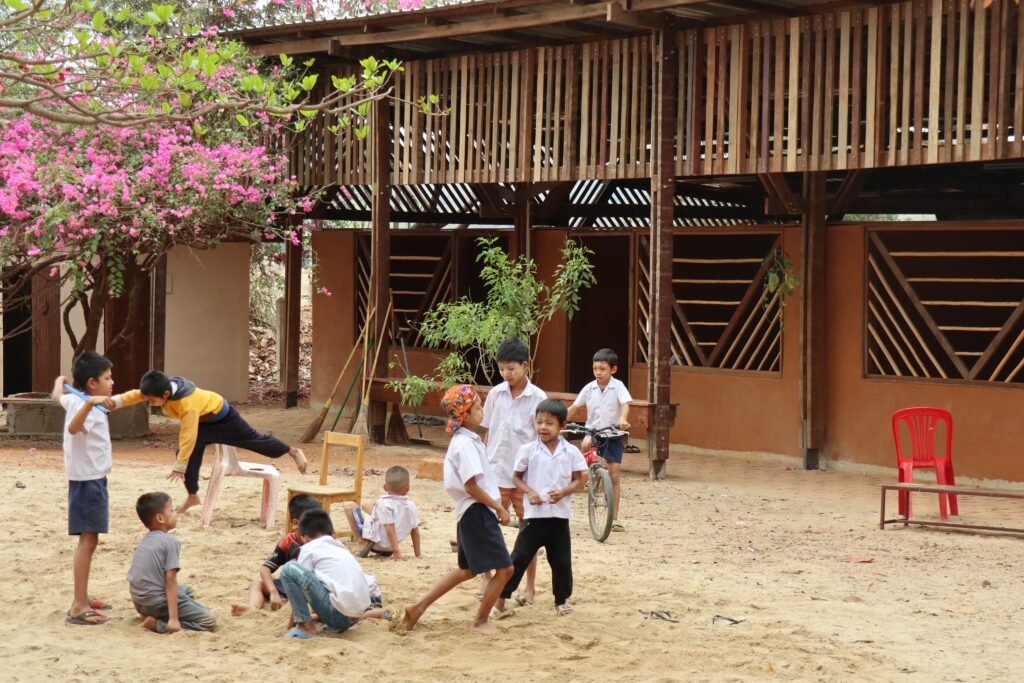
Submission by Simple Architecture.
Being a good ancestor
Practice
1. Do you have a clearly stated purpose aligned with the planetary emergency? We’re looking for a bold ambition here, and a culture which recognises the need for long-term thinking.
Over the past twelve years we have established a very strong relationship with various communities along the Thai-Burma border. Every year in January/ February we are coming back to work alongside these local communities on improving school environment by adding class-, washroom or generally renovating or improving existing school facilities.
For these projects we are usually working with three local stakeholders that are supporting around seventy Learning Centres along the border. These community based organisations are Help without Frontiers (HwF), Burma Migrant Workers Education Committee (BMWEC) and Burma Migrant Teachers Association (BMTA).
These three organisations are supporting the schools with legal aid, teacher salaries, stationary and fund for the school bus. Very rarely there are funds available to improve the learning environments.
2. Do you have a clearly stated purpose aligned with the planetary emergency? We’re looking for a bold ambition here, and a culture which recognises the need for long-term thinking.
It is essential to our approach that we avoid purchasing material from big construction companies as much as possible. By doing so, we can ensure that the money spend will circulate within the local community. We are rather producing earthen bricks ourselves and pay salaries to local workers, then buying cheap and unsustainable concrete bricks from regional suppliers.
Buying bamboo, reused timber and eucalyptus locally furthermore reduces overall costs and allows us to invest even more into the salaries of our team of local workers.
3. Do you share research and knowledge for the benefit of society and the wider world?
Every year we are inviting high schools and universities from Bangkok to gain hands-on experience and to learn about earthen/ adobe brick making in workshops that last between two to four days.
Since 2016 we are cooperating closely with Harrow International school from Bangkok who joined our construction site this year for the sixth time with up to forty students between the age of twelve and sixteen. Additionally the students learn about the civil war conflict which is raging in Burma again since the latest military coup on February 1st 2021, they understand why people are fleeing across the border in Thailand to find safety and protection and they learn, why these communities still live in constant fear from local Thai governments who are trying to extort money from these vulnerable communities.
Project
1. Do you advocate for long-term thinking at the outset of work? Do you initiate work with long-term thinking and challenge clients? Also, can the organisation demonstrate that this approach has worked?
During in career brake in 2011, I visited a community center in northern Thailand to learn about the advantages of earthen construction. In 2012 we were asked to design and uild a new training center for Mae Tao Clinic, which serves migrant and refugee communities from burma. The budget was limited and we started to experiment with local soil and over a period of four months we were able to complete the construction of two new trainig rooms and a multi-purpose/ library building. For the past 15 years, the facility that we have build is in constant use. We have learned a lot from the mistakes that we have made to become better and avoid those mistakes in later projects. Every three to four years we return to add another/ new layer of natural plaster to classroom walls.
2. Does your work take account of the future climate and the need for resilience?
Our buildings are easily adaptable to new circumstances that can occur over night. Especially in a semi-legal environment in which these school are operating it needs to be possible to move an existing school to a different location in a relatively short period of time. The use of earthen walls also benefits a potential change in usage. The walls can be taken down easily and the bricks can be reused in a different arrangement.
3. Does the majority of your work go beyond mitigating negatives and towards optimising positives?
We are designing buildings that enhance the students well-being and provide a save and inspiring learning environment.
Co-evolving with nature
Practice
1. Do you use biophilia within your premises and/or do you regularly gather in natural settings?
Trees are mostly considered valuable within the communities we are collaborating with. Trees are providing shade to many local schools that were only able to buy metal sheet roofing. These metals sheets, if not protected by trees, would get unbearably hot if fully exposed to the sun and during the dry season in general. Each of our projects is very different to the previous one and we are always advocating for keeping all the trees and planting even more trees after completion of the project.
2. Can you share examples of where you have considered nature in decision making?
During the design stage of some of our projects we incorporated design solution to include trees/ roots as well as overhanding branches into the design. During the design of New Day School in 2024 we build four new classrooms around two rows of existing trees. For the Araksa Tea House in 2017 not a single tea plant had to be relocated. At the 2025 Irrawaddy Flower Garden Classroom construction we design a detail to provide more breathing room for an existing tree. This detail also provided additional natural lighting and ventilating inside the classroom.
3. Are you supporting nature locally and nationally?
No.
Project
1. Can you demonstrate work that strives to match the performance of a mature ecosystem?
Selected by climatic properties, availability, ecological footprint and social factors, soil, timber and bamboo are the main sources for the construction of the classroom building. Soil with a good clay content is usually available on site. Additionally we purchased all recycled timber from a wood shop nearby. Local wood is mostly in excellent condition, tanned from the weather and therefore termite proof.
To reduce carbon emission, the use of local and natural material, such as adobe bricks and second hand timber, has therefore been our priority. This resulted in a minimal use of transportation and a reduction of immediate costs. Only for the foundations we had to use reinforced concrete to provide a strong base for the adobe walls and protect the earthen walls from standing water during floods.
2. Are you working on material stewardship?
Earthen Bricks (Adobes), as a building material, has been known in Thailand for generations but the common knowledge unfortunately is slowly disappearing. By showing examples, carrying out brick making workshops and involving local communities to participate during the construction process, we are trying to reinitiate the use of Earthen Bricks “Baan Din” not only in Thailand, but also in other parts of the planet.
3. Does the majority of your work demonstrate the use of biologically-inspired approaches such as Bioregionalism, Biophilia or Biomimicry?
To understand the positive effects of Earthen Bricks and to learn to produce them individually is an important task we are taking on. We are trying to continue reintroducing these traditional and vernacular building techniques into local communities and exposing them to new generations of architects at local and international universities.
Additional earthen bricks, if not stabilised by adding cement or other aggregates, can be directly giving back to the soil. The material will 100% dissolve in the rain.
If the building would get demolished, all wooden frames and columns could be sold back to the local wood shops. The roof material can be sold to the recycling shops in town.
Creating a just space for people
Practice
1. Do you have a progressive EDI policy and can you evidence many forms of diversity, which are welcomed and acknowledged, within your company/organisation?
Our practice is an open network of international consultants/ students from Germany, UK, India, Thailand and Singapore. Our projects are often rooted within marginalised communities. Many of our projects are self-funded. Over the past twelve year we have worked with 200+ volunteers from various parts of the globe. Around 80% of volunteers who are applying to participate in a project are female. We will never accept discrimination in any form toward an individual or group of individual’s. Our projects will always be inclusive and we ensure fair treatment and opportunity for all.
2. Do you operate a no overtime culture, meet the living wage consistently, and stipulate a fair salary ratio between staff of all levels?
Within the practice, co-workers and consultant can organise the work on their own schedule.
Every hour/ day of work will get paid uin full.
3. Do you support charities, community groups, social enterprises, action groups and others through pro-bono work, charitable giving or in-kind donations?
The majority of the projects, the practice is working on, are on a pro-bono bases. This is due to the fact that we are working with local communities and stakeholders which are often financially not able to finance the work of an architect during design and/or construction phases.
Often, like with our projects within Nakhivale Refugee Camp and along the Thai-Burma border, marginalised communities have no access to architecture.
4. Do you use an ethical framework to assess opportunities and/or supply chain partners and is them team consulted on these decisions?
I think that our practise is generally to small to publicly announce that we are not working with certain clients, suppliers or organisations. But we are pretty aware and highly allergic to any form of oppression and injustice.
We would generally not consider working with certain big corporates and have refused project proposals in the past by companies with questionable reputations.
Project
1. Does your work demonstrate deep engagement with local stakeholders and end users?
Back in 2012 we established a core team of local workers (Karen & Burmese). Additionally we are hiring workers with different skill sets from the local community. During the construction process we exchanged knowledge of building techniques and try to implement local solutions which results in a more eloquent skill-set for all parties. With the use of local knowledge we can make sure that the communities are able to self-maintain the buildings after completion.
Sometimes teachers and parents from the school community are getting involved during the construction process, while students are joining during after school activities which overall results in a stronger feeling of ownership among the whole school community.
2. Does your work create connected and resilient communities which positively contribute to neighbourhoods and allow equality of access?
Our project are build on a very strong relationship with the communities we are collaborating with. During the design phase of the project we are conducting various stages of intuitive design exercises with students, parents and teachers. In this exercises we learn about their needs, hopes and expectations for the future.
Our team consist of local migrant workers who themselves very often have strong connections to the schools, with some of their own children are visiting.
We are trying to avoid purchasing material from big construction companies to keep the circle of money as close as possible to the school community. Buying bamboo, reused timber and eucalyptus locally reduces the overall costs of the construction project and allows us to invest even more into the salaries of our team of local workers.
3. Does the majority of your work promote equity in society, and consider all people, not only building inhabitants
Our core team of local workers (migrants from various Burmese ethnic backgrounds) got established during our first projects in 2012. Since then the core team of five guys stayed the same with PaGee (the boss), Aung Eh (Electricity Specialist), BanYa (Metal- and Woodworks) Nei (Clayplaster and Bamboo) and KraPaw (Metal, Welding and Furniture).
Some of the workers did not have a legal status in Thailand. Together with a local community based organisation which supports migrant right along the Thai-Burma border, we tried to provide legal documents for all the workers and there families.