
Submission by Sheppard Robson.
Being a good ancestor
Practice
1. Do you have a clearly stated purpose aligned with the planetary emergency? We’re looking for a bold ambition here, and a culture which recognises the need for long-term thinking.
In 2000, we established our internal sustainability group. In 2022, we published our first Sustainability and Innovation Charter — a public pledge outlining our industry commitments and sustainable development principles. The charter is built around seven key tenets that shape our work and long-term thinking:
- Promote regenerative practices
- Employ sustainable design principles
- Establish methodologies to meet targets
- Evaluate performance in-use
- Realise comprehensive toolkit for achieving net zero
- Integrate health, wellness, inclusivity and fairness
- Share knowledge collaboratively
In 2025, we updated the charter, strengthening and refocusing our commitments and holding ourselves accountable to actions taken since 2022. We will continue to review the charter every three years, ensuring our ambitions remain responsive to the planetary emergency and the need for collective action. This year, we have additionally committed to an internal sustainability strategy focused on Projects, Practice, and Community, which sets out measurable outcomes.
2. Do you have a clearly stated purpose aligned with the planetary emergency? We’re looking for a bold ambition here, and a culture which recognises the need for long-term thinking.
Established 87 years ago and in our fifth generation of ownership, we are highly experienced in managing succession. Our values are passed down through initiatives like our Sustainability Charter and our open design review culture.
The bedrock of this success is nurturing talent and clearly communicating routes for progression at the practice, giving people the space and opportunity for our team to build their careers with us.
We moved to an LLP structure in 2014, which allowed us to significantly expand the company’s ownership and leadership groups. Our thinking is that most of the next generation of leadership is “already in the building,” and only one of the current 25 partners joined as a partner; the rest have risen within the company’s structure. We do not publicly identify the next generation of equity partners; instead, we empower all partners to shape the future of our business.
3. Do you share research and knowledge for the benefit of society and the wider world?
Our Sustainability and Innovation Charter commits us to sharing knowledge collaboratively. Our Sustainability Publication: Unwavering Focus on the Big Picture, serves as a resource for the wider industry, outlining sustainable design approaches and key lessons learnt.
Our Social Value Lead has created a Social Value: Guide for Designers, addressing how teams can embed social value into design processes and helping clients realise social value potential for their projects.
We regularly host panel discussions, sharing knowledge with industry leaders. Roundtables hosted this past year include: PBSA roundtable: Unlocking Viability; From the Ground Up: how to make tall urban buildings feel connected at ground level; Re:Humanising the City: an interior design-focused talk on enticing talent into the City; and Radical Retrofit: Pall Mall.
We’re under no illusion that events and public-facing documents are going to have a direct impact on society but hope they help drive progress within the built environment.
Project
1. Do you advocate for long-term thinking at the outset of work? Do you initiate work with long-term thinking and challenge clients? Also, can the organisation demonstrate that this approach has worked?
Agility and durability are fundamental to our work. Project briefing underpins our designs; this allows us to cater for the client’s current strategies and future eventualities. For example, our long-term partnership with the BBC has seen us design a range of flexible workplaces that have adapted to changes with minimal intervention, using a movable “kit of parts”. Again, at Notre Dame College, the inherent adaptability has allowed it to adapt to changing educational and community requirements of the school.
Our design review process means that projects are scrutinised by other typology specialists, so we design buildings that can pivot to different uses and lengthen their lifespan. For example, student living that can adapt to being a hotel or BTR development; an office that can be used for labs; or – as with the Liverpool Schools Programme (LSP), schools that can be repurposed for a range of workplace and leisure uses.
2. Does your work take account of the future climate and the need for resilience?
Our design work mitigates the future impact of extreme weather across both flooding and overheating risks. At the University of York, SuDS, swales and native planting promote controlled water collection while enhancing biodiversity.
Our façades are modelled to their solar orientation to improve resilience to extreme climates. The LEED Platinum Siemens HQ in Abu Dhabi and the Ev0 Building in Didsbury — the latter of which exceeds the UKNZCBS 2025 targets for upfront carbon and UKGBC Paris Proof operational energy targets — exemplify this approach in practice.
On our on-going projects, we are testing overheating resilience using CIBSE’s TM59 methodology in-house, so we can inform our façade design at earlier stages and to respond to the UK’s future climate.
Our research project Metro:Morphosis, winner of Arup’s Façades of the Future North design competition, explored how future façades can respond to the twin crises of climate change, biodiversity loss and social wellbeing.
3. Does the majority of your work go beyond mitigating negatives and towards optimising positives?
We push sustainability targets, working with clients with shared ambitions to go beyond minimum standards. We appreciate there is still a lot of work to do to go beyond mitigating negatives, towards optimising positives regarding embodied carbon.
Recent examples where we have managed to drive positives include a new generation of six net zero carbon in operation schools across England and Wales including Mynydd Isa and Coleg Sir Gâr, and retrofitted workplaces. A recent example includes saving Pall Mall, a grade II-listed building from demolition and reviving a lost space in central Manchester.
As early adopters and sponsors of the UK Net Zero Carbon Buildings Standard (NZCBS), we are engaging with the wider industry in the new Standard. 60 Queen Victoria Street has been selected as a Pilot project, where we are upgrading the glazing in-situ. This is one of the first projects in England to do so.
Co-evolving with nature
Practice
1. Do you use biophilia within your premises and/or do you regularly gather in natural settings?
Our London office is designed to connect people with nature throughout the day. With narrow, naturally ventilated floors, all team members benefit from daylight and views of the central courtyard. Several green and wildflower roofs are situated around the buildings, with meeting rooms overlooking them, bringing natural landscapes into everyday working life.
The central courtyard space serves as a communal space, where staff can enjoy the outdoors, with tables and chairs encouraging moments and rest.
We offer a variety of year-round wellness initiatives designed to encourage time outdoors, including wellbeing walks around Regent’s Park, Pilates classes, and bootcamp sessions.
2. Can you share examples of where you have considered nature in decision making?
No.
3. Are you supporting nature locally and nationally?
Our London office was the first business to be recognised through Camden’s BeeLine Initiative – an interactive map celebrating local green spaces that support biodiversity.
We partner with local community gardens to help maintain and uplift their services. One example is our partnership with Frendsbury Gardens, which is a local community garden running nature sessions for children and isolated or vulnerable adults. Our team designed and built a sheltered outdoor classroom, enabling session to continue in all weathers.
Our Volunteering Policy provides each staff member with one-working day each year to participate in volunteering initiatives of their choosing. Through this policy, our staff have volunteered with organisations such as City of Trees, Global Generation, and Glasgow City Council supporting planting initiatives, litter picking, and cleaning up of important wildlife regions. We are committed to expanding these partnerships to continue to amplify our positive impact both locally and nationally.
Project
1. Can you demonstrate work that strives to match the performance of a mature ecosystem?
Many of our projects demonstrate our approach to working with existing ecological systems.
At the University of Manchester’s Fallowfield Campus, a 3,300-bed development across 23 residential blocks, building placement is deliberately organised around the site’s existing mature tree cover, retaining the majority of over 500 trees and losing only around 70, allowing the development to inherit a mature ecosystem.
At the University of York’s student residences, a brownfield site was transformed to bring species diversity and enhance student wellbeing. Native wildflowers, hedges and groundcover blend existing woodland into courtyard areas, with blocks positioned to allow wildlife to spread from the adjacent lake, resulting in 8,684m² of biodiversity improvements.
At TTP Campus, Cambridgeshire, 773 new trees, a 984m² wildlife pond and 950m of native hedgerow complement retained mature specimens, with the loss of a small central copse mitigated by over 800 native trees creating a new parkland landscape
2. Are you working on material stewardship?
Material Stewardship at Sheppard Robson is approached through a critical lens. In 2024, we appointed our first Sustainable Materials Specialist to strengthen this commitment. Our Sustainable Materials Specialist develops our S|E|E|D (Social, Environmental, Economic, Design) Library — a material database capturing supplier information on low carbon approaches, health and wellbeing, circular economy, and social responsibility.
We actively push material boundaries across our interiors and architecture sectors. The Rabobank refurbishment project exemplifies this, delivering a high-quality CAT B fit-out by embedding whole life carbon reduction, circular economy principles, and health and wellbeing into every material decision-making from the outset.
We also use OneClick and our in-house Upfront Embodied Carbon Tool to evaluate material options at early design stages, testing lifecycle carbon impacts through quantifiable industry data. This equips our teams with vital insights to drive a low carbon agenda in both client and design discussions.
3. Does the majority of your work demonstrate the use of biologically-inspired approaches such as Bioregionalism, Biophilia or Biomimicry?
When the brief permits, we incorporate biologically inspired approaches within our designs. Our interior design arm, ID:SR, embrace biophilia within their designs, seeing this an important aspect of wellbeing. This has been notable on the multiple award-winning Deloitte, 1 New Street Square, London – the largest WELL Gold, New and Existing Interiors project worldwide, and the first to achieve both BREEAM Outstanding and WELL Gold. Our biophilic design included the installation of 6,300 plants in 700 displays, 140sqm moss walls and images of nature to bring the building to life and create opportunities for mindfulness.
Creating a just space for people
Practice
1. Do you have a progressive EDI policy and can you evidence many forms of diversity, which are welcomed and acknowledged, within your company/organisation?
We have a progressive EDI policy that is central to the running of the practice. EDI is a core aspect of our annual business plan, providing dedicated budget and investment to drive meaningful change within our practice and projects.
A dedicated Partner Liaison supports our 20-strong ED+I group, allowing it to function with Partner-level support. By being a core aspect of the annual budgetary discussions and having a clear leadership role, this creates a healthy and important dialogue with leadership.
Women continue to take leadership roles at the practice, with five women promoted to partner level in the last four years, demonstrating that progression is not limited by gender.
We are also involved in student engagement initiatives to widen access to the industry. This includes apprenticeships, our work experience programme in partnership with organisations such as Positive Steps, and design workshops at our studios for local students and universities.
2. Do you operate a no overtime culture, meet the living wage consistently, and stipulate a fair salary ratio between staff of all levels?
The practice is a Real Living Wage Employer and has systems in place to encourage a healthy work-life balance. Our resources group works across the business to review all capacity and responsible resources work accordingly, with the goal of giving our team the space to do their best work and satisfy our clients’ requirements. This careful allocation results in retaining our staff for an average of seven years (compared to an average of 3.9 years according to D3 Architects survey), with a significant number of our team returning to us after working elsewhere. This consistency of our core team has helped to result in c.76% of our clients being repeat business.
Again, long-established structures, such as a thorough annual salary review process, allow us to benchmark salaries and maintain fair, equal pay.
3. Do you support charities, community groups, social enterprises, action groups and others through pro-bono work, charitable giving or in-kind donations?
Our dedicated Social Value Policy emphasises supporting local charities, community groups, and local schools/universities across three key themes:
- Building Communities: contributing to healthier and resilient communities
- Improving Access: promoting local skills, employment and inspiring the next generation of architects
- Creating Sustainable Places: decarbonising and safeguarding our planet
Each year, we engage with organisations such as Open City, Climate Change all Change, Article 25, and Positive Steps, with our Social Value Lead tracking and monitoring all initiatives to better understand impact.
As a large practice, we emphasise utilising our design expertise to provide pro-bono support for community projects. We dedicated over 500 hours to support Camden Food Bank, providing design support for a new space offering storage, distribution and counselling services to those most in need. Through this initiative, we are demonstrating our commitment to using design as a tool for meaningful social impact.
4. Do you use an ethical framework to assess opportunities and/or supply chain partners and is them team consulted on these decisions?
The practice has project selection criteria shared on our intranet. This allows the leadership to evaluate new projects more rigorously. This includes a review of the commissioning client, the social impact of the projects, and whether the brief is aligned with our sustainability ambitions and Charter.
We have sub-consultant evaluation forms, which includes questions on environmental management and social responsibility, which are sent to our sub-consultants to complete annually as part of our ISO 9001 Quality Management System procedures.
We also have supply chain questionnaires on aspects of environmental and social sustainability for our smaller business suppliers. The initial format of these is intended to gather relevant information and encourage participation. Following this engagement, we will look to introduce thresholds and targets. These are sent out to key suppliers annually as part of our ISO 14001 Environmental Management System procedures.
Project
1. Does your work demonstrate deep engagement with local stakeholders and end users?
Stakeholder engagement and co-creation are fundamental to our work.
At the youth-led Contact Theatre, Manchester, we helped create Con:Struct – a team of young people who played a pivotal role in ensuring the design reflected the needs and attitude of its members, staff, and community. This co-creation approach contributed to many aspects of the project, including its sustainability strategy.
We believe post-occupancy evaluation (POE) should be carried out on all projects. Our in-house POE process and membership of the BUS Methodology Partner Network allow us to provide POE as a dedicated service on our projects. The process encompasses carrying out occupant satisfaction surveys, building visits, and a utility analysis.
Our ongoing relationship with Notre Dame Catholic College exemplifies this commitment, allowing us to understand how the school has adapted to its space, with lessons learnt feeding directly into our future education projects. This ensures that our buildings evolve with end-users.
2. Does your work create connected and resilient communities which positively contribute to neighbourhoods and allow equality of access?
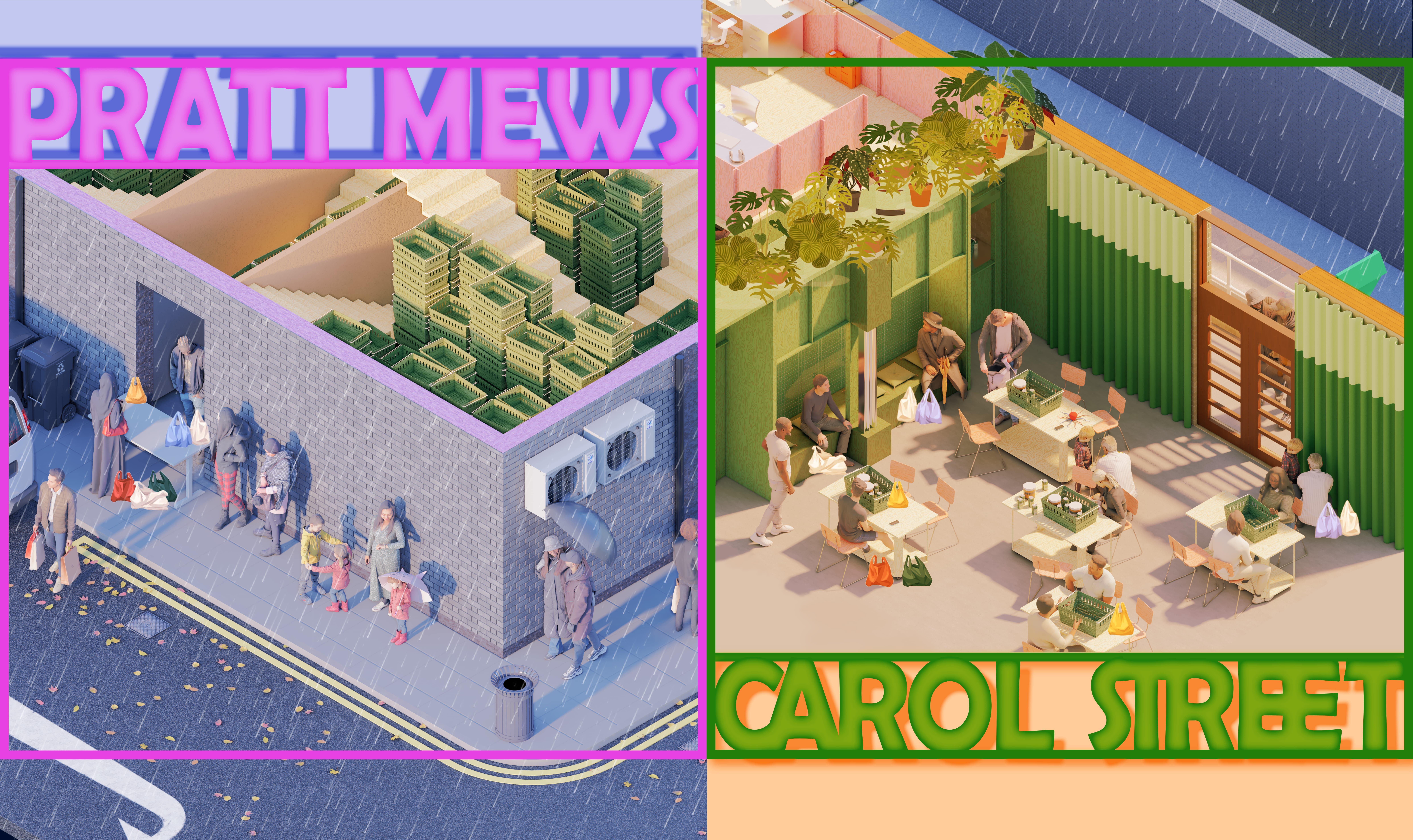
Our year-long pro-bono Camden Food Bank project addresses food poverty – a pressing issue across Camden and the UK. Following a site visit to understand existing operations, we found that the existing space was unfit for purpose, requiring volunteers to carry heavy goods up and down multiple flights of stairs. In addition, visitors are unable to enter the space and gain any counselling, instead collecting baskets at the entrance.
Our proposed design aims to create an efficient layout that streamlines workflows for the volunteers, allowing them to maximise their time and resources in helping community members. The main hall and counselling room creates a safe and welcoming environment for visitors, many of whom may face barriers to accessing needed support.
With the space receiving an extended 10-year lease, we are committed to working with Camden Food Bank to provide long-term guidance and design the space for adaptability of future needs.
3. Does the majority of your work promote equity in society, and consider all people, not only building inhabitants
We are passionate about ensuring our projects have a lasting impact on not only occupants but also the surrounding communities and all stakeholders. Through projects such as the Earls Court redevelopment, we host design workshops with local schools in partnership with Open City, widening access to the profession and promoting equity.
We prioritise supporting small businesses and uplifting local economies while sourcing responsibly. At BBC Cymru Wales a strong local sourcing agenda was implemented, with most of the products sourced from the UK; including Welsh wool producer Melin Tregwnt, whose co-located supply chain supports the region’s wider social and economic ambitions, helping reverse the trend of wool being sourced from Australia and New Zealand.
Our dedicated Supply Chain Questionnaire ensures compliance with the Modern Slavery Act, OECD due diligence for conflict materials, and structure ED+I policies across our suppliers, ensuring our commitment to equity extends beyond our buildings.