
Submission by Sheppard Robson.
Being a good ancestor
Practice
1. Does the practice have a clearly stated purpose aligned with the planetary emergency? We are looking for a bold ambition here, and a practice culture which recognises the need for long-term thinking. For example, a strong mission, a theory of change, or a sustainability roadmap.
We first wrote our internal sustainability policies when we established the sustainability group in 2000. As a public pledge to prioritise sustainability recovery, we published our Sustainability and Innovation Charter in the midst of the Covid-19 pandemic.
The charter includes a summary of our interpretation of our industry commitments and the sustainable development principles that we subscribe to. Drawing on our exemplar projects, the document outlines seven key tenets which shape our work and thinking.
Now in 2025, the need for collective acceleration is clearer than ever. We have completed the second update of the charter to strengthen, refocus and reflect on how we’ve responded to these tenets since 2022, to keep ourselves accountable to the commitments we have made. We are committed to reviewing our charter every three years.
As a practice, we are committed to not lose sight or focus on our responsibility to combat climate change.
2. Does the practice have a clear succession plan, which passes on ownership and protects the values and legacy of those who built and contributed to the practice? For example is the practice an employee owned trust.
Established 87 years ago and in our fifth generation of ownership, we are very experienced in managing succession. Our values are passed down through initiatives like our Sustainability Charter and our open design review culture.
The bedrock of this success is nurturing talent and clearly communicating routes for progression at the practice, giving people the space and opportunity for our team to build their careers with us.
We moved to an LLP structure in 2014, which allowed us to significantly expand the company’s ownership and leadership groups. Our thinking is that most of the next generation of leadership is “already in the building,” and only one of the current 25 partners joined as a partner; the rest have risen within the company’s structure. We do not publicly identify the next generation of equity partners; instead, we empower all partners to shape the future of our business.
3. Does the practice share research and knowledge for the benefit of society and the wider world? For example, you regularly carry out post occupancy evaluation and share information with others.
We committed in our Sustainability and Innovation Charter to share knowledge and research collaboratively.
A key milestone for our commitment was the launch of our Sustainability publication, which outlines our approach, processes and key lessons learnt across sustainability.
Our Social Value Champion has created a social value guide for design teams that addresses how teams can embed social value throughout the design process and is designed to help clients realise social value potential for their projects.
We regularly host panel discussions at our offices, one of which included our Green Week panel discussion, Accelerating Action, which addressed what we need to do now to design resilient and equitable cities in the future.
We know that we need to improve diversity, inclusivity, and accessibility. Each year, we engage with students from under-represented backgrounds to ensure that we are presenting opportunities and enhancing their knowledge and interests.
Project
1. Does the practice advocate for long-term thinking at the outset of projects? Do you initiate projects with long-term thinking and challenge the client on design life? Also, can the practice demonstrate that this approach has worked – with a shorter or longer design life, or an innovative approach to financing or payback period?
Agility and durability are fundamental to our work – this is true of our speculative projects and designs tuned to the specific occupiers. For the latter, project briefing underpins our designs; this allows us to cater for the client’s current strategies and future eventualities. For example, our long-term partnership with the BBC has seen us design a range of inherently flexible workplaces that have adapted to changes since the pandemic with minimal intervention, using a movable “kit of parts”.
Our design review process means that projects are scrutinised by other typology specialists, so we design buildings that can pivot to different uses and lengthen their lifespan. For example, student living that can adapt to being a hotel or BTR development; an office that can be used for labs; or – as with the Liverpool Schools Programme (LSP), schools that can be repurposed for a range of workplace and leisure uses.
2. Do your projects take account of the future climate and the need for resilience? For example, do the projects demonstrate flexibility, design for adaptation, design for disassembly, non-deterministic solutions, or demountable structures.
Our projects also mitigate the future impact of extreme weather, including droughts and flash floods. For example, at the University of York, the use of SuDS, swales, and reintroduction of native planting promotes controlled water collection while creating a landscape for all to enjoy.
Facades that are carefully modelled to their solar orientation allow buildings to be more resilient to extreme climates. We have a long lineage of self-shading buildings, from LEED Platinum Siemens HQ in Abu Dhabi to the Ev0 Building, Didsbury, which meets LETI 2020 design targets for upfront carbon and the UK Green Building Council’s Paris Proof operational energy use targets.
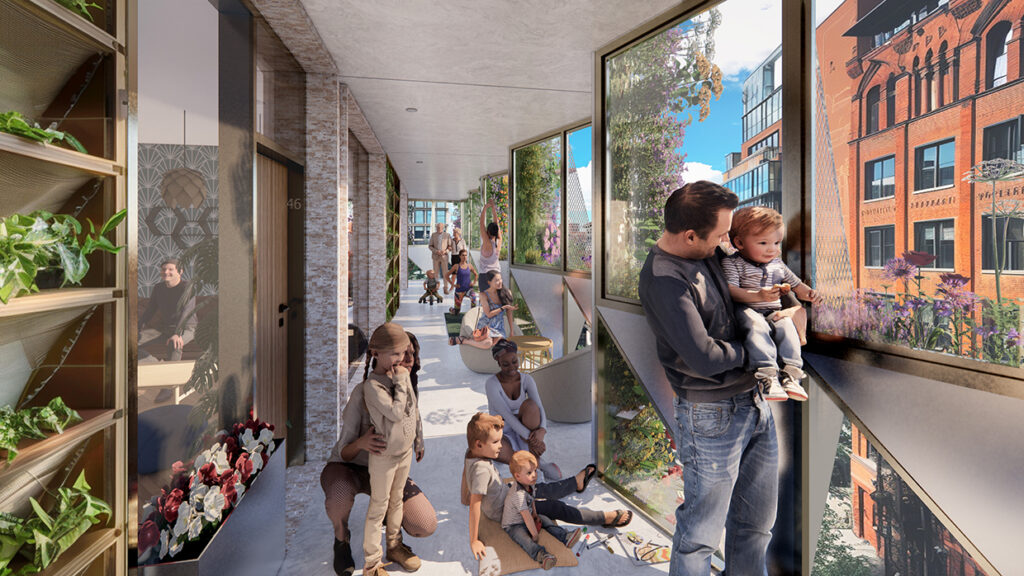
A recent research project, Metro:Morphosis Office to Urban Village explored how the future façade can engage with the twin crisis of a climate and biodiversity emergency and the social issues around mental health and loneliness. This project won Arup’s Façades of the Future North design competition.
3. Do the majority of your projects go beyond mitigating negatives and towards optimising positives? For example, are they meeting or exceeding the RIBA 2030 Challenge.
As one of the UK’s largest practices, with a diverse range of projects and clients, it is not possible for ‘the majority’ of our projects to exceed RIBA 2030 targets. However, on all projects, we seek to push sustainability targets where viable.
In addition, we find clients and projects that push beyond 2030 targets as leaders in sustainability; recent impactful examples include a new generation of net zero carbon in operation schools across England and Wales, as well as a series of radically retrofitted workplaces throughout the UK. We are also early adopters and sponsors of the UK NZCBS, working with them to engage the industry in the new Standard. At least one of our projects has also been selected as a Pilot project.
Co-evolving with nature
Practice
1. Does the practice use biophilia within the office or regularly host meetings and retreats in natural settings? For example do you have extensive planting within the office or rely on natural patterns and imagery for stress relief or quiet areas.
Our London office has narrow, naturally ventilated floors which allows all team members access to daylight and views of the central courtyard. Our meeting rooms are also arranged to get views onto one of our green spaces. Internally, we have created a variety of work environments to suit differing needs, including quiet working spaces and a contemplation space with plants, soft lighting and privacy curtains. Each year, for our annual Green Week, we enhance our offices with additional greening, bringing in green walls, moss walls, and a variety of large plants.
Several of our staff initiatives involve taking wellness walks and doing activities such as Pilates and bootcamp outdoors when possible. We host key staff gatherings such as our summer and spring parties in our courtyard to allow staff to enjoy the outdoors.
2. Can the practice share examples where it has considered nature in decision making? For example by having a nature proxy to encourage eco-centric decision making, using natural systems as inspiration for the company structure, recognising the seasonal nature of people’s capacity and workload or celebrating equinoxes and solstices together.
No.
3. Is the practice supporting nature locally and nationally? For example, does the practice support local gardens, gardeners, planting programmes, rewilding programmes or advocate for changes in legislation to protect nature.
Our London office is recognised through the BeeLine Initiative by Camden Clean Air, a community project that recognises local, green spaces through an interactive map to support local biodiversity. We were the first business on the map.
We supported a local community garden, Frendsbury Gardens, who run a range of initiatives from nature sessions for children to gardening sessions for isolated and vulnerable adults. Previously, the garden had no shelter from the rain, limiting their ability to provide programming year-round. Our staff worked with them to design and build a sheltered classroom.
Each year, we support and invest in a variety of charities and local organisations such as Friends of the Earth, Camden Think&Do, and Fruitful, all advocates for the protection of our green spaces or offering planting programmes.
We host presentations to ensure staff are up to date on legislation and organise activities to encourage actions that protect nature.
Project
1. Can the practice demonstrate projects which strive to match the performance of a mature ecosystem? As a minimum this would mean achieving biodiversity net gain.
For the University of York student residences, a largely brownfield site was transformed both to bring species diversity and to enhance student wellbeing. Blocks closest to the lake are positioned to allow wildlife to spread. The planting strategy provides hedges, native wildflowers and groundcover and blends existing woodland clumps into courtyard areas. The result was 8684m² of biodiversity improvements.
For technology workplace TTP Campus, Cambridgeshire, promoting biodiversity was a key part of the sustainability strategy. Alongside new wildflower meadows are 773 new trees, a new 984m² wildlife pond and 950m of native hedgerow.
The majority of existing trees on site were retained, bar a small copse of mature Birch trees in the centre of the site removed to facilitate the proposals. Their loss was mitigated by the huge array of native trees planted to create the final parkland – over 800 trees in total – including large, semi-mature specimens.
2. Is the practice working on material stewardship? For example, evidence could be shown through repeated use of low carbon materials, extensive material libraries and research or publications supporting responsible use of materials and elimination of waste.
Our S|E|E|D (Social, Environmental, Economic, Design) Library, a material database for primarily interior products and materials, captures information from suppliers on low carbon approach, health and wellbeing aspects, circular economy, and company and social responsibility. We also have an in-house embodied carbon design development tool that we crafted following industry standards. This tool enables design teams to assess upfront embodied carbon implications of options at early project stages, when the most impactful savings strategies can be realised.
In 2024 we hired our first Sustainable Materials Specialist, Noa Barak, to support our continued commitment to material stewardship. She develops our S|E|E|D database and allows us to investigate materials holistically.
Noa is an active member of the UKGBC’s Supply Chain Decarbonisation Task Group, collaborating on workstreams focused on the key topics of Procurement and Supplier and SME Engagement, to understand the challenges and actions that can be taken to help accelerate decarbonisation.
3. Do the majority of projects demonstrate the use of biologically-inspired approaches such as Bioregionalism, Biophilia, Biomimicry, Ecomimicry (also referred to as Ecosystems Thinking, Industrial Ecology or Industrial Symbiosis) or BioTRIZ?
No.
Creating a just space for people
Practice
1. Does the practice have a progressive EDI policy and can you evidence many forms of diversity, which are welcomed and acknowledged, within the practice?
Our 15-strong ED+I group is led by our Social Value Champion, as the ED+I Champion. The team has the budget to drive forward issues and communication within the practice and across our projects. This includes a programme of events and a healthy dialogue with leadership.
The practice has recently increased investment into the ED+I group to further drive initiatives. We have a dedicated Action Plan setting out targets and objectives for the next three years and have established a clear structure, working groups, and governance that reflects intersectionality.
The company’s leadership needs to be engaged in the conversation and, as such, we have a designated partner who works closely with the group to promote initiatives.
We created a dedicated multi-faith room and a wellness room within our London office and are creating more routes to work with us through apprenticeships, collaborative practice courses and an internal mentoring programme.
2. Does the practice operate a no overtime culture, meet the living wage consistently, and stipulate a fair salary ratio between staff of all levels?
The practice has systems in place to encourage a healthy work-life balance. Our resources group works across the business to review all capacity and responsible resources work accordingly, with the goal of giving our team the space to do their best work and satisfy our clients’ requirements. This careful allocation results in retaining our staff for an average of 7 years (compared to an average of 3.9 years according to D3 Architects survey), with a significant number of our team returning to us after working elsewhere. This consistency of our core team has helped to result in c.76% of our clients being repeat business.
Again, long-established structures in the form of a three-month annual salary review process allow us to benchmark salaries and maintain fair, equal pay.
3. Does the practice support charities, community groups, social enterprises, action groups and others through pro-bono work, charitable giving or in-kind donations?
Each year, we carry out pro-bono architectural work to enhance and support the communities around each of our offices. We have worked with Power Up North London, drafting architectural drawings for the placement of PVs at a local school in Camden. Currently, we are working with Camden Foodbank to help design a new community space that includes a storage and distribution space for food donations and a community centre with counselling rooms for local community members.
Our Volunteering Policy allocates one full working day to staff to carry out volunteering initiatives for local organisations and charities.
Our Social Value Champion tracks and promotes initiatives across the practice. We have supported organisations such as the Albert Kennedy Trust, Make Space for Girls, Open City Accelerate, and Positive Steps. For the past 7 years, we have donated to Article 25 and are now Silver Sponsors for their More than a Building Network.
4. Does the practice publicly refuse to work with certain clients, suppliers or organisations on ethical grounds?
The practice has project selection criteria shared on our intranet. This allows the leadership to evaluate new projects more rigorously. This includes a review of the commissioning client, the social impact of the projects, and whether the brief is aligned with our sustainability ambitions and Charter.
We have sub-consultant evaluation forms, which include questions on environmental management and social responsibility, which are sent to our sub-consultants to complete annually as part of our ISO 9001 Quality Management System procedures.
We also have supply chain questionnaires on aspects of environmental and social sustainability for our smaller business suppliers. The initial format of these is intended to gather relevant information and encourage participation. Following this engagement, we will look to introduce thresholds and targets. These are sent out to key suppliers annually as part of our ISO 14001 Environmental Management System procedures.
Project
1. Do the projects demonstrate deep engagement with local stakeholders and end users? For example, is there evidence that your project engagement goes beyond consultation towards co-design?
Engagement and co-creation are fundamental attributes of our work, and our projects have allowed us to push forward best practices.
At the youth-led Contact Theatre, Manchester, we helped create Con:Struct, a team of young people associated with the Theatre who played a pivotal role in ensuring that the developing design reflected not just the needs but also the ‘attitude’ of its members, staff, and community. This co-creation approach contributed to many aspects of the project, including sustainability strategy.
When designing BBC Wales, we used co-creation to create inclusive workplaces that catered to neurodiversity. In the early design phases, we worked with the BBC’s diversity group and wore virtual reality headsets that simulated how a neurodivergent person might experience a typical office space. This insight and empathy impacted the design of the floorplate, as well as many of the surfaces and wayfinding.
2. Do your projects create connected and resilient places which positively contribute to their neighbourhoods and allow equality of access? For example, do your projects create economic opportunity, retain value locally and generate social value?
We create egalitarian and community-driven spaces. For example, 245 Hammersmith Road integrates civic spaces including a public reception area, cafe, library, and workspaces for community use. The project delivered over £28 million in social value and won the ‘Social Innovation Award’ in 2021, demonstrating a novel and creative approach.
At the University of York, the campus landscape is open to the public for walking, cycling, and summer festivals, while the student hubs – named after key LGBTQ+ icons – celebrate diversity and offer safe spaces and pastoral services for people from all backgrounds.
For TTP’s new tech campus, we engaged extensively with the local community of Melbourne – the project funded improvements to a much-used underpass and the contractor SDC landscaped the local community hub. We worked with the client, who has operated in the area for over 35 years, to create a campus in harmony with its community.
3. Do the majority of your projects promote equity in society, and consider all people, not only the building inhabitants? For example, do your projects show due regard for workers within the supply chain and take active steps to avoid modern slavery?
We promote equality through our project outreach work to schools; for example, our workshops with Normand Croft Primary School as part of the Earls Court redevelopment engage young people in design exercises. More information is available in our Opening Doors, Opening Minds publication.
Projects, like our work with the BBC, have a strong local sourcing agenda, with most products sourced from the UK; this enables closer scrutiny of the supplier’s values and the quality of the product and repairs. We have run local student competitions to nurture emerging design talent, showcasing winners’ work in BBC buildings, with prizes including paid placements.
Our S|E|E|D library questionnaire includes a section on company approach and social responsibility that suppliers must complete to be part of the database. These include compliance with Modern Slavery Act, due diligence for conflict materials as set out by OECD, and if an ED+I policy is in place.