
Submission by Perkins&Will.
Being a good ancestor
Practice
1. Does the practice have a clearly stated purpose aligned with the planetary emergency? We are looking for a bold ambition here, and a practice culture which recognises the need for long-term thinking. For example, a strong mission, a theory of change, or a sustainability roadmap.
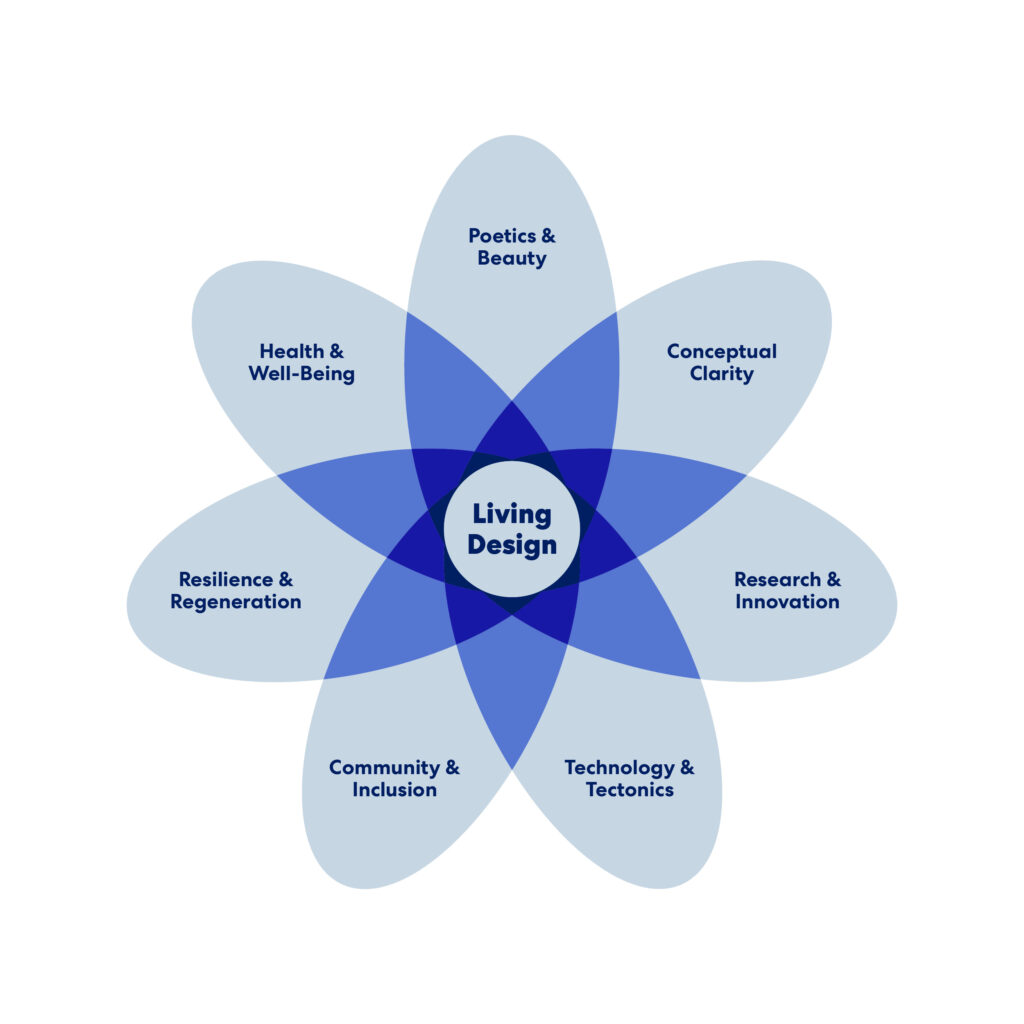
We have clarified our purpose at Perkins&Will to believe that buildings must become living objects – dynamic, restorative forces that help communities and ecosystems reach their potential. We have a commitment to regeneration, resilience, and long-term thinking in all our projects. The planetary emergency demands urgent action: our living design drivers focus on creating architecture that gives back more than it takes, embedding the principles of the circular economy to eliminate waste and regenerate resources.
We identify stressors from our design briefs – social, environmental, economic – and we see each challenge as a call to act. Our regenerative project roadmap sets out clear steps: this is evidenced and recorded through the living design framework.
We’re driven by the belief that architecture must be a tool for regeneration, crafting solutions that endure and adapt into the future. It is our design responsibility to design for what the world must become.
2. Does the practice have a clear succession plan, which passes on ownership and protects the values and legacy of those who built and contributed to the practice? For example is the practice an employee owned trust.
At Perkins&Will we have introduced new processes within the last year. We believe the true legacy of a practice lives in its people. Our Future Leadership Program is a commitment to grow leaders who will protect, challenge, and evolve the values we have built together. Through our Thrive Platform, we actively assess and nurture every individual’s potential, making sure that every voice is heard and every talent can shine.
We take accountability seriously – That’s why we invest in our staff early, giving them real opportunities for meaningful work and leadership roles that matter. Growth in leadership is not about climbing a ladder – it’s about carrying a vision, inspiring change, and ensuring the spirit of Perkins&Will thrives far beyond this generation.
Our succession plan is rooted in stewardship, not entitlement. We are building a future where leadership is shared and its values protected.
3. Does the practice share research and knowledge for the benefit of society and the wider world? For example, you regularly carry out post occupancy evaluation and share information with others.
From last year’s entry, we see every project as an opportunity to ask a new innovation question and evidence this through the living design framework – a chance to push boundaries, test ideas, and create knowledge that benefits the wider world. Sharing what we learn is a fundamental part of our purpose.
This year, our in-house research fund supported the development of a Wetlands Design Playbook, translating technical innovation into practical tools that others can use to drive regenerative design. Beyond our own projects, our team actively contributes to wider industry transformation: many of us are members of leading knowledge groups such as LETI, UKGBC, NZCBS, BSI, CEN, and BCO. Through these collaborations, we have co-authored eight publications in the last year alone, helping to set new standards, shape best practice, and amplify our impact far beyond our own studio.
Project
1. Does the practice advocate for long-term thinking at the outset of projects? Do you initiate projects with long-term thinking and challenge the client on design life? Also, can the practice demonstrate that this approach has worked – with a shorter or longer design life, or an innovative approach to financing or payback period?
To reiterate our stance, long-term thinking is embedded from the very first conversation at Perkins&Will. We challenge briefs rigorously, taking time to deeply understand the site, location, and client requirements before beginning the design. We advocate for long-term views on social and environmental impacts, questioning not just what a building should be today, but how it can adapt, endure, and regenerate over its lifespan.
Our approach prioritises agility and durability – using circularity kit-of-parts strategies to enable dismantling and reconfiguration to extend our designs indefinitely. We actively push boundaries, seeking to create assets rather than disposable products. Through material passporting, with 4 four major projects in 2024, we ensure products can have a life beyond a single project, supporting a circular economy.
In practice, this has delivered real outcomes: projects designed with modularity and adaptable uses have attracted alternative financing models proving the value of long-term design.
2. Do your projects take account of the future climate and the need for resilience? For example, do the projects demonstrate flexibility, design for adaptation, design for disassembly, non-deterministic solutions, or demountable structures.
Designing for resilience is fundamental at Perkins&Will. We use Prometheus future climate data to model our projects’ adaptability over a 100-year timeframe using DSY data, assessing the long-term impacts of rising temperatures and shifting water availability. Every design decision considers its effect on climate impact and biodiversity loss, as well as reducing carbon both embodied and operational alongside resource usage such as water, a change of process within 2024. Our projects are built for long life and loose fit: flexible structural grids and modular, prefabricated components allow for adaptation over time. We prioritise reversible and demountable fixtures, eliminating glues wherever possible to enable future reuse.
In practice, this approach delivers real resilience: 63% of our projects have undergone a resilience risk assessment and action plan. Whether it’s designing a building that can evolve to unknown use cases, we are committed to non-deterministic, flexible solutions that will survive in the future.
3. Do the majority of your projects go beyond mitigating negatives and towards optimising positives? For example, are they meeting or exceeding the RIBA 2030 Challenge.
As an update for 2025, design should actively create positive outcomes. From the outset, we establish a positive dialogue with our clients, setting clear regenerative targets early and tracking them throughout the design process. We rigorously examine why quantities change from the original vision, ensuring we stay accountable to our goals.
We’re proud that 20% of our projects exceed the RIBA 2030 Challenge energy targets, and 30% exceed embodied carbon targets. Every project undergoes a full Life Cycle Assessment (LCA) to benchmark and reduce carbon while maximising circularity. We don’t stop at carbon: materials are evaluated for their wider environmental impact, with a commitment to reducing toxicity and promoting healthier indoor environments.
Our approach, is a systems approach, more than a single metric and avoiding a ‘tick box’ mentality. All our new buildings are fully electric and follow a clear roadmap to net zero operational carbon, ensuring they are future-ready.
Co-evolving with nature
Practice
1. Does the practice use biophilia within the office or regularly host meetings and retreats in natural settings? For example do you have extensive planting within the office or rely on natural patterns and imagery for stress relief or quiet areas.
Our practice has modified its view to embrace biophilic principles not just in design with natural materials, but in the rhythm of our daily work. Our office roof garden is a vibrant, green sanctuary where staff can recharge, reflect, or brainstorm surrounded by nature.
We actively promote walking meetings, especially in the beautiful setting of Lincoln’s Inn Fields. These walks are more than just exercise; they’re a way to clear the mind and inspire creativity. We also make a point of informing staff about local green spaces such as Red Lion Square, encouraging their use during breaks.
Biophilia isn’t just an aesthetic choice for us – it’s part of our ethos. We believe that engaging with nature daily, even in small ways, boosts wellbeing and reduces stress. Nature is not just outside our windows – it’s embedded in our designs.
2. Can the practice share examples where it has considered nature in decision making? For example by having a nature proxy to encourage eco-centric decision making, using natural systems as inspiration for the company structure, recognising the seasonal nature of people’s capacity and workload or celebrating equinoxes and solstices together.
To update from the 2024 entry, nature is not an afterthought in our practice – it is a stakeholder in the decision process. We consistently assess the ecological impact of our projects, ensuring that any disruption is not only mitigated but transformed into an opportunity for restoration and enhancement. A powerful example is our recent city block development in Oxford, where we went beyond regulatory requirements to weave the built environment into the local ecosystem. By integrating meaningful connections to nearby green and blue infrastructure, the project enhances local biodiversity and strengthens local flood resilience – showing that urban growth and environmental features do not require compromise.
By aligning our work with the patterns and principles of nature, we don’t just create static building containers – we create living systems.
3. Is the practice supporting nature locally and nationally? For example, does the practice support local gardens, gardeners, planting programmes, rewilding programmes or advocate for changes in legislation to protect nature.
Through observation, our update for 2025 is that Perkins&Will supports nature both locally and nationally. We believe that every project offers an opportunity to give back to the natural world. That’s why the majority of our projects are designed with the potential to enhance ecosystems, either on-site or through carefully planned off-site interventions.
We are currently exploring innovative ways to transform roof services into productive, food-growing environments in collaboration with external partners. This work involves deeply understanding the local climate and context, ensuring that what we grow and how we grow it is tailored to place and people.
Connection to nature is a fundamental principle of our design ethos. Every project we undertake considers its relationship to natural systems – from water and soil to biodiversity and microclimate. But we go further, embedding stewardship into our designs so that care for nature continues long after the project is complete.
Project
1. Can the practice demonstrate projects which strive to match the performance of a mature ecosystem? As a minimum this would mean achieving biodiversity net gain.
In 2024 our projects have strived to emulate the resilience, productivity, and regenerative capacity of mature ecosystems, even in dense urban settings. In cities, we focus intently on integrating natural systems wherever we can – especially on rooftops, where underutilised surfaces can be transformed into thriving ecosystems.
Our project at 150 Holborn had a baseline of zero – a previous building with no ecological contribution. There we created a biodiverse-rich roofscape designed specifically to support pollinators and native species. This intervention not only enhances the wellbeing of building users but significantly improves the urban ecological fabric. It’s a carefully calibrated response to the local climate, flora, and fauna – not a generic green roof, but a living system.
We view biodiversity net gain not as a target but as a prerequisite. In every project, we ask how nature can be a standalone system rather than a pot bound plant.
2. Is the practice working on material stewardship? For example, evidence could be shown through repeated use of low carbon materials, extensive material libraries and research or publications supporting responsible use of materials and elimination of waste.
To reinforce our previous entry materials are integral to regenerative design. We have evolved beyond our precautionary principle to actively champion materials that are safe, circular, and ethically sourced. Our switch list prioritises viable market alternatives that eliminate chemicals of concern, aligning our practice with international evaluations for human and ecological health.
Our in-house material library and product showcases have been updated to reflect these principles, making it easier for our teams and collaborators to make responsible choices. Currently, 55% of specified products meet these criteria, with UK fire regulations presenting the main technical constraint.
We’re proud to see a rise in biobased materials across our work, and we go further by introducing material passports to a growing number of projects. These tools support long-term reuse and traceability, helping to enhance circular economy principles. Through every specification we show how beautiful design can, and must, be deeply responsible.
3. Do the majority of projects demonstrate the use of biologically-inspired approaches such as Bioregionalism, Biophilia, Biomimicry, Ecomimicry (also referred to as Ecosystems Thinking, Industrial Ecology or Industrial Symbiosis) or BioTRIZ?
In 2024 we started to think about this aspect in more detail to show how our projects are informed by biologically inspired thinking, a truly regenerative architecture must function as part of a living system, and that means designing with nature’s processes, not against it.
Our approach begins with supply chain mapping, where we prioritise local materials – supporting local economies and reducing environmental strain. Increasingly, this has led us to adopt more biological and biobased materials, selected for performance and for their ability to safely return to nature at the end of their life.
Materials are chosen and detailed with a clear path back to natural or industrial cycles, eliminating waste at all life cycle stages. Our work reflects a shift from building as object to building as organism. In doing so, we design spaces that look to adapt, regenerate, and endure, just like the natural systems.
Creating a just space for people
Practice
1. Does the practice have a progressive EDI policy and can you evidence many forms of diversity, which are welcomed and acknowledged, within the practice?
Modifying our previous entry, we have a specialist working group in the office covering DEI initiatives. This has been running for over 6 years and includes a range of events and initiatives. The latest iteration on these surveys is a ‘Tensense’ survey which tries to understand the thoughts and feelings of the whole office to make interventions, on a quarterly basis, towards a more inclusive work environment.
Specialist training has been formulated for the firm to equip everyone with the correct terminology, mindset and recognising events that occur day-to-day in the office such as making sure that all voices are heard and unintentional bias. This has been followed through in updated terms of company policy and processes such as having blind job applications so aspects such as class, education and ethnicity are discounted from the decision process.
2. Does the practice operate a no overtime culture, meet the living wage consistently, and stipulate a fair salary ratio between staff of all levels?
Perkins&Will have a strong culture of no overtime and to iterate last year’s entry:
We pay overtime and offer time off in lieu for additional hours worked. We are an accredited living wage employer. A salary review process every year to ensure that our pay is consistent, fair and balanced across roles so that staff receive equal pay. We carry out an extensive salary benchmarking exercise to ensure our salaries are in line with the industry. Through our Thrive process, reviews are carried out throughout the year and feedback is given to employees. Part of this discussion is promotions and wage discussions. Our company job titles, and structure give a clear indication to staff on salary bandings and levels of responsibility.
3. Does the practice support charities, community groups, social enterprises, action groups and others through pro-bono work, charitable giving or in-kind donations?
In 2024 Perkins&Will has a policy on social value activities. The company matches funds of any contributions raised by employees for things such as bike rides and distance running. These events and training can have paid time taken off with leadership approval. We have a policy of giving a small percentage of our profits towards pro bono work, which has resulted in using our expertise for community buildings, conducting school talks with lessons in architecture, we have also participated in local community events.
We are in the process of evidencing all the social value work we undertake so that we can publish this on our website.
4. Does the practice publicly refuse to work with certain clients, suppliers or organisations on ethical grounds?
Similar to the process described last year, we undertake serious discussion both at tender and before contract signing on each client’s business activities and their reputation. This involves looking at the business through a political, business and ethical lens. We undergo an in-depth study of their business and policies before committing to tender, and if we see that there is no health and wellbeing accommodation within a project this becomes a reason for refusal to work with certain clients.
We have refused a major project in 2024 since the project was not contributing any social value to the local population.
Project
1. Do the projects demonstrate deep engagement with local stakeholders and end users? For example, is there evidence that your project engagement goes beyond consultation towards co-design?
Perkins&Will have updated their stakeholder process over the last year. We believe that meaningful design cannot exist without meaningful dialogue, and that every stakeholder, especially those often underrepresented, deserves to be part of shaping the spaces they inhabit.
From the earliest stages, we work closely with our clients to understand existing engagement processes, while proactively identifying whose voices need to be brought in. We assess both the influence and interests of all stakeholder groups are raised to ensure no perspective is overlooked.
Our Living Design process is built on stakeholder mapping and ongoing collaboration. We host workshops throughout a project’s lifecycle – not as a tick-box exercise, but as a vital design tool. Ideas are shared, feedback is gathered, and outcomes are revisited with care and transparency. Together with our clients, we chart a path forward that reflects collective wisdom.
2. Do your projects create connected and resilient places which positively contribute to their neighbourhoods and allow equality of access? For example, do your projects create economic opportunity, retain value locally and generate social value?
Perkins&Will have honed our knowledge over the last year and recognise our greatest power to shape a better world lies in the decisions we make every day – and material choice is one of the most powerful. Wherever possible, we source as close to the site as we can, not only to shorten supply chains and reduce carbon emissions, but to invest directly in local communities.
But our commitment doesn’t end with environmental stewardship. We design with the diverse ways people experience space in mind. Our projects are developed with neurodiversity and accessibility embedded from the outset, not added as an afterthought. We’ve developed practical toolkits and guidance to ensure that every design choice supports comfort, dignity, and belonging for all.
Every material, every layout, every detail carries meaning. Through thoughtful specification and inclusive design, we’re creating buildings that don’t just stand – they serve and they support their inhabitants.
3. Do the majority of your projects promote equity in society, and consider all people, not only the building inhabitants? For example, do your projects show due regard for workers within the supply chain and take active steps to avoid modern slavery?
We have updated our processes in 2024 to reflect that integrity begins in the lives of the people who make projects possible. That’s why we’ve embedded a rigorous vetting process to champion human rights, fairness, and transparency.
Modern slavery policies are non-negotiable in our work. We keep our supply chains as short as possible, not only to reduce environmental impact but to ensure we can stand behind the wellbeing of every worker involved. Our designers frequently visit factories – not just to understand the products, but to witness working conditions firsthand. In previous projects alongside contractors, we’ve introduced a transparent scoring system for tier two suppliers, evaluating diversity of ownership, company size, and workforce representation. Every supplier we engage is asked to provide clear policy documentation through our tailored questionnaire. This isn’t a box-ticking exercise – it’s a reflection of the world we want to help build.