
Submission by Pedder & Scampton Architects.
Being a good ancestor
Practice
1. Does the practice have a clearly stated purpose aligned with the planetary emergency? We are looking for a bold ambition here, and a practice culture which recognises the need for long-term thinking. For example, a strong mission, a theory of change, or a sustainability roadmap.
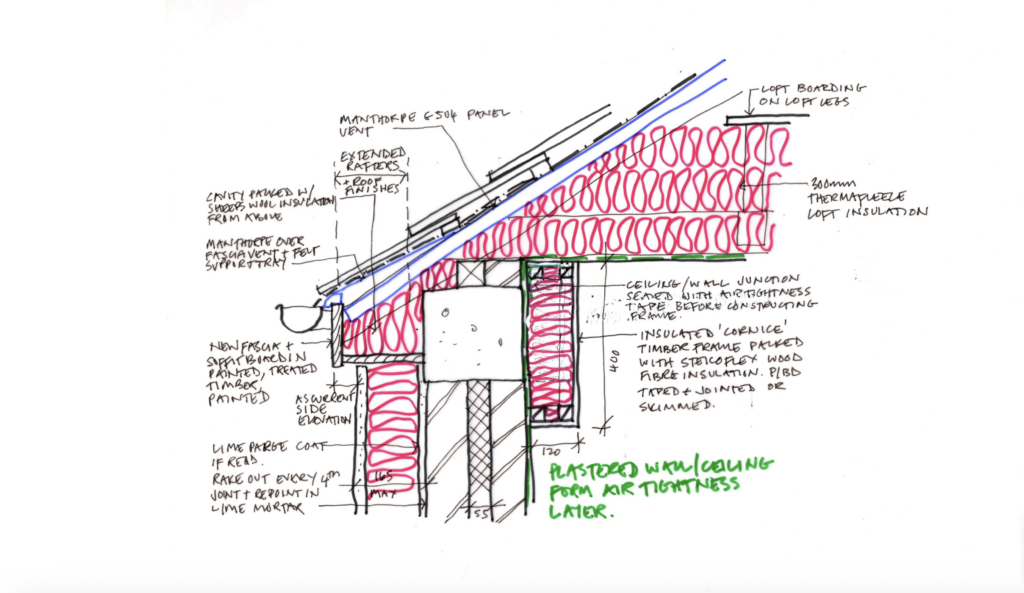
Our tiny practice works almost exclusively on existing buildings, both domestic and non domestic. Our mission is to practically and affordably reduce the in use carbon footprint of some of the many substandard London homes and to disseminate how to do this. Delivering low carbon new buildings is straightforward in comparison to the challenges of retrofit, which remains a massive challenge. Our projects range from Victorian terraced cottages to 1930s semis and include complete retrofits and works where the client remains in occupation and requires minimum disturbance. We have started to use PHPP to test the most appropriate interventions, we specify natural materials and incorporate renewable energy sources wherever possible and employ dataloggers to test the results. We leave our clients with a plan as to how to achieve further improvements without undoing the works they have already done and our small builders with new skills in highly insulated and airtight construction.
2. Does the practice have a clear succession plan, which passes on ownership and protects the values and legacy of those who built and contributed to the practice? For example is the practice an employee owned trust.
We don’t have a formal succession plan but we do see that the values and legacy of the practice are passed on through our staff who take the knowledge of both specialist design for the neurodiverse and those with special needs and strategies to address the planetary emergency with them when they move on. We also disseminate this knowledge through talks, lectures and advising larger practices. For us the priority is the knowledge and skills and attitudes more than the practice as an entity although we are obviously hopeful that it will continue into the future.
3. Does the practice share research and knowledge for the benefit of society and the wider world? For example, you regularly carry out post occupancy evaluation and share information with others.
We are currently evaluating the performance of our recently completed upgrades to a 1930s semi and will collaborate with our PHPP Consultant to publish the results. We are carrying out post occupancy air tightness tests to review the success of the works carried out (as compared with the preworks test) and will review with the client any works might be required to address any issues that become apparent. We have published articles on other completed projects aimed to assist those who are carrying out self build projects. As our expertise develops this will become a regular aspect of our future works
We also have a specialism in design for the neurodiverse and the elderly and we regularly give talks on the key issues and how to design for them. We also give specialist advice to larger practices on how to reflect the needs of these groups in their designs.
Project
1. Does the practice advocate for long-term thinking at the outset of projects? Do you initiate projects with long-term thinking and challenge the client on design life? Also, can the practice demonstrate that this approach has worked – with a shorter or longer design life, or an innovative approach to financing or payback period?
We do advocate for long term thinking. We encourage all our clients to carry fabric improvements as the foundation for each project and take time to ensure that spatial adaptations we suggest are long term and flexible responses to client needs. We specify durable and long lasting natural materials. We prioritise improving existing fabric over adding extensions but where these are appropriate build them to be as low carbon as possible – timber structures, highly insulated and airtight, lime render and timber cladding etc. It is notable that most of our clients remain in their properties for the long term and make few changes.
Where we are working on a meanwhile project to create short term community space we take care to work with the existing spaces to minimise material heavy and structural alterations, rather making a few key adjustments to meet user group needs and create maximum benefit.
2. Do your projects take account of the future climate and the need for resilience? For example, do the projects demonstrate flexibility, design for adaptation, design for disassembly, non-deterministic solutions, or demountable structures.
We aim for all of our projects to demonstrate flexibility and the possibilities of adaptation – both to reflect climate change needs and changed requirements of the occupants. For example a community centre in Neasden in the base of an old Press building was designed for three different local user groups who were antagonistic to each other. The spaces were designed such that the three separate areas could be opened up to each other as relations improved. Many of our projects are within existing buildings where the extent of possible disassembly is predetermined and often limited but where we design new buildings then these can be disassembled and the components reused. For example at our horticultural therapy building in Battersea Park the timber and steel structures can be unbolted and the slate roof and wall cladding removed and reused elsewhere. It is a key aspect of many of our neurodiversity projects that the main spaces can be used flexibly with a range of different types and size of space that can be adapted for many different user needs and activities.
3. Do the majority of your projects go beyond mitigating negatives and towards optimising positives? For example, are they meeting or exceeding the RIBA 2030 Challenge.
No.
Co-evolving with nature
Practice
1. Does the practice use biophilia within the office or regularly host meetings and retreats in natural settings? For example do you have extensive planting within the office or rely on natural patterns and imagery for stress relief or quiet areas.
Our office is tiny, one room. But we have a slowly increasing and flourishing collection of plants in the window, we don’t have room for many more! We appreciate the views onto the street trees outside and occasionally hold office meetings in the small local park.
2. Can the practice share examples where it has considered nature in decision making? For example by having a nature proxy to encourage eco-centric decision making, using natural systems as inspiration for the company structure, recognising the seasonal nature of people’s capacity and workload or celebrating equinoxes and solstices together.
Our company is so small that we communicate directly all the time with a flat and minimal management structure. We all work in the office rather than online to better support each other and as such are sensitive to each other’s needs as the seasons change and are able to work flexibly around these.
3. Is the practice supporting nature locally and nationally? For example, does the practice support local gardens, gardeners, planting programmes, rewilding programmes or advocate for changes in legislation to protect nature.
At a personal level both directors have small projects that increase local biodiversity/rewilding and we encourage our clients to incorporate planting and nature in their projects wherever possible – for example generous planters for a gardening project in an inner city hostel for the homeless.
This is an area where we aim to improve.
Project
1. Can the practice demonstrate projects which strive to match the performance of a mature ecosystem? As a minimum this would mean achieving biodiversity net gain.
Many of our projects are small and inner city with limited local space but we always try to incorporate elements that improve on the current biodiversity. For example green roofs planted with wild flowers, raised planters for meanwhile projects with hard outdoor spaces. At our community project in Neasden we turned a disused delivery yard into a community garden with extensive planting and introduced a new oak tree. Our proposals for disability services on a hard urban site included careful design to avoid impacting the existing mature trees complemented by sensory and growing gardens and outdoor space for adult play.
2. Is the practice working on material stewardship? For example, evidence could be shown through repeated use of low carbon materials, extensive material libraries and research or publications supporting responsible use of materials and elimination of waste.
As a matter of course we have replaced high embodied carbon insulation with natural wherever possible – woodfibre, sheeps wool, cork etc. and have developed a series of specifications for different retrofit applications and performances. We encourage our clients towards recycled materials. We specify lime mortars, renders and plasters in lieu of cement based and gypsum on a more and more regular basis. We include requirements to reduce waste in our tender documents but this is a bit of an uphill battle. We were awarded the Zero Waste Scotland prize in 2017 for our Scottish Longhouse project which reused demolition materials on site, incorporated natural insulation and traditional lime based masonry techniques.
3. Do the majority of projects demonstrate the use of biologically-inspired approaches such as Bioregionalism, Biophilia, Biomimicry, Ecomimicry (also referred to as Ecosystems Thinking, Industrial Ecology or Industrial Symbiosis) or BioTRIZ?
No.
Creating a just space for people
Practice
1. Does the practice have a progressive EDI policy and can you evidence many forms of diversity, which are welcomed and acknowledged, within the practice?
The practice is very small, 2-4 people but we employ people from many ethnicities and sexual orientations and they have all contributed towards the success of our projects and the success of the practice. We have a preference for a diverse mix of staff and are mindful of this when interviewing. We have very much enjoyed working with a transgender client and offered him our support further to the recent high court decision. We are very unhappy with the way that this has been interpreted.
2. Does the practice operate a no overtime culture, meet the living wage consistently, and stipulate a fair salary ratio between staff of all levels?
We encourage our staff to leave promptly in the evenings and lead by example. On occasions when overtime is unavoidable – for example when attending evening co-design sessions with local communities – we offer time off in lieu. We always pay the living wage. We only ever have 1-2 employees but we review salaries to make sure that they are fair.
3. Does the practice support charities, community groups, social enterprises, action groups and others through pro-bono work, charitable giving or in-kind donations?
We work with many community groups, school communities etc and are always involved in some level of pro bono work as we aim to go the extra mile.
4. Does the practice publicly refuse to work with certain clients, suppliers or organisations on ethical grounds?
No.
Project
1. Do the projects demonstrate deep engagement with local stakeholders and end users? For example, is there evidence that your project engagement goes beyond consultation towards co-design?
Yes. Many of our projects have involved extensive consultation or co-design. For example we co-designed a community garden in Neasden, and our disability hub in Croydon and our autism campus in Haringey involved extensive consultation with families, carers, specialist staff and the management running each service.
We are currently engaged in 10 week co-design sessions with the local community to design two community hubs in inner London. These will look at everything from user’s perceptions of their local area to design of the activities in the hub and how they are to be delivered and by whom to design of spaces and finishes.
We also work as much as possible with other small local businesses – specialist consultants but also small Contractors. We support the Contractors to improve their skills and widen the range of services that they can offer.
2. Do your projects create connected and resilient places which positively contribute to their neighbourhoods and allow equality of access? For example, do your projects create economic opportunity, retain value locally and generate social value?
Our horticultural therapy building in Battersea Park replaces a collection of sheds with a new building designed to accommodate the widely ranging needs of the users and considerably improves the appearance of that section of the park. It includes a kiosk for the sale of plants grown in the project gardens which gives the users social confidence and sales experience. Aside from daily sessions for local users other events are also put on for the local community who are engaged with the project.
Our autism campus in Haringey combines the first drop in centre in Haringey for local residents with Aspergers with a day centre for those with autism and learning disabilities. These are both much needed services for local residents whose needs are often neglected. The appearance of the buildings has been improved with simple external alterations and the interiors refitted to meet the specific needs of the neurodiverse.
3. Do the majority of your projects promote equity in society, and consider all people, not only the building inhabitants? For example, do your projects show due regard for workers within the supply chain and take active steps to avoid modern slavery?
By definition, almost all of our non domestic projects (currently about 75% of our workload) promote equity in society, providing facilities and services where these have been lacking and promoting community cohesion. Currently many of our domestic projects also cater for people with special needs. Where relevant we consider the environment around our projects and aim to improve these.
We engage closely with the Contractors for our projects to understand their skills and how they run their businesses and appreciate and engage with the individual workers on each site but as a small practice it is very hard for us to engage with the wider supply chain beyond this.