
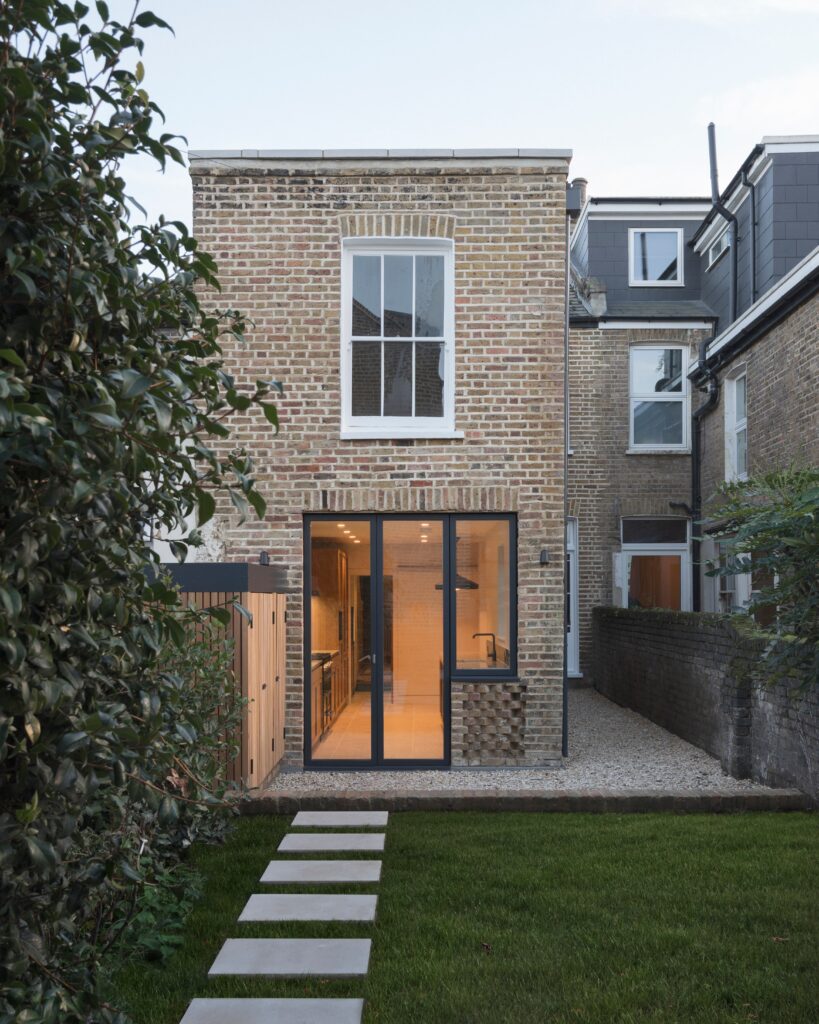
Submission by Patrick Crowe Architects.
Being a good ancestor
Practice
1. Do you have a clearly stated purpose aligned with the planetary emergency? We’re looking for a bold ambition here, and a culture which recognises the need for long-term thinking.
Consume less, live better.
2. Do you have a clearly stated purpose aligned with the planetary emergency? We’re looking for a bold ambition here, and a culture which recognises the need for long-term thinking.
Open learning approach, sharing knowledge, iterative discussions across domains and generations.
3. Do you share research and knowledge for the benefit of society and the wider world?
We have an open book approach, based on an iterative process of knowledge building. We include all our clients in each and every aspect of the approach, keeping them well informed and engaged.
We invite and engage with students of the built environment to join us in this process, arranging visits, meetings and discussions.
Project
1. Do you advocate for long-term thinking at the outset of work? Do you initiate work with long-term thinking and challenge clients? Also, can the organisation demonstrate that this approach has worked?
Creating positive environments which will stand the test of time, be easily adaptable and create less adverse impact in their creation and lifetime is our primary focus.
When approaching a new project, we typically start by looking at how the existing building and surroundings could be reused/ reconfigured without necessitating additional unnecessary works.
Long term thinking can be implemented by unpicking and clarifying the client’s goals, enabling us to offer positive informed solutions based on a robust wholistic long term approach. Long term proposals frequently have a better chance of success where we can emphasise benefits to client in their own terms, this may be via environmental, budget, aesthetics reasons. We have learned that stainable human activity can frequently be a budget and aesthetic winning approach.
Many of our successful projects became reconfiguration/reworking projects rather than the initial brief to demolish and extend/ rebuild.
2. Does your work take account of the future climate and the need for resilience?
We engage with the effects and causes of climate changes. We look for passive solutions, based on traditional approaches, which have worked for centuries and still provide a viable approach to addressing climate changes
3. Does the majority of your work go beyond mitigating negatives and towards optimising positives?
We offer design solutions, which focus on positive inspiring end goals. Wherever we meet resistance, we seek to adapt our argument and redescribe goals within a client’s frame of reference. This may to emphasize lower costs, lower maintenance, durability, pleasure.
We find expressing and clarifying ideas in a client’s context is the key to a powerful argument.
Co-evolving with nature
Practice
1. Do you use biophilia within your premises and/or do you regularly gather in natural settings?
Many of our projects aim to enhance the connection with the outdoors- eg. garden, yard or balcony. We have designed roof extensions which incorporate generous biodiverse roof landscape. This helps win the case to our clients and also helps with planning aspects too.
We have incorporated ‘grow gardens, family play gardens, wild landscapes into our projects- all of which help provide amenity to residents and support a better natural environment.
2. Can you share examples of where you have considered nature in decision making?
We have been asked many times to design projects in locations we know may be difficult in planning terms.
Incorporating natural elements in a meaningful manner can greatly assist the case for the proposal. A biodiverse roof covering helped secure planning for what could have been a planning refusal, and provided the client with a real benefit to their home
One project incorporated a grow garden to a client’s request. This helped inform the layout and design of the project. A win for functionality, the environment and wellbeing.
3. Are you supporting nature locally and nationally?
We push for helping ecosystems thrive. Discussions are arranged around local species, real benefits, avoiding greenwashing arguments, engaging with experts who can input.
Project
1. Can you demonstrate work that strives to match the performance of a mature ecosystem?
Our projects involve actively working within and fostering the integral ecosystem, promoting biodiversity, adapting to local landscape and site conditions, consuming less, living better by user participation
2. Are you working on material stewardship?
We are actively changing our approach to selecting materials and performance. We find many companies in the supply chain are eager to help us, offering advice, webinars, conferences, technical advice too. We progress cautiously, but are finding that many companies share the same ethos and backed up by tested evidence.
3. Does the majority of your work demonstrate the use of biologically-inspired approaches such as Bioregionalism, Biophilia or Biomimicry?
Increasingly so. There seems to be a wealth of knowledge available, and materiality which support this, the key is finding access to this realm, and developing with it.
Creating a just space for people
Practice
1. Do you have a progressive EDI policy and can you evidence many forms of diversity, which are welcomed and acknowledged, within your company/organisation?
We are goal focussed, and strive for improvement with each project, learning wherever possible from whomever we meet.
We are also part of an educational programme which assists students of all backgrounds and approaches to life, helping open up opportunities for all and enhancing our view of the world we inhabit.
2. Do you operate a no overtime culture, meet the living wage consistently, and stipulate a fair salary ratio between staff of all levels?
We are transparent, goal focussed and fair. This applies to each and every individual we encounter- consultants, clients, suppliers, employees.
3. Do you support charities, community groups, social enterprises, action groups and others through pro-bono work, charitable giving or in-kind donations?
We regularly provide assistance to community projects, offering advice, guidance and time without charge. These projects help a diverse range of community members.
4. Do you use an ethical framework to assess opportunities and/or supply chain partners and is them team consulted on these decisions?
The studio believes in fairness and opportunities for all. We keep well informed and prioritise those with an ethos and value similar to our own thinking.
Project
1. Does your work demonstrate deep engagement with local stakeholders and end users?
Yes, actively so. Our community volunteering work definitely does this. Our daily work focuses on end users within an ecosystem.
2. Does your work create connected and resilient communities which positively contribute to neighbourhoods and allow equality of access?
We have been working with a local community for a number of years, seeking to engage locals and assist them achieve a better physical environment- community hub, community garden, affordable homes. Not a top-down approach but an active collaboration with communities.
3. Does the majority of your work promote equity in society, and consider all people, not only building inhabitants
Yes, fairness, equality, environment are intrinsic to our work.