
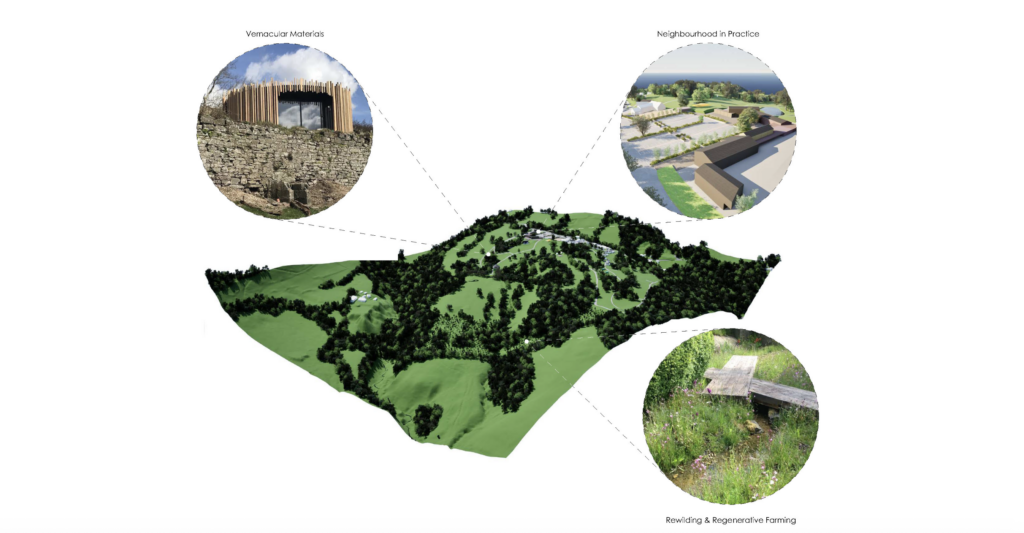
Submission by MWD Architects.
Being a good ancestor
Practice
1. Does the practice have a clearly stated purpose aligned with the planetary emergency? We are looking for a bold ambition here, and a practice culture which recognises the need for long-term thinking. For example, a strong mission, a theory of change, or a sustainability roadmap.
At MWD Architects, our work is grounded in a deep commitment to addressing the climate and ecological emergency through regenerative, low-impact design. We take a long-term, systems-based view of architecture, placing emphasis on nature-led solutions, material responsibility, and holistic thinking across every scale. Our practice ethos is grounded in long-term, regenerative thinking, prioritising environmental responsibility, social value, and intergenerational equity in every project we take on, while many of our projects respond directly to One Planet principles. While we may not yet have a single written ‘theory of change,’ our design culture, project outcomes and decision-making processes all reflect this commitment to legacy thinking and planetary safekeeping.
2. Does the practice have a clear succession plan, which passes on ownership and protects the values and legacy of those who built and contributed to the practice? For example is the practice an employee owned trust.
No.
3. Does the practice share research and knowledge for the benefit of society and the wider world? For example, you regularly carry out post occupancy evaluation and share information with others.
We actively share insights and knowledge through competitions, award submissions, client and community presentations, and public platforms like LinkedIn. We are committed to transparency and collaboration and regularly participate in dialogues around regenerative architecture, natural materials, and affordable housing solutions. Our work with clients often includes knowledge-sharing workshops, and we openly promote lessons learned from our projects, including construction techniques, material performance, and environmental outcomes. This openness helps advance the wider discourse around ethical and ecologically conscious design..
Project
1. Does the practice advocate for long-term thinking at the outset of projects? Do you initiate projects with long-term thinking and challenge the client on design life? Also, can the practice demonstrate that this approach has worked – with a shorter or longer design life, or an innovative approach to financing or payback period?
We begin every project with a long-term perspective, focusing on adaptability, whole-life value, and social relevance. Our designs prioritise durability, maintenance, and ecological responsibility from day one, and we challenge clients to think beyond conventional timelines. For example, our One Planet Park Homes rethink affordability and longevity in housing through a model that is low-cost, low-impact, and inherently adaptable. We regularly support clients in reimagining financial and planning models that suit resilient, flexible futures, especially in rural and edge-of-settlement contexts.
2. Do your projects take account of the future climate and the need for resilience? For example, do the projects demonstrate flexibility, design for adaptation, design for disassembly, non-deterministic solutions, or demountable structures.
Our projects are designed to respond to future climate scenarios and site-specific environmental pressures. We favour breathable construction, low-tech passive strategies, and long-life detailing. Many of our buildings are designed to be demountable or adaptable, often reusing existing structures, as seen in a recent project, which transformed a redundant barn into a highly insulated modern living space while preserving embodied energy. Our use of locally sourced natural materials and carbon-aware detailing ensures thermal comfort and resilience without overreliance on energy-intensive systems.
3. Do the majority of your projects go beyond mitigating negatives and towards optimising positives? For example, are they meeting or exceeding the RIBA 2030 Challenge.
At MWD Architects, our projects consistently aim to go beyond harm reduction and instead seek to generate meaningful positive outcomes, for people, place, and planet. While not formally signed up to the RIBA 2030 Climate Challenge, our design approach aligns closely with its targets in both spirit and practice. We prioritise fabric-first solutions, passive design, renewable technologies, and natural materials with low embodied carbon. Our projects, which generate more energy than they use, and our One Planet Park Homes, demonstrate our commitment to designing beyond compliance. We also collaborate closely with clients to integrate biodiversity, circularity, and social value into our work. Through each stage, we work to create buildings that are not only environmentally responsible but also regenerative in intent, enhancing ecological systems, supporting community resilience, and providing long-term value.
Co-evolving with nature
Practice
1. Does the practice use biophilia within the office or regularly host meetings and retreats in natural settings? For example do you have extensive planting within the office or rely on natural patterns and imagery for stress relief or quiet areas.
Our studio culture places great importance on fostering well being through connection with the natural world. Biophilic elements such as indoor planting are incorporated throughout our office, and we maximise daylight where possible. On brighter days, our team often holds creative discussions and design workshops outdoors, in the garden of our Director’s nearby home. This setting provides space to reflect, think freely, and connect more closely with our environment, a natural extension of the values that underpin our architectural work.
2. Can the practice share examples where it has considered nature in decision making? For example by having a nature proxy to encourage eco-centric decision making, using natural systems as inspiration for the company structure, recognising the seasonal nature of people’s capacity and workload or celebrating equinoxes and solstices together.
Nature is not just a backdrop to our work, but a central influence in our decision-making processes. Through our sister companies, MWD Makers and Castan Cabins, we’ve embedded a nature-centric philosophy into our modular home designs; each one named after a natural element or native species in Welsh, such as the ‘Masarnen’ (Maple), ‘Ywen’ (Yew), and ‘Ty Tân’ (Fire House). While these serve as aesthetic choices, more importantly, they reflect our commitment to embedding ecological thinking, symbolism, and cultural reverence for nature into every aspect of what we create.
3. Is the practice supporting nature locally and nationally? For example, does the practice support local gardens, gardeners, planting programmes, rewilding programmes or advocate for changes in legislation to protect nature.
The practice and Mark Waghorn advocate for nature conservation and use of permaculture principles and the design of productive food production spaces that follow natural systems and patterns. Mark Waghorn applies these principles in his own garden and holds regular team workshops there to share his learning with team members, and is an active member of the local permaculture and gardening groups. The practice has also collaborated with the permaculture designer Paul Jennings in the One Planet Hamlet and Cardarnle projects.
Project
1. Can the practice demonstrate projects which strive to match the performance of a mature ecosystem? As a minimum this would mean achieving biodiversity net gain.
Projects such as Cardarnle, Hadu and Demark Farm demonstrate the practice’s understanding of the importance of developing a mutually beneficial relationship between a built environment, its occupants and the natural world. Our practice’s aim is to use design to address environmental problems and social inequity and to create exemplars to inspire others. Our goal is to make the transition to a low consumption future as attractive as possible to the general population.
2. Is the practice working on material stewardship? For example, evidence could be shown through repeated use of low carbon materials, extensive material libraries and research or publications supporting responsible use of materials and elimination of waste.
The practice has invested heavily in developing standardised designs of dwellings that are built using local and naturally sourced materials. In 2024 it completed its prototype One Planet Park Home, which is a mobile dwelling designed to meet the legal definition of a caravan and the British Standard for park homes. The One Planet Park Home model has been developed to use only UK grown timber in its structure and UK grown hemp insulation. Mark Waghorn has shared his experience in developing this design with academics and other experts in live talks and on social media, and is looking to market this as a product for a UK-wide market.
3. Do the majority of projects demonstrate the use of biologically-inspired approaches such as Bioregionalism, Biophilia, Biomimicry, Ecomimicry (also referred to as Ecosystems Thinking, Industrial Ecology or Industrial Symbiosis) or BioTRIZ?
Practice director, Mark Waghorn’s principal inspiration in nature-inspired design is the established methodology of permaculture. He completed a Permaculture Design Certificate in 2012 and applies this training and systems thinking to all his projects. The three permaculture ethics of earth care, people care and fair share underpin all his activities, and the twelve permaculture principles provide a powerful set of design tools in the realisation of all the practice’s projects.
Creating a just space for people
Practice
1. Does the practice have a progressive EDI policy and can you evidence many forms of diversity, which are welcomed and acknowledged, within the practice?
While MWD Architects does not currently have a formal written EDI policy, we are committed to fostering a respectful, inclusive, and supportive workplace. Our small team reflects a range of backgrounds and lived experiences, including gender balance (three women, two men) and international representation, with team members from both UK and Thai backgrounds. We support flexible and hybrid working arrangements to accommodate parenting and health needs, and our small team size encourages open dialogue, mutual support, and equal opportunity across roles. Mentoring is embedded into our culture, especially for Part 1 and Part 2 assistants, ensuring knowledge sharing and a clear pathway for growth and development. We recognise that embedding diversity and inclusion is an ongoing responsibility and are actively exploring how we can formalise our approach in the future.
2. Does the practice operate a no overtime culture, meet the living wage consistently, and stipulate a fair salary ratio between staff of all levels?
MWD Architects operates a culture that prioritises wellbeing and work-life balance. We do not have an overtime culture and actively encourage our team to maintain healthy boundaries between work and personal life. All staff are paid at or above the Real Living Wage, and salaries are reviewed fairly and transparently. As a small practice, our salary structure reflects role and experience, but the gap between the highest and lowest paid team members remains modest and proportionate. Flexibility is built into our working model, including hybrid and reduced-hour arrangements that support parents, caregivers, and those with additional commitments.
3. Does the practice support charities, community groups, social enterprises, action groups and others through pro-bono work, charitable giving or in-kind donations?
No.
4. Does the practice publicly refuse to work with certain clients, suppliers or organisations on ethical grounds?
Yes.
Project
1. Do the projects demonstrate deep engagement with local stakeholders and end users? For example, is there evidence that your project engagement goes beyond consultation towards co-design?
No.
2. Do your projects create connected and resilient places which positively contribute to their neighbourhoods and allow equality of access? For example, do your projects create economic opportunity, retain value locally and generate social value?
Our projects are grounded in principles of local engagement, sustainability, and social responsibility. Whether working with housing associations, private clients, or community-led initiatives, we prioritise designs that generate lasting local benefit. Examples include our collaboration with Down to Earth and Coastal Housing on the Pennard housing scheme, which was built with natural materials by members of disadvantaged community groups, creating skills training, healthcare outcomes, and social value in one project. Our One Planet Park Homes and cabins are designed to be affordable, low-carbon homes that offer people a route into home ownership while reducing environmental impact. Many of our clients are small-scale landowners or community members seeking to self-build or restore and enhance the ecological value of their land. In each case, we seek to retain value within the community by using local materials, supporting rural economies, and designing homes that enable people to live lightly and thrive locally.
3. Do the majority of your projects promote equity in society, and consider all people, not only the building inhabitants? For example, do your projects show due regard for workers within the supply chain and take active steps to avoid modern slavery?
We believe architecture should serve broader societal equity, not just immediate end users. Our projects are often designed with affordability and community benefit in mind, including social housing and One Planet Development schemes that promote access to low-impact living for a wider demographic. Through our sister company, MWD Makers, we maintain closer control over procurement and supply chains, prioritising local and ethical sourcing wherever possible. While we are a small practice and not currently subject to formal reporting obligations under the Modern Slavery Act, we are mindful of the origins and impacts of materials and labour, and favour transparent, traceable suppliers, especially when working with timber and insulation products. Beyond compliance, we design with inclusivity in mind, ensuring our spaces are welcoming and accessible, and we promote community-centred development that supports resilience, wellbeing and equal opportunity across all aspects of our work.