
Submission by Max Fordham LLP.
Being a good ancestor
Practice
1. Do you have a clearly stated purpose aligned with the planetary emergency? We’re looking for a bold ambition here, and a culture which recognises the need for long-term thinking.
Our founder was a pioneer in sustainable, low-energy and low-carbon building design. Our design philosophy ‘beautiful engineering’ endures, with our explicit purpose to work with the built environment ‘to deliver a sustainable future and a thriving planet’.
We continue to push boundaries, keep learning, keep sharing what we’ve learnt, and keep campaigning for our industry to do better. We’ve been committed to net zero carbon since 2020, published the Net Zero Carbon Guide, committed to design without fossil fuels as the default, and have challenged ourselves to go Beyond Net Zero and consider how our work could be biodiversity positive.
We ‘practice what we preach’ through many commitments, including the Science Based Targets initiative, the World Green Building Council Net Zero Carbon Buildings Commitment, and being the first UK business to have all our offices verified as net zero carbon in operation.
2. Do you have a clearly stated purpose aligned with the planetary emergency? We’re looking for a bold ambition here, and a culture which recognises the need for long-term thinking.
Care and responsibility have always been central to our democratic practice, and in our 60th year, we continue to believe it’s our shared responsibility to look after each other, to care for our communities, and to create a sustainable world.
We’re an employee-owned business and our culture thrives on open, honest, collaborative relationships based on mutual trust and respect. We strive to build a diverse partnership that is truly representative of the society we live in.
The partnership has a protective effect on our values and the practice legacy, keeping our founder’s ethos and approach alive, alongside a strong recruitment and training model that creates space for new members of the practice to develop skills and ideas, and encourages them to make an impact. Transparency, collaboration, and democratic decision-making are core principles, and all our people can voice their opinions and contribute meaningfully to the running of the business.
3. Do you share research and knowledge for the benefit of society and the wider world?
We’re committed to sharing our knowledge and experience, such as our 2026 Beyond Net Zero whitepaper sharing lessons learned on our projects. In 2020 we created The Net Zero Carbon Guide, a free and open resource helping navigate pursuit of net zero carbon for both old and new buildings. We’ve hosted multi-stakeholder workshops to explore how masterplanning choices can enable, or stifle, regenerative outcomes over decades, and gathered clients, engineers, contractors, manufacturers, academics and policy voices together to think about what MEP reuse can look like in practice.
We contributed to the UK Net Zero Carbon Building Standard through four working groups, and our experts regularly speak at conferences such as CIBSE Decarbonisation Conference and Footprint+. We seek out opportunities to share our research in industry journals, to give lecture and to tutor at universities, and inspire the next generation at careers fairs and school workshops.
Project
1. Do you advocate for long-term thinking at the outset of work? Do you initiate work with long-term thinking and challenge clients? Also, can the organisation demonstrate that this approach has worked?
We advocate for long-term decision making.
On Holloway Park we persuaded the client to undertake a holistic whole life carbon optioneering study of the heating and cooling energy strategy. This studied 3 distinct energy strategies and calculated their upfront and long-term carbon impacts by quantifying 15year energy use data coupled with energy carbon figures accounting for decarbonisation of the grid (15 years is roughly the service life of key system elements, and is a balance between uncertainty and usefulness as technology evolves and decarbonises).
We ran sensitivity studies about how shocks to the grid decarbonisation trajectory impacts options, and studied non-quantifiable impacts on peak energy demand, assessing how options mitigate or worsen the UK grid’s need to increase capacity.
We demonstrated the preferred system that was good today and for its operational life, robust against shocks to energy carbon projections and minimised impacts on long-term infrastructure outside the building limits.
2. Does your work take account of the future climate and the need for resilience?
We embed future resilience into all our designs. We help clients understand climate data and testing standards, and what this means for their building’s resilience – for example the return periods of the different DSY climate files, and the emissions scenarios for the future projections.
We tailor our recommended approach to suit the risk to occupants, but in general our starting point is to recommend day-one comfort under the 2050s (2040-2069) DSY1 (1-in-7 year heat wave); with easy adaptation for the 2080s (2070-2100) DSY1.
This approach has recently been implemented on Liverpool School of Architecture, Oxford Humanities and a Co-living scheme in Southwark. We have also developed a future overheating mitigation framework for a major housing association, with adaptation measures including mounting points for external shading and ceiling fans, or – where a noisy environment precludes natural ventilation – space allowance for retrofit of efficient MVHR ‘trim’ cooling.
3. Does the majority of your work go beyond mitigating negatives and towards optimising positives?
We’ve challenged ourselves for our projects to go beyond net zero and be biodiversity positive by considering environmental impacts both on site and beyond throughout the supply chain. We’ve benchmarked some of our most sustainable projects against the embodied and operational carbon limits of the UKNZCBS, revealing how challenging meeting these targets can be. Our projects Agar Grove Phase 1C, Ravelin Sports, and the Entopia building have achieved in-use operational energy below the limits of the UKNZCBS. We’ve revised our bespoke sustainability framework to support project teams in considering and achieving wider environmental and social benefits, beyond measurable KPIs.
Projects which achieved positives for the water cycle include replacing a proposed borehole water supply with regionally unique rainwater harvesting systems for Patongo Vocational Centre in Uganda to reduce loss of groundwater, and a ‘stepwell’ aquifer recharge system at Delhi BRIJ.
Co-evolving with nature
Practice
1. Do you use biophilia within your premises and/or do you regularly gather in natural settings?
Our offices are a veritable forest of planting! From the practice’s inception, 60 years ago, the office has been filled and enlivened with well-tended plants, many of which are offshoots of the original office plants from the 1980s. Our founder’s wife established and nurtured the interior office greenery until the mid-00s, and the many Monstera plants we have today are all descendants of the original plant from the 1980s. The office planting tradition continues today with colleagues regularly exchanging cuttings.
2. Can you share examples of where you have considered nature in decision making?
We have an ethical committee who agree procurement choices (for our office). We purchase locally sourced supplies wherever possible, including rainforest alliance coffee delivered by ebike from a local roaster, milk in reusable glass bottles, English wines for events, and food/drink with the lowest food miles and packaging for our in-office events. We also subscribe to an ethical consumer website.
We support cycling to/from work, with secure bike storage and showers provided. Our offices are selected for their daylighting and natural ventilation, so they are comfortable and productive places to work. Our Cambridge office features removable seasonal glazing which can be insulated during winter and used to ventilate in summer. We know that natural light is associated with many psychological and physiological benefits, improving overall wellbeing and mood. We ensure our offices have a view (especially of the sky and nature) to promote better mental health, productivity and learning ability.
3. Are you supporting nature locally and nationally?
Sustainability team are leading an initiative for world biodiversity day, that encourages direct involvement in supporting nature where we live and work. Personal challenges include no-mow or pesticide-free gardening, water conservation, joining local wildlife organisations, writing to local council, volunteering for litter picking/clean-up, choosing second-hand or borrowing over new. Within the practice the initiative has included the creation of a new discussion group around circular economy of MEP equipment, looking for opportunities to design for reduced materials consumption, and discussing embodied biodiversity.
Our sustainability team regularly share their findings with all engineers on the impact of used materials and equipment as part of our designs. We ensure our engineers are well informed on this topic to enable them to drive more efficient designs in terms of material use, and lead discussions on the topic with clients and design teams.
Project
1. Can you demonstrate work that strives to match the performance of a mature ecosystem?
The honest answer is “no”, though ecology is an area we particularly strive to improve on. We seek to work in accord with natural processes of a site, so these are visible and understood, connecting and acknowledging our place as part of nature. For example blue-green infrastructure which accommodates and expresses the site’s water cycles, landscapes which allow plant life cycles to remain uninterrupted and celebrated, all integrated with community needs for play, foraging, growing, rest and interaction with nature.
Last year, we challenged ourselves to consider what ‘biodiversity positive’ could mean on our projects. This isn’t yet a defined aim, and right now we want to focus on the outcomes rather than the measurements. It’s about reducing on-site water consumption, and increasing our expertise and successes in MEP reuse – both of which reduce offsite ecological harm of extraction and processing – as much as seeking opportunity for on-site biodiversity.
2. Are you working on material stewardship?
We are shifting repair and reuse of MEP from an exception to a standard approach. We undertake early-stage surveys and audits to identify viable assets, alongside proactive design integration to consider reuse when key decisions are made. We engage with supply chains to validate technical feasibility, develop refurbishment and take-back routes, raising confidence in delivery.
At the Rylands Building, Manchester, we relocated a generator for reuse, recovered 600 LED lights for remanufacturing, and stripped out 12.6 tonnes of escalator parts for reuse by wider industry.
We’re updating our internal design processes to increase the proportion of MEP systems retained and reused, reducing upfront carbon and supporting a circular, resilient, and commercially viable MEP supply chain.
We procure reused re-warrantied light fittings and secondhand furniture for our own offices.
We embrace our founder’s approach to work with the surrounding environment, minimising the amount of technology and materials needed.
3. Does the majority of your work demonstrate the use of biologically-inspired approaches such as Bioregionalism, Biophilia or Biomimicry?
Nature is a great inspiration in our projects:
- Torre Hadid, Milan, has pressure neutralising natural vent openings in the tower based on the tubercles of Peregrine Falcons
- St Martin in the Fields has a subterranean air supply network inspired by how plants breathe through their roots
- Delhi Live Museum has a roof mounted evaporative cooling system based on the evapotranspiration of leaves
- Museum SAN spaces are designed to use only natural light (no electric) to strengthen the connection to outside.
- Oxford HUM has a shading system for the dome designed to replicate Komorebi – the dappled light through trees, in order to promote wellbeing
- Our lighting schemes on many projects are inspired by the experience of light in nature, such as starry night skies, sunsets, patterns of reflection of sun on water, and lighting systems with sun and sky components which track solar bodies over the day to encourage circadian responses.
Creating a just space for people
Practice
1. Do you have a progressive EDI policy and can you evidence many forms of diversity, which are welcomed and acknowledged, within your company/organisation?
Our EDI Group uses internal surveys to help guide the practice on important issues
- Training for everyone involved in recruitment to understand and support the Practice’s commitment to diversity and inclusion, and diversify interview panels.
- Job descriptions, personnel specifications and job adverts are as inclusive as possible.
- Promoting vacancies through organisations that work with school/university leavers, unemployed people and experienced hires.
- Unconscious bias sessions for all practice members.
- Regularly reviewing the gender pay gap.
- Peer-to-peer mentoring for senior women in the Practice, to improve retention and progression.
- BAME, Chronic Illness and Disability, Dyslexia+, LGBTQ+, and
- WAMG internal networks, with all practice members welcome to join.
We’re a commercial supporter of Part W.
Flexible working supports our diverse workforce. In 2017 we were awarded the ACE Inclusion and Diversity Champion of the Year award, and in 2021 we became a signatory of the Mayor’s Fund for London Diversity Pledge.
2. Do you operate a no overtime culture, meet the living wage consistently, and stipulate a fair salary ratio between staff of all levels?
We are a Living Wage employer, and we pay the London Living wage.
All members of the practice are paid for every hour they work, within a maximum number of annual hours that is agreed with them, and takes into account individual circumstances and preferred working pattern, and therefore there is no overtime. Flexible working enables people to work around family commitments. All hourly rates are internally transparent and shared with all members of practice.
Annual performance reviews are also moderated across the practice.
The pay ratio between the highest and lowest paid members of the practice is less than 4.
3. Do you support charities, community groups, social enterprises, action groups and others through pro-bono work, charitable giving or in-kind donations?
The practice also delivers work experience opportunities to school students, typically in the 15-18 age range, which has previously been delivered by HR in conjunction with named supervising engineer(s).
The practice will continue to offer social value work opportunities across the offices on the 50:50 paid and voluntary basis.
Outreach items such as schools talks – primary schools, careers events, etc.
We’ve joined ACAN (Architects Climate Action Network) as a Company Supporter, and recently become part of the Supporters Circle for Part W action group calling for gender equity in the built environment.
We’ve partnered with Article 25 to deliver International Outreach, enabling us to support causes that we care deeply about.
4. Do you use an ethical framework to assess opportunities and/or supply chain partners and is them team consulted on these decisions?
Our partnership of around 120 people is our highest decision-making body and our approach to ethical decisions is a process of continual discussion and response within the practice. We discuss and reject project opportunities from oppressive regimes on a case by case basis.
We confirm our commitment against human trafficking and slavery of any form. As a Practice we are therefore committed to ensuring that we treat all members of the Practice, our suppliers, and other stakeholders in an open and transparent way and to satisfy ourselves that we only engage organisations whose treatment of their staff and own supply chain reflect our values. This includes professional services where we occasionally sub-contract part of the services we are appointed to provide.
Project
1. Does your work demonstrate deep engagement with local stakeholders and end users?
Our championing and delivery of soft landings on many projects moves from consultation towards co-design.
Agar Grove Estate redevelopment has been led by the community, with extensive consultation with residents. The phasing was based around a ‘single decant’ process to maintain the community spirit, allowing residents to stay on-site and move straight into their homes once complete. Phase 1a completed in 2018 as a proof of concept that Passivhaus can be delivered at scale, and meaningfully tackled fuel poverty by reducing residents’ fuel bills by 70%. Each subsequent phase has evolved and become progressively better and lower carbon. Post-Occupancy Evaluation shows excellent energy performance and very happy and comfortable occupants.
Our engagement with building users during design stages enables us to attune to environmental design and systems operation to the capabilities and needs of occupiers, to increase inclusion and aid satisfaction, as well as lowering energy use.
2. Does your work create connected and resilient communities which positively contribute to neighbourhoods and allow equality of access?
Our inhouse sustainability framework includes both people and environment, so healthy, connected, resilient communities are pursued alongside the more established and regulated sustainability topics, such as energy use.
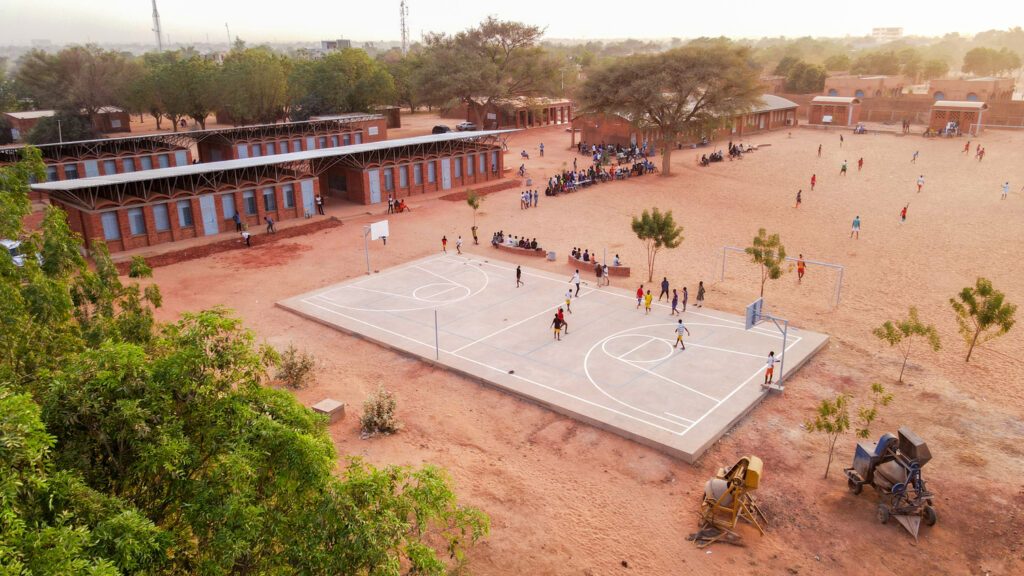
College Amadou Hampate Ba, Niger, utilises locally available materials, local construction methods and skills. It helps mitigate the extreme heat by using passive design principles, addressing challenging climatic conditions to create comfortable learning spaces.
Laterite stone is scheme’s principal material, an inexpensive, locally available resource with a low embodied carbon – an underutilised asset in Niger. The material, quarried just 10km away, provides thermal mass to regulate heat release during the day and offers better breathability compared to the prevalent cement blocks; it is cheaper and more reliable than an air conditioning system.
A new water tower is included in the masterplan and will guarantee that fresh water can reach the far extremes of the site.
3. Does the majority of your work promote equity in society, and consider all people, not only building inhabitants
We consider equity fundamental to sustainability. We encourage clients to consider wider society in their briefs, and how their project could widen access across society and through time. We encourage clients to harness project benefits during the design and construction phases – not just the completed design – such as opportunities for co-design, and education and training as part of the construction process. We promote sourcing from local craftspeople and salvage yards to generate local economic opportunity.
We avoid specifying PVC in our projects, because this emits chlorine gas in fires, which is very harmful to the health of those exposed.
We actively avoid specifying products from companies who we have found out to be not ethical. We encourage clients to incorporate measures to reduce risk of modern slavery in their project supply chain. We undertake training to detect modern slavery (e.g. on construction sites) via our inhouse learning platform.